
ACCT-211 · Lesson 2 of 12 · 30 min
Fair value measurement and financial statement presentation
Lesson 1 described two families of measurement: historical cost and current value. Historical cost is easy to verify but can grow stale; current value is more relevant for some assets but depends on estimates. Fair value is the current value that standards use most often, for investments in shares and bonds, for impairment tests, for assets acquired in a business combination, for investment property and biological assets under IFRS, and for many disclosures. This lesson explains how fair value is measured and how its inputs are graded by reliability. It then turns to presentation: how the income statement and statement of comprehensive income are organized, including the new IFRS 18 categories and subtotals and the US disaggregated expense disclosures, and how discontinued operations are shown. Lesson 3 covers the statement of financial position and the statement of cash flows.
What fair value means
ASC 820, Fair Value Measurement, defines fair value as the price that would be received to sell an asset or paid to transfer a liability in an orderly transaction between market participants at the measurement date. IFRS 13 uses essentially the same definition; the two were developed together in 2011 and remain closely aligned.
Several words in the definition carry weight. It is an exit price, what the company would receive to sell, not what it would pay to buy (an entry price), although the two are often close. It is market-based, not entity-specific: it reflects the assumptions market participants would use, not management's own plans. It assumes an orderly transaction, not a forced sale or distressed liquidation. It is measured in the principal market for the asset (the market with the greatest volume and level of activity) or, if there is none, the most advantageous market. Transaction costs are not deducted from fair value, although transport costs to get the asset to market are.
For non-financial assets such as land, buildings or equipment, fair value assumes the asset's highest and best use: the use by market participants that would maximize its value, provided it is physically possible, legally permissible and financially feasible. If Northlake owns a vacant lot zoned for commercial development that it uses for parking service vans, its fair value reflects commercial development value if that is legally permitted and feasible, even though Northlake intends to keep parking vans there.
Valuation techniques
Standards recognize three valuation approaches, and an entity uses whichever are appropriate and for which enough data is available, maximizing the use of observable inputs. The market approach uses prices and other information from market transactions involving identical or comparable assets, such as quoted share prices or multiples of comparable companies. The income approach converts future amounts (cash flows or earnings) into a single current amount by discounting, as in a discounted cash flow model or option-pricing model. The cost approach reflects the amount that would be required currently to replace the service capacity of an asset (current replacement cost), adjusted for obsolescence; it is common for specialized equipment.
Worked problem
Fair value with an income approach
Northlake holds a five-year note receivable from a municipal customer, face $500,000, paying 3 percent interest annually, with 3 years remaining. Market participants currently require 6 percent for similar credit risk. What is the note's fair value?
Show solution
- Cash flows: interest of $15,000 at the end of each of 3 years, plus $500,000 principal at the end of year 3.
- Discount at 6 percent: PV of interest = 15,000 × [1 − 1.06⁻³] ÷ 0.06 = 15,000 × 2.6730 = $40,095.
- PV of principal = 500,000 × 1.06⁻³ = 500,000 × 0.83962 = $419,810.
- Fair value = 40,095 + 419,810 = $459,905.
Answer: The note's fair value is about $459,900, below face, because its 3 percent coupon is below the 6 percent market rate. If the note is held at amortized cost, this fair value is disclosed rather than recognized.
The fair value hierarchy
Because fair value can rely on more or fewer estimates, the standards classify the inputs used into three levels and require disclosure by level. Level 1 inputs are quoted prices (unadjusted) in active markets for identical assets or liabilities that the entity can access at the measurement date, such as the closing price of a share on the TSX or NYSE. Level 2 inputs are observable inputs other than Level 1 prices: quoted prices for similar assets, prices in inactive markets, and observable inputs such as interest rates, yield curves and credit spreads. Level 3 inputs are unobservable, reflecting the entity's own assumptions about what market participants would use, such as projected cash flows for a private company or a discount rate built from judgment. The whole measurement is classified at the lowest level of any significant input.
| Level | Inputs | Typical examples | Disclosure burden |
|---|---|---|---|
| 1 | Quoted prices for identical items in active markets | Listed shares, exchange-traded funds, government bonds traded daily | Lowest: value and level |
| 2 | Observable inputs other than Level 1 prices | Corporate bonds priced from yield curves, interest rate swaps, real estate with close comparables | Moderate: techniques and inputs |
| 3 | Unobservable inputs based on the entity's assumptions | Private company shares, specialized equipment, contingent consideration in an acquisition | Highest: techniques, inputs, sensitivity, reconciliation of movements |
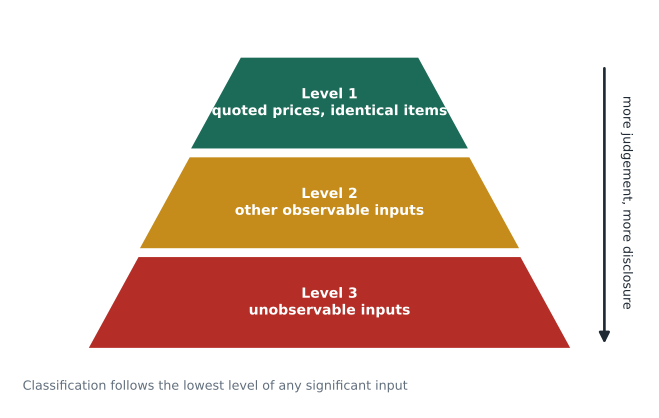
The hierarchy is about inputs, not about which assets are safe. A share of a large listed company is Level 1 even if its price is volatile; a private company's shares are Level 3 even if the business is stable. For Level 3 measurements, both IFRS 13 and ASC 820 require a reconciliation of opening and closing balances, quantitative information about significant unobservable inputs and a description of valuation processes; IFRS also requires sensitivity information. Analysts pay close attention to Level 3 balances because they are where management judgment can most influence reported values.
# Classify fair value measurements by the lowest significant input (illustrative)
holdings = [
    # name, fair value, levels of significant inputs used
    ("Listed shares (exchange price)", 820_000, [1]),
    ("Corporate bond (priced from yield curve)", 410_000, [2]),
    ("Interest rate swap (observable curves)", 35_000, [2]),
    ("Shares of a private supplier (DCF)", 260_000, [2, 3]),
    ("Contingent consideration owed (probabilities)", -140_000, [3]),
]
totals = {1: 0, 2: 0, 3: 0}
for name, fv, levels in holdings:
    level = max(levels)          # lowest priority = highest level number
    totals[level] += fv
    print(f"Level {level}  {fv:>10,}  {name}")
print("Totals by level:", {k: f"{v:,}" for k, v in totals.items()})
assets = sum(fv for _, fv, _ in holdings if fv > 0)
print(f"Share of fair-valued assets in Level 3: {260_000 / assets:.1%}")Level 1 820,000 Listed shares (exchange price)
Level 2 410,000 Corporate bond (priced from yield curve)
Level 2 35,000 Interest rate swap (observable curves)
Level 3 260,000 Shares of a private supplier (DCF)
Level 3 -140,000 Contingent consideration owed (probabilities)
Totals by level: {1: '820,000', 2: '445,000', 3: '120,000'}
Share of fair-valued assets in Level 3: 17.0%The private supplier's shares use some observable inputs, but the cash flow forecast is a significant unobservable input, so the whole measurement drops to Level 3. The contingent consideration is a liability measured at fair value and is also Level 3. About 17 percent of Northlake's fair-valued assets rely on its own assumptions, which a reader of the notes would want to examine.
Presenting performance: the statement of profit or loss
US GAAP does not prescribe a full income statement format. Public companies follow SEC Regulation S-X (Rule 5-03), which lists captions such as net sales, cost of goods sold, selling, general and administrative expenses, interest expense, income tax expense and net income. Companies present either a single-step statement (all revenues less all expenses) or, more commonly, a multiple-step statement with subtotals such as gross profit and operating income, although 'operating income' is not defined in US GAAP. Expenses are usually presented by function (cost of sales, selling, general and administrative, research and development).
The FASB addressed the same need for detail differently. ASU 2024-03, Disaggregation of Income Statement Expenses (often called DISE), requires public business entities to disclose, in a tabular note, the amounts of purchases of inventory, employee compensation, depreciation, intangible asset amortization and, for oil and gas producers, depletion included in each relevant expense caption on the face of the income statement, together with selling expenses and a qualitative description of amounts not separately disaggregated. It is effective for annual periods beginning after 15 December 2026 and interim periods beginning after 15 December 2027 (as clarified by ASU 2025-01), with early adoption permitted. By contrast, IFRS 18, effective for annual periods beginning on or after 1 January 2027, changes the face of the IFRS income statement itself: operating, investing and financing categories, two defined subtotals (operating profit, and profit before financing and income taxes) and disclosure of management-defined performance measures. A US analyst comparing a US company with an IFRS reporter after 2027 will see different structures.
Worked problem
Comparing a US multiple-step statement with IFRS 18
Northlake (a US public company) has revenue $61.0 million, cost of sales $36.6 million, selling, general and administrative $14.2 million, research and development $3.1 million, dividend income $0.3 million, interest expense $1.6 million and income tax $1.5 million. Prepare a US multiple-step statement and show how an IFRS 18 reporter with the same figures would differ.
Show solution
- Gross profit = 61.0 − 36.6 = 24.4. Operating income = 24.4 − 14.2 − 3.1 = $7.1 million (a common but undefined subtotal).
- Other income and expense: dividend income +0.3, interest expense −1.6. Income before taxes = $5.8 million. Net income = 5.8 − 1.5 = $4.3 million.
- An IFRS 18 reporter would show the defined subtotals operating profit $7.1 million and profit before financing and income taxes $7.4 million, with dividend income in the investing category.
- Under ASU 2024-03, the US note would also disaggregate cost of sales and SG&A into purchases of inventory, employee compensation, depreciation and amortization.
Answer: Net income is $4.3 million under both; the structure and required subtotals differ.
Other comprehensive income
Some gains and losses bypass net income and are reported in other comprehensive income (OCI) under ASC 220: unrealized gains and losses on available-for-sale debt securities, foreign currency translation adjustments, certain cash flow hedge results and pension remeasurements (ACCT-212). Unlike IFRS, US GAAP does not allow revaluation of property, plant and equipment, so there is no revaluation surplus, and equity investments are measured at fair value through net income rather than OCI. Accumulated OCI appears in equity, and amounts are generally reclassified ('recycled') into net income when realized. Comprehensive income is presented in one continuous statement or in two consecutive statements.
Discontinued operations
When an entity disposes of, or classifies as held for sale, a component whose disposal represents a strategic shift that has (or will have) a major effect on operations and results, ASC 205-20 requires its results to be presented separately, net of tax, after income from continuing operations, with prior periods restated. A long-lived asset or disposal group classified as held for sale under ASC 360 is measured at the lower of carrying amount and fair value less costs to sell and is no longer depreciated. Separating discontinued operations helps users predict future results from the operations that will continue.
Worked problem
Discontinued operation
In November Northlake commits to sell its marine-sensor division, a separate major line of business. The division earned an operating loss of $400,000 in the year and incurred a $250,000 impairment on remeasurement to fair value less costs to sell. The tax rate is 25 percent. What is reported?
Show solution
- Loss from the discontinued operation before tax = 400,000 + 250,000 = $650,000.
- Tax recovery at 25 percent = $162,500.
- Loss from discontinued operations, net of tax = $487,500, shown as one line below profit from continuing operations.
- Prior-year figures for the division are reclassified to discontinued operations so the comparison is consistent.
Answer: Report a single net-of-tax loss of $487,500 from discontinued operations, with restated comparatives and details in the notes.
Common mistakes
MistakeUsing an entry price (what it would cost to buy) as fair value.
InsteadFair value is an exit price: what would be received to sell the asset in an orderly transaction.
MistakeClassifying a measurement by its most observable input.
InsteadClassify by the lowest-level input that is significant to the whole measurement.
MistakeDeducting transaction costs from fair value.
InsteadTransaction costs are not part of fair value; transport costs to the principal market are.
MistakeValuing land by the owner's current use when a more valuable legal and feasible use exists.
InsteadFair value of a non-financial asset reflects its highest and best use by market participants.
MistakeAssuming ASU 2024-03 changes the face of the income statement.
InsteadASU 2024-03 adds note disclosures; the face of the statement can stay the same.
Summary and key terms
- Fair value is a market-based exit price in an orderly transaction in the principal (or most advantageous) market.
- Non-financial assets are valued at their highest and best use by market participants.
- Market, income and cost approaches are used, maximizing observable inputs.
- Level 1 inputs are quoted prices for identical items; Level 2 are other observable inputs; Level 3 are unobservable.
- ASU 2024-03 (annual periods beginning after 15 December 2026) requires disaggregation of expense captions in a note.
- OCI captures items such as translation adjustments and unrealized gains on available-for-sale debt securities.
- Discontinued operations are shown net of tax as a single amount with restated comparatives.
- Disaggregation of income statement expenses
- The ASU 2024-03 requirement to break expense captions into natural categories in a note.
- Fair value
- The price that would be received to sell an asset or paid to transfer a liability in an orderly transaction between market participants.
- Exit price
- The price received to sell an asset or paid to transfer a liability.
- Principal market
- The market with the greatest volume and level of activity for the asset or liability.
- Highest and best use
- The use of a non-financial asset that would maximize its value and is physically possible, legally permissible and financially feasible.
- Level 1 input
- A quoted price in an active market for an identical asset or liability.
- Level 2 input
- An observable input other than a Level 1 quoted price.
- Level 3 input
- An unobservable input reflecting the entity's assumptions.
- Other comprehensive income
- Income and expense items recognized outside profit or loss as required or permitted by standards.
- Discontinued operation
- A component disposed of or held for sale that meets the standard's criteria and is presented separately.
Practice problems
Work each problem on paper first, then reveal the answer to check.
Is fair value an entry price or an exit price?
Show answer
An exit price.
A share trades daily on the TSX. Which level is its fair value?
Show answer
Level 1.
A bond is valued from a yield curve and the issuer's observable credit spread. Which level?
Show answer
Level 2.
Northlake values its stake in a private supplier with a DCF using its own forecasts. Which level?
Show answer
Level 3.
Name the three valuation approaches.
Show answer
Market, income and cost.
Recompute the note example with a 5 percent market rate.
Show answer
Interest PV 15,000 × 2.7232 = 40,849; principal 500,000 × 0.86384 = 431,919; fair value about $472,768.
Name three natural expense categories required by ASU 2024-03.
Show answer
Purchases of inventory, employee compensation, depreciation, intangible asset amortization (and depletion).
Why are discontinued operations shown separately?
Show answer
So users can predict future results from continuing operations.
Are assets held for sale depreciated?
Show answer
No; they are measured at the lower of carrying amount and fair value less costs to sell.
Modify the Python program so the private supplier uses only Level 2 inputs. What share of assets is Level 3 now?
Show answer
Zero percent of assets (only the contingent consideration liability remains Level 3).
Lesson quiz · 5 questions
Score 60% or more to complete this lesson.
Create a free account to save your progress, take quizzes and earn a certificate.