
TRD-102 · Lesson 8 of 12 · 30 min
Pipe offsets and rolling offsets
Pipes rarely run in a straight line from where they start to where they need to go. A drain has to jog around a beam, a water line has to step over a duct, and a riser has to move sideways to line up with a sleeve on the floor above. The change of position is called an offset, and working it out is the single most common piece of trigonometry in the piping trades. Maya Chen spends much of her second month on Kingsway Tower roughing in the drain, waste and vent piping on the residential floors, and Luis Ferreira has her work out every offset on paper before she cuts. In Canada the drawings give the positions in millimetres, while pipe and fittings are still named by their nominal inch sizes, so this lesson works the Canadian examples in millimetres.
Everything in this lesson builds on lesson 7. An offset is a right triangle in disguise, and the fittings that make it fix the angle. Once the angle is known, one multiplier turns the distance you need to move into the length of pipe between the fittings.
The parts of an offset
Picture a pipe running along a wall that has to move over to a new line, parallel to the first. Two fittings of the same angle make the move: one turns the pipe off its original line, the other turns it back. Three measurements describe the offset, and the piping trades use these names for them:
- Set (also called offset or rise): the distance between the centre line of the original run and the centre line of the new run, measured square to the pipe.
- Run (also called advance): the distance the offset gains along the direction of the pipe, from the centre of the first fitting to the centre of the second.
- Travel: the centre-to-centre distance along the angled piece of pipe between the two fittings. This is the hypotenuse of the triangle.
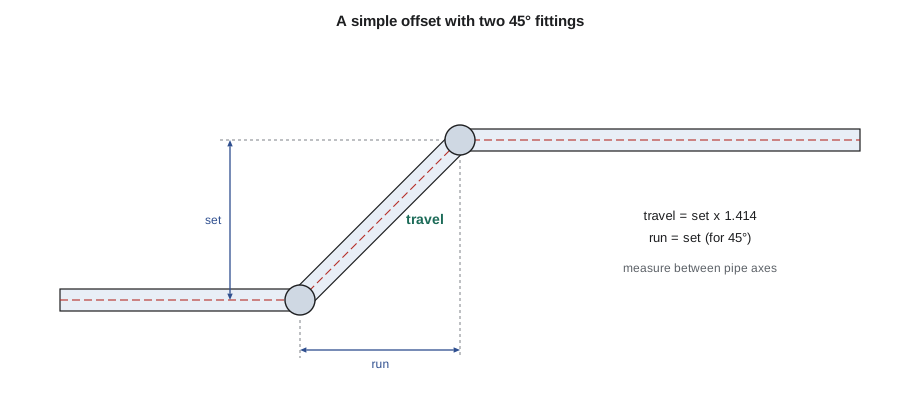
Measurements are always taken to the centre lines of the pipes, not to their edges. A common way to find the set on site is to measure from a wall or a string line to the side of each pipe and then add or subtract half the outside diameter, so that you are working centre to centre.
The fitting angle sets the multiplier
Fittings come in standard angles: 90°, 60°, 45°, 22-1/2° and 11-1/4°. An offset uses a pair of fittings smaller than 90°, and in drainage work the 45° is by far the most common. In the offset triangle, the angle at each fitting is the fitting angle, the set is the side opposite that angle, and the travel is the hypotenuse. So sine links them:
Because the fitting angles are always the same few values, the trades work out these ratios once and keep them as multipliers. Multiply the set by the travel multiplier to get the travel; multiply the set by the run multiplier to get the run.
| Fitting angle | Travel multiplier (1 / sin) | Run multiplier (1 / tan) | Typical use |
|---|---|---|---|
| 60° | 1.155 | 0.577 | Steep, short offsets |
| 45° | 1.414 | 1.000 | Most drainage and general offsets |
| 22-1/2° | 2.613 | 2.414 | Gentle offsets where there is room along the run |
| 11-1/4° | 5.126 | 5.027 | Very small corrections in long runs |
The 45° row is worth memorizing: travel is the set times 1.414, and the run equals the set. For a 45° offset, the pipe moves along exactly as far as it moves over, which makes it easy to picture and to check.
Worked problem
A 45° offset
A 3 in drain has to move 450 mm sideways, centre to centre, to clear a column. Maya uses two 45° fittings. What are the travel and the run?
Show solution
- Travel: \(450 \times 1.414 = 636.3\) mm, which rounds to 636 mm.
- Run: \(450 \times 1.000 = 450\) mm.
Answer: Travel 636 mm centre to centre; run 450 mm.
Worked problem
A 22-1/2° offset
Above a corridor ceiling there is room to make a gentle offset. A water line must move 300 mm. Using 22-1/2° fittings, what are the travel and the run?
Show solution
- Travel: \(300 \times 2.613 = 783.9\) mm, about 784 mm.
- Run: \(300 \times 2.414 = 724.2\) mm, about 724 mm.
Answer: Travel about 784 mm; run about 724 mm. The gentler angle needs a much longer run.
Comparing the two examples shows the trade-off. A steeper fitting gives a short offset that fits tight spaces but makes a sharper change of direction; a gentler fitting needs more room along the pipe but changes direction more smoothly, which suits drainage flow and makes pulling wire easier in conduit.
From travel to cut length: take-off and make-up
The travel is measured centre to centre of the fittings, but the pipe does not run to the centre of the fittings. Two adjustments turn the travel into the length you actually cut.
- Take-off (sometimes called the fitting allowance or centre-to-end dimension) is the distance from the centre of a fitting to the face of its socket or hub. It is subtracted, once for each fitting, because the fitting body fills that space.
- Make-up (also called socket depth or engagement) is the length of pipe that goes inside each socket. For glued plastic and soldered copper fittings, it is added back, once for each end, because the pipe must reach the bottom of the socket.
Many manufacturers publish a single figure for each fitting that combines the two, and experienced fitters learn the common ones by heart. The method is always the same:
For threaded steel pipe, the make-up is the length of thread that screws into the fitting. For grooved and no-hub joints, the pipe usually butts close to the centre gasket, and the published dimensions treat the joint differently. Always use the figures for the fittings in your hand; dimensions differ between manufacturers and between pressure and drainage patterns.
Worked problem
Cut length for a plastic offset
For the 45° offset with a 636 mm travel, the 3 in drainage 45° fittings Maya is using have a centre-to-socket-bottom dimension of 48 mm. (This combined figure already includes the socket depth.) What is the cut length?
Show solution
- With a combined centre-to-socket-bottom figure, subtract it once for each fitting.
- \(636 - 2 \times 48 = 636 - 96 = 540\) mm.
Answer: Cut the pipe at 540 mm.
The fitting dimension in this example is illustrative. Look up the actual figure for the brand and pattern of fitting on your job; Luis keeps a laminated card with the figures for the fittings Northbridge buys most.
Parallel offsets
When two or more pipes run side by side and all have to make the same offset, they cannot all turn at the same point, or the outer pipes would end up closer together on the new line than on the old one. To keep the spacing equal, each pipe after the first starts its offset a little further along. The extra distance depends on the spacing between the pipes and the fitting angle:
| Fitting angle | Half angle | tan of half angle |
|---|---|---|
| 60° | 30° | 0.577 |
| 45° | 22-1/2° | 0.414 |
| 22-1/2° | 11-1/4° | 0.199 |
Worked problem
Two pipes, one offset
A hot and a cold water line run 150 mm apart, centre to centre, and both must make the same 45° offset. How much further along does the second line start its offset?
Show solution
- \(150 \times \tan 22.5° = 150 \times 0.414 = 62.1\) mm.
Answer: About 62 mm further along. Both pipes have the same travel, so their cut lengths match.
Whether the inside pipe or the outside pipe starts first depends on which way the offset turns. Sketch the bend in plan with the pipes drawn to scale, and the order becomes obvious.
Rolling offsets
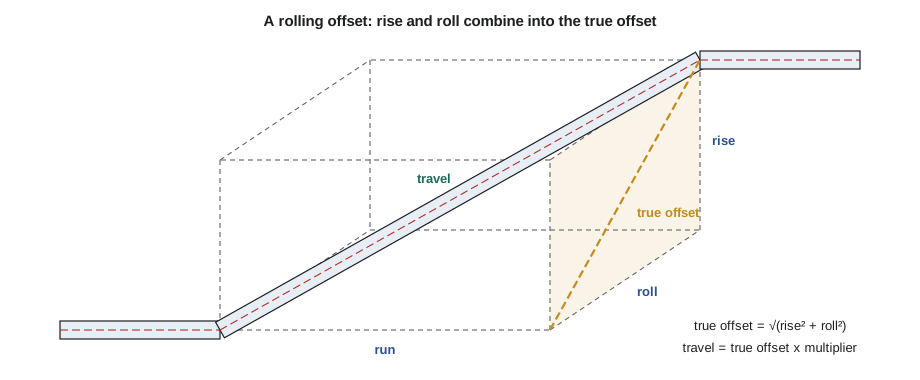
A rolling offset moves the pipe in two directions at once: for example, up and sideways, to get over a duct and line up with a sleeve that is also off to one side. The angled piece runs diagonally through a box. The trick is to collapse the two directions into one.
- Measure the vertical move (called the rise or set) and the horizontal move (called the roll), both centre to centre.
- Find the true offset, the straight-line distance the pipe has to move square to its direction, with the Pythagorean theorem: the true offset is the square root of the rise squared plus the roll squared.
- Treat the true offset like the set of a simple offset: multiply by the travel multiplier for the fitting angle to get the travel, and by the run multiplier to get the run.
- Turn the two fittings so that the angled pipe points along the true offset direction. Fitters roll the fittings to the right angle using a level or by measuring both moves.
Worked problem
A rolling offset over a duct
A 2 in vent has to rise 300 mm and roll 400 mm to the side to reach a sleeve. Maya will use 45° fittings. What are the true offset, travel and run?
Show solution
- True offset: \(\sqrt{300^2 + 400^2} = \sqrt{90\,000 + 160\,000} = \sqrt{250\,000} = 500\) mm.
- Travel: \(500 \times 1.414 = 707\) mm.
- Run: \(500 \times 1.000 = 500\) mm.
Answer: True offset 500 mm, travel about 707 mm centre to centre, run 500 mm. The numbers are a 3-4-5 triangle scaled by 100 mm.
A common error is to calculate the travel for the rise and for the roll separately and add them. That gives far too long a pipe. The rise and roll are at right angles to each other, so they combine with Pythagoras, not by adding.
Conduit offsets use the same triangle
Electricians bend offsets into conduit instead of using fittings, but the geometry is identical. Sam Torres, the electrical apprentice on Kingsway Tower, marks two bends at a chosen angle, and the distance between the marks is the travel: the offset depth times the same 1 / sin multiplier. Conduit has one extra wrinkle. Because the conduit bends instead of turning sharply at a fitting, it gets slightly shorter overall, an effect electricians call shrink, and they move their first mark to allow for it. Lesson 7 introduced conduit bending; TRD courses for electricians cover shrink tables in detail.
An offset calculator in code
This program does the full calculation for simple and rolling offsets: it combines rise and roll, finds travel and run for a chosen fitting angle, and subtracts a fitting allowance to give a cut length.
import math

def offset(rise, roll=0.0, angle=45.0, allowance=0.0):
    """Return true offset, travel, run and cut length for two fittings of `angle` degrees."""
    true_off = math.hypot(rise, roll)          # Pythagoras for rolling offsets
    a = math.radians(angle)
    travel = true_off / math.sin(a)
    run = true_off / math.tan(a)
    cut = travel - 2 * allowance               # combined fitting allowance, one per fitting
    return true_off, travel, run, cut

jobs = [("45 simple", 450, 0, 45, 48),
        ("22.5 simple", 300, 0, 22.5, 0),
        ("45 rolling", 300, 400, 45, 0)]
for name, rise, roll, ang, allow in jobs:
    t, tr, rn, cut = offset(rise, roll, ang, allow)
print(f"{name:12s} true {t:7.1f} travel {tr:7.1f} run {rn:7.1f} cut {cut:7.1f} mm")45 simple true 450.0 travel 636.4 run 450.0 cut 540.4 mm 22.5 simple true 300.0 travel 783.9 run 724.3 cut 783.9 mm 45 rolling true 500.0 travel 707.1 run 500.0 cut 707.1 mm
The math.hypot function is Pythagoras: it returns the square root of the sum of the squares. The results match the worked examples, which is the point of writing the program: it is a quick, independent check of hand calculations.
Common mistakes
MistakeMeasuring the set to the edges of the pipes instead of the centre lines.
InsteadMeasure to the side of each pipe, then add or subtract half the outside diameter so you are working centre to centre.
MistakeCutting the pipe to the travel.
InsteadTravel is centre to centre. Subtract the take-off for each fitting and add the make-up for each socket, or use the combined figure, to get the cut length.
MistakeAdding the rise and the roll in a rolling offset.
InsteadCombine them with Pythagoras to get the true offset, then apply the multiplier.
MistakeUsing the run multiplier where the travel multiplier is needed.
InsteadTravel is set divided by sine (1.414 for 45°); run is set divided by tangent (1.000 for 45°).
MistakeStarting all parallel pipes at the same point.
InsteadAdvance each pipe after the first by the spacing times the tangent of half the fitting angle.
Summary and key terms
- An offset is a right triangle: the set is opposite the fitting angle and the travel is the hypotenuse.
- Travel equals set times 1 / sin of the fitting angle; run equals set times 1 / tan.
- For 45° fittings, travel is set times 1.414 and run equals set.
- Cut length is travel minus the take-off of each fitting plus the make-up in each socket.
- Parallel offsets advance each pipe by the spacing times the tangent of half the fitting angle.
- In a rolling offset, the rise and roll combine by Pythagoras into the true offset.
- Offset
- A change in the position of a pipe line, made with two fittings of the same angle.
- Set
- The centre-to-centre distance a pipe moves sideways in an offset.
- Run (advance)
- The distance an offset gains along the direction of the pipe.
- Travel
- The centre-to-centre length of the angled piece between the two fittings.
- Take-off
- The distance from the centre of a fitting to the face of its socket or hub.
- Make-up
- The length of pipe that goes inside a socket or threads into a fitting.
- Rolling offset
- An offset that moves the pipe in two directions at once.
- True offset
- The combined straight-line move in a rolling offset, found by Pythagoras.
Practice problems
Work each problem on paper first, then reveal the answer to check.
What is the travel of a 45° offset with a 250 mm set?
Show answer
250 x 1.414 = 353.5 mm, about 354 mm.
A 60° offset has a set of 200 mm. Find the run.
Show answer
200 x 0.577 = 115.4 mm.
A rolling offset rises 600 mm and rolls 800 mm. Find the true offset.
Show answer
The square root of 360 000 + 640 000 is 1000 mm.
Using 22-1/2° fittings, what is the travel for a 150 mm set?
Show answer
150 x 2.613 = 392 mm.
Two pipes 200 mm apart make a 45° offset. How much further does the second one advance?
Show answer
200 x 0.414 = 82.8 mm.
A travel is 707 mm and each fitting's combined allowance is 40 mm. Find the cut length.
Show answer
707 - 80 = 627 mm.
Lesson quiz · 5 questions
Score 60% or more to complete this lesson.
Create a free account to save your progress, take quizzes and earn a certificate.