
TRD-102 · Lesson 10 of 12 · 29 min
Ratios, proportions and scale drawings
A ratio compares two quantities. Mortar is mixed one part cement to three parts sand. A small engine runs on fuel mixed fifty to one with oil. A drawing shows the building at one-fiftieth or one-forty-eighth of its real size. A crew of four lays a certain length of pipe in a day, so a crew of six should lay more. All of these are ratio problems, and they are solved with one idea: when two ratios are equal, you can find any missing number by cross-multiplying.
On Kingsway Tower, Maya meets ratios every day without calling them that: reading the scale on a drawing, mixing glycol for the heating loop test, and working out how long the floor rough-in will take if Luis gets another apprentice. This lesson makes the method explicit so that it works every time, including when the numbers are awkward.
Ratios and parts
A ratio such as 1 : 3 means that for every 1 part of the first thing there are 3 parts of the second. The parts can be any unit, as long as both are measured the same way: shovels, buckets, litres, gallons or kilograms. The total number of parts is the sum of the numbers in the ratio, and each ingredient's share of the total is its number divided by that sum.
| Mix | Typical ratio | Parts in total | Share of the first ingredient |
|---|---|---|---|
| Masonry mortar (cement to sand, by volume) | 1 : 3 | 4 | 1/4 = 25 % |
| A traditional general-purpose concrete (cement : sand : stone) | 1 : 2 : 3 | 6 | 1/6 = 16.7 % |
| Two-stroke fuel (gasoline to oil) | 50 : 1 | 51 | 50/51 = 98 % |
| Water-to-cement ratio (by mass) | 0.45 | not a parts mix | Kilograms of water per kilogram of cement |
The last row is a different kind of ratio. The water-to-cement ratio of concrete is a single number, the mass of water divided by the mass of cement. It controls the strength of the concrete: more water makes concrete easier to place but weaker. That is why adding water to a ready-mix truck on site without the supplier's or engineer's approval is not allowed on most jobs.
Worked problem
Mixing mortar
A mason needs about 0.12 m³ of 1 : 3 mortar for a small block wall around the garbage enclosure. How much cement and how much sand, by volume?
Show solution
- Total parts: \(1 + 3 = 4\).
- Cement: \(0.12 \times \tfrac{1}{4} = 0.03\) m³.
- Sand: \(0.12 \times \tfrac{3}{4} = 0.09\) m³.
Answer: 0.03 m³ of cement and 0.09 m³ of sand, before water. In practice the mix shrinks slightly as the sand fills the gaps, so masons mix a little extra.
Worked problem
Two-stroke fuel
The cut-off saw needs fuel mixed at 50 : 1. How much oil goes into 5 L of gasoline?
Show solution
- Oil is one-fiftieth of the gasoline: \(5 \div 50 = 0.1\) L.
- 0.1 L is 100 mL.
Answer: 100 mL of oil. A wrong mix ruins the engine: too little oil seizes it, too much fouls the plug.
Solving proportions by cross-multiplying
A proportion says that two ratios are equal. If three of the four numbers are known, the fourth is found by cross-multiplying: multiply diagonally across the equals sign and divide by the remaining number.
The key is to set up the ratios with the same units in the same positions: litres over litres, or metres over hours, on both sides. If you write the first ratio as glycol over water, the second must also be glycol over water.
Worked problem
Scaling up a recipe
The heating loop test mix uses 3 L of glycol for every 7 L of water. Luis needs to fill a system that holds 85 L in total. How much glycol goes in?
Show solution
- Glycol is 3 parts of \(3 + 7 = 10\) parts in total.
- Set up the proportion: \(\frac{3}{10} = \frac{x}{85}\).
- Cross-multiply: \(x = \frac{3 \times 85}{10} = 25.5\) L.
Answer: 25.5 L of glycol and 59.5 L of water: a 30 percent glycol mix.
Scale drawings
Every drawing on Kingsway Tower is drawn to scale: each line on the paper is a fixed fraction of the real length. The scale is written in the title block and often under each view. Knowing how to read it lets you check a dimension that is missing, estimate a length quickly, or sketch your own layout to scale.
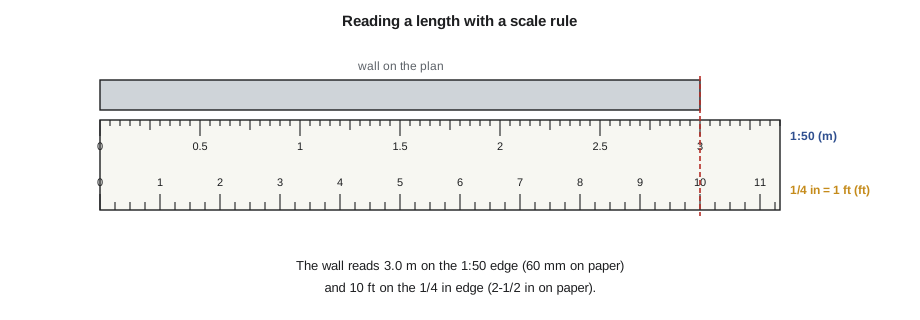
Canadian drawings use metric ratio scales. A scale of 1 : 50 means 1 mm on the drawing represents 50 mm on site. Floor plans are often drawn at 1 : 100 or 1 : 50, details at 1 : 20, 1 : 10 or 1 : 5, and site plans at 1 : 200 or 1 : 500. Some drawings for imperial-sized products, and older drawings, use architectural scales such as 1/4 in = 1 ft 0 in, so it is worth knowing both.
| Scale | Ratio | Drawing length for 1 m | Drawing length for 10 ft |
|---|---|---|---|
| 1 : 100 | 1 : 100 | 10 mm | about 30 mm (1.2 in) |
| 1 : 50 | 1 : 50 | 20 mm | about 61 mm (2.4 in) |
| 1/8 in = 1 ft 0 in | 1 : 96 | about 10.4 mm | 1-1/4 in |
| 1/4 in = 1 ft 0 in | 1 : 48 | about 20.8 mm | 2-1/2 in |
| 1 : 20 | 1 : 20 | 50 mm | about 152 mm (6 in) |
Worked problem
Finding a real length from a drawing
On a 1 : 50 plan, the distance from a grid line to the centre of a floor drain measures 47 mm on the paper. What is the real distance?
Show solution
- Real = drawing times 50: \(47 \times 50 = 2350\) mm.
Answer: About 2350 mm.
There is an important caution: never rely on scaling a drawing when a dimension is given or can be calculated from given dimensions. Paper stretches, prints are often reduced, and PDF copies are frequently printed at fit-to-page instead of full size. Many drawings carry a note such as "do not scale" for exactly this reason. Scaling is for estimating and checking, and for finding approximate locations so you can ask the right question. When a critical dimension is missing, raise it with the foreman so that it can go to the designer as a request for information.
A quick way to check whether a print is at true size is to measure the graphic scale bar printed on most drawings. If the bar labelled 5 m measures 100 mm on a 1 : 50 drawing, the print is full size; if it measures 71 mm, the sheet was reduced (in that case to an A-size smaller, or from 24 in by 36 in down to 11 in by 17 in), and every scaled length must be adjusted.
Direct and inverse proportion: crews and rates
Two quantities are directly proportional if doubling one doubles the other. Material and length are directly proportional: twice the length of pipe needs twice the hangers. Many job-planning problems use a rate, an amount per unit of time or per unit of something else, and direct proportion.
Two quantities are inversely proportional if doubling one halves the other. In ideal conditions, crew size and time are inversely proportional: twice the workers finish in half the time. Real jobs are not quite ideal, because people get in each other's way and some tasks cannot be split, but the inverse rule is a useful first estimate.
Worked problem
Crew size and time
Luis estimates that two workers will finish the drain, waste and vent rough-in on one residential floor in 9 working days. If a third worker joins, roughly how long should it take?
Show solution
- Total work in worker-days: \(2 \times 9 = 18\).
- With three workers: \(18 \div 3 = 6\) days.
Answer: About 6 days, perhaps a little more because three people on one floor share the same layout, material and lift.
Worked problem
A production rate
Maya and Luis hang 42 m of insulated copper in a 7.5 hour shift. At the same rate, how long will a 196 m run take?
Show solution
- Rate: \(42 \div 7.5 = 5.6\) m per hour.
- Time: \(196 \div 5.6 = 35\) hours, about 4.7 shifts.
Answer: About five shifts. Rates like this, recorded honestly on daily reports, are what estimators use to price the next job.
Ratios and proportions in code
This program splits a total into parts by a ratio and converts lengths with a drawing scale, the two calculations in this lesson that come up most often.
def split(total, *parts):
    """Divide `total` in the ratio given by `parts`, e.g. split(85, 3, 7)."""
    s = sum(parts)
    return [total * p / s for p in parts]

def real_from_drawing(measured, ratio):
    """Real length from a length measured on a drawing at 1:ratio (same units)."""
    return measured * ratio

print("mortar 1:3   ", [round(v, 3) for v in split(0.12, 1, 3)])
print("concrete 1:2:3", [round(v, 3) for v in split(1.5, 1, 2, 3)])
print("glycol 3:7   ", [round(v, 2) for v in split(85, 3, 7)])
for m in [47, 112]:
print(f"{m} mm on a 1:50 drawing is {real_from_drawing(m, 50):g} mm on site")mortar 1:3 [0.03, 0.09] concrete 1:2:3 [0.25, 0.5, 0.75] glycol 3:7 [25.5, 59.5] 47 mm on a 1:50 drawing is 2350 mm on site 112 mm on a 1:50 drawing is 5600 mm on site
The scale function works for any ratio scale. For a 1 : 50 drawing, 112 mm on paper is 5600 mm on site.
Comparing by unit price
A ratio also answers the everyday question of which package is the better buy. Divide each price by its quantity to get a unit price, then compare like with like. A box of 100 fasteners for 18.50 costs 0.185 each; a box of 250 for 41.25 costs 0.165 each, so the bigger box is cheaper per piece, provided the job will actually use them. The same method compares a bulk bag of sand with bags, or a long coil of tubing with straight lengths. Write the unit next to every unit price, such as per metre, per foot, per piece or per kilogram, so that two prices with different units are never compared by mistake.
Common mistakes
MistakeMixing up the order of a ratio, such as reading 1 : 3 mortar as 3 cement to 1 sand.
InsteadThe order of the numbers matches the order of the ingredients named. Write the names above the numbers.
MistakeDividing a total by the larger number in a ratio instead of the total number of parts.
InsteadAdd the parts first. For 3 : 7, glycol is 3/10 of the total, not 3/7.
MistakeScaling a reduced print as if it were full size.
InsteadCheck the graphic scale bar, and never scale when a dimension is given or can be calculated.
MistakeSetting up a proportion with different units in matching positions.
InsteadKeep litres over litres or metres over hours on both sides of the equals sign.
MistakeAssuming that doubling a crew always halves the time exactly.
InsteadUse inverse proportion as a first estimate, then allow for crowding and tasks that cannot be split.
Summary and key terms
- A ratio compares quantities measured in the same unit; the total number of parts is the sum of the numbers.
- Each ingredient's amount is the total times its number divided by the total parts.
- Solve proportions by cross-multiplying, with matching units in matching positions.
- A drawing scale of 1 : n means real length is n times the drawing length; 1/4 in = 1 ft is 1 : 48.
- Scale drawings only to estimate or check; use given dimensions and ask about missing ones.
- Material is directly proportional to length; crew size and time are roughly inversely proportional.
- Ratio
- A comparison of two or more quantities, written a : b.
- Proportion
- A statement that two ratios are equal.
- Cross-multiplying
- Solving a proportion by multiplying diagonally across the equals sign.
- Scale
- The ratio between a length on a drawing and the real length it represents.
- Graphic scale
- A bar printed on a drawing that shows real lengths, used to check print size.
- Water-to-cement ratio
- The mass of water divided by the mass of cement in concrete.
- Production rate
- An amount of work done per unit of time, such as metres per hour.
Practice problems
Work each problem on paper first, then reveal the answer to check.
How much cement is in 0.6 m³ of 1 : 2 : 3 concrete, by volume?
Show answer
0.6 x 1/6 = 0.1 m³.
How much oil for 2.5 L of gasoline at 40 : 1?
Show answer
2.5 / 40 = 0.0625 L, or 62.5 mL.
A wall measures 86 mm on a 1 : 100 plan. How long is it?
Show answer
8600 mm, or 8.6 m.
Four workers take 12 days. Roughly how long would six take?
Show answer
48 worker-days / 6 = 8 days.
A crew installs 18 sprinkler heads in 6 hours. How long for 75 heads?
Show answer
3 heads per hour, so 25 hours.
Solve 5 / 8 = x / 52.
Show answer
x = 5 x 52 / 8 = 32.5.
Lesson quiz · 5 questions
Score 60% or more to complete this lesson.
Create a free account to save your progress, take quizzes and earn a certificate.