
TRD-102 · Lesson 6 of 12 · 31 min
Right triangles: Pythagoras and squaring a layout
Right angles are everywhere in a building: walls meet floors, studs meet plates, pipes turn at elbows, and rooms are laid out as rectangles. Whenever two lengths meet at a right angle, a third length, the diagonal, is fixed by a rule that is over two thousand years old and still used on every site every day. The Pythagorean theorem lets tradespeople check that a layout is square, find the length of a diagonal brace or pipe, and calculate distances that cannot be measured directly.
At Kingsway Tower, Maya and Sam Torres, the first-year electrical apprentice, are sent to lay out sleeve and box locations on a freshly poured deck. Their foreman wants the layout square to the grid lines before anything is drilled. This lesson gives them the tools.
The Pythagorean theorem
In a right triangle, the side opposite the right angle is the longest side, called the hypotenuse. The other two sides are often called the legs. The theorem says that the square of the hypotenuse equals the sum of the squares of the legs.
To find the hypotenuse, square both legs, add them, and take the square root. To find a missing leg, square the hypotenuse, subtract the square of the known leg, and take the square root: \(a = \sqrt{c^2 - b^2}\). The units of all three sides must match, and the answer is in the same unit.
Worked problem
Finding a diagonal
A rectangular mechanical room is 4.80 m by 3.60 m. What is the distance from one corner to the opposite corner?
Show solution
- \(c = \sqrt{4.80^2 + 3.60^2} = \sqrt{23.04 + 12.96} = \sqrt{36.00}\).
- \(c = 6.00\) m.
Answer: 6.00 m. The room's sides are 4 x 1.2 and 3 x 1.2, so its diagonal is 5 x 1.2, a 3-4-5 triangle scaled up.
Worked problem
Finding a missing leg
A 4.0 m ladder must reach a landing; its foot is 1.0 m from the wall. How high up the wall does it reach?
Show solution
- \(a = \sqrt{4.0^2 - 1.0^2} = \sqrt{16 - 1} = \sqrt{15}\).
- \(a = 3.87\) m.
Answer: About 3.87 m. The 1-to-4 ratio here is the setup recommended for straight ladders in TRD-101.
The 3-4-5 rule for squaring
The most useful right triangle on a site has sides of 3, 4 and 5 units: 3 squared is 9, 4 squared is 16, and 9 plus 16 is 25, which is 5 squared. Any multiple works the same way: 6-8-10, 9-12-15, 12-16-20. Tradespeople use it to set out a right angle with nothing more than a tape and a pencil.
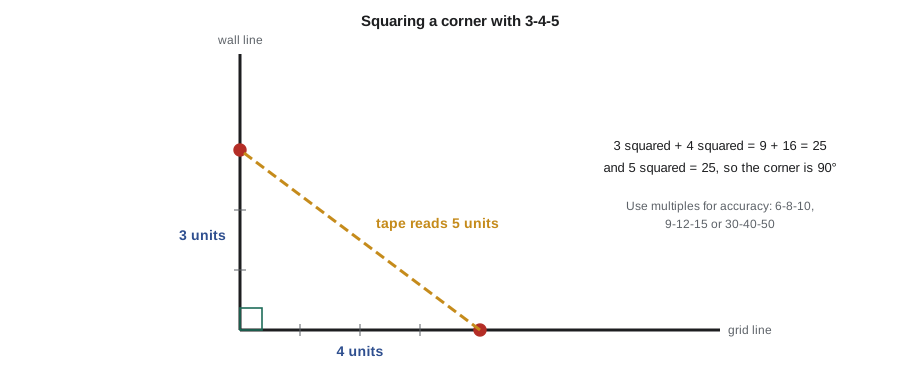
The method: from the corner, measure 3 units along one line and mark it. Measure 4 units along the other line and mark it. Measure between the marks. If the distance is exactly 5 units, the angle is square. If it is more than 5, the angle is open (more than 90 degrees); if less, it is closed. Adjust the second line until the diagonal reads 5.
Use the largest multiple the space allows, because a small error in a short triangle becomes a big error over a long wall. On a deck, Maya and Sam use 3 m, 4 m and 5 m, or 1.2, 1.6 and 2.0 m in a tight space. In feet, 6-8-10 or 9-12-15 are common.
Worked problem
How much error matters
Sam measures a 1.2-1.6-2.0 m triangle, but his diagonal reads 2.01 m. If he extends the line 12 m, how far out of square is it at the far end?
Show solution
- A 10 mm error in a 2.0 m diagonal opens the angle by about 0.6 degrees.
- Over 12 m, the line moves sideways by about \(12000 \times \tan 0.6° \approx 125\) mm.
- Lesson 7 shows how to calculate the angle; the point here is the size of the effect.
Answer: About 125 mm, far too much. A longer triangle, or the diagonal check below, catches it.
Checking a rectangle by its diagonals
A quick check for any rectangle, whether a room, a slab form, a pad or a frame: measure both diagonals. If the shape is a true rectangle, the diagonals are equal. If one is longer, the shape is a parallelogram, pushed out of square, and the corners at the ends of the long diagonal are open. To square it, push along the long diagonal until both match.
The diagonal check also tells you whether opposite sides are equal, which the 3-4-5 rule does not. For a full check: measure all four sides, confirm opposite sides match, then confirm the diagonals match. Calculate what the diagonal should be with the theorem, so you know the target, not just that they agree.
Worked problem
Squaring a form
A form for a 2.40 m by 1.20 m pad has diagonals of 2.690 m and 2.676 m. Is it square, and what should each diagonal be?
Show solution
- Target: \(\sqrt{2.40^2 + 1.20^2} = \sqrt{7.20} = 2.683\) m.
- The diagonals differ by 14 mm, so the form is out of square.
- Push the corner at the end of the 2.690 m diagonal in until both read 2.683 m.
Answer: Not square; adjust until both diagonals read 2.683 m.
Diagonals in three dimensions
The theorem works in three dimensions too. The straight-line distance between opposite corners of a box is the square root of the sum of the squares of its length, width and height. A pipe or cable running diagonally across a room and up to a ceiling, or a sloped duct, uses this.
Worked problem
A diagonal run
A sprinkler branch must run from a point on the floor of a room to the opposite top corner. The room is 4.0 m by 3.0 m and 2.7 m high. What is the straight-line distance?
Show solution
- \(d = \sqrt{4.0^2 + 3.0^2 + 2.7^2} = \sqrt{16 + 9 + 7.29} = \sqrt{32.29}\).
- \(d = 5.68\) m.
Answer: About 5.68 m.
In practice a pipe rarely runs that way; it follows walls and structure. Lesson 8 applies the same idea to rolling offsets, where a pipe changes position in two directions at once.
Square roots without stress
Every phone and construction calculator has a square root key. The most common error is the order of operations: you must add the squares before taking the root. On many calculators, type the whole expression with brackets, \(\sqrt{(4.8^2 + 3.6^2)}\), or find each square, add, then press the root key. A quick check: the hypotenuse must be longer than the longer leg but shorter than the two legs added together. If 4.8 and 3.6 give a hypotenuse of 8.4 or 3.0, something is wrong.
Some numbers are worth recognizing as perfect squares: 9, 16, 25, 36, 49, 64, 81, 100, 144, 169, 225, 400. If the sum of squares comes to one of these, the answer is a whole number.
| Triangle | Legs | Hypotenuse | Use |
|---|---|---|---|
| 3-4-5 | 3, 4 | 5 | Basic squaring |
| 6-8-10 | 6, 8 | 10 | Squaring in feet |
| 5-12-13 | 5, 12 | 13 | Another whole-number triangle |
| 8-15-17 | 8, 15 | 17 | Long walls |
| 1-1-1.414 | 1, 1 | 1.414 | 45 degree offsets (lesson 8) |
A layout checker in code
This program checks a set of rectangular layouts by comparing measured diagonals with the calculated target and reports which corner to move.
import math

def check(name, length, width, d1, d2, tol=0.003):
    target = math.hypot(length, width)
    print(f"{name}: target diagonal {target:.3f} m; measured {d1:.3f} and {d2:.3f}")
    if abs(d1 - d2) <= tol and abs(d1 - target) <= tol:
        print("   square and to size")
    else:
        longer = "first" if d1 > d2 else "second"
        print(f"   out by {abs(d1 - d2) * 1000:.0f} mm; push along the {longer} diagonal")

check("heater pad form", 2.40, 1.20, 2.690, 2.676)
check("sleeve grid", 6.00, 4.50, 7.500, 7.501)
check("pump pad form", 1.50, 1.00, 1.809, 1.796)heater pad form: target diagonal 2.683 m; measured 2.690 and 2.676 out by 14 mm; push along the first diagonal sleeve grid: target diagonal 7.500 m; measured 7.500 and 7.501 square and to size pump pad form: target diagonal 1.803 m; measured 1.809 and 1.796 out by 13 mm; push along the first diagonal
The math.hypot function computes the square root of the sum of squares directly, which avoids typing errors. The tolerance in the program is the kind of value a foreman might set for formwork; finish work needs tighter numbers.
Other Pythagorean triples
The 3-4-5 triangle is not the only whole-number right triangle. Several others are handy when 3-4-5 does not fit the space or the tape. Any multiple of a triple also works, so 6-8-10, 9-12-15 and 30-40-50 are all right triangles.
| Triple | Check | Where it helps |
|---|---|---|
| 3-4-5 | 9 + 16 = 25 | General layout; any multiple |
| 5-12-13 | 25 + 144 = 169 | Long narrow layouts, such as a corridor wall |
| 8-15-17 | 64 + 225 = 289 | Medium layouts when 3-4-5 multiples land on awkward marks |
| 7-24-25 | 49 + 576 = 625 | Very long, narrow layouts |
Worked problem
Squaring a long wall
A corridor wall must run square off a grid line, but the corridor is only 1.6 m wide. Which triple fits, and what marks does Dave use?
Show solution
- A 5-12-13 triangle scaled by 0.3 m gives 1.5 m, 3.6 m and 3.9 m.
- Mark 1.5 m along the grid line, 3.6 m along the wall line, and adjust until the diagonal is 3.9 m.
Answer: A 5-12-13 triangle: the short side fits the narrow space and the long side gives better accuracy along the wall.
Brace and rafter lengths
Any diagonal member in a frame is the hypotenuse of a right triangle. A temporary brace from a wall top plate to a stake in the floor, a kicker on a formwork wall, or a common rafter from the plate to the ridge are all found the same way.
Worked problem
Length of a temporary brace
A wall frame 2.4 m high needs a brace from the top plate to a block fastened to the slab 1.8 m out from the wall. How long is the brace, before allowing for the angle cuts?
Show solution
- \(c = \sqrt{2.4^2 + 1.8^2} = \sqrt{5.76 + 3.24} = \sqrt{9.00} = 3.0\) m.
Answer: 3.0 m. The numbers are a 3-4-5 triangle scaled by 0.6 m.
For rafters, the run is half the building width less half the ridge board, and the rise is the run times the pitch from lesson 9. The Pythagorean theorem then gives the rafter length along its top edge, before adding the overhang.
A frame or wall that is out of square shows up later as tapered drywall joints, doors that bind and tiles that need sliver cuts at one end of the room. Checking with a triple or with equal diagonals takes a minute; fixing a frame after the drywall is on takes a day. On Kingsway Tower, Dave's crew checks every corner of every suite layout before the first plate is fastened, and Maya now does the same with her sleeve layouts on the deck: two measurements from a grid line and one diagonal, written on the deck beside the mark so the inspector can see the check was done.
Common mistakes
MistakeTaking square roots before adding: writing the root of a squared plus the root of b squared.
InsteadAdd the squares first, then take one square root.
MistakeUsing a short 3-4-5 triangle for a long layout.
InsteadUse the largest multiple the space allows.
MistakeChecking only that diagonals are equal.
InsteadAlso confirm opposite sides are equal and the diagonals match the calculated value.
MistakeMixing units, such as one leg in feet and the other in inches.
InsteadConvert both legs to the same unit first.
MistakeUsing the theorem on a triangle that is not right-angled.
InsteadIt applies only when one angle is exactly 90 degrees.
Summary and key terms
- In a right triangle, c squared equals a squared plus b squared.
- Find a missing leg with the root of c squared minus b squared.
- The 3-4-5 triangle and its multiples set out right angles with a tape.
- A rectangle is square when its diagonals are equal and match the calculated value.
- The three-dimensional diagonal is the root of L squared plus W squared plus H squared.
- Check that the hypotenuse is longer than either leg and shorter than their sum.
- Right triangle
- A triangle with one 90 degree angle.
- Hypotenuse
- The longest side of a right triangle, opposite the right angle.
- Legs
- The two sides that form the right angle.
- Square (layout)
- Meeting at exactly 90 degrees.
- Diagonal check
- Comparing the two diagonals of a rectangle to confirm it is square.
- Pythagorean triple
- Three whole numbers that satisfy the theorem, such as 3, 4, 5.
Practice problems
Work each problem on paper first, then reveal the answer to check.
Find the hypotenuse of a triangle with legs 2.4 m and 1.8 m.
Show answer
Root of 5.76 + 3.24 = root of 9 = 3.0 m.
A diagonal is 5.0 m and one leg is 3.0 m. Find the other leg.
Show answer
Root of 25 - 9 = 4.0 m.
What should the diagonals of a 3.6 m by 2.7 m slab form be?
Show answer
Root of 12.96 + 7.29 = root of 20.25 = 4.5 m.
What multiple of 3-4-5 has a 4 m side?
Show answer
3-4-5 m itself; the diagonal is 5 m.
Find the box diagonal for 3.0 by 2.0 by 2.4 m.
Show answer
Root of 9 + 4 + 5.76 = root of 18.76 = 4.33 m.
Lesson quiz · 5 questions
Score 60% or more to complete this lesson.
Create a free account to save your progress, take quizzes and earn a certificate.