
TRD-102 · Lesson 11 of 12 · 30 min
Formulas on the job: rearranging, Ohm's law and water pressure
A formula is a short sentence written in symbols. Area equals length times width. Fall equals run times slope. Voltage equals current times resistance. Every trade uses a handful of formulas over and over, and the skill is not memorizing dozens of them but knowing how to put numbers in correctly, in the right order and the right units, and how to rearrange a formula when the number you need is not the one on the left-hand side.
This lesson works through the general method and then applies it to two families of formulas that every apprentice on Kingsway Tower meets: Sam Torres's electrical formulas and Maya Chen's water pressure and pipe expansion formulas. The same method works for any formula in a code book, a manufacturer's manual or a trade textbook.
Order of operations
When a formula has several operations, they must be done in a fixed order, or two people will get two different answers from the same numbers. In Canadian schools the order is usually taught as BEDMAS: brackets first, then exponents (powers and roots), then division and multiplication from left to right, then addition and subtraction from left to right.
A fraction bar acts like brackets around everything above it and everything below it. Most scientific calculators and phone calculators follow the order of operations, but a basic four-function calculator does each operation as you press it. To be safe on any calculator, work out the top and the bottom of a fraction separately, or use the bracket keys.
Worked problem
Order of operations in a stair check
Work out 2 x 170 + 280, the comfort check from lesson 9.
Show solution
- Multiplication before addition: \(2 \times 170 = 340\).
- Then add: \(340 + 280 = 620\) mm.
- Adding first, \(2 \times (170 + 280) = 900\), gives a very different and wrong answer.
Answer: 620 mm.
Rearranging a formula
To rearrange a formula, you get the wanted quantity by itself on one side of the equals sign. The rule is simple: whatever you do to one side, do to the other. To undo multiplication, divide both sides; to undo division, multiply; to undo addition, subtract; to undo a square, take the square root.
Worked problem
Rearranging the area formula
The area of a rectangle is A = L x W. A room must have an area of 18 m² (or 194 sq ft) and is 3.6 m (or 12 ft) wide. How long is it?
Show solution
- Start with \(A = L \times W\). Divide both sides by \(W\): \(L = \frac{A}{W}\).
- Metric: \(L = 18 \div 3.6 = 5.0\) m. Imperial: \(L = 194 \div 12 = 16.2\) ft.
Answer: 5.0 m, or about 16 ft 2 in.
A useful check after rearranging is to put the answer back into the original formula. If 5.0 m times 3.6 m gives 18 m², the rearrangement and the arithmetic are both right.
Rearranging also shows how quantities behave. In L = A / W, a wider room needs less length for the same area. Reading a formula this way, before putting any numbers in, helps catch answers that are obviously wrong.
Ohm's law and electrical power
Ohm's law connects the three basic electrical quantities. Voltage (V, in volts) is the electrical pressure that pushes current. Current (I, in amperes or amps) is the flow of charge. Resistance (R, in ohms) is how much a conductor or device opposes that flow. Power (P, in watts) is the rate at which electrical energy is used.
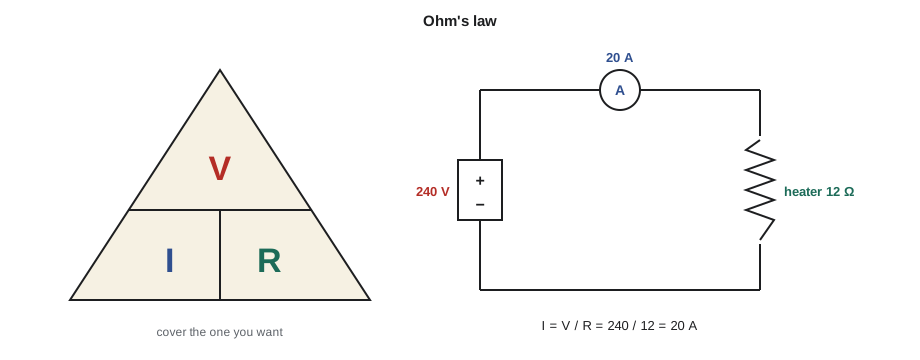
The three forms of Ohm's law are the same formula rearranged. Many electricians draw a triangle with V on top and I and R along the bottom: cover the quantity you want, and the other two show how to calculate it, either side by side to multiply or one above the other to divide. The power formula can be combined with Ohm's law to give P = I² R and P = V² / R, which are useful when only two quantities are known.
Worked problem
Current drawn by a heater
A portable construction heater on Kingsway Tower is rated 4800 W at 240 V. What current does it draw, and what is its resistance when hot?
Show solution
- Current from power: \(I = \frac{P}{V} = \frac{4800}{240} = 20\) A.
- Resistance from Ohm's law: \(R = \frac{V}{I} = \frac{240}{20} = 12\) ohms.
Answer: 20 A and 12 ohms. Sam checks that the temporary power circuit feeding it is rated for that current, with a margin, before it is plugged in.
Worked problem
How many tools on one circuit?
A temporary 120 V receptacle circuit is protected by a 15 A breaker. Continuous loads are commonly kept to about 80 percent of the breaker rating. How many 6 A work lights can run continuously on it?
Show solution
- Usable current: \(15 \times 0.8 = 12\) A.
- Lights: \(12 \div 6 = 2\).
Answer: Two lights, drawing 12 A, about 1440 W in total. A third would overload the circuit and trip the breaker, which is the breaker doing its job.
Electrical calculations on a real installation follow the electrical code, which sets conductor sizes, overcurrent protection and load rules. These examples show how the formulas work; they are not a substitute for the code or for a licensed electrician's design.
Water pressure and height
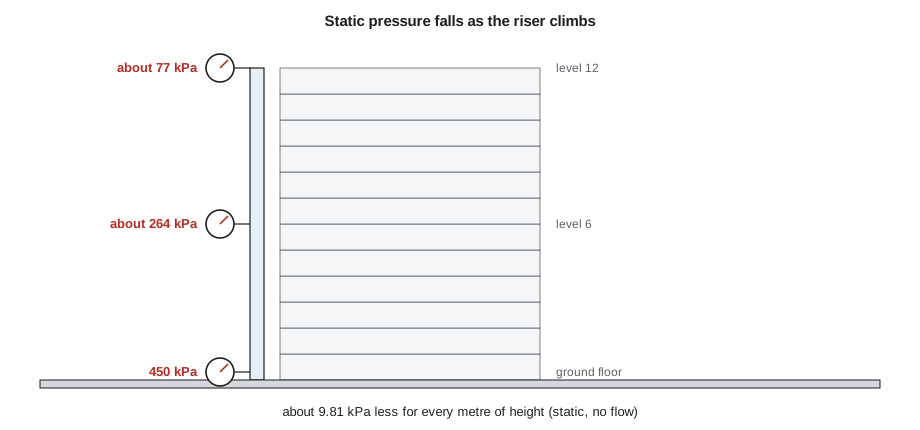
Water has weight, so the pressure in a column of water increases with depth. In a building, that means the pressure at the bottom of a riser is higher than at the top, and a pump has to work harder to push water up to the top floors. The relationship is simple and exact enough for site work:
Read it backward and one unit of pressure lifts water a fixed height: 1 kPa supports about 0.102 m of water, and 1 psi supports about 2.31 ft. Plumbers call height expressed this way head, and many pump curves are drawn in metres or feet of head rather than in pressure units.
Worked problem
Pressure at the top floor
The city main gives 450 kPa at the ground-floor meter. The highest fixture on Kingsway Tower is about 38 m above the meter. Ignoring friction losses, what static pressure is left at the top fixture?
Show solution
- Pressure used by height: \(9.81 \times 38 = 372.8\) kPa.
- Left at the top: \(450 - 373 = 77\) kPa.
Answer: About 77 kPa before friction, which is low for many fixtures and much too low once water is flowing. That is why tall buildings have booster pumps.
The same formula explains test pressures and why a gauge at the bottom of a stack reads higher than one at the top during a water test. When a drainage stack is filled for a test, the pressure on the lowest joints is the height of water above them times 9.81 kPa per metre or 0.433 psi per foot.
Thermal expansion of pipe
Pipe gets longer when it heats up and shorter when it cools. On a long hot water or heating line, the change is large enough to bend pipe, pull hangers off the structure or break joints if it is not allowed for with loops, offsets or expansion joints. The change in length is proportional to the original length and to the change in temperature:
Here \(\Delta L\) is the change in length, \(L\) the original length, \(\Delta T\) the change in temperature and \(\alpha\) the coefficient of expansion for the material. For copper, \(\alpha\) is about 0.0000168 per degree Celsius, which works out to roughly 1.7 mm per 10 m of pipe for each 10 degree rise. Plastic pipes expand several times more than copper or steel; manufacturers publish the figures for their products.
Worked problem
Expansion of a hot water main
A copper domestic hot water main runs 30 m along the parking level ceiling. It is installed at 10°C and runs at 60°C. How much does it grow?
Show solution
- \(\Delta T = 60 - 10 = 50\) °C.
- \(\Delta L = 0.0000168 \times 30\,000 \times 50 = 25.2\) mm (using the length in millimetres).
Answer: About 25 mm, enough to need an expansion loop or offset designed by the engineer.
Here is the units trick: put the length in the unit you want the answer in. Using millimetres for L gives the growth in millimetres; using inches gives inches. The coefficient is per degree, so the temperature must use the same scale as the coefficient.
Formulas in code
Writing a formula as a small function is the cleanest way to use it again and again without slipping. Each function below is one formula from this lesson, with its units in the name or the comment.
def ohms_current(volts, ohms):        # I = V / R
    return volts / ohms

def power_current(watts, volts):       # I = P / V
    return watts / volts

def static_pressure(height):            # metres of water to kPa
    return 9.81 * height

def expansion(length, d_temp, alpha=1.68e-05):   # copper, length in output units
    return alpha * length * d_temp

print("heater current      ", power_current(4800, 240), "A")
print("heater resistance   ", 240 / power_current(4800, 240), "ohms")
print("head to top fixture ", round(static_pressure(38), 1), "kPa")
print("left at top fixture ", round(450 - static_pressure(38), 1), "kPa")
print("hot water main grows", round(expansion(30000, 50), 2), "mm")heater current 20.0 A heater resistance 12.0 ohms head to top fixture 372.8 kPa left at top fixture 77.2 kPa hot water main grows 25.2 mm
The outputs match the worked examples. Small, named functions like these are also how a spreadsheet should be built: one formula per column, with the units in the column heading.
Checking a formula by its units
One of the best ways to catch a mistake in a formula is to follow the units through it, the same unit-factor idea as lesson 3. Write the unit beside every number, multiply and divide the units along with the numbers, and see what unit comes out. If it is the unit you expected, the setup is probably right. If it is not, something is upside down or missing.
- Area: metres times metres gives square metres, so A = L x W comes out in the right unit.
- Fall: metres times a slope (metres per metre) gives metres, so fall = run x slope is consistent.
- Current from power: watts divided by volts gives amps, because a watt is a volt times an amp.
- Time from a production rate: metres divided by metres per hour gives hours. Had you multiplied, the unit would have been square metres per hour, which is nonsense, and the mistake would show at once.
This check takes seconds and works for formulas you have never seen before. Inspectors, engineers and experienced tradespeople do it almost without thinking, and it is a habit worth building early.
Common mistakes
MistakeDoing addition before multiplication because it comes first when reading left to right.
InsteadFollow the order of operations: brackets, powers, multiplication and division, then addition and subtraction.
MistakeRearranging only one side of the equation.
InsteadWhatever you do to one side, do to the other, then check by substituting the answer back.
MistakeUsing watts where amps are needed when sizing a circuit.
InsteadConvert with I = P / V before comparing with the breaker or conductor rating.
MistakeForgetting that pressure drops with height when choosing fixtures for upper floors.
InsteadSubtract 9.81 kPa per metre (0.433 psi per foot) of height, then allow for friction losses.
MistakeMixing temperature scales or length units in the expansion formula.
InsteadUse the coefficient for the same temperature scale, and put the length in the unit you want the answer in.
Summary and key terms
- Do operations in order: brackets, powers, multiplication and division, then addition and subtraction.
- Rearrange a formula by doing the same operation to both sides, then check by substituting back.
- Ohm's law: V = I x R, so I = V / R and R = V / I. Power: P = V x I.
- Keep continuous loads to a fraction of the breaker rating, commonly about 80 percent, as the code requires.
- Water pressure rises 9.81 kPa per metre of depth, or 0.433 psi per foot.
- Thermal expansion is proportional to length and temperature change: delta L = alpha x L x delta T.
- Formula
- A rule written in symbols that relates quantities.
- Order of operations
- The agreed order for doing the operations in a calculation.
- Voltage
- Electrical pressure, measured in volts.
- Current
- The flow of electric charge, measured in amperes.
- Resistance
- Opposition to current, measured in ohms.
- Head
- Pressure expressed as the height of a column of water.
- Coefficient of expansion
- The fractional change in length of a material per degree of temperature change.
Practice problems
Work each problem on paper first, then reveal the answer to check.
Rearrange V = I x R to find R.
Show answer
R = V / I.
A 1500 W kettle on 120 V draws how much current?
Show answer
1500 / 120 = 12.5 A.
A 240 V circuit has 16 ohms of resistance. What is the current?
Show answer
240 / 16 = 15 A.
What is the static pressure 25 m below the top of a full water column?
Show answer
9.81 x 25 = 245 kPa.
How much does 20 m of copper grow when heated by 40 °C?
Show answer
0.0000168 x 20 000 x 40 = 13.4 mm.
Work out 3 + 4 x 5 squared.
Show answer
5 squared is 25; 4 x 25 = 100; 3 + 100 = 103.
Lesson quiz · 5 questions
Score 60% or more to complete this lesson.
Create a free account to save your progress, take quizzes and earn a certificate.