
TRD-102 · Lesson 4 of 12 · 29 min
Perimeter and area of floors, walls and roofs
Perimeter and area are the first measurements of quantity. Perimeter, the distance around a shape, tells you how much baseboard, edge form, firestop sealant around a room or cable along a wall you need. Area, the amount of surface, tells you how much flooring, drywall, insulation, roofing, membrane or paint. Every trade uses both, and every estimate begins with them.
On Kingsway Tower, the drywall, flooring and painting contractors all start from the same suite drawings. Maya's mechanical crew uses area too: floor area drives the radiant heating layout and the number of sprinkler heads, and wall area sets the amount of fire-rated sealant and insulation around pipe penetrations. In this lesson the apprentices work through a typical one-bedroom suite on the seventh floor.
Perimeter
The perimeter of any shape made of straight sides is the sum of the side lengths. For a rectangle with length L and width W, that is twice the length plus twice the width.
For irregular rooms, add every side, going around in order so that no side is missed or counted twice. A useful shortcut for L-shaped and stepped rooms whose walls all meet at right angles: the perimeter equals the perimeter of the smallest rectangle that encloses the room. The steps in and out add and subtract the same lengths.
Perimeter is a length, so it is measured in metres, millimetres, feet or inches, never in square units. When you order trim or cable by perimeter, subtract the widths of doorways where the material does not run, then add an allowance for joints and waste.
Area of rectangles and composite shapes
The area of a rectangle is length times width. The answer is in square units: square metres (m²) if the lengths were in metres, square feet if they were in feet. Both lengths must be in the same unit before you multiply. Multiplying metres by millimetres, or feet by inches, is one of the most common estimating errors.
A composite shape is any area that can be split into rectangles, triangles and circles. Split it, find each area, then add them. If the shape has a piece missing, such as a column or a shaft, find the whole area and subtract the missing piece.
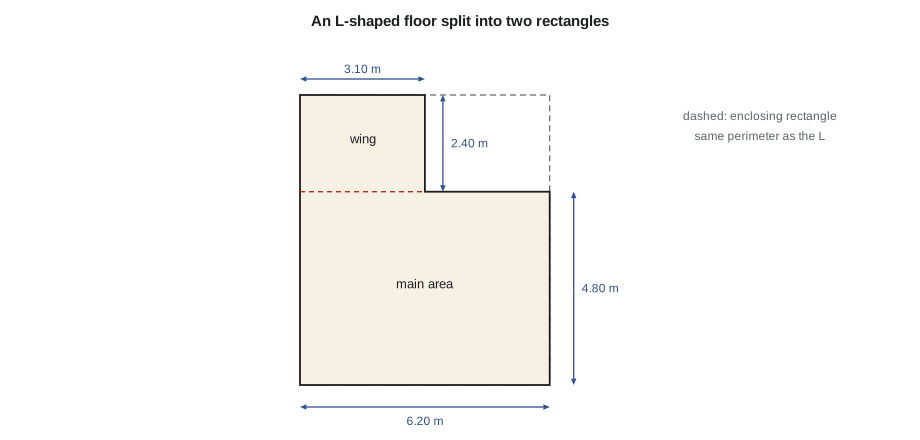
Worked problem
Floor area and perimeter of an L-shaped suite
The suite floor in the figure is a 6.20 m by 4.80 m main area with a 3.10 m by 2.40 m wing. Find its floor area and perimeter.
Show solution
- Main area: \(6.20 \times 4.80 = 29.76\) m².
- Wing: \(3.10 \times 2.40 = 7.44\) m².
- Total area: \(29.76 + 7.44 = 37.20\) m².
- Enclosing rectangle: \(6.20\) m wide by \(4.80 + 2.40 = 7.20\) m deep.
- Perimeter: \(2 \times 6.20 + 2 \times 7.20 = 26.80\) m.
Answer: 37.20 m² of floor and 26.80 m of perimeter.
Wall area
The area of the walls in a room is the perimeter times the wall height, less the openings. For drywall and paint, subtract doors and windows. For some materials, such as vapour barrier or fire-rated board, the specification may say not to subtract small openings because the offcuts are not usable; follow the specification.
Worked problem
Drywall for a bedroom
A bedroom is 4.00 m by 3.50 m with a 2.70 m ceiling. It has one door 0.90 m by 2.10 m and one window 1.50 m by 1.20 m. How many 1220 by 2440 mm sheets are needed for the walls with a 10 percent allowance?
Show solution
- Perimeter: \(2 \times 4.00 + 2 \times 3.50 = 15.00\) m.
- Gross wall area: \(15.00 \times 2.70 = 40.50\) m².
- Openings: \(0.90 \times 2.10 + 1.50 \times 1.20 = 1.89 + 1.80 = 3.69\) m².
- Net area: \(40.50 - 3.69 = 36.81\) m².
- One sheet: \(1.22 \times 2.44 = 2.977\) m². Sheets: \(36.81 \div 2.977 = 12.37\).
- With 10 percent: \(12.37 \times 1.10 = 13.6\), so 14 sheets.
Answer: 14 sheets.
Experienced drywall estimators often count sheets wall by wall instead, laying out where each sheet goes, because whole sheets and offcuts do not always fit together the way areas suggest. The area method gives a quick check on that count.
Triangles, trapezoids and roofs
A triangle's area is half its base times its height, where the height is measured at right angles to the base. A gable end wall, the triangular wall under a pitched roof, is the classic example. A trapezoid, a four-sided shape with two parallel sides, has an area equal to the average of the parallel sides times the distance between them. Hip roof planes and the side walls of a sloped ceiling are often trapezoids.
Worked problem
A gable end
The gable end of the rooftop mechanical penthouse is 7.20 m wide and rises 1.80 m to the peak. What is its area?
Show solution
- \(A = \tfrac{1}{2} \times 7.20 \times 1.80 = 6.48\) m².
Answer: 6.48 m².
Roof areas need care, because a sloped roof has more surface than the floor area it covers. Lesson 10 shows how to find the true length of a sloped roof from its pitch; multiply the plan area by the same factor to get the roof surface.
Circles
Pipes, round ducts, core holes, columns and tanks bring circles into the trades. The distance across a circle through its centre is the diameter d; half of it is the radius r. The distance around the circle, the circumference, is \(\pi d\), and the area is \(\pi r^2\). The number \(\pi\) is about 3.1416.
Worked problem
Core holes and insulation
A 100 mm (about 4 in) core is drilled through a concrete slab for a drain. What is the area of the hole, and how long a strip of sealant tape goes once around it?
Show solution
- Radius: \(r = 50\) mm. Area: \(\pi \times 50^2 = 7854\) mm², about 0.0079 m².
- Circumference: \(\pi \times 100 = 314\) mm.
Answer: About 7854 mm² of hole and 314 mm of tape. Fire-stopping products often specify their quantity by the annular space around the pipe, which is the area of the hole minus the area of the pipe.
The same circumference formula tells you how wide a sheet of jacketing must be to wrap insulated pipe: the circumference of the outside of the insulation plus an overlap.
Converting area units
Because area is length times length, area conversion factors are length factors squared. One metre is 3.2808 ft, so one square metre is 3.2808 squared, about 10.764 square feet. One foot is 12 inches, so one square foot is 144 square inches.
| To convert | Multiply by |
|---|---|
| m² to sq ft | 10.764 |
| sq ft to m² | 0.0929 |
| sq ft to sq in | 144 |
| m² to mm² | 1,000,000 |
| sq yd to sq ft | 9 |
The million in the metric row surprises people: a square metre is 1,000 mm by 1,000 mm, so it contains a million square millimetres. Wire and rebar cross-sections are given in mm², which is why the numbers are small: a common 2.5 mm² conductor is tiny compared with a square metre of wall.
Coverage rates
Many materials are sold by coverage: a can of paint, a bag of thinset, a pail of fire-stop sealant or a roll of membrane covers a stated area. Divide the area by the coverage per unit, round up, and add any second coat or waste allowance.
Paint, for example, commonly covers about 9 m² per litre per coat on smooth drywall, which is roughly 350 to 400 square feet per US gallon, but the label on the actual product is what counts. Rough or porous surfaces take more.
Worked problem
Paint for the suite walls
The suite's total wall area after openings is 118 m². Two coats are required. The paint covers 9 m² per litre and comes in 3.78 L cans. How many cans?
Show solution
- Area to cover: \(118 \times 2 = 236\) m².
- Litres: \(236 \div 9 = 26.2\) L.
- Cans: \(26.2 \div 3.78 = 6.9\), so 7 cans.
Answer: 7 cans.
Area by coordinates
For an irregular shape drawn on a grid, such as a site boundary or an odd-shaped mechanical room, there is a neat method that needs only the coordinates of the corners, listed in order around the shape. It is sometimes called the shoelace formula, after the criss-cross pattern of the multiplication. Survey and estimating software use it.
def shoelace(points):
    """Area of a polygon from its corners listed in order around the shape."""
    s = 0.0
    for (x1, y1), (x2, y2) in zip(points, points[1:] + points[:1]):
        s += x1 * y2 - x2 * y1
    return abs(s) / 2

# The L-shaped suite, corners in metres, going around counterclockwise
suite = [(0, 0), (6.20, 0), (6.20, 4.80), (3.10, 4.80), (3.10, 7.20), (0, 7.20)]
perimeter = sum(((x2 - x1) ** 2 + (y2 - y1) ** 2) ** 0.5
                for (x1, y1), (x2, y2) in zip(suite, suite[1:] + suite[:1]))
print(f"Area = {shoelace(suite):.2f} m2, perimeter = {perimeter:.2f} m")Area = 37.20 m2, perimeter = 26.80 m
The program confirms the hand calculation for the suite. It works for any straight-sided shape, including ones with angled walls that are awkward to split into rectangles.
Irregular areas: the average-width method
Not every area is made of neat rectangles and triangles. A curved planting bed beside the entrance, a pond liner, or a patch of damaged slab may have an irregular edge. A practical way to estimate such an area is to divide it into equal strips, measure the width of the shape at regular stations along a straight baseline, average the widths, and multiply by the length.
The more stations you measure, the closer the estimate. For ordering material, an estimate within a few percent is enough, and the waste allowance from lesson 12 covers the rest.
Worked problem
Estimating a curved patch
Damaged topping on the parking level has an irregular outline. Along a 6.0 m baseline, Dave measures its width every 1.0 m: 0.0, 1.4, 2.1, 2.5, 2.2, 1.6 and 0.4 m. Estimate the area.
Show solution
- For strips, treat each width as covering 1.0 m, with the two end readings counted half each (the trapezoid rule).
- Sum: \(\tfrac{0.0}{2} + 1.4 + 2.1 + 2.5 + 2.2 + 1.6 + \tfrac{0.4}{2} = 10.0\) m.
- Area: \(10.0 \times 1.0 = 10.0\) m².
Answer: About 10 m².
When to deduct openings
For wall finishes, the question is whether to subtract doors, windows and other openings. Trades handle it differently, and it is worth knowing the custom before you estimate.
- Paint and wall coverings: subtract large openings such as garage doors and storefront glazing; many painters ignore openings smaller than about 1 square metre or 10 square feet, because cutting in around them uses extra time and material anyway.
- Drywall: estimators often do not deduct ordinary doors and windows, because the cut-out pieces are usually waste. They do deduct very large openings.
- Insulation and vapour barrier: deduct openings, but add overlaps at seams.
- Masonry: deduct openings, then add for the lintels, sills and extra cutting around them.
Whatever the custom, write down what you did. A takeoff that says "openings not deducted" can be checked by anyone; one that does not say leaves the next person guessing.
Common mistakes
MistakeMultiplying lengths in different units, such as metres by millimetres.
InsteadConvert both lengths to the same unit before multiplying.
MistakeConverting area with the length factor, such as multiplying m² by 3.28.
InsteadSquare the length factor: 1 m² is 10.764 sq ft.
MistakeForgetting to subtract openings, or subtracting them when the specification says not to.
InsteadRead the specification and apply it consistently.
MistakeUsing the diameter in place of the radius in the area of a circle.
InsteadUse r squared, or use pi/4 times d squared.
MistakeUsing plan area for a sloped roof.
InsteadMultiply plan area by the slope factor to get the true surface.
Summary and key terms
- Perimeter is the distance around a shape and is a length.
- Area is length times width for rectangles and is in square units.
- Split composite shapes into rectangles, triangles and circles, then add or subtract.
- Wall area is perimeter times height minus openings.
- A circle has circumference pi d and area pi r squared.
- Area conversion factors are length factors squared; divide area by coverage and round up.
- Perimeter
- The total distance around a shape.
- Area
- The amount of surface inside a shape, in square units.
- Composite shape
- A shape made of simpler shapes whose areas can be added or subtracted.
- Circumference
- The distance around a circle.
- Coverage rate
- The area one unit of a material will cover.
- Gable end
- The triangular wall at the end of a pitched roof.
Practice problems
Work each problem on paper first, then reveal the answer to check.
A room is 5.40 m by 3.80 m. Find its area and perimeter.
Show answer
20.52 m²; 18.40 m.
Convert 20.52 m² to square feet.
Show answer
20.52 x 10.764 = 220.9 sq ft.
A triangular area has a base of 6.0 m and a height of 2.5 m. Find its area.
Show answer
7.5 m².
Find the area of a round hole 150 mm in diameter.
Show answer
pi x 75 squared = 17,671 mm².
A wall is 9.6 m long and 2.7 m high with a 0.9 by 2.1 m door. What is the net area?
Show answer
25.92 - 1.89 = 24.03 m².
Lesson quiz · 5 questions
Score 60% or more to complete this lesson.
Create a free account to save your progress, take quizzes and earn a certificate.