
TRD-102 · Lesson 1 of 12 · 30 min
Reading a tape measure and working with fractions
Every trade on Kingsway Tower measures something dozens of times a day. Maya Chen, the first-year plumbing apprentice with Northbridge Mechanical, cuts copper and plastic pipe to length, sets hangers at a spacing, marks sleeve locations on the deck and checks rough-in heights against the drawings. Her mentor, Luis Ferreira, has a simple rule for every new apprentice: measure carefully, write it down, say it back, then cut once. This course turns the arithmetic behind that rule into habits. It follows Maya and the other apprentices through the math of a real building, from reading a tape to estimating the material for a whole floor.
Canada is officially metric, and the drawings for Kingsway Tower are dimensioned in millimetres. But Canadian sites run on both systems. Lumber is still sold as 2x4s and 2x6s, plywood comes in 4 ft by 8 ft sheets, pipe and fittings are named by nominal inch sizes, and many tradespeople think in feet and inches. That is why most tapes on a Canadian site are dual scale, with inches on one edge and centimetres and millimetres on the other. This lesson starts with the imperial edge, because fractions of an inch are where most cutting mistakes happen, then covers the metric edge. Lesson 3 covers conversions between the two systems.
The parts of a tape measure
A tape measure looks simple, but each part has a job, and knowing them prevents errors that are hard to find later.
| Part | What it does | What to watch for |
|---|---|---|
| Blade | The marked steel ribbon, usually 25 mm (1 in) wide and 7.5 m to 10 m (25 ft to 33 ft) long | Kinks and worn markings make readings unreliable |
| Hook (end tab) | Catches the edge of the material for outside measurements; pushes against a surface for inside ones | The hook is loose on purpose; it slides by exactly its own thickness |
| Case | Holds the blade; many cases are marked with their length for inside measurements | Add the case length printed on the back when you measure inside a frame |
| Lock | Holds the blade extended | Release it before letting the blade retract, and do not let it snap back |
| Stud marks | Highlighted marks every 16 in on the inch edge | Common framing spacing; the small black diamonds every 19.2 in divide 8 ft into five |
| Metric edge | Centimetres numbered, millimetres between them | Some tapes number every 10 mm, others every 100 mm with a red label |
The sliding hook confuses many new workers. It is supposed to move. When you hook it over the end of a board, it slides out so that the measurement starts at the far face of the hook. When you push it against a wall, it slides in so that the measurement starts at the near face. In both cases the zero point is where the material begins. A bent hook, or a hook that has been crimped tight, throws every reading off by its thickness, which is around a millimetre or a sixteenth of an inch. That is enough to make pipe joints leak or trim gaps show.
For the most accurate measurement, many tradespeople burn an inch, or on the metric side, burn 100 mm. They line up the 1 in mark (or the 100 mm mark) with the starting edge instead of using the hook, read the far end, then subtract the inch or the 100 mm. Forgetting to subtract is the classic mistake, so say it out loud: "burned an inch".
Reading the inch edge to a sixteenth
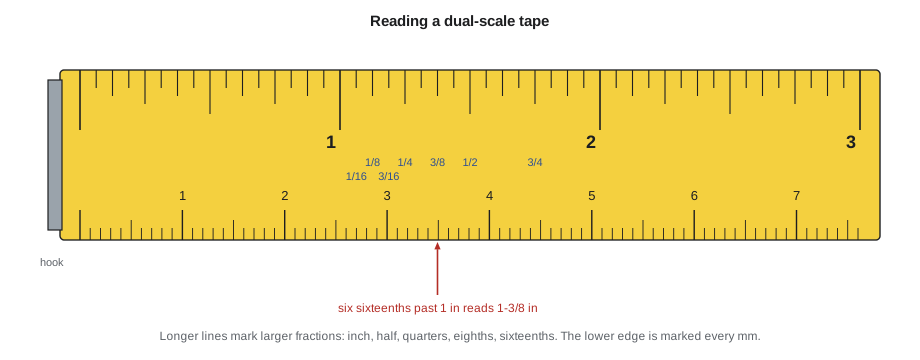
Most tapes divide each inch into sixteen parts. The marks have different lengths to make them easy to tell apart. The longest line, with a number, is the inch. The next longest, in the middle, is the half inch. The two medium lines at the quarter points are 1/4 and 3/4. The four shorter lines are the eighths: 1/8, 3/8, 5/8 and 7/8. The eight shortest lines are the sixteenths: 1/16, 3/16, 5/16 and so on, every odd number of sixteenths.
A reliable way to read any mark is to count sixteenths from the last whole inch and then reduce the fraction. If the end of the pipe falls on the sixth mark past 14 in, the reading is 14 and 6/16 in. Six sixteenths reduces to three eighths, so you write 14-3/8 in. With practice you will recognize the common marks at a glance, but counting is never wrong.
| Sixteenths past the inch | Reduced fraction | Decimal of an inch |
|---|---|---|
| 1 | 1/16 | 0.0625 |
| 2 | 1/8 | 0.125 |
| 3 | 3/16 | 0.1875 |
| 4 | 1/4 | 0.25 |
| 5 | 5/16 | 0.3125 |
| 6 | 3/8 | 0.375 |
| 7 | 7/16 | 0.4375 |
| 8 | 1/2 | 0.5 |
| 9 | 9/16 | 0.5625 |
| 10 | 5/8 | 0.625 |
| 11 | 11/16 | 0.6875 |
| 12 | 3/4 | 0.75 |
| 13 | 13/16 | 0.8125 |
| 14 | 7/8 | 0.875 |
| 15 | 15/16 | 0.9375 |
Look at the pattern: every even number of sixteenths reduces. Two sixteenths is one eighth, four is one quarter, eight is one half. Only the odd numbers of sixteenths stay as sixteenths. Writing fractions in lowest terms matters because it is how everyone on site says them. A foreman who hears "ten sixteenths" may hesitate; "five eighths" is instant.
Lengths longer than a foot are written in feet and inches. On a tape that is numbered in inches only, 43-5/16 in is 3 ft 7-5/16 in, because 3 ft is 36 in and 43 minus 36 leaves 7. Many tapes print the foot marks in red, and some print a small 3F (or similar) next to each inch past a whole foot. Get in the habit of writing the dimension the same way the drawing does, so the person reading your cut list does not have to convert.
Fractions: the rules that matter on site
You do not need every rule of school arithmetic to work with fractions on a job. You need four operations done reliably, plus the habit of reducing the answer.
- To add or subtract fractions, they must have the same denominator. Convert to sixteenths (or eighths) first, add or subtract the tops, then reduce.
- To add or subtract mixed numbers, handle the whole inches and the fractions separately. If a subtraction needs more fraction than you have, borrow one inch as 16/16.
- To multiply a length by a whole number, multiply the inches and the fraction separately, then carry any whole inches out of the fraction.
- To divide a length into equal parts, the easiest method is to convert to decimal inches (lesson 2), divide, then convert the decimal back to the nearest sixteenth.
Worked problem
Adding two measurements
Maya needs a piece of pipe to fill a gap of 2-3/8 in plus a fitting allowance of 1-11/16 in. What length does she cut?
Show solution
- Write both fractions in sixteenths: \(\tfrac{3}{8} = \tfrac{6}{16}\), so the lengths are \(2\tfrac{6}{16}\) and \(1\tfrac{11}{16}\).
- Add the whole inches: \(2 + 1 = 3\). Add the fractions: \(\tfrac{6}{16} + \tfrac{11}{16} = \tfrac{17}{16}\).
- \(\tfrac{17}{16}\) is more than one inch: \(\tfrac{17}{16} = 1\tfrac{1}{16}\). Carry the inch: \(3 + 1\tfrac{1}{16} = 4\tfrac{1}{16}\).
Answer: 4-1/16 in.
Worked problem
Subtracting with borrowing
A 10 in length of conduit has 3-5/8 in cut off. How long is the piece that is left, ignoring the saw kerf?
Show solution
- Write 10 in as \(9\tfrac{16}{16}\) in so there is a fraction to subtract from.
- Change \(3\tfrac{5}{8}\) to \(3\tfrac{10}{16}\).
- Subtract: \(9\tfrac{16}{16} - 3\tfrac{10}{16} = 6\tfrac{6}{16} = 6\tfrac{3}{8}\).
Answer: 6-3/8 in.
Worked problem
Multiplying with a saw kerf
Luis asks Maya to cut four hanger rods at 2 ft 3-1/2 in each from one length of threaded rod. Each cut removes about 1/8 in of material. How much rod does she use, counting four cuts?
Show solution
- Convert to inches: 2 ft 3-1/2 in is \(27\tfrac{1}{2}\) in.
- Four pieces: \(4 \times 27 = 108\) and \(4 \times \tfrac{1}{2} = 2\), so \(110\) in.
- Four cuts: \(4 \times \tfrac{1}{8} = \tfrac{4}{8} = \tfrac{1}{2}\) in.
- Total: \(110 + \tfrac{1}{2} = 110\tfrac{1}{2}\) in, which is 9 ft 2-1/2 in.
Answer: 110-1/2 in, or 9 ft 2-1/2 in.
Worked problem
Dividing a space evenly
Three pipe hangers must be spaced evenly across an opening 7 ft 5 in wide, creating three equal spaces. How far apart are they, to the nearest sixteenth?
Show solution
- Convert: 7 ft 5 in is \(7 \times 12 + 5 = 89\) in.
- Divide: \(89 \div 3 = 29.667\) in.
- Convert the decimal part to sixteenths: \(0.667 \times 16 = 10.67\), which rounds to 11.
- So the spacing is \(29\tfrac{11}{16}\) in. Check: \(3 \times 29\tfrac{11}{16} = 89\tfrac{1}{16}\) in, within a sixteenth of the opening.
Answer: 29-11/16 in between hangers (to the nearest sixteenth).
The metric edge
On the metric edge the arithmetic is easier, because everything is in tens. Each centimetre is divided into 10 millimetres, and on most Canadian tapes the numbers go up by centimetres, with every tenth number (each 100 mm) highlighted. Kingsway Tower's drawings are dimensioned in millimetres, so the habit to build is to read and write millimetres only. A sleeve located at 1 m, 47 cm and 6 mm is written 1476 mm. There is no need for fractions; you add and subtract whole numbers.
One millimetre is a little less than 1/16 in: 1/16 in is about 1.6 mm. So reading the metric edge to the nearest millimetre is slightly more precise than reading the inch edge to the nearest sixteenth. For most rough-in work either is fine. For finish carpentry, cabinetry and some mechanical connections, a millimetre or a sixteenth is the tolerance you have to hit.
Worked problem
Metric cut list
Maya measures a run of PEX between two fittings as 2385 mm, face of fitting to face of fitting. Each fitting takes the pipe 19 mm deep. What length does she cut?
Show solution
- The pipe must reach into both fittings, so add the insertion depth twice.
- \(2385 + 2 \times 19 = 2385 + 38 = 2423\) mm.
Answer: 2423 mm, which she writes on the cut list and says back to Luis: "twenty-four twenty-three".
Taking a good measurement
Most measuring errors are not math errors. They come from where the tape was held, what was being measured, and how the number was recorded. Luis teaches the same five habits to every apprentice:
- Know what you are measuring: face of the wall or face of the stud, centre of the pipe or edge of the fitting, top of the slab or top of the finished floor. Write the reference on the cut list.
- Keep the blade straight and tight. A sagging tape reads long over a long span; over a few metres or ten feet a sag can add several millimetres or more than an eighth of an inch.
- Read straight on, not at an angle. Looking at the blade from the side shifts the apparent mark.
- Mark with a fine line or a V (a crow's foot) whose point is exactly at the measurement, not a fat smudge.
- Write the number down immediately, read it back, and check long or critical dimensions twice, ideally from a different starting point.
For layout from a fixed point, such as locating several sleeves along one grid line, measure every location from the same starting point instead of from the last mark. This is called running dimensions. If you measure each space from the previous mark, small errors add up along the line. If you measure each one from the start, errors do not accumulate.
| Method | How it works | Effect of a 1/16 in (about 1.5 mm) error per mark over 10 marks |
|---|---|---|
| Chained (mark to mark) | Each space measured from the previous mark | Up to about 5/8 in (about 15 mm) at the last mark |
| Running (from one start) | Every mark measured from the same zero | Still about 1/16 in (about 1.5 mm) at every mark |
Using code to check fraction work
Throughout this course, short Python programs show how to check calculations. You do not need to program on site; a calculator does the same work. But seeing the steps written out makes the method clear, and the programs are handy if you ever build your own cut-list spreadsheet. This one rounds decimal inches to the nearest sixteenth and writes the result in feet, inches and a reduced fraction.
from fractions import Fraction

def to_tape(inches, denom=16):
    """Round decimal inches to the nearest 1/denom and format as ft-in-fraction."""
    n = round(inches * denom)              # whole number of sixteenths
    feet, rem = divmod(n, 12 * denom)
    whole, part = divmod(rem, denom)
    frac = Fraction(part, denom)           # Fraction reduces automatically
    text = f"{whole}" + (f"-{frac}" if part else "") + " in"
    return (f"{feet} ft " if feet else "") + text

for x in [29.667, 43.3125, 110.5, 7.94, 0.375]:
print(f"{x:8.4f} in -> {to_tape(x)}")29.6670 in -> 2 ft 5-11/16 in 43.3125 in -> 3 ft 7-5/16 in 110.5000 in -> 9 ft 2-1/2 in 7.9400 in -> 7-15/16 in 0.3750 in -> 0-3/8 in
The program counts in sixteenths, splits off whole feet and whole inches, and lets Python's Fraction type reduce what is left. Look at 7.94 in: 0.94 in is 15.04 sixteenths, so the nearest mark is 15/16, and the result is 7-15/16 in.
Common mistakes
MistakeReading the number before the mark instead of the last whole inch passed, for example reading 14-3/8 as 15-3/8.
InsteadFind the last whole inch the end has passed, then count sixteenths forward from it.
MistakeLeaving fractions unreduced, such as writing 10/16 or 4/8 on a cut list.
InsteadReduce every fraction: 10/16 is 5/8 and 4/8 is 1/2. It is faster and clearer for everyone.
MistakeBurning an inch and forgetting to subtract it.
InsteadSay "burned an inch" out loud and subtract it before writing the number.
MistakeIgnoring the saw kerf when cutting several pieces from one length.
InsteadAllow one kerf per cut, about 1/8 in (3 mm) for many blades, when working out how many pieces a length will give.
MistakeMixing references, such as face of stud on one end and face of drywall on the other.
InsteadWrite the reference with the dimension and use the same one at both ends.
Summary and key terms
- A tape's hook slides by its own thickness so that both inside and outside measurements start at true zero.
- Read the inch edge by counting sixteenths past the last whole inch, then reduce the fraction.
- Add and subtract fractions in a common denominator; borrow 16/16 when subtracting needs it.
- Divide lengths by converting to decimal inches, dividing, and rounding back to the nearest sixteenth.
- On the metric edge, read and write whole millimetres.
- Measure layouts from one starting point so that errors do not add up.
- Hook (end tab)
- The sliding metal tab at the end of a tape that sets true zero for inside and outside measurements.
- Sixteenth
- One sixteenth of an inch, the smallest division on most inch tapes, about 1.6 mm.
- Mixed number
- A whole number and a fraction written together, such as 4-1/16.
- Reduce
- To write a fraction in lowest terms by dividing top and bottom by the same number.
- Saw kerf
- The width of material removed by a saw cut.
- Burning an inch
- Measuring from the 1 in (or 100 mm) mark for accuracy and subtracting it afterward.
- Running dimensions
- Layout dimensions all measured from the same starting point.
Practice problems
Work each problem on paper first, then reveal the answer to check.
Reduce 12/16 and 14/16.
Show answer
3/4 and 7/8.
Add 5-7/8 in and 3-5/16 in.
Show answer
5-14/16 + 3-5/16 = 8-19/16 = 9-3/16 in.
Subtract 2-15/16 in from 8-1/4 in.
Show answer
8-4/16 becomes 7-20/16; 7-20/16 - 2-15/16 = 5-5/16 in.
How many 18 in pieces can be cut from a 10 ft length with a 1/8 in kerf per cut?
Show answer
120 in / 18.125 in = 6.6, so 6 pieces.
Convert 0.81 in to the nearest sixteenth.
Show answer
0.81 x 16 = 12.96, so 13/16 in.
A tape reads 1250 mm after burning 100 mm. What is the true measurement?
Show answer
1150 mm.
Lesson quiz · 5 questions
Score 60% or more to complete this lesson.
Create a free account to save your progress, take quizzes and earn a certificate.