
TRD-102 · Lesson 3 of 12 · 30 min
Metric and imperial measurement in Canadian construction
Canada adopted the metric system in the 1970s, and the National Building Code, the Ontario Building Code and most engineering drawings are written in SI units. But the change was never complete on construction sites. Lumber, plywood, pipe, tubing, fittings, fasteners and many tools are still named and often sized in inches, and the US market next door keeps imperial products flowing into Canadian supply houses. A Canadian tradesperson therefore needs to be fluent in both systems and to know which one each product and document uses. This lesson sets out the units, the conversion factors, and a method that makes conversions reliable.
The SI system in one page
The International System of Units (SI) builds every unit from a few base units and a set of prefixes that move by powers of ten. For trades work, the units that matter are these:
| Quantity | SI unit | Symbol | Common trade units |
|---|---|---|---|
| Length | metre | m | millimetre (mm), metre (m), kilometre (km) |
| Area | square metre | m² | m², mm² for wire and bar cross-sections |
| Volume | cubic metre | m³ | m³ for concrete and soil, litre (L) for liquids |
| Mass | kilogram | kg | kg, tonne (1,000 kg) |
| Force | newton | N | kN for loads |
| Pressure | pascal | Pa | kilopascal (kPa) for water and air pressure |
| Temperature | degree Celsius | °C | °C |
| Electrical | volt, ampere, ohm, watt | V, A, Ω, W | V, A, Ω, W, kW |
| Prefix | Symbol | Multiplier | Example |
|---|---|---|---|
| kilo | k | 1,000 | 1 km = 1,000 m; 1 kW = 1,000 W |
| (none) | 1 | metre, gram, litre | |
| centi | c | 1/100 | 1 cm = 10 mm |
| milli | m | 1/1,000 | 1 mm = 0.001 m; 1 mL = 0.001 L |
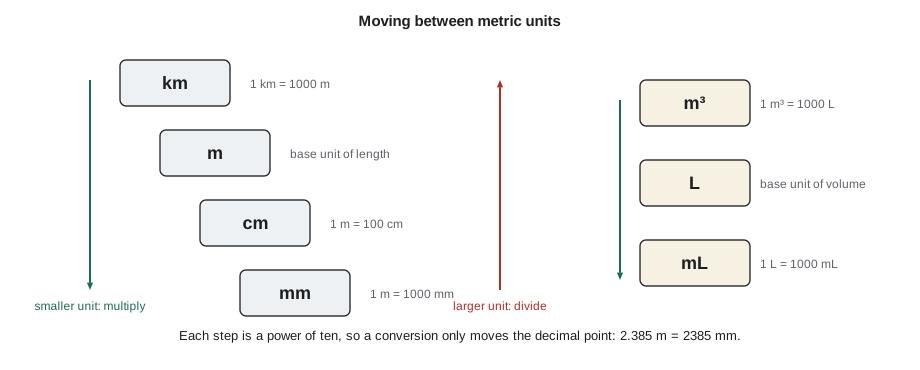
Because every step is a power of ten, converting within the metric system is a matter of moving the decimal point. 2.385 m is 2385 mm; 750 mm is 0.75 m; 1,500 L is 1.5 m³ because one cubic metre holds 1,000 litres. That simplicity is the main argument for metric: there are no 12s, 3s, 16s or 5,280s to remember.
A writing rule that prevents errors: Canadian construction drawings almost always give lengths in millimetres without writing the unit on each dimension. A dimension of 2400 on a floor plan means 2400 mm. If you see a number with a decimal point, such as 2.4, it is in metres, usually an elevation or a large site dimension. Check the drawing notes, which state the units.
The customary and imperial units
Imperial and US customary length units are the same: 12 inches to a foot, 3 feet to a yard. Volume units differ between the British imperial and US systems, which matters for liquids. The US gallon is about 3.785 litres; the British imperial gallon, still seen on some older Canadian equipment and documents, is about 4.546 litres. On any modern North American product, gallon means the US gallon unless it says otherwise.
| Quantity | Unit relationships |
|---|---|
| Length | 12 in = 1 ft; 3 ft = 1 yd; 5,280 ft = 1 mile |
| Area | 144 sq in = 1 sq ft; 9 sq ft = 1 sq yd |
| Volume | 1,728 cu in = 1 cu ft; 27 cu ft = 1 cu yd |
| Liquid volume (US) | 4 quarts = 1 gallon; 1 gallon = 231 cu in; 1 cu ft holds about 7.48 gallons |
| Weight | 16 oz = 1 lb; 2,000 lb = 1 short ton |
| Pressure | pounds per square inch (psi) |
| Temperature | degrees Fahrenheit (°F) |
The awkward multipliers (12, 3, 144, 27, 1,728) are where errors creep in. Area and volume are the worst: a square foot is 144 square inches, not 12, and a cubic yard is 27 cubic feet, not 3. Lessons 4 and 5 return to this.
Conversion factors
Some conversion factors are exact by definition; others are rounded. The inch is defined as exactly 25.4 mm, which makes every length conversion exact if you start from that number.
| From | To | Multiply by | Notes |
|---|---|---|---|
| inches | millimetres | 25.4 | Exact |
| feet | metres | 0.3048 | Exact |
| metres | feet | 3.2808 | Rounded |
| square feet | square metres | 0.0929 | 1 m² is about 10.764 sq ft |
| cubic yards | cubic metres | 0.7646 | 1 m³ is about 1.308 cu yd |
| US gallons | litres | 3.785 | Rounded |
| pounds | kilograms | 0.4536 | 1 kg is about 2.205 lb |
| psi | kilopascals | 6.895 | 100 psi is about 690 kPa |
| °C | °F | x 9/5 + 32 | Not a single multiplier |
Use enough decimal places for the job. For a pipe length, 3.2808 ft per metre is plenty. For rough estimating in your head, 1 m is a little more than 3 ft 3 in, 1 in is about 25 mm, and 1 m³ is about 1.3 cu yd.
The unit-factor method
The surest way to convert is to multiply by a fraction that equals one, written so that the unit you want to get rid of cancels. Because 1 ft equals 0.3048 m, the fraction 0.3048 m over 1 ft equals one, and so does its upside-down version. Choose the one that puts the old unit on the bottom.
Worked problem
Feet to millimetres
A pipe chase is 14 ft 6 in long. How long is it in millimetres?
Show solution
- Convert to inches first: \(14 \times 12 + 6 = 174\) in.
- Multiply by a factor equal to one: \(174\ \text{in} \times \frac{25.4\ \text{mm}}{1\ \text{in}} = 4419.6\ \text{mm}\).
- The inch units cancel, leaving millimetres.
Answer: About 4420 mm.
Worked problem
Chaining factors
A pump is rated at 40 US gallons per minute. What is that in litres per second?
Show solution
- \(40\ \tfrac{\text{gal}}{\text{min}} \times \frac{3.785\ \text{L}}{1\ \text{gal}} \times \frac{1\ \text{min}}{60\ \text{s}}\).
- \(= 40 \times 3.785 \div 60 = 2.52\ \text{L/s}\).
Answer: About 2.5 L/s.
Worked problem
Pressure
A water test calls for 100 psi. What gauge reading in kilopascals is equivalent?
Show solution
- \(100\ \text{psi} \times \frac{6.895\ \text{kPa}}{1\ \text{psi}} = 689.5\ \text{kPa}\).
Answer: About 690 kPa. (Many gauges show both scales.)
Writing the units in every step looks slow, but it catches the most common error, multiplying when you should divide. If the units do not cancel to what you want, the setup is wrong.
Worked problem
Temperature
A pipe insulation product is rated to 120 °C. What is that in °F? And what is 40 °F in °C?
Show solution
- \(°F = °C \times \tfrac{9}{5} + 32 = 120 \times 1.8 + 32 = 248\ °F\).
- \(°C = (°F - 32) \times \tfrac{5}{9} = (40 - 32) \times 0.5556 = 4.4\ °C\).
Answer: 248 °F, and about 4.4 °C.
Nominal and actual sizes
Many building products are named by a nominal size that is not their actual measurement. You must know the actual size to lay out and fit them.
| Product | Nominal name | Actual size | Why |
|---|---|---|---|
| Dimension lumber | 2x4 | 1-1/2 in x 3-1/2 in (38 x 89 mm) | Named before drying and planing |
| Dimension lumber | 2x6 | 1-1/2 in x 5-1/2 in (38 x 140 mm) | Same reason |
| Sheet goods | 4 x 8 sheet | 48 in x 96 in (about 1220 x 2440 mm) | Actual matches nominal |
| Copper tube, type L | 1/2 in | Outside diameter 5/8 in (about 15.9 mm) | Copper tube is named about 1/8 in under its outside diameter |
| Steel and plastic pipe | 1/2 in | Outside diameter about 0.84 in (21.3 mm) | Pipe sizes are traditional names |
| Rebar | 10M | About 11.3 mm diameter | Metric bar number is a rounded diameter in mm |
Canadian rebar uses metric designations: 10M, 15M, 20M, 25M and so on, where the number is roughly the bar diameter in millimetres. Electrical conduit and fittings carry metric trade designators in the Canadian Electrical Code (for example, 16 and 21) alongside the familiar 1/2 in and 3/4 in names. When a drawing and a supplier use different systems, convert carefully and confirm with your supervisor.
Hard and soft conversion are terms worth knowing. A soft conversion changes the numbers but not the product: a 4 ft by 8 ft sheet is described as 1220 by 2440 mm. A hard conversion changes the product to a round metric size, such as a 1200 by 2400 mm sheet. Mixing the two causes trouble. A layout drawn on a 600 mm module will not line up with sheets that are really 1220 mm wide, so the drawings and the materials must agree.
A conversion helper in code
This program stores conversion factors in a table and converts a list of site values. The structure mirrors the unit-factor method: one multiplier per pair of units.
FACTORS = {
    ("in", "mm"): 25.4, ("ft", "m"): 0.3048, ("m", "ft"): 1 / 0.3048,
    ("sqft", "m2"): 0.3048 ** 2, ("cuyd", "m3"): 0.9144 ** 3,
    ("gal", "L"): 3.785411784, ("lb", "kg"): 0.45359237, ("psi", "kPa"): 6.894757,
}

def convert(value, frm, to):
    if (frm, to) in FACTORS:
        return value * FACTORS[(frm, to)]
    if (to, frm) in FACTORS:              # use the reverse pair if needed
        return value / FACTORS[(to, frm)]
    raise ValueError(f"no factor for {frm} -> {to}")

jobs = [(174, "in", "mm"), (2.4, "m", "ft"), (850, "sqft", "m2"),
        (6, "cuyd", "m3"), (100, "psi", "kPa"), (25, "kg", "lb")]
for v, a, b in jobs:
print(f"{v:>7} {a:<4} = {convert(v, a, b):9.2f} {b}") 174 in = 4419.60 mm
2.4 m = 7.87 ft
850 sqft = 78.97 m2
6 cuyd = 4.59 m3
100 psi = 689.48 kPa
25 kg = 55.12 lbEvery factor is built from the exact definitions: 0.3048 m per foot and 0.9144 m per yard. Squaring or cubing the length factor gives exact area and volume factors, which avoids rounding errors.
Converting rates: flow, weight per length and speed
Many numbers on a job are rates: one unit divided by another. Pump capacity is volume per minute, pipe and rebar are sold by weight per length, and a conveyor or a hoist moves at a distance per second. The unit-factor method from this lesson works on rates too. You convert the top unit and the bottom unit separately, multiplying by a factor that equals one each time.
| Rate | Metric unit | US customary unit | Approximate factor |
|---|---|---|---|
| Flow | litres per minute (L/min) | US gallons per minute (gpm) | 1 gpm is about 3.785 L/min |
| Flow | litres per second (L/s) | gallons per minute | 1 L/s is about 15.85 gpm |
| Weight per length | kilograms per metre (kg/m) | pounds per foot (lb/ft) | 1 lb/ft is about 1.488 kg/m |
| Speed | metres per second (m/s) | feet per minute (fpm) | 1 m/s is about 196.9 fpm |
| Pressure per height of water | kilopascals per metre (kPa/m) | psi per foot | 9.81 kPa/m; 0.433 psi/ft |
The gallon in the table is the US gallon. An imperial gallon, still mentioned on some older Canadian equipment, is about 4.546 L, roughly 20 percent bigger. When a pump or tank label gives gallons, check which one it means before converting.
Worked problem
Converting a pump rating
A dewatering pump for the elevator pit is rated at 50 US gpm. The site's discharge permit allows no more than 3.5 L/s. Does the pump meet the limit?
Show solution
- Convert gallons to litres: \(50 \times 3.785 = 189.3\) L/min.
- Convert minutes to seconds: \(189.3 \div 60 = 3.15\) L/s.
- Compare: 3.15 L/s is less than 3.5 L/s.
Answer: Yes, at about 3.15 L/s the pump is under the 3.5 L/s limit.
Worked problem
Weight of a bundle of pipe
Schedule 40 steel pipe of nominal size 2 in weighs about 5.44 kg/m. A bundle holds 10 pieces at 6.4 m each. Roughly how heavy is the bundle?
Show solution
- Total length: \(10 \times 6.4 = 64\) m.
- Weight: \(64 \times 5.44 = 348\) kg.
Answer: About 350 kg, far too heavy to lift by hand; it needs a forklift or a crane and a rigger.
Knowing the weight of what you are about to move is a safety calculation as much as a math one. TRD-105 covers estimating load weights for rigging; the arithmetic is exactly this.
Common mistakes
MistakeUsing 12 or 3 when converting areas and volumes.
InsteadSquare or cube the length factor: 144 sq in per sq ft, 27 cu ft per cu yd.
MistakeConfusing US and imperial gallons on old equipment.
InsteadCheck the label; the US gallon is 3.785 L, the imperial gallon 4.546 L.
MistakeReading a metric dimension without units as inches or centimetres.
InsteadCheck the drawing notes; plain numbers on metric drawings are millimetres.
MistakeLaying out with nominal sizes, such as treating a 2x4 as 2 in thick.
InsteadUse actual sizes: a 2x4 is 1-1/2 in by 3-1/2 in.
MistakeMultiplying when you should divide in a conversion.
InsteadWrite the units and make sure the old unit cancels.
Summary and key terms
- SI units move by powers of ten, so conversions within metric move the decimal point.
- The inch is exactly 25.4 mm and the foot exactly 0.3048 m.
- Area and volume factors are the length factor squared or cubed.
- The unit-factor method multiplies by fractions equal to one so that units cancel.
- Nominal sizes of lumber, pipe and tube differ from actual sizes.
- Hard and soft conversions must not be mixed in one layout.
- SI
- The International System of Units, the modern metric system.
- Nominal size
- The name of a product size, which may differ from its actual dimensions.
- Unit factor
- A fraction equal to one, such as 25.4 mm over 1 in, used to convert units.
- Soft conversion
- Restating an existing product size in other units without changing the product.
- Hard conversion
- Changing a product to a round size in the new unit system.
- kPa
- Kilopascal, the SI unit used for water and air pressure; about 0.145 psi.
Practice problems
Work each problem on paper first, then reveal the answer to check.
Convert 3200 mm to metres and to feet.
Show answer
3.2 m; 3.2 x 3.2808 = 10.50 ft.
How many square feet are in 12 m²?
Show answer
12 x 10.764 = 129.2 sq ft.
Convert 4.5 cu yd to m³.
Show answer
4.5 x 0.7646 = 3.44 m³.
What is the actual thickness and width of a 2x6?
Show answer
1-1/2 in by 5-1/2 in (38 x 140 mm).
Convert 60 kPa to psi.
Show answer
60 / 6.895 = 8.7 psi.
Convert 22 °C to °F.
Show answer
22 x 1.8 + 32 = 71.6 °F.
Lesson quiz · 5 questions
Score 60% or more to complete this lesson.
Create a free account to save your progress, take quizzes and earn a certificate.