
ROOF-330 · Lesson 4 of 12 · 24 min
Repair or replace
▶ Video coming soon A video version of this lesson is on the way.
Teodor Lisowski, the maintenance manager at Ferncliff Bakery, had a decision to make in the new year. Crew 2 had cut out and replaced the wet area around the north drains on November 5 and 6, and on Friday, November 13 Ridgecap would send him a report on the surfacing of the rest of the 1984 built-up roof with two options: re-gravel it, or restore it in the spring of 2027 with an emulsion and a reflective coating. At the November 2 session, Glen used Ferncliff to show Rory and Keisha how a contractor helps an owner choose between repairing a roof, restoring it and replacing it. "Every roof eventually gets replaced," he said. "The question is when, and whether the money you spend before then is buying time or just buying buckets."
This lesson covers the choices an owner has, the facts that decide between them, how to compare their costs fairly, and how to present the choice so the owner can make it.
The choices
An owner with an ageing or leaking roof usually has four choices, and they are not all available on every roof:
| Choice | What it means | When it fits |
|---|---|---|
| Repair | Fix specific leaks and damage; leave the rest | The roof is sound overall and problems are local |
| Restore | Repair, then renew the whole surface: re-gravel, coat, or add a new cap sheet | Membrane and insulation are mostly sound but the surface is worn |
| Recover | Install a new roof over the existing one (lesson 5) | Existing roof is dry, sound, one layer, and the codes and makers allow it |
| Replace | Tear off to the deck and install a new roof | Wet or failed assembly, deck problems, or the owner wants a new system |
Doing nothing is also a choice, and owners make it more often than roofers would like. Part of the contractor's job is to explain what happens if they do: which leaks will continue, what damage they cause, and how the cost of the eventual replacement grows as the deck and insulation get wetter.
What decides it
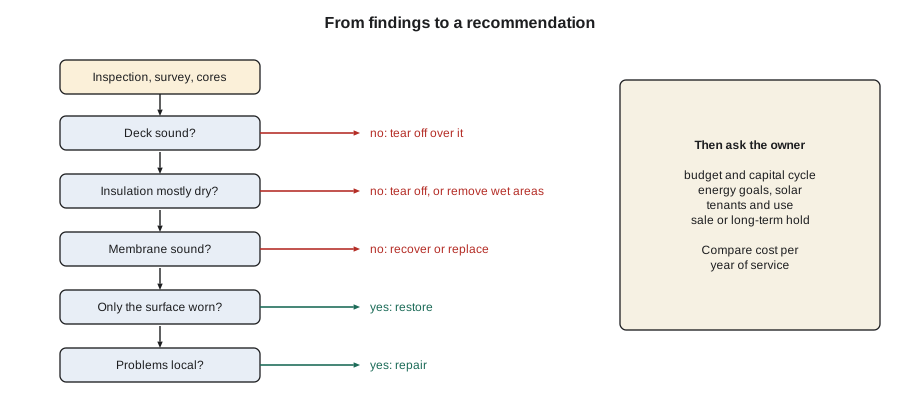
The decision rests on a handful of facts, most of which come from the inspection, the moisture survey and the cores:
- Age and expected life. A roof near the end of its expected life is a poor candidate for expensive repairs. Typical lives vary by system and climate, and maker warranties are not a measure of life, but owners need some sense of how many years a roof might have left.
- Extent of wet insulation. Wet areas have to be removed in any choice except doing nothing. As the wet fraction grows, repair and restoration make less sense. Many restoration programs and coating makers set a limit on the wet area they will accept before they warranty a restoration, commonly somewhere around a quarter of the roof; past that, replacement is usually the better value.
- Condition of the membrane. Seams failing throughout, brittle membrane, widespread splits or shrinkage mean the membrane is at the end of its life even if the insulation is dry.
- Condition of the deck. Rusted steel, rotted wood or a sagging deck must be repaired, which means tearing off over it.
- Leak history. A roof that leaks in one place for one reason is a repair. A roof that leaks in many places for many reasons is usually telling you something.
- What the owner needs. Energy upgrades, a change of use, solar panels, a building sale, a capital budget cycle, or a tenant who cannot tolerate leaks all change the answer.
- Codes and warranties. Some choices trigger code requirements, such as energy rules on replacement, or need a maker's approval to keep or obtain a warranty.
Comparing costs fairly
Owners naturally compare first costs: the repair is cheap, the replacement is expensive. A fairer comparison divides each option's cost by the years of service it buys. This is a simple version of life-cycle costing; a full analysis would also count interest, inflation, energy savings and the cost of leaks, but the simple version already changes many conversations.
Worked problem
Ferncliff: three options
Ferncliff's roof is 650 m² of 1984 built-up roofing. Glen priced three options for discussion (sample figures): re-gravel with a new flood coat and gravel for 32,000 dollars, expected to give about 8 more years; restore with an emulsion and reflective acrylic coating, with walkways, for 46,000 dollars, expected to give about 12 years; or replace with a new two-ply modified bitumen roof over new insulation for 210,000 dollars, expected to last about 25 years. Compare the cost per year of service.
Show solution
- Re-gravel: 32,000 ÷ 8 = 4,000 dollars per year.
- Restore: 46,000 ÷ 12 = 3,833 dollars per year.
- Replace: 210,000 ÷ 25 = 8,400 dollars per year.
Answer: On these sample figures, restoring is the best value per year of service, and replacing is about twice as much per year. But the restoration figure only holds if the roof under the coating is dry and sound, which is why the report recommends a moisture survey in the spring before Ferncliff commits to it. The replacement figure also leaves out the energy saved by new insulation, which would narrow the gap.
The life estimates are the weak point of any such comparison. They are judgements, based on experience with similar roofs and on the condition found, and they should be presented as estimates with a range. A report that says "restoration should give about 10 to 15 years if the survey confirms the roof is dry" is honest; one that promises 15 years is not.
Parkdale: repair or replace?
The Parkdale Arena wing showed the other side of the decision. Its 1997 ballasted EPDM was 29 years old, near the end of the life Glen would expect from a 1.14 mm loose-laid membrane in Hamilton. The October 22 survey had found torn flashing and bridging along the east parapet, scoured ballast and a clogged drain. Ahmed's survey found about a fifth of the insulation wet, concentrated in the north-east corner and along the east parapet.
Worked problem
Testing the repair option at Parkdale
To repair Parkdale properly, the 300 m² of wet insulation would have to be cut out and replaced with new insulation and new membrane spliced in, the east parapet re-flashed, and the ballast reset. Glen estimated the repair at about 95 dollars per square metre of wet area plus 18,000 dollars for the parapet (sample figures), and expected it to give about 6 years before the rest of the 29-year-old membrane needed replacing. What is the repair's cost per year of service?
Show solution
- Wet-area repair = 300 × 95 = 28,500 dollars.
- Total = 28,500 + 18,000 = 46,500 dollars.
- Per year = 46,500 ÷ 6 = 7,750 dollars per year.
Answer: About 7,750 dollars per year of service for a patched 29-year-old roof, with leaks still likely elsewhere. Lesson 12 prices the replacement at about 300,000 dollars for a roof Glen expects to last 25 years or more, about 12,000 dollars per year, but with new insulation, a new membrane and a warranty. The repair is cheaper per year, but it only defers the replacement, and the replacement in six years will cost more. Glen's report gave Hugo both numbers and recommended replacement, because the city had a capital budget cycle coming and a dressing room that could not keep leaking.
Presenting the choice
The owner makes the decision; the contractor's job is to make it an informed one. A good options report states the findings briefly, lists the realistic options with what each includes, what it costs, how long it should last and what risks it leaves, and makes a recommendation with the reasons. It is honest about uncertainty and about the contractor's interest: a contractor who always recommends replacement soon stops being trusted. Glen's rule is to recommend what he would do if the building were his, and to write down why.
Some owners cannot afford the best option this year. A phased plan can help: repair the urgent items now, restore or replace one roof area at a time over several years, or schedule replacement for a budget year while maintaining the roof until then. A phased plan must still be honest about what each phase leaves undone.
Phasing a replacement
Large roofs, and owners with tight budgets, often replace a roof in phases: one roof area or one building section each year. Phasing spreads the cost and lets the worst areas go first, but it has costs of its own. Each phase needs its own mobilization, crane and setup, so the total cost is higher than doing the roof at once. The joints between old and new roofs need temporary tie-ins that will be cut out later. And the maker's warranty usually covers each phase separately, with its own start date, unless the maker agrees otherwise.
Worked problem
Is phasing worth it?
An owner asks whether to replace a 4,000 m² roof at once for 760,000 dollars, or in two phases a year apart. Glen estimates (sample figures) that each phase would cost half of the single-job price plus 22,000 dollars for its own mobilization, crane and tie-in, and that the price of the second phase would rise by 4 in 100 over the year. What does phasing cost compared with doing it at once?
Show solution
- Phase 1 = 380,000 + 22,000 = 402,000 dollars.
- Phase 2 = (380,000 + 22,000) × 1.04 = 418,080 dollars.
- Total = 402,000 + 418,080 = 820,080 dollars.
- Extra cost of phasing = 820,080 − 760,000 = 60,080 dollars.
Answer: Phasing costs about 60,000 dollars more on these sample figures, about 8 in 100. It can still be the right choice if the owner cannot fund the whole roof this year, or if one half is leaking now and the other half has years left, but the owner should know the price of the choice.
Storm damage and insurance
Sometimes the repair-or-replace question is asked by an insurer. After a hailstorm or windstorm, the owner's insurer usually sends an adjuster, and the roofer's inspection report and photos become part of the claim. The roofer's job is to report what the storm did and what it did not do: new damage, with photos and measurements, separated from wear and old damage that was there before. Insurers generally pay for sudden damage from a covered event, not for a roof wearing out, and a report that mixes them up does the owner no favours. Some damage is clear, such as torn membrane or missing shingles; some needs testing, such as hail bruising that may crack a membrane later. A roofer should never promise an owner that insurance will pay for a new roof; that is the insurer's decision under the policy.
Talking to owners
Most owners are not roofers. They want to know three things: is it leaking or about to, what will it cost, and how long will it last. Glen's advice to apprentices who will one day be standing in front of an owner is to answer those three questions in plain words first, then show the evidence: photos, cores, survey maps. Avoid trade jargon unless you explain it, never exaggerate a problem to make a sale, and never play one down to avoid an awkward conversation. An owner who is told the truth about a 29-year-old roof will usually be back, either for the replacement or for the maintenance that keeps it going a few more years.
When the answer is uncertain
Some roofs do not give a clear answer. The survey may show a few small wet areas, the membrane may be ageing but sound, and the owner may have no budget this year. In those cases a short, honest plan is often best: repair the wet areas and the details now, add the roof to a maintenance program, survey again in two or three years, and budget for replacement in a stated year. That plan gives the owner a known cost now, a check on whether the roof is getting worse, and time to budget. It also gives the contractor a record to point to when the replacement comes, so nobody is surprised.
Common mistakes
MistakeComparing options by first cost only.
InsteadCompare cost per year of service, and mention energy and leak costs.
MistakePromising a fixed life for a restoration or repair.
InsteadGive a range and the conditions it depends on.
MistakeCoating over a roof without checking for wet insulation.
InsteadSurvey first; remove wet areas or choose another option.
MistakeAlways recommending replacement.
InsteadRecommend what you would do with your own building, and explain why.
MistakeIgnoring the owner's budget cycle and plans.
InsteadAsk about budgets, tenants, solar, sale and energy goals before recommending.
Summary and key terms
- The main choices are repair, restore, recover and replace; doing nothing has costs too.
- Age, wet insulation, membrane and deck condition, leak history, owner needs, codes and warranties decide the choice.
- Restorations usually need mostly dry, sound roofs; many programs limit the wet area they will accept.
- Compare cost per year of service, not first cost alone, and present life estimates as ranges.
- A good options report gives findings, options, costs, lives, risks and a reasoned recommendation.
- Phased plans can fit a budget but must say what each phase leaves undone.
- Restoration
- Renewing the whole surface of a sound roof, for example with a coating or new gravel, to extend its life.
- Life-cycle cost
- The cost of an option over the whole time it serves, often expressed per year.
- Options report
- A report that sets out the realistic choices with costs, lives and a recommendation.
- Phased plan
- A plan that spreads repair or replacement over several stages or years.
- Expected life
- An estimate of how long a roof or repair will serve under normal conditions.
- Capital budget
- An owner's plan for large spending, often set years ahead.
Practice problems
Work each problem on paper first, then reveal the answer to check.
A repair costs 24,000 dollars for 4 years; a replacement costs 150,000 dollars for 25 years. Compare cost per year.
Show answer
6,000 versus 6,000 dollars a year: equal, before leak and energy costs.
A restoration costs 40,000 dollars for 10 years. What is its cost per year?
Show answer
4,000 dollars.
Name four facts that decide between repair and replacement.
Show answer
Age, wet insulation, membrane condition, deck condition, leak history, owner needs, codes.
Why survey a roof before a coating restoration?
Show answer
Coatings over wet insulation trap the water; most programs limit the wet area.
What should an options report end with?
Show answer
A recommendation with the reasons for it.
Lesson quiz · 5 questions
Score 60% or more to complete this lesson.
Create a free account to save your progress, take quizzes and earn a certificate.