
ROOF-330 · Lesson 10 of 12 · 25 min
Warranties and manufacturer inspections
▶ Video coming soon A video version of this lesson is on the way.
On Thursday, October 29, Rory had walked the new Redhill roof with Sabine, Derek Asante from the membrane maker and Martin Oyelaran, the owner's consultant, while Derek marked eleven punch-list items with a paint stick. The crew fixed them by a quarter past two, and a week later the maker issued a 20-year system warranty. At the November 9 session, Glen passed round a copy of it. "Read the exclusions," he said. "Then read the owner's responsibilities. Then tell me who this warranty protects, and from what."
This lesson covers the kinds of roof warranties, what they usually cover and exclude, what the contractor's workmanship warranty adds, the maker's inspections that issue and keep a warranty in force, and what everyone has to do to keep it valid.
Kinds of warranty
A roof usually comes with two separate promises: one from the maker of the roofing system, and one from the contractor who installed it.
| Warranty | Given by | Usually covers | Typical length |
|---|---|---|---|
| Material warranty | Maker | Replacement of defective material only; no labour | 10 to 20 years or more |
| Limited system warranty | Maker | Repair of leaks caused by defective material or workmanship, up to a dollar limit, often the original contract value | 10 to 20 years |
| No-dollar-limit (NDL) system warranty | Maker | Repair of leaks caused by defects in the whole system, materials and workmanship, with no dollar cap | 10 to 30 years |
| Workmanship warranty | Contractor | Repair of leaks caused by installation defects | Often 2 years; sometimes longer |
| Extended or enhanced coverage | Maker, for an extra fee | Higher wind speeds, hail, longer term, or puncture resistance | Varies |
System and NDL warranties are only issued when the roof is built entirely with the maker's approved components, by a contractor the maker has approved, and passes the maker's inspection. Most makers charge a fee for them, often priced per square or per square metre and higher for longer terms. The warranty fee goes in the estimate.
Worked problem
The warranty fee
The maker's fee for the 20-year system warranty on the Redhill roof was quoted at a sample rate of 1.60 dollars per square metre. The roof is 5,978 m². What was the fee?
Show solution
- Fee = 5,978 × 1.60 = 9,565 dollars.
Answer: About 9,600 dollars on the sample rate, carried in the estimate as a direct cost. Glen always confirms the fee with the maker before bidding, because it changes with the term, the system and the building's wind exposure.
What warranties exclude
Warranties are as important for what they leave out as for what they cover. Typical exclusions include:
- Damage from weather beyond stated limits: wind above the warranted speed, hail above a stated size, lightning, earthquakes and other natural events.
- Damage by people: foot traffic, dropped tools, vandalism, other trades, and alterations or penetrations made without the maker's approval.
- Problems with the building rather than the roof: structural movement, deck failure, condensation from inside the building, failure of walls, windows or other parts that let water in above or around the roof.
- Ponding, unless the warranty covers it, and damage from chemicals, grease or exhaust the membrane is not resistant to.
- Consequential damage: almost all roof warranties cover repairing the roof, not the building's contents, finishes, lost business or mould.
That last exclusion surprises many owners. A roof warranty pays to stop the leak, not to replace the ceiling, the stock or the hockey equipment it ruined. Owners need property insurance for that, and contractors need liability insurance for damage they cause.
The workmanship warranty
The contractor's workmanship warranty covers leaks caused by how the roof was installed, for a stated period, often two years, which is when most installation defects show up. During that period, a leak call goes to the contractor first, who investigates and repairs at no cost if the cause is workmanship. Many makers require the contractor to repair workmanship defects for the first two years of a system warranty before the maker takes over. Ridgecap's standard is a two-year workmanship warranty on commercial roofs, and on steep-slope houses a longer one under the shingle maker's enhanced program when the owner buys it. Some owners ask for longer workmanship terms, which a contractor should price as a real cost and risk.
The maker's inspections
Makers inspect roofs at three points. During the work, on larger or more complex jobs, a technical representative may visit to check that the assembly and details match what was approved. At completion, the final inspection decides whether the warranty is issued: the representative walks the roof, checks seams, flashings and details, and writes a punch list of items to fix. The warranty is issued only when every item is fixed and the paperwork is in. Some warranties also include inspections during the term, often at year two before the workmanship period ends, and the owner may pay for more.
A final inspection goes well when the crew has inspected the roof first. At Redhill, Sabine and Owen had walked every seam and probed every weld the day before Derek came, and the eleven items he found were small: a few short laps at corners, two missing sealant beads at termination bar ends, a walkway pad not yet adhered. A crew that waits for the maker to find its mistakes will meet a much longer list.
Worked problem
Reading the dates
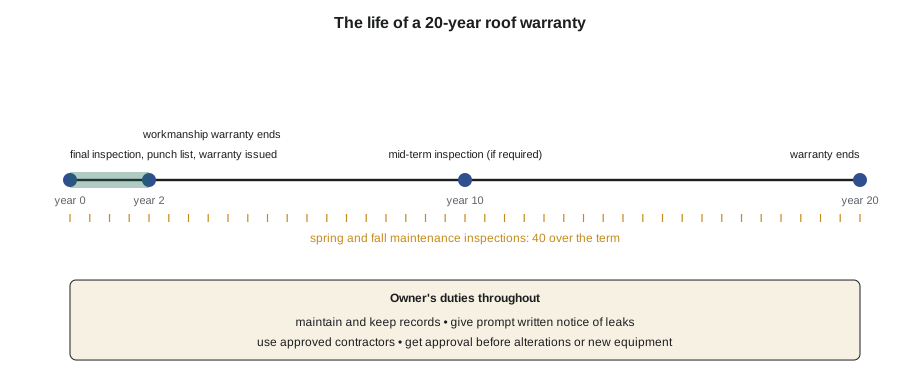
The Redhill roof was completed and accepted on Friday, October 30, 2026, and the warranty runs from that date. When does the 20-year system warranty end, when does Ridgecap's two-year workmanship warranty end, and how many of Nadine's spring and fall inspections fall within the warranty?
Show solution
- System warranty ends: October 30, 2046.
- Workmanship warranty ends: October 30, 2028.
- Inspections: two a year for 20 years = 40, starting with the first one planned for April 2027.
Answer: Forty maintenance inspections over the warranty, each one recorded in the roof's file. If the owner ever makes a claim, those records will show the roof was looked after.
Keeping a warranty valid
Most warranties put duties on the owner. The owner usually must:
- Maintain the roof as the warranty and the maker's guide require, and keep records of the maintenance.
- Give the maker prompt written notice of a leak, often within a stated number of days of finding it.
- Allow only the maker's approved contractors to repair the roof, and get the maker's approval before alterations, new penetrations or equipment such as solar panels.
- Pay for repairs that turn out not to be covered, such as damage by other trades.
- Transfer the warranty properly if the building is sold, where the warranty allows it.
Contractors have duties too: register the roof and apply for the warranty on time, use only approved materials and details, keep records and photos of the work, respond to leak calls promptly, and tell the maker about changes. Glen's warning to apprentices is simple: "The fastest way to void a warranty is a well-meaning roofer with a tube of sealant who isn't on the maker's list. If you're sent to a roof that's under somebody else's warranty, phone the office before you touch it."
Warranties are contracts, and in Ontario, as elsewhere, they sit alongside the construction contract and the general law; a warranty does not usually reduce the contractor's obligations under its contract. When a question about a warranty or a claim becomes a dispute, owners and contractors take advice on the contract itself.
Claims
When a roof under warranty leaks, the usual sequence is: the owner calls the contractor during the workmanship period, or the maker after it, as the warranty says; the contractor or maker investigates and finds the cause; if it is covered, the repair is made at no cost to the owner; if it is not, the owner is told why and offered a price. A good investigation report, written to the standard of ROOF-320 lesson 12 with photos of the cause, is what settles most claims without argument.
Becoming an approved contractor
Makers do not issue system warranties on roofs built by just anyone. A contractor applies to the maker's program, shows its experience, insurance, safety record and financial standing, and has its crews trained on the maker's systems. Many programs have levels: an approved or certified contractor can install the maker's systems with limited warranties, and a higher level, earned by a record of good roofs and passed inspections, can offer the longer and no-dollar-limit warranties. The maker tracks each contractor's inspection results and warranty claims, and a contractor with too many failed inspections or claims can be dropped. Ridgecap holds approvals with several low-slope membrane makers and with the shingle makers it uses most, which is why Glen can offer owners a choice of systems.
Steep-slope warranties
Shingle makers' warranties follow the same pattern on a smaller scale. A standard shingle warranty covers manufacturing defects in the shingles, with full coverage for the first years and reduced coverage after. Enhanced warranties, available when a certified contractor installs a complete system of the maker's components (starter, underlayment, eave protection, shingles, ridge cap and ventilation) and registers the roof, extend the full-coverage period and can include the contractor's workmanship for a longer time, with the maker backing it. Wind coverage depends on the shingle, the nailing pattern and the starter used at eaves and rakes. Many shingle warranties can be transferred once to a new owner, often only if the transfer is registered within a set time after the sale.
Worked problem
Comparing two shingle warranties
A homeowner on Linden Street compares two offers (sample terms). Offer A: standard shingle warranty, Ridgecap's 2-year workmanship warranty, price 8,500 dollars. Offer B: enhanced system warranty with 25 years of workmanship coverage backed by the maker, price 9,250 dollars. What does the enhanced warranty cost per year of extra workmanship coverage?
Show solution
- Extra price = 9,250 − 8,500 = 750 dollars.
- Extra workmanship coverage = 25 − 2 = 23 years.
- Cost per extra year = 750 ÷ 23 = 33 dollars a year.
Answer: About 33 dollars a year of extra protection, on these sample terms. Glen presents both offers and lets the owner choose; he explains that the enhanced warranty requires registration and the maker's complete system, and that it covers installation defects, not storm damage.
A claim at Ashgrove
Ridgecap's records show how a claim works in practice. In September 2026, Nadine's team found a split at an inside corner of the base flashing on the Ashgrove Plaza front parapet, a roof finished in June and still in its first year. It was a workmanship defect, a corner reinforcing piece that had not been fully bonded at one edge, so Ridgecap repaired it at no cost under its workmanship warranty, recorded it in the roof's file with photos, and told the maker, as the warranty required. Had the split been in the field of the membrane from a material defect, the maker would have handled it. Had it been a puncture next to the pharmacy's rooftop units, it would have been the owner's cost, and the access log would have helped find out who was responsible.
What a roofer should say about warranties
Apprentices and forepersons are often asked by owners about warranties on the roof. The safe answers are short. Tell them what you know: who installed the roof, who the maker is, and where the warranty document is kept. Never promise what a warranty covers, how long it lasts, or that a claim will be paid; those depend on the document and the maker. Never tell an owner that a repair you are about to make will be covered, or that something is not covered, until the office has checked. And always record and report anything you see on a warranted roof that could affect a claim, such as damage by other trades, new equipment set without approval, or blocked drains. Those notes are how Ridgecap keeps its customers' warranties, and its own reputation, intact.
Glen ended the November 9 session by handing back the Redhill warranty. "It protects the owner from defects in the roof we built," Rory said. "Not from the weather, not from other trades, and not from not looking after it." Glen nodded. "And it protects us only if we built it right and wrote it all down."
Common mistakes
MistakePromising an owner that the warranty covers interior damage.
InsteadExplain that roof warranties cover the roof; insurance covers contents and finishes.
MistakeLeaving the warranty fee out of the estimate.
InsteadConfirm the fee with the maker and carry it as a direct cost.
MistakeWaiting for the maker's inspector to find defects.
InsteadInspect the roof yourself first and fix what you find.
MistakeRepairing another contractor's warranted roof without checking.
InsteadPhone the office; only approved contractors should touch it.
MistakeLetting other trades cut into a warranted roof.
InsteadRequire the maker's approval and an approved roofer for every new penetration.
Summary and key terms
- Roofs usually have a maker's warranty and a contractor's workmanship warranty.
- Maker warranties range from material-only to limited system to no-dollar-limit; system warranties need approved components, contractor and inspection.
- Warranties exclude severe weather, damage by others, building problems and consequential damage.
- Workmanship warranties are often two years and come to the contractor first.
- The maker's final inspection and punch list decide whether the warranty is issued.
- Owners must maintain, keep records, give prompt notice and get approval for changes; contractors must register, document and respond.
- System warranty
- A maker's warranty covering leaks caused by defects in the whole roof system.
- No-dollar-limit warranty
- A system warranty with no cap on the cost of covered repairs (NDL).
- Workmanship warranty
- The contractor's warranty covering installation defects.
- Punch list
- A list of items to fix before work is accepted or a warranty is issued.
- Consequential damage
- Damage that results from a leak, such as ruined contents or finishes.
- Exclusion
- Something a warranty states it does not cover.
- Approved contractor
- A contractor a maker has approved to install its systems under warranty.
Practice problems
Work each problem on paper first, then reveal the answer to check.
A warranty fee is 1.40 dollars per m² on 2,200 m². What is the fee?
Show answer
3,080 dollars.
A 15-year warranty starts on June 4, 2026. When does it end?
Show answer
June 4, 2041.
Name three things roof warranties typically exclude.
Show answer
Severe weather beyond limits, damage by others, building problems, consequential damage.
Who usually handles a leak in the first two years?
Show answer
The installing contractor, under its workmanship warranty.
Name two duties of the owner under most roof warranties.
Show answer
Maintain and keep records, give prompt notice, use approved contractors, get approval for changes.
Lesson quiz · 5 questions
Score 60% or more to complete this lesson.
Create a free account to save your progress, take quizzes and earn a certificate.