
ROOF-330 · Lesson 11 of 12 · 23 min
Running a roofing crew
▶ Video coming soon A video version of this lesson is on the way.
Dana Renaud has run Crew 2 for eleven years. At the November 9 session Glen asked her to talk about the job she does when she is not roofing, and she started with a list on the whiteboard: plan the job, plan the day, keep everyone safe, keep the roof dry, keep the customer informed, track the hours, train the apprentices, and get everyone home. "The roofing's the easy part," she said. "You already know how to roof. A foreperson's job is making sure eight people do it together, in the right order, without anybody getting hurt, and finishing when the estimate said we would."
This lesson covers the foreperson's role and legal duties, planning a job and a day, safety leadership, tracking production against the estimate, communicating with the customer and the office, and leading and training a crew.
The foreperson's role
A roofing foreperson, or crew lead, is a working supervisor: usually an experienced journeyperson who still roofs, but who is responsible for the crew, the work and the site. In most companies the foreperson reports to a superintendent, the service manager or the owner, receives the job with its estimate, drawings and specification, and is expected to build it to the specification, safely, within the estimated hours. The role combines four kinds of work: planning, supervising safety, managing production and quality, and communicating.
In Ontario, a foreperson who directs workers is a supervisor under the Occupational Health and Safety Act, and the Act places its own duties on supervisors. In its own words, the Act requires a supervisor to be competent: to know the work and how to organize it, to know the Act and regulations that apply to it, and to know the hazards of the work. A supervisor must make sure workers work in the manner and with the protective devices and procedures the law and the employer require, tell workers about the hazards they face, and take every precaution reasonable in the circumstances to protect them. On a project with six or more workers regularly employed, the workers select a health and safety representative, and at twenty or more, a joint health and safety committee is required.
Planning the job
A job is planned before the crew arrives. The foreperson reads the estimate, the drawings and specification, and the maker's requirements; visits the site if possible; and plans:
- Sequence: where to start, which way to work so water drains away from unfinished areas, and how each day's work will be closed in watertight by the end of the day.
- Access and material handling: where the crane, hoist or ladder goes, where materials are landed and stored on the roof without overloading it, and how debris comes down.
- Fall protection and the site safety plan: guardrails, warning lines, anchors, skylight covers, rescue plan, hot-work permits and fire watch where torches or kettles are used, and protection of the public below.
- Deliveries and crew size: when each material arrives, how many people are needed each day, and which skills.
- Coordination: the owner's contacts, building access, other trades on the roof, mechanical shutdowns for rooftop units and intakes, and noise or odour limits.
Worked problem
How long will Parkdale take?
The Parkdale estimate carries about 770 labour-hours. Dana would run it with a crew of eight: herself, five roofers and two labourers, working 8-hour days. How many working days is that, and how many should she plan if Ridgecap allows one day lost to weather for every four worked in summer?
Show solution
- Crew-hours per day = 8 × 8 = 64.
- Working days = 770 ÷ 64 = 12.0 days.
- With weather: 12 × 5 ÷ 4 = 15 days, three weeks.
Answer: Twelve working days, planned as three weeks to allow for weather. Dana would also ask Hugo for the arena's summer schedule, because a dressing room under a tear-off cannot be used on a rainy day.
Planning the day
Each day starts with a short meeting at the truck or the bottom of the ladder: the plan for the day, who does what, the hazards today and the controls for them, the weather, and any changes. Many companies call this a tailgate or toolbox talk, and record it on a form with the crew's signatures. It is the best ten minutes of the day for safety, because it is specific: not "be careful", but "we're working within 2 m of the north edge this morning before the guardrail goes up, so everyone on that side is tied off to the anchors Marco set yesterday."
The day ends with the work closed in, materials secured against wind, the roof cleared of debris and loose tools, tarps and night seals checked, the fire watch completed after any hot work, and a few lines written in the daily report.
Tracking production
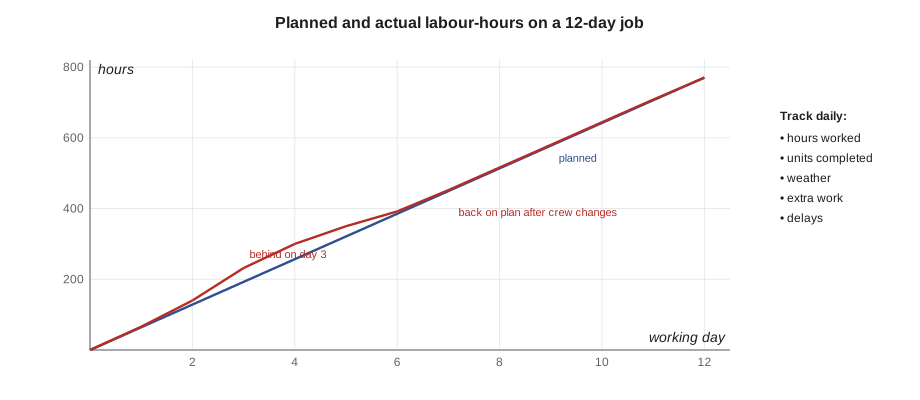
An estimate is a prediction; the job is the test. A foreperson tracks hours against the estimate's production rates every day, so that a problem shows up on day three, not on the last day. The daily report records the crew, hours worked, work completed in measurable units, weather, deliveries, problems and delays, and any extra work the customer asked for.
Worked problem
Is the crew on target?
On day three at Parkdale, the crew would be installing the insulation, estimated at 0.18 labour-hours per square metre. Suppose the full crew of eight spends the whole 8-hour day on it and completes 310 m². What is the actual rate, and is the crew ahead or behind?
Show solution
- Hours = 8 × 8 = 64.
- Actual rate = 64 ÷ 310 = 0.206 h/m².
- Estimated hours for 310 m² = 310 × 0.18 = 55.8 h.
- Difference = 64 − 55.8 = 8.2 hours over.
Answer: Behind by about 8 hours in one day. One day is not a trend: the first day of a new task is often slow. But if day four is the same, the foreperson needs to find out why: too many people on one task, materials landed too far away, a slow crane, or an estimate that was too tight. The answer goes back to Glen, so the next estimate is better.
Production tracking is also how extra work gets paid. When an owner asks for something not in the contract, or the crew finds something nobody could have known, such as rotted deck, the foreperson records it, photographs it, and tells the office before doing it, so a change order can be agreed. Extra work done without a record is usually work done for free.
Quality
Quality is checked as the work goes, not at the end. The foreperson checks the first of everything: the first row of fasteners, the first seam, the first flashing, the first curb, against the specification and the maker's requirements, and checks seams and details daily, such as probing every heat-welded seam before the crew leaves. Photos of each stage, especially of work that will be covered, go into the job file. A crew that checks its own work meets a short punch list when the maker's representative comes, as lesson 10 described.
Communicating
A foreperson talks to more people than anyone else on the job: the crew, the office, the owner's representative, the consultant, the maker's representative, other trades and sometimes the public. Good forepersons tell the owner what is happening before it happens: when the crane will block the parking lot, when the dressing rooms will be noisy, when the building may smell of adhesive and which intakes must be shut off. They write things down. They report problems the same day, with photos, and they do not promise what the contract does not include.
Leading and training
The foreperson is the person apprentices learn the trade from. Dana's approach is to give each apprentice one task to own each week, show it once, watch them do it, and then let them do it while she checks the first few. She pairs new workers with experienced ones, never leaves an apprentice alone at a roof edge, and expects questions. Ridgecap's apprentices log their hours and tasks for their apprenticeship records, and the foreperson signs off the tasks they have done.
Leading a crew also means dealing with people: assigning work fairly, correcting mistakes without humiliating anyone, dealing with lateness, conflict and fatigue, and recognizing heat stress, impairment or fear in a worker who should not be on the roof that day. Dana's last point on the whiteboard was the one she meant most: "If somebody tells you something's not safe, you stop and look. Every time. The day you don't is the day somebody gets hurt."
Weather, heat and the public
Roofing crews work in the weather, and the foreperson decides when the weather stops the work. Wind is the most common stop: large sheets of membrane, insulation boards and even bundles can be lifted and thrown in gusts, and makers set wind limits for installing their membranes. Rain stops torching, adhering and welding, and wet insulation must never be covered. Cold slows adhesives and sealants and stiffens membranes; most makers set minimum temperatures for their products. Lightning clears the roof. Ridgecap's crews carry a pocket wind meter, and Dana checks the forecast at the start of the day and again at lunch.
Heat is a quieter hazard. A black roof surface in July can be far hotter than the air, and heavy work in full sun can bring on heat exhaustion or heat stroke. Ontario's guidance on heat stress expects employers to have a plan: water, shade, rest breaks that lengthen as the heat rises, earlier start times, training to recognize the symptoms, and a buddy system so nobody works alone in the heat. Ridgecap's heat plan, run by Anjali, sets work and rest cycles by the humidex.
The public is the other group a foreperson protects. Sidewalks and entrances under the work are closed or covered, bins and cranes are barricaded, materials are never stored near an unguarded edge where wind could take them, and the owner's staff and visitors are told where they can and cannot go. At Parkdale, the arena's parking lot and the skate shop entrance would both be under the crane's path, so Dana's plan would schedule lifts before the arena opened each morning, with the area taped off and a labourer posted at the entrance.
The daily report
Dana's daily report fits on one page. It is the record that settles arguments months later, and the information Glen uses to improve the next estimate.
| Section | What Dana writes |
|---|---|
| Job and date | Job name and number, date, start and finish times |
| Weather | Morning and afternoon conditions, wind, temperature, any stops |
| Crew | Names, trades and hours for each person |
| Work done | Quantities by task, such as square metres insulated, metres of flashing, curbs done |
| Deliveries and equipment | What arrived, crane hours, bins swapped |
| Safety | Toolbox talk topic, inspections, near misses, incidents |
| Problems and extras | Delays, damage found, owner requests, change orders started, with photo numbers |
| Visitors | Owner, consultant, maker's representative, inspectors |
Incidents and near misses are reported the same day, not saved for the weekly meeting. A critical injury on an Ontario project must also be reported immediately to the Ministry, and the scene left undisturbed except to help the injured or prevent further harm, as the law requires; Anjali handles those reports, but the foreperson is the person who calls her.
Becoming a foreperson
Most forepersons are promoted from the crew, and the move is harder than it looks. Yesterday's co-workers become the people you direct, and the habits that made a good roofer, such as working fast and fixing problems yourself, need balancing with planning, checking and talking. Ridgecap gives new forepersons a smaller crew first, pairs them with an experienced foreperson for their first season, and sends them on supervisor training: in Ontario, the Ministry's supervisor health and safety awareness training is required by law, and Ridgecap adds courses on leadership and planning. Dana's advice to Rory, who will be ready for it in a few years, was to start now: "Watch how jobs are planned. Read the estimate before the job starts. Ask why we do things in the order we do. By the time somebody hands you a crew, you'll already know how."
Common mistakes
MistakeStarting work without a plan to close in the roof each day.
InsteadPlan the sequence so every day ends watertight.
MistakeGiving a toolbox talk that just says be careful.
InsteadName today's hazards and today's controls, specifically.
MistakeWaiting until the end of the job to compare hours with the estimate.
InsteadTrack production daily and find the cause early.
MistakeDoing extra work without telling the office.
InsteadRecord, photograph and report it first so a change order can be agreed.
MistakeLeaving an apprentice to learn alone.
InsteadShow, watch, check, and never leave an apprentice alone at an edge.
Summary and key terms
- In Ontario, a foreperson is a supervisor under the OHSA, with duties to be competent, ensure safe work, inform workers and take every reasonable precaution.
- Plan the job: sequence, daily close-in, access, fall protection, hot work, deliveries, crew and coordination.
- Start each day with a specific toolbox talk and end it with the roof closed in and secured.
- Track hours against the estimate daily; find causes early and report them.
- Record and report extra work before doing it, so a change order can be agreed.
- Check quality as the work goes, communicate before things happen, and train apprentices deliberately.
- Foreperson
- The working supervisor who leads a crew on site.
- Toolbox talk
- A short daily safety meeting about the day's work and hazards; also called a tailgate talk.
- Daily report
- The foreperson's record of crew, hours, work done, weather and problems each day.
- Change order
- A written agreement to change the work and the price.
- Close-in
- Making each day's work watertight before leaving.
- Competent person
- Under the Ontario OHSA, a person qualified by knowledge, training and experience to organize the work, who knows the law and the hazards; supervisors must be competent persons.
Practice problems
Work each problem on paper first, then reveal the answer to check.
A job is estimated at 480 hours with a crew of six on 8-hour days. How many working days?
Show answer
480 ÷ 48 = 10 days.
A crew of five works 8 hours and installs 200 m² estimated at 0.18 h/m². Ahead or behind?
Show answer
40 h used versus 36 h estimated: 4 hours behind.
What should a toolbox talk cover?
Show answer
The day's plan, tasks, specific hazards and controls, weather and changes.
What must happen before extra work is done?
Show answer
Record it, photograph it and tell the office so a change order can be agreed.
At how many regularly employed workers does an Ontario project need a joint health and safety committee?
Show answer
Twenty or more.
Lesson quiz · 5 questions
Score 60% or more to complete this lesson.
Create a free account to save your progress, take quizzes and earn a certificate.