
ROOF-330 · Lesson 1 of 12 · 23 min
Roof inspections
▶ Video coming soon A video version of this lesson is on the way.
On the Monday evening after the Harbourside inspection, Glen Pelham spread Theo's inspection forms across the big table in the Ridgecap office. Rory and Keisha had been on that roof on Saturday, October 31, walking it with Theo, and Glen wanted them to see what happened to the forms next. "Twenty years from now you'll be running crews, or bidding work, or both," he said. "Every job you ever get starts with somebody looking at a roof and writing down what they saw. If they write it down badly, everybody downstream guesses." Nadine Szabo, Ridgecap's service manager, had brought the binder for the company's maintenance contracts: sixty-four buildings, each inspected every spring and every fall.
This course is about the work around the roof as much as the roof itself: inspecting and surveying roofs, keeping them in service, deciding when to repair, recover or replace, dealing with gardens and solar panels on top of them, measuring and pricing the work, understanding warranties, and running the crew that does it. This first lesson is about the inspection, because every other decision depends on it.
Why roofs are inspected
Roofs are inspected for different reasons, and the reason decides how the inspection is done and what goes in the report.
| Kind of inspection | Who asks for it | What it looks for |
|---|---|---|
| Routine maintenance inspection | The owner, under a maintenance contract | Damage, wear, debris, drains, details that need attention before they leak |
| Leak investigation | The owner, after a leak | The source of one leak (ROOF-320 lesson 12) |
| Condition assessment | An owner planning a budget, or a buyer | Overall condition, remaining life, cost of repair or replacement |
| Storm or damage inspection | The owner or an insurer, after wind or hail | New damage, its extent and its cause |
| Warranty inspection | The membrane maker | Whether the roof was built to the maker's requirements, or a claim is valid |
| Pre-bid inspection | The contractor | Conditions that change the price: access, layers, wet areas, deck, details |
A routine inspection is the most common, and the most often done badly, because it is routine. The roof looks fine from the hatch, the inspector walks the middle, takes a few pictures and goes home. Most problems on a low-slope roof are at the edges, the details and the drains, and they are found by walking every one of them.
Planning the inspection
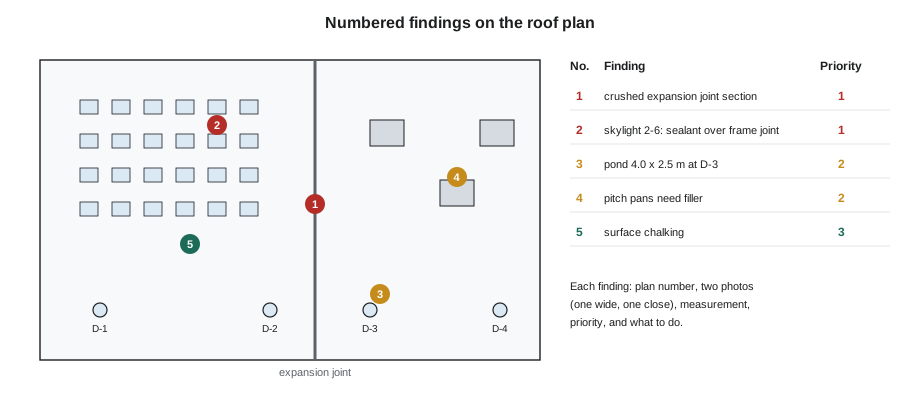
Before going up, the inspector gathers what is already known: the roof plan or a sketch, the age and type of the roof, the warranty and who holds it, past reports and repairs, and the owner's list of leaks with dates. Nadine's binder holds all of this for each contract building, along with a roof plan with numbered areas, drains, curbs and skylights, so that a finding can be located exactly. For a first visit to a building, the inspector sketches the plan on site, paced or measured from the edges.
The visit itself needs the same planning as any roof work: safe access, fall protection, and a plan for the hazards at the edges and openings. Inspectors walk close to edges and skylights to look at them, which is exactly where the falls happen. The rules from ROOF-110 apply to inspectors as much as to roofers: guardrails, a travel restraint system, or a fall arrest system where a worker could fall more than 3 m, Working at Heights training, and skylights treated as openings; Ridgecap's rule is that nobody inspects alone, and nobody stands closer than 2 m to an unguarded edge or skylight without being tied off.
Worked problem
Planning the walk
The Harbourside warehouse roof is 148 m long and 61 m wide. Theo wants the inspectors to walk lanes running the length of the roof, close enough together that every part of the field is within 3 m of somebody's path. How far apart are the lanes, how many lanes are needed, and how far do the inspectors walk in the field, not counting the perimeter and details?
Show solution
- Each lane covers 3 m on each side, so lanes are 6 m apart.
- Lanes across the width = 61 ÷ 6 = 10.2, so 11 lanes.
- Distance = 11 × 148 = 1,628 m, about 1.6 km.
Answer: Eleven lanes and about 1.6 km of walking in the field alone. With the perimeter, the expansion joint, 24 skylights, 6 exhaust fans and 11 rooftop units to look at, Theo planned on four hours for two people.
Inside first
A good inspection starts inside the building. Ceiling stains, wet ceiling tiles, rust on the deck, drips at light fixtures and buckets on the floor point to the parts of the roof that need the closest look. The owner's maintenance staff usually know where the buckets go. Looking at the underside of the deck also shows what the roof sits on, and whether the deck is sagging, rusting or rotting. At Harbourside on October 31, the stained curb wall of skylight 2-6 and a rusted section of deck flute under it were found from the warehouse floor before anyone went up.
What to look at on the roof
Theo's form, like most, works through the roof in the same order every time, so nothing is skipped:
- Perimeter: edge metal and copings, joints and cleats, fascia, gutters and scuppers; base flashings up the walls and parapets, their top fastening and counterflashings.
- Drains: strainers in place, clear of debris, clamping rings tight, water draining, no ponding around them; overflow drains and scuppers clear.
- Field: seams, laps and the membrane surface; blisters, ridges, splits, punctures, loose or missing ballast, worn or alligatored surfacing, ponding, debris and damage from foot traffic.
- Penetrations and curbs: pipe boots, pitch pans, vents, hot stacks, rooftop unit curbs and caps, skylights and hatches, expansion joints, walkway pads.
- Rooftop equipment and other trades: panels left off units, condensate lines draining onto the roof, grease from kitchen exhausts, abandoned equipment, screws and debris left by service technicians.
- Signs of what is underneath: soft spots, a spongy feel underfoot, fastener heads lifting through the membrane, wrinkles over insulation joints.
Ponding deserves a measurement, not a guess. The industry's usual test is that water still standing about 48 hours after a rain, in weather that would normally dry it, is ponding; water that drains in that time is not. Ponds matter because they load the structure, speed up wear of the membrane and surfacing, and turn any small hole into a large leak.
Worked problem
How much does a pond weigh?
Theo found a pond 4.0 m by 2.5 m, about 20 mm deep on average, near drain D-3 at Harbourside, two days after rain. What does the water weigh, and what is the load per square metre?
Show solution
- Area = 4.0 × 2.5 = 10.0 m².
- Volume = 10.0 × 0.020 = 0.200 m³ = 200 litres.
- Water weighs 1 kg per litre: 200 kg.
- Load = 200 ÷ 10.0 = 20 kg/m².
Answer: About 200 kg, or 20 kg/m². That is not much for one pond on a steel deck, but ponds make the deck deflect, which deepens the pond, and a blocked drain can turn a small pond into a large one. The report notes the size, depth and date, and recommends checking the drain's level and the strainer.
Photos and records
Photos are the evidence. Each finding gets at least two: one wide enough to show where it is on the roof, with a recognizable feature such as a curb or drain in the frame, and one close enough to show the problem, with a tape or a pen for scale. The photo numbers go on the form and on the plan. Most inspectors now use a tablet or phone app that tags each photo with its location and time, but the plan with numbered findings is still what makes a report usable by someone who was not there.
Measurements go in the record too: blister sizes, split lengths, pond depths, flashing heights where they look low, and the readings from a moisture meter if one is used. A note that says "some ponding near drain" is not a record; "pond 4.0 × 2.5 m, 20 mm deep, D-3, 48 h after rain" is.
Priorities
A list of forty findings with no priorities is not much use to an owner with a budget. Most contractors rate findings in three or four classes. Ridgecap uses three:
| Priority | Meaning | Harbourside examples, October 31 |
|---|---|---|
| 1 Urgent | Leaking now or likely to leak soon; safety hazard | Crushed expansion joint section; skylight 2-6 with sealant across the frame joint and a stained curb |
| 2 Plan this year | Wear or damage that will lead to leaks if left | Two loose walkway pads at the rooftop units; two pitch pans needing filler |
| 3 Monitor | Normal ageing; watch at the next inspection | Surface chalking of the membrane; minor scuffing at the rooftop units |
Each priority 1 item is reported to the owner the same day, by phone or e-mail, not only in the written report a week later. On October 31, Theo called Corinne Abara from the roof about the expansion joint before he climbed down.
Writing the report
An inspection report is written for a reader who was not on the roof, may not know roofing, and has to make a decision about money. It usually has a short summary first: what the roof is, its general condition, the urgent items and the recommended actions with rough costs. Then come the detailed findings with the plan and photos, and the recommendations sorted by priority. The language is plain and factual. A report says what was seen and what it means; it does not guess beyond the evidence, and it says when something could not be checked, such as a roof area covered in snow or a detail hidden under equipment.
Nadine's rule for her inspectors is that every finding answers four questions: where it is, what it is, why it matters, and what to do about it. "If you can't say why it matters, it doesn't go in," she told Rory. "If you can't say what to do about it, ask me before it goes in."
Steep-slope inspections
Most of this lesson is about low-slope roofs, but steep roofs are inspected too, usually from the ground with binoculars, from a ladder at the eaves, from a drone, or by walking the roof where its slope, surface and the weather allow it safely. A steep-slope inspection looks for missing, lifted, cracked or curled shingles; granule loss and bare spots; exposed or popped nails; worn or rusted flashings at chimneys, walls, valleys and vents; loose or cracked pipe boots; signs of ice damming at the eaves, such as stains on the fascia and soffit; gutters that are clogged, sagging or pulling away; and moss, debris or tree branches on the roof. Inside, the attic tells as much as the roof: daylight through the deck, stains on the sheathing, frost or mould on the underside of the sheathing in winter, wet insulation, and whether the soffit vents are open and the bathroom fans exhaust outdoors, as ROOF-120 explained.
Drone inspections have become common on steep and large roofs, because they keep the inspector off the roof and produce clear photos and measurements. They do not replace walking a low-slope roof, because a drone cannot feel a soft spot, lift a drain strainer or test a seam. Drones flown for business are regulated: in Canada, the pilot needs a Transport Canada drone pilot certificate for the drone's weight class and the airspace, and must follow the rules on distance from people and airports.
| Where | What to look for on a steep roof |
|---|---|
| Field of the roof | Missing, lifted, cracked or curled shingles; granule loss; exposed nails; moss and debris |
| Flashings | Chimney, wall, valley and vent flashings rusted, lifted or sealed with old caulk |
| Penetrations | Cracked pipe boots; vents and fans loose or damaged |
| Eaves and gutters | Ice-dam stains; clogged, sagging or loose gutters; missing kickouts |
| Attic | Daylight, stains, frost or mould on the sheathing, wet insulation, blocked vents |
Whatever the roof, the inspector also notes what could not be seen and why. A report that says "the north slope was snow-covered and was not inspected" protects everyone; one that is silent leaves the owner believing the whole roof was checked.
Common mistakes
MistakeWalking the middle of the roof and photographing the view.
InsteadWalk every edge, drain, curb and penetration, in the same order every time.
MistakeSkipping the inside of the building.
InsteadStart inside: stains, buckets and the underside of the deck show where to look.
MistakeWriting "some ponding" or "flashing looks low".
InsteadMeasure: size, depth, height, length, and the date and weather.
MistakeBurying an urgent item in a long report.
InsteadCall the owner about priority 1 items the same day.
MistakeInspecting near edges and skylights without protection.
InsteadInspectors need the same fall protection as roofers.
Summary and key terms
- Inspections have different purposes: maintenance, leak investigation, condition assessment, storm damage, warranty and pre-bid.
- Plan first: plans, age, warranty, past reports, leak history, safe access and fall protection.
- Start inside, then work through the perimeter, drains, field, penetrations, equipment and signs of what is underneath, in a fixed order.
- Water standing about 48 hours after rain is usually treated as ponding; measure it.
- Every finding gets a number on the plan, photos and a priority; urgent items are reported the same day.
- A report answers where, what, why it matters and what to do, in plain language.
- Maintenance inspection
- A routine inspection, usually spring and fall, to find problems before they leak.
- Condition assessment
- An inspection to judge overall condition, remaining life and the cost of repair or replacement.
- Ponding
- Water that stays on a roof well after rain, often taken as about 48 hours in drying weather.
- Priority
- A ranking of findings by urgency, so the owner knows what to do first.
- Alligatoring
- A pattern of cracks in a weathered bitumen surface, like reptile skin.
- Roof plan
- A drawing of the roof from above, with areas, drains, curbs and other features numbered.
Practice problems
Work each problem on paper first, then reveal the answer to check.
Lanes are walked 6 m apart on a roof 42 m wide and 90 m long. How many lanes and how far?
Show answer
42 ÷ 6 = 7, plus one: 8 lanes × 90 m = 720 m.
A pond is 3.0 × 2.0 m and 15 mm deep. What does it weigh?
Show answer
6.0 × 0.015 = 0.09 m³ = 90 kg.
Name four things to look for at a roof drain.
Show answer
Strainer in place, debris, clamping ring tight, water draining, ponding around it.
Why start an inspection inside the building?
Show answer
Stains and leaks show where to look, and the deck underside shows its condition.
What four questions should every finding answer?
Show answer
Where, what, why it matters and what to do.
Lesson quiz · 5 questions
Score 60% or more to complete this lesson.
Create a free account to save your progress, take quizzes and earn a certificate.