
ROOF-330 · Lesson 2 of 12 · 27 min
Moisture surveys and core cuts
▶ Video coming soon A video version of this lesson is on the way.
Hugo Maranda had asked Ridgecap for two prices on the Parkdale Arena wing: one to repair the east parapet, which he had accepted, and one to replace the whole roof. Glen would not price the second one without knowing how much of the insulation was wet. "If it's dry, we might be looking at a recover," he said at the October 26 session. "If it's wet, we're tearing it off, and the price doubles. I'm not guessing about a number that size." So on Wednesday, October 28, while Rory was on the parish hall roof with Crew 3, Glen met Ahmed Rahim of Clearline Roof Diagnostics on the Parkdale roof with two labourers from Crew 1 and a nuclear moisture gauge.
This lesson covers why wet insulation matters, the three main ways of finding it without tearing the roof apart, the core cuts that confirm what the instruments say, and how to repair a core so the survey does not cause the next leak.
Why wet insulation matters
Water in a roof assembly does damage long before it shows up on a ceiling. Wet insulation loses much of its thermal resistance, so the building loses heat through those areas. It adds weight. It can freeze and expand, breaking down foam boards and fibreboards and pushing up the membrane. It rusts steel decks and fasteners and rots wood decks and nailers. Wet insulation also decides what can be done with a roof: as lesson 5 explains, the codes and the makers do not allow a new roof to be laid over wet materials, so a roof that might have been recovered has to be torn off, at least in the wet areas.
A survey answers three questions: is there wet material in the roof, where is it, and how much? Inspections from the surface cannot answer them. Soft spots underfoot and blisters are clues, but large areas of wet insulation can lie under a membrane that looks perfect.
Infrared surveys
An infrared camera does not see water. It sees surface temperature. On a clear, dry day the sun warms the whole roof; after sunset the roof cools, but wet insulation holds heat longer than dry insulation because water stores much more heat. For a few hours after dark, the wet areas show up as warmer patches on the camera. The survey is done from the roof, or sometimes from the air, and the warm patches are marked on the roof with paint and drawn on a plan. The method is described in ASTM C1153.
Infrared works well on roofs with a thin, uniform surface: adhered single-ply, smooth or granule-surfaced modified bitumen, built-up roofs with light gravel. It works poorly or not at all when the conditions are wrong: after a cloudy day, when the roof surface is wet from rain or dew, in strong wind, or when the surface varies, as with heavy gravel, ballast stones, pavers or a reflective coating with patches. It also struggles with insulation that holds little heat when wet, such as some closed-cell foams, and on roofs over heated spaces where the building heat masks the pattern.
Nuclear surveys
A nuclear moisture gauge holds a small radioactive source that sends fast neutrons into the roof. Hydrogen atoms slow them down, and the gauge counts the slow neutrons that bounce back. Water is full of hydrogen, so more slow neutrons mean more moisture. Readings are taken on a grid, usually every 1.5 to 3 m, and plotted as a contour map. The gauge works through most surfacings, in daylight and in most weather, but the readings are only relative: bitumen, some insulations and even the thickness of the gravel contain hydrogen too, so every survey is calibrated against core samples. The operator needs a licence and training to use and transport the gauge, and the source is kept in a shielded case.
Worked problem
Laying out the Parkdale grid
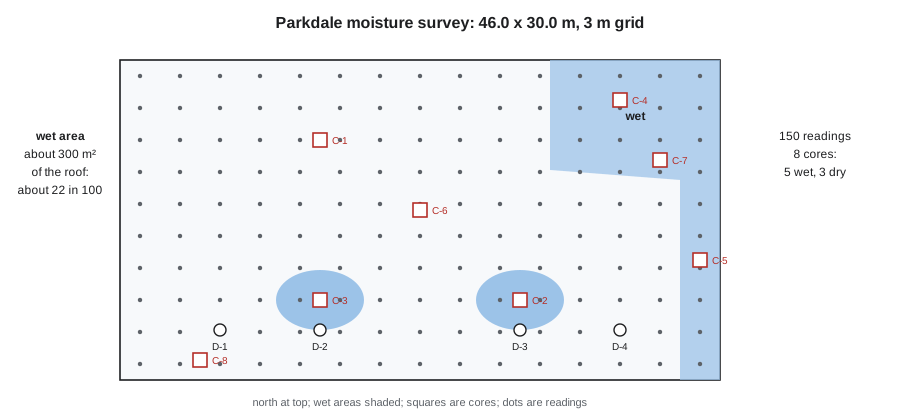
The Parkdale roof is 46.0 m by 30.0 m. Ahmed set his grid at 3 m spacing, starting 1.5 m in from each edge. How many readings did he take?
Show solution
- Points along the length: from 1.5 m to 43.5 m at 3 m spacing = 46.0 ÷ 3 = 15.3, so 15 points.
- Points across the width: from 1.5 m to 28.5 m = 30.0 ÷ 3 = 10 points.
- Readings = 15 × 10 = 150.
Answer: 150 readings on the main grid. Ahmed added closer readings around the high spots to find the edges of the wet areas, and took the whole set in about five hours.
On a ballasted roof like Parkdale's, the stone was a problem for every method. Infrared would see only the stone; electrical scanners need contact with the membrane. Ahmed had the labourers rake the ballast into windrows along each grid line, so the gauge sat on bare membrane, and raked it back as they went.
Electrical capacitance and impedance surveys
Impedance and capacitance meters pass a low-frequency electrical field into the roof from a plate on the surface; wet materials change the field. The meter is rolled or carried across the roof in a grid, readings are compared with readings on known dry areas, and high readings are marked. ASTM D7954 describes the method. Meters work best on single-ply and smooth membranes over non-conductive insulation and decks; they are thrown off by metal surfaces and foils, carbon-black membranes, standing water on the surface, and ballast or gravel. Like nuclear readings, the results are comparative and must be confirmed with cores.
| Method | Works well on | Main limits |
|---|---|---|
| Infrared (ASTM C1153) | Uniform surfaces after a clear, dry, sunny day; large roofs | Weather; heavy gravel, ballast, pavers; patchy coatings; some foams |
| Nuclear | Most surfaces including gravel; any time of day | Relative readings only; licensed operator; slow on large roofs |
| Impedance or capacitance (ASTM D7954) | Single-ply and smooth membranes; quick on small roofs | Metal, foil, carbon-black or wet surfaces; ballast; relative readings |
| Core cuts | Every survey, to confirm and calibrate | Destructive; each one must be repaired |
Core cuts
A core cut is a small sample cut through the whole roof assembly down to the deck, usually with a hole saw or a core drill about 50 to 100 mm across, or as a square cut with a knife on built-up roofs. Cores do three jobs. They show what the roof is made of: how many layers of membrane and insulation, what kind, how thick, how it is attached, and whether there is an older roof underneath. They confirm the survey: a core in a high-reading area that comes up wet, and one in a low area that comes up dry, calibrate the instrument. And they give a measured moisture content.
Moisture content is measured by weighing. Each piece of the core is sealed in a bag on the roof, weighed wet at the lab or office, dried in an oven, and weighed again. The moisture content is the weight of water as a fraction of the dry weight.
Worked problem
Reading a core
Core C-4 at Parkdale came from the north-east corner, the highest reading on Ahmed's map. The top layer of polyiso from the core weighed 46.2 g wet and 38.5 g after drying. What was its moisture content?
Show solution
- Water = 46.2 − 38.5 = 7.7 g.
- Moisture content = 7.7 ÷ 38.5 = 0.20.
- That is 20 parts water to 100 parts dry insulation by weight.
Answer: The board was holding a fifth of its own weight in water: clearly wet. The core from the middle of the roof, C-6, came in at about 2 in 100, which Ahmed treated as dry.
Cores are not taken at random. A typical plan takes some in the highest readings, some at the edges of the wet areas, and some in low readings, but not only at the very highest readings, which may come from something other than water. At Parkdale, Ahmed cut eight cores. Five were in or at the edge of the high readings, and all five were wet. The three in low-reading areas were dry. Every core showed the same assembly: the 1997 EPDM, loose-laid, over two layers of 38 mm polyiso, loose-laid on the steel deck, with no vapour retarder and no older roof underneath.
Worked problem
How much of the roof is wet?
Ahmed's contour map showed about 300 m² of wet insulation: most of it in the north-east corner and a strip along the east parapet, with two smaller patches around drains D-2 and D-3. The roof is 1,380 m². What fraction of the roof is wet?
Show solution
- Fraction = 300 ÷ 1,380 = 0.217.
- About 22 parts in 100, a little over a fifth of the roof.
Answer: About a fifth of the roof. The wet areas lined up with the leaks Hugo had reported in the dressing rooms below the east parapet, and with the torn flashing and scoured ballast found on the October 22 survey.
Repairing cores
Every core is a hole in somebody's roof, and it is the surveyor's or contractor's job to close it the same day. The hole is filled with insulation of the same thickness, cut to fit snugly, and the membrane is patched with the same membrane type or a compatible one, lapping well past the cut on all sides, using the maker's materials and methods: a heat-welded patch on TPO or PVC, a primed cover strip or seam-tape patch on EPDM, a torched or cold-applied two-ply patch on modified bitumen, or plies and flood coat on built-up roofing. On ballasted and gravel roofs the surfacing goes back over the patch. The patch is photographed and its location goes on the survey plan, so it can be found again and checked at the next inspection. A membrane maker's warranty may require the maker's approval or notice before cores are cut, so check before cutting into a roof that is still under warranty.
The survey report
A moisture survey report gives the date, weather and method; the roof plan with the grid, readings or images, and the outlined wet areas with their areas; the core locations, what each core showed and its moisture content; and the surveyor's conclusions and limits. Ahmed's report reached Glen on Monday, November 2, and the numbers in it decided the scope of the Parkdale bid, as lesson 12 shows.
Choosing a method
Survey firms choose the method to suit the roof, and on some roofs they combine methods. A typical choice runs like this. On a large adhered single-ply or smooth bitumen roof, an infrared survey at night covers the whole roof quickly, and a few cores confirm it. On a small single-ply roof, an impedance scan in daylight is quick and cheap. On a gravel-surfaced built-up roof, or on a roof that infrared cannot read, a nuclear grid works, at a slower pace. On a ballasted roof, every method needs the stone moved, so the survey is planned with the labour to rake lanes, as at Parkdale. And on any roof, if only a few areas are in doubt, a handful of cores alone may answer the question.
Timing matters too. A survey just after a long wet spell may find moisture in the top of the insulation that will dry out; one in late winter may find condensation that has collected under the membrane from inside the building, as described in ROOF-310. Experienced surveyors note the season and the weather and interpret the readings with them in mind, and they say in the report when a result could be seasonal.
Worked problem
Weighing the cost of a survey
Ahmed's survey cost Ridgecap 2,600 dollars (sample figure), which Glen would recover in the bid. If the survey had shown the Parkdale insulation was dry, a recover might have saved the owner about 60 dollars per square metre over a tear-off on 1,380 m² (sample figure). How much was the survey worth knowing about?
Show solution
- Possible saving = 60 × 1,380 = 82,800 dollars.
- Survey cost = 2,600 dollars, about 3 in 100 of the possible saving.
Answer: A survey costs little compared with the decision it informs. Even when the answer is the expensive one, as at Parkdale, the owner pays for a scope that is based on evidence, not on a guess that might turn out wrong once the crew starts cutting.
Survey results stay useful after the decision. A survey kept in the roof's file shows the next inspector where the roof was wet, and a repeat survey a few years later shows whether wet areas are growing. Nadine has added a repeat infrared survey to the Harbourside plans for April 2027, after the exhaust-cap leak found in ROOF-320, to see how far water had spread before the repair.
Common mistakes
MistakeDoing an infrared survey after a cloudy day or with a wet roof surface.
InsteadSurvey on a clear evening after a sunny, dry day, with the roof surface dry.
MistakeTrusting instrument readings without cores.
InsteadConfirm and calibrate every survey with cores in high, edge and low readings.
MistakeCutting cores only at the highest readings.
InsteadInclude edges and low readings, so the survey is calibrated.
MistakeLeaving a core patched with sealant until later.
InsteadFill and patch every core the same day with the maker's materials, and record where it is.
MistakeCutting into a roof under warranty without asking.
InsteadCheck whether the maker needs notice or approval first.
Summary and key terms
- Wet insulation loses thermal resistance, adds weight, rots and rusts decks, and rules out a recover in the wet areas.
- Infrared finds warm wet areas after sunset on suitable roofs; it fails with poor weather and uneven surfaces.
- Nuclear gauges count slowed neutrons on a grid; readings are relative and need cores; operators are licensed.
- Impedance and capacitance meters suit smooth single-ply roofs; metal, foil, carbon black and ballast upset them.
- Cores show the assembly, calibrate the survey and give moisture content by weighing wet and dry.
- Every core is filled and patched the same day with the maker's materials and recorded on the plan.
- Infrared survey
- A survey that maps surface temperature after sunset to find wet insulation, which stays warmer.
- Nuclear moisture gauge
- An instrument that counts neutrons slowed by hydrogen to compare moisture in a roof on a grid.
- Impedance meter
- An instrument that compares moisture by the effect of wet materials on an electrical field.
- Core cut
- A small sample cut through the roof assembly to the deck.
- Moisture content
- The weight of water in a sample divided by its dry weight.
- Calibrate
- To relate instrument readings to measured moisture using cores.
Practice problems
Work each problem on paper first, then reveal the answer to check.
A core weighs 52.0 g wet and 40.0 g dry. What is its moisture content?
Show answer
(52.0 − 40.0) ÷ 40.0 = 0.30, or 30 in 100.
A roof is 36 m by 24 m. How many readings on a 3 m grid starting 1.5 m in?
Show answer
12 × 8 = 96 readings.
Why are infrared surveys done after sunset?
Show answer
Wet areas hold the day's heat longer than dry areas as the roof cools.
Which method works through gravel and in daylight?
Show answer
The nuclear gauge.
Name the three jobs of a core cut.
Show answer
Show the assembly, confirm or calibrate the survey, and measure moisture content.
Lesson quiz · 5 questions
Score 60% or more to complete this lesson.
Create a free account to save your progress, take quizzes and earn a certificate.