
ROOF-310 · Lesson 6 of 12 · 27 min
Condensation in roof assemblies
▶ Video coming soon A video version of this lesson is on the way.
For the study night on Tuesday, November 3, Glen brought a psychrometric chart printed on a sheet as big as the table, and a cold can of pop from the fridge. He set the can on the table and waited. In a minute its sides were wet. "Where did the water come from?" he asked. Keisha said the can was leaking, and everyone laughed. Rory said the air. "Right. The air in this room has water in it. The can is colder than the air's dew point, so the water comes out on the can. Now imagine the can is the underside of a membrane in January, and the air is coming out of a dental suite at Northgate."
This lesson explains dew point and relative humidity, shows how temperature falls through a roof assembly, and uses a simple method to find where condensation can form and whether a vapour retarder is warm enough to stay dry. It ends with the limits of the method and the warning signs of condensation on real roofs.
Humidity and dew point
Air can hold only so much water vapour, and the amount depends on temperature: warm air holds much more than cold air. Relative humidity (RH) is how much vapour the air holds, as a part of the most it could hold at that temperature. If air is cooled without adding or removing water, its RH rises until it reaches 100, the saturation point. The temperature at which that happens is the dew point. Any surface colder than the dew point of the air touching it collects condensation, or frost if it is below freezing.
The dew point depends on both the air temperature and the RH. The table gives dew points for typical indoor air:
| Indoor air | Relative humidity | Dew point |
|---|---|---|
| 21 °C | 30 in 100 | 2.8 °C |
| 21 °C | 35 in 100 | 5.0 °C |
| 21 °C | 40 in 100 | 6.9 °C |
| 21 °C | 50 in 100 | 10.2 °C |
| 21 °C | 60 in 100 | 12.9 °C |
| 28 °C (pool) | 60 in 100 | 19.5 °C |
Northgate's ventilation system humidifies the building to about 35 to 40 in 100 in winter, and the dental suite and laboratory add more moisture from sterilizers and equipment. With air at 21 °C and 40 in 100, any surface in the roof colder than about 7 °C that the indoor air can reach will collect water.
How temperature falls through an assembly
In steady winter conditions, the temperature drops through each layer in proportion to that layer's share of the total thermal resistance. A layer with a quarter of the total resistance takes a quarter of the total temperature drop. So the temperature at any plane in the roof can be found from:
where the resistance below the plane is the sum of the inside air film and every layer between the room and that plane. The insulation carries almost all the drop, so the deck and anything under the insulation stays close to room temperature, and the underside of the membrane stays close to the outdoor temperature.
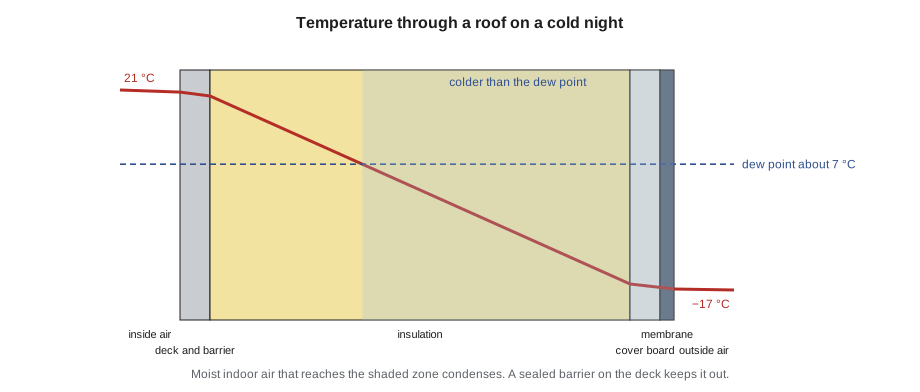
The method uses a design winter temperature for the outdoor side. The checks in this lesson use −17 °C, close to the design January temperature for Hamilton, and indoor air at 21 °C. A designer uses the values from the code's climate data and the building's real indoor conditions.
Check 1: the old Northgate roof
Worked problem
Where was the cold surface at Northgate?
The old Northgate roof had an inside air film of RSI 0.11, 90 mm of polyiso at RSI 1.0 per 25 mm (3.6) and an outside film of RSI 0.03, with no barrier. Find the temperature at the top of the deck and at the underside of the membrane on a −17 °C night with 21 °C inside.
Show solution
- R total = 0.11 + 3.6 + 0.03 = 3.74. Temperature difference = 21 − (−17) = 38 °C.
- Top of deck: 21 − 38 × 0.11 ÷ 3.74 = 21 − 1.1 = 19.9 °C.
- Underside of membrane: 21 − 38 × (0.11 + 3.6) ÷ 3.74 = 21 − 37.7 = −16.7 °C.
Answer: The underside of the membrane sat at about −17 °C, 24 degrees below the indoor dew point of about 7 °C. Every bit of indoor air that leaked through the deck laps and straight board joints froze there as frost, then melted into the insulation on mild days.
This is why condensation in roofs is almost never at the deck. The deck is warm. The cold plane is up under the membrane, and only a continuous air barrier below the insulation stops the warm, moist air from reaching it.
Check 2: is the new vapour retarder warm enough?
A vapour retarder works only if it stays warmer than the dew point of the air on its warm side; otherwise condensation forms on its underside, in the room-side layers. The check is to find the temperature at the barrier at the thinnest point of the insulation, where the barrier is coldest.
Worked problem
The barrier on the Northgate deck
In Martin's design, the barrier is on the deck. At the thinnest point, next to a drain, the insulation is 100 mm of flat polyiso plus 13 mm of tapered panel, which he rates at RSI 0.9 per 25 mm for cold weather, under a 13 mm gypsum cover board of RSI 0.08. Find the temperature at the barrier on a −17 °C night.
Show solution
- Insulation = 113 ÷ 25 × 0.9 = RSI 4.07.
- R total = 0.11 + 4.07 + 0.08 + 0.03 = 4.29.
- At the barrier, only the inside film is below it: 21 − 38 × 0.11 ÷ 4.29 = 21 − 0.97 = 20.0 °C.
Answer: About 20 °C, far above the 7 °C dew point. A barrier on the deck under all the insulation stays warm.
Worked problem
What if the barrier were higher up?
Suppose someone proposed putting the barrier on top of the first 50 mm layer, so the fasteners would not pierce it. At the thinnest point, what would its temperature be?
Show solution
- Below the barrier: 0.11 + 50 ÷ 25 × 0.9 = 0.11 + 1.80 = 1.91.
- Temperature = 21 − 38 × 1.91 ÷ 4.29 = 21 − 16.9 = 4.1 °C.
Answer: About 4 °C, below the 7 °C dew point. Indoor air that reached the underside of the barrier through the deck would condense in the bottom layer of insulation. The proposal fails; the barrier stays on the deck.
A rule of thumb that comes out of checks like these is that at least two thirds of the insulation's thermal resistance should be above the vapour retarder in a cold climate, and more for humid buildings. Designers check the actual numbers rather than relying on the rule.
Check 3: a humid building
Pools, laundries and some food plants run at high humidity all winter, and their roofs need the most care. The higher the dew point, the less insulation can sit below the barrier.
Worked problem
A pool roof
A community pool hall is kept at 28 °C and 60 in 100, a dew point of about 19.5 °C. Its roof has 150 mm of polyiso at RSI 0.9 per 25 mm, a 13 mm gypsum cover board (0.08) and films of 0.11 and 0.03. Find the barrier temperature on a −17 °C night if the barrier is on the deck, and if it is above the first 50 mm.
Show solution
- R total = 0.11 + 5.40 + 0.08 + 0.03 = 5.62. Temperature difference = 28 − (−17) = 45 °C.
- On the deck: 28 − 45 × 0.11 ÷ 5.62 = 28 − 0.9 = 27.1 °C.
- Above 50 mm: 28 − 45 × (0.11 + 1.80) ÷ 5.62 = 28 − 15.3 = 12.7 °C.
Answer: On the deck, the barrier is at about 27 °C, safely above 19.5 °C. One layer up, it would be at about 13 °C, far below the dew point. Pool roofs also need the most careful air sealing, because the air below is so wet.
Cold spots
The calculation assumes a uniform roof, but real roofs have places where the insulation is thin or interrupted. These cold spots collect condensation first:
- Roof drains and their leaders: the drain bowl and the pipe below it are cold metal carrying cold water, and they sweat or frost in the ceiling space unless the drain body and leader are insulated.
- Drain sumps, where the insulation is thinnest.
- Parapets and roof edges, where the roof insulation stops and the wall insulation may not meet it.
- Curbs, hatches and skylight frames that are not insulated.
- Fasteners and plates through a single insulation layer, which can frost from inside on very cold nights.
At Northgate, the late-winter ceiling stains in the dental suite that the previous contractor had blamed on pipe boots were directly under two drains and the sagging bay. Some of that water was frost melting from the underside of the membrane; some was condensation from the uninsulated drain bowls.
The limits of the simple method
The temperature-gradient method is a steady-state check of vapour diffusion at one design condition. It is good for deciding where a barrier goes and whether it is warm enough. It does not account for:
- Air leakage, which delivers far more moisture than diffusion. No calculation saves a roof whose air barrier has holes.
- Sun, which warms the membrane by day and drives moisture downward in summer.
- Night sky cooling, which can drop a membrane below the outdoor air temperature on clear nights.
- Moisture stored in materials, such as new concrete or wet insulation, which has to go somewhere as the seasons change.
For unusual buildings, consultants use hygrothermal computer models that follow heat and moisture hour by hour through a typical year. Martin ran one for the Northgate laboratory area, because of its humidity, and it agreed with the simple check: with the barrier on the deck, the assembly stayed dry.
Cold storage and reversed drive
In a freezer or cooler building, the vapour drive is reversed: the outside air is warmer and wetter than the inside for most of the year, so moisture tries to move inward and down through the roof. The vapour control layer must then be on the outside of the insulation, which is usually the membrane itself, and the insulation joints and air seals must be especially tight. Polyiso's cold-temperature behaviour matters here too (lesson 2). Cold storage roofs are a specialty, and their assemblies are designed with the insulation and membrane makers.
Signs of condensation on a real roof
- Ceiling stains or drips in late winter or early spring, under sound membrane, often on mild days after a cold spell.
- Stains near drains, skylights and edges, or in rooms with high humidity.
- Frost or wet patches on the underside of the deck seen from inside.
- Rusted fasteners and deck in test cuts, with beaded water on the underside of the membrane.
- Infrared scans showing wet insulation away from any membrane damage.
"If the drips come in March and the membrane's fine, think inside first," Glen said, and wrote it at the top of the chart.
Reading the psychrometric chart
Glen's big chart shows the properties of moist air on one sheet. Dry-bulb temperature runs along the bottom. The amount of water in the air, as grams per kilogram of dry air or as vapour pressure, runs up the right side. Curved lines rise from left to right for each relative humidity, and the top curve is saturation, 100 in 100. To find a dew point, start at the room's temperature and humidity, move straight left (the amount of water stays the same as the air cools) until you meet the saturation curve, and read the temperature there.
Rory found the Northgate room condition, 21 °C at 40 in 100, moved left, and met the saturation curve at about 7 °C, the same as the table. Then Glen had him start at the pool condition and do it again. "Twenty degrees warmer dew point means twenty degrees less room for error," Glen said. The chart also shows why heating cold outdoor air dries it: winter air brought in and warmed moves straight right on the chart, to a low relative humidity, which is why buildings that want comfortable humidity add moisture with humidifiers, as Northgate does.
Moisture built in during construction
Some condensation problems begin before the building is occupied. Concrete decks, masonry parapets, wet-cured fills and insulation that was rained on during construction all carry water into a roof. In the first winter, that moisture moves toward the cold underside of the membrane just as indoor moisture does, and it can show up as stains that look like leaks. Designers allow for it by requiring concrete moisture tests before the barrier goes on, by scheduling the roof after the building is closed in and dried, and by keeping temporary heaters that burn fuel indoors from pumping large amounts of water vapour into a new building that does not yet have its ventilation running.
Common mistakes
MistakeBlaming every winter drip on a membrane leak.
InsteadCheck for condensation: timing, location, humidity and an air barrier.
MistakePlacing the vapour retarder part way up the insulation without checking its temperature.
InsteadCalculate the barrier temperature at the thinnest point.
MistakeLeaving drain bowls and leaders uninsulated.
InsteadInsulate drain bodies and leaders so they do not sweat in the ceiling space.
MistakeTrusting the calculation while the air barrier has holes.
InsteadSeal the air barrier; air leakage overwhelms diffusion.
MistakeUsing summer or room-temperature conditions for a winter check.
InsteadUse the design winter temperature and real indoor humidity.
Summary and key terms
- Condensation forms on any surface colder than the dew point of the air touching it.
- Temperature drops through each layer in proportion to its share of the total thermal resistance.
- In winter, the cold plane is under the membrane; the deck stays warm.
- A vapour retarder must stay above the indoor dew point; check it at the thinnest insulation.
- Humid buildings allow little or no insulation below the barrier.
- The simple method ignores air leakage, sun and stored moisture; models are used for unusual cases.
- Relative humidity
- The amount of water vapour in the air as a part of the most it can hold at that temperature.
- Dew point
- The temperature at which air becomes saturated and condensation begins.
- Saturation
- The state of air holding all the water vapour it can at its temperature.
- Temperature gradient
- The change in temperature through the layers of an assembly.
- Design winter temperature
- The outdoor temperature used for winter design checks, from the code's climate data.
- Cold spot
- A place where insulation is thin or interrupted and surfaces are colder.
- Hygrothermal model
- A computer model that follows heat and moisture through an assembly over time.
- Psychrometric chart
- A chart showing the properties of moist air, including dew point and relative humidity.
Practice problems
Work each problem on paper first, then reveal the answer to check.
Air at 21 °C and 50 in 100 has a dew point of about 10 °C. Will a surface at 8 °C collect condensation?
Show answer
Yes, because 8 °C is below the dew point.
A layer has a quarter of a roof's total resistance and the total drop is 40 °C. How much does the temperature fall across it?
Show answer
40 × 1/4 = 10 °C.
Why is the deck usually warm in winter?
Show answer
Almost all the resistance, and so almost all the temperature drop, is in the insulation above it.
Where in the roof did condensation form at Northgate?
Show answer
Under the membrane, at the cold top of the insulation.
Name two cold spots in a roof.
Show answer
Drain bowls and leaders, and parapet edges; also curbs and sumps.
Lesson quiz · 5 questions
Score 60% or more to complete this lesson.
Create a free account to save your progress, take quizzes and earn a certificate.