
ROOF-310 · Lesson 10 of 12 · 23 min
Ponding water and its effects
▶ Video coming soon A video version of this lesson is on the way.
Two days after a hard rain in early May, Dana had taken Rory up onto the Northgate roof during the storm repair to look at the sagging bay. A dark, shallow pond still sat in the middle of it, rimmed with a ring of grey silt where the water had stood a little higher the day before. A few tufts of grass had rooted in the silt along the edge. Dana handed Rory a can of marking paint and a folding rule. "Paint the outline, measure the depth in the middle, and photograph it with the rule in the picture," she said. "Then tell me how much it weighs." The pond was about 30 mm deep at the middle and covered about 25 m². Rory worked it out on the back of his notebook: about three quarters of a tonne of water, sitting on a roof that was never designed to hold a pond.
This lesson explains what ponding is, how it damages roofs, how it loads the structure and can grow by itself, what causes it, how it is measured and recorded, and how it is fixed. It draws on the lessons on slope (3), drains (8) and gutters (9), and leads into the Northgate design in lesson 12.
What counts as ponding
Every low-slope roof holds a little water for a short time after rain: in the slight dips at board joints, along cricket valleys (lesson 3) and around drains. That is normal. The industry's common definition of ponding is water that remains on the roof 48 hours after the rain stops, in weather that allows drying. A pond that is still there after two dry days is a defect to be recorded and, usually, corrected. Many membrane warranties exclude damage caused by ponding, and some makers require the roof to drain within 48 hours for the warranty to apply at all.
How ponding damages a roof
- Faster aging: water that sits on a membrane, together with sun and heat, speeds up the breakdown of many membranes and coatings. Bitumen surfaces can lose granules and blister; some single-ply membranes and coatings have reduced life under permanent water.
- Dirt, algae and plants: each pond leaves a ring of silt; algae and moss grow in it, and seeds root, sending roots into seams and laps.
- Leaks: a pinhole or a weak lap that would shed running water lets standing water through, under pressure, day after day.
- Ice: in winter, ponds freeze, and freeze-thaw cycles stress laps and flashings. A frozen pond also blocks the next melt from reaching the drains.
- Hazards: ponds hide damage, and ice on a pond is a slip and fall hazard for anyone on the roof.
- Load: water is heavy, and the structure may not have been designed for it.
At Northgate, the area of wet insulation found in the spring included the part of the roof beside the sagging bay, and the old membrane there had more patches than anywhere else on the roof.
Water is heavy
A layer of water 1 mm deep over 1 m² weighs 1 kg, so each millimetre of water adds about 0.0098 kPa (about 9.8 N/m²) of load. A few centimetres of water across a large roof is many tonnes.
Worked problem
The weight of the Northgate pond
The Northgate pond averaged about 30 mm deep over 25 m² (taking the middle depth as the average, which overstates it a little for a dish-shaped pond). How much did it weigh, and what load is 30 mm of water per square metre?
Show solution
- Volume = 0.030 × 25 = 0.75 m³ = 750 L, which weighs 750 kg.
- Force = 750 × 9.81 = 7,360 N, about 7.4 kN.
- Load = 30 × 0.0098 = 0.29 kPa.
Answer: About three quarters of a tonne, and about 0.29 kPa where the water was deepest. That is a large part of the extra load a light steel deck roof is designed to carry beyond its own weight.
Snow and rain loads in Ontario come from Part 4 of the Building Code and its climate data, and the structural engineer designs for them, including the rain that can collect up to the overflow level (lesson 8). Roofers do not design for these loads, but they create or remove them: a re-roof that adds height at the perimeter, raises an overflow scupper or blocks a drain changes how much water the roof can hold.
Ponding instability
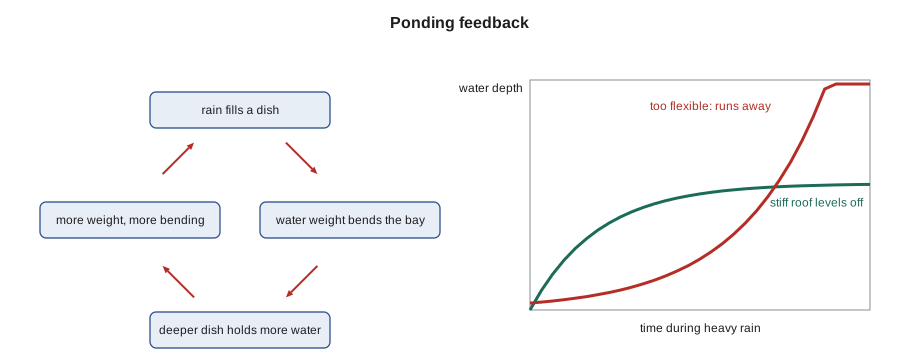
Water on a flexible roof makes the roof bend. The bend makes a deeper dish, which holds more water, which makes it bend more. On a stiff roof, this settles at a slightly deeper pond and stops. On a roof that is too flexible for the water it can hold, it never stops: the pond deepens and the deflection grows until something gives. That is ponding instability, and it has caused roof collapses, usually on light steel joist and deck roofs during heavy rain with blocked drains.
Worked problem
How much deeper does the pond get?
A simplified example: suppose a roof bay bends 0.4 mm for every 1 mm of water on it. Rain fills it with 25 mm of water. The extra bend lets in more water, which bends it more, and so on. The final depth is 25 ÷ (1 − 0.4). How deep does the water end up, and what happens if the bay bends 1 mm or more for every millimetre of water?
Show solution
- Final depth = 25 ÷ (1 − 0.4) = 25 ÷ 0.6 = 41.7 mm.
- If the bay bends 1 mm or more per millimetre of water, 1 − 1 = 0 and the depth never settles: each new millimetre of bend lets in at least another millimetre of water.
Answer: About 42 mm, two thirds more than the rain alone. Real structural checks are more involved, but the idea is the same: a stiff roof settles, a flexible one runs away.
Causes of ponding
- Deck deflection: long, light spans sag under their own weight, rooftop units, snow and water. Mid-bay sags like Northgate's are the classic pattern.
- Settlement and creep: structures move over decades.
- Drains in the wrong place: drains at columns, where the deck is highest, instead of mid-bay, where it is lowest.
- Drains set too high: a drain body or clamping ring above the surrounding surface, often after re-roofs added layers without sumps.
- Blocked or slow drains, strainers and scuppers.
- Crushed or wet insulation, which compresses and leaves a dip, often along walkways and around rooftop units.
- Poor tapered design or installation: missing crickets, panels laid backwards, flat valleys.
- Additions: new rooftop units, solar arrays and their ballast, or raised perimeters from a re-roof, changing how water moves.
Measuring and recording ponding
Ponding is recorded the way Rory did at Northgate, so that someone who was not there can understand it:
- Wait at least 48 hours after rain, in drying weather.
- Outline each pond with marking paint or chalk at its edge.
- Measure the depth at the deepest point and at a few other points with a rule, and the length and width of the outline.
- Photograph each pond with the rule in the picture, and from a distance to show its location.
- Mark the ponds on a roof plan with their depths and areas, and note the nearest drains and their condition.
- Where the cause is not obvious, survey elevations with a level (lesson 3).
On the Cedarbrook school roof, Dana went back up two days after the storm of July 22 to check the newly finished wing. There were no ponds anywhere. She photographed the dry drains anyway and added the photos to the closeout file. "Evidence that it drains is worth as much as evidence that it doesn't," she said.
Fixing ponding
The fix depends on the cause, and the cause must be found first. The usual remedies are:
- Clear and repair drains, strainers and scuppers, and reset drains that sit high, with proper sumps.
- Add drains at the low points, usually mid-bay, with new leaders, as at Northgate.
- Add slope with tapered insulation or crickets on a re-roof, or with tapered fill over a small area on a repair, using the membrane maker's approved materials.
- Replace crushed or wet insulation and protect traffic routes with walkway pads.
- Have the structure reviewed by an engineer where the deck has sagged, before adding the weight of new layers, and reinforce it if needed.
What does not work is filling a pond with extra plies, roofing cement or loose granules. Patches like that add weight, crack, and hold water under their edges. Neither does cutting a channel through the roof surface to let a pond drain toward a drain; it damages the membrane and the insulation below.
A repair that adds slope on part of an existing roof has to tie into the existing surface without creating a new dam. On small areas, Ridgecap uses tapered insulation set in adhesive over the existing membrane after it is cleaned and primed, with a new membrane layer over the whole repair, as the maker allows; the edges of the repair are feathered so water flows off them, not along them.
Ponding and rooftop equipment
Rooftop equipment causes ponding in two ways: its weight deflects the deck around it, and its curb blocks water flowing down the slope. Crickets on the uphill side of curbs (lesson 3) solve the second problem. The first is solved in design by supporting equipment on the structure, not just the deck. When a new unit is added to an old roof, as the third rooftop unit was added at Northgate in 2019, the structure and the drainage should both be checked. No one checked them in 2019, and the sagging bay at Northgate is next to that unit.
Snow, drifts and rain on snow
In a Hamilton winter, water on a roof is often frozen or held in snow. Snow drifts pile up against parapets, at steps between roof levels and behind rooftop units, and the snow load there can be several times the load on open areas of the roof. When rain falls on snow, the snow soaks it up like a sponge and gets heavier without any water reaching the drains. A thaw then releases it all at once, often while drains and scuppers are still choked with ice. The structural design allows for drifts and rain on snow; roofers make sure the roof can still drain when the thaw comes by keeping drains and scuppers clear going into winter, and by not stacking materials, snow cleared from walkways or equipment in the drift areas where the load is already highest.
Clearing snow from a roof is sometimes needed after a very heavy storm, and it is dangerous work. It is done to a written plan with fall protection, by crews who know where the edges, skylights and drains are under the snow, using plastic shovels that do not cut the membrane, and never down to bare membrane. Snow is spread evenly or removed from the roof rather than piled in one place, which would create the very load it was meant to relieve.
Ponding and the warranty
Membrane warranties are written by the maker, and each one says what it covers. Many exclude damage caused by ponding water; some exclude any area where water stands beyond a set time; and some require the roof to drain completely within 48 hours as a condition of the whole warranty. Before Ridgecap accepts a warranty job on a roof with known ponding, Glen asks the maker's technical representative in writing whether the design is acceptable, and records the answer in the job file. On a re-roof, that question often decides whether the owner pays for tapered insulation and new drains. At Northgate, the owner's decision to add drains and slope was made easier by the maker's answer that ponding over the sagging bay would not be covered.
Working safely around ponds
- Water hides holes, broken boards and loose plates; probe or avoid it rather than walking through it.
- Wet membrane is slippery, and ice on a pond is worse; keep fall protection and edge rules in mind when a pond is near the edge.
- Do not use electric tools while standing in water, and keep cords out of ponds.
- Mark and report any area where the deck feels soft under a pond; it may be corroded or overloaded.
Common mistakes
MistakeAccepting water that stands for days as normal.
InsteadRecord any water still there 48 hours after rain in drying weather.
MistakeFilling ponds with extra plies, cement or granules.
InsteadFind the cause and correct the slope or drainage.
MistakeRe-roofing over a sagging deck without a structural review.
InsteadHave an engineer review deflection before adding weight.
MistakeAdding rooftop equipment without checking structure and drainage.
InsteadSupport equipment on the structure and add crickets.
MistakeLeaving drains plugged or strainers off after work.
InsteadClear and test drains at the end of every job.
Summary and key terms
- Ponding is water that remains 48 hours after rain in drying weather.
- Ponds speed aging, grow algae and plants, cause leaks and ice, and add load.
- Each millimetre of water adds a measurable load; large ponds weigh tonnes.
- Water bends a flexible roof, which holds more water; on a roof that is too flexible, the pond grows without limit.
- Common causes are deck sag, drains in the wrong place or too high, blocked drains, crushed insulation and poor tapered work.
- Ponds are measured, photographed and mapped; fixes address the cause, never just fill the pond.
- Ponding
- Water that remains on a roof 48 hours after rain, in weather that allows drying.
- Deflection
- The bending of a deck or structural member under load.
- Ponding instability
- Runaway deflection in which water deepens a sag, and the sag holds more water.
- Rain load
- The load from water that can collect on a roof, used in structural design.
- Silt line
- The ring of dirt left at the edge of a pond, showing its highest level.
- Mid-bay
- The middle of a structural bay between supports, where a deck sags most.
- Walkway pad
- A protective pad on a membrane along traffic routes.
- Feathered edge
- The thin, tapered edge of a repair or fill that lets water flow off it.
Practice problems
Work each problem on paper first, then reveal the answer to check.
How much does water 20 mm deep over 40 m² weigh?
Show answer
0.020 × 40 = 0.8 m³, about 800 kg.
What is the usual definition of ponding?
Show answer
Water remaining 48 hours after rain in drying weather.
Why are drains best placed mid-bay rather than at columns?
Show answer
The deck sags most mid-bay, so that is the low point.
A bay bends 0.5 mm per mm of water and rain puts 20 mm on it. What is the final depth in the simple model?
Show answer
20 ÷ (1 − 0.5) = 40 mm.
Why not fill a pond with roofing cement?
Show answer
It adds weight, cracks and holds water under its edges; the cause is not fixed.
Lesson quiz · 5 questions
Score 60% or more to complete this lesson.
Create a free account to save your progress, take quizzes and earn a certificate.