
RCDD-116 · Lesson 4 of 12 · 23 min
Administration standards and labelling
▶ Video coming soon A video version of this lesson is on the way.
Ines Kowalczyk has run the network at the owner's old clinic for nine years, and she has one request for Harbourview that matters more to her than any other. In the old building, she says, nobody knows where anything goes. Patch panels were labelled 1 to 48 on every floor, half the faceplates have no labels, and finding which switch port feeds an exam room takes a technician with a toner most of an afternoon. She wants a building where any technician can read a label and know exactly what it is and where its other end is. That is what administration standards are for.
What administration covers
Administration is the discipline of identifying, labelling and recording every part of the telecommunications infrastructure so that it can be managed for its whole life. It covers far more than the labels themselves. It includes the identifier scheme that gives every element a unique name, the records that describe each element and its connections, the drawings that show where things are, and the processes for keeping all of these current when the system changes. A well-administered system lets the owner trace any circuit in minutes, plan changes without surprises and prove what is installed.
In North America, the governing standard is ANSI/TIA-606, the Administration Standard for Telecommunications Infrastructure, now in its D revision. In Canada, CSA has historically adopted TIA administration requirements for Canadian use, and ISO/IEC 14763-2 is the international equivalent. The standard does not tell owners exactly what their labels must say. It defines classes of administration, required identifiers and formats, label performance and records, and leaves room for owners to adapt the scheme to their own needs.
Classes of administration
ANSI/TIA-606 scales its requirements to the size and complexity of the infrastructure through four classes. The designer chooses a class based on the project, and the specification should name it.
| Class | Typical scope | What it adds |
|---|---|---|
| Class 1 | A single building served by one telecommunications space. | Identifiers for the space, horizontal links and the bonding busbar. |
| Class 2 | A single building with several telecommunications spaces. | Adds backbone cables, building bonding elements and firestop locations. |
| Class 3 | A campus with several buildings and outside plant. | Adds building and campus identifiers and outside plant elements. |
| Class 4 | Several sites or campuses managed together. | Adds site identifiers so that names stay unique across the enterprise. |
Harbourview is a single building with several telecommunications rooms, an equipment room and a campus link to an existing building on the same property. Daniel recommends Class 3, because the campus link and the existing building need identifiers that stay unique across both buildings. Ines points out that the owner runs two other clinics across the city, and Roz suggests writing the scheme so that site identifiers can be added later, which would bring it to Class 4 without relabelling anything.
Building identifiers
The heart of administration is the identifier: a short, unique, structured name for each element. ANSI/TIA-606 builds identifiers from parts that narrow the location step by step, from the building to the space, the rack or cabinet, the panel and the port. The standard recommends a particular format and character set, but owners may use their own as long as every identifier is unique and the format is applied consistently. What matters most is that an identifier is meaningful to a technician standing in front of it.
A common approach identifies a telecommunications space by its floor and a letter, such as 3A for the core room on the third floor. Racks and cabinets are then identified by their position on a floor grid in the room, so a rack in grid row A, column 02 might be AB02 in some schemes or A02 in simpler ones. Patch panels are identified by their position in the rack, often a letter counted from the top, and ports by number. A horizontal link is identified by the panel port where it terminates, and the faceplate at the outlet carries the same identifier so that both ends match.
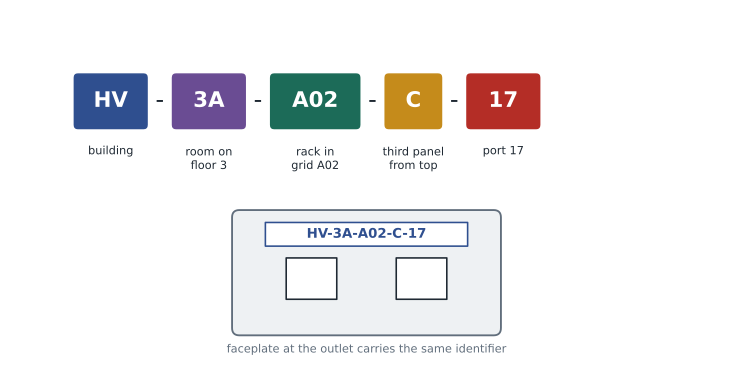
Daniel's scheme for Harbourview follows this pattern, with a building prefix for Class 3. A horizontal link in the core room on the third floor might be HV-3A-A02-C-17: building HV, room 3A, rack A02, panel C, port 17. The outlet in the classroom where that link ends carries the same text. A backbone cable between the equipment room and room 3A is identified by both ends, such as HV-1E/HV-3A-01 for the first backbone cable between those spaces, and each strand or pair within it by number.
What must be identified
Administration covers every element that someone may need to find, trace or maintain. The list grows with the class, but a complete design identifies at least the following.
- Telecommunications spaces: entrance facilities, equipment rooms, telecommunications rooms and enclosures.
- Racks, cabinets and frames, by grid position in each space.
- Patch panels, connecting blocks and fibre enclosures, by position in each rack.
- Ports and positions on every panel, and outlets at every work area.
- Horizontal links, backbone cables and campus cables, by their end points.
- Pathways such as sleeves, conduits and cable trays, at each end and at intervals.
- Firestop locations, so that each penetration and its listed system can be found and inspected.
- Bonding busbars and bonding conductors, so that the bonding infrastructure can be traced and tested.
Pathways and firestops are often forgotten, but they matter for the life of the building. A future installer needs to know which sleeve has room, and a fire inspector needs to see which listed system was used at each wall. Labelling them during construction costs little; finding them later after ceilings are closed costs a great deal.
Label requirements
A label must stay legible and attached for the life of the element it identifies. ANSI/TIA-606 refers to UL 969 for label durability and requires labels that are printed by machine rather than handwritten, sized and placed so that they can be read without disturbing the cable, and resistant to the environment where they are used. Cable labels are usually self-laminating wrap-around labels placed within a short distance of each termination, so that the label stays visible after the cable is dressed. Panel and faceplate labels are usually printed inserts or labels designed for the product.
Placement rules matter as much as materials. A label on a cable must be visible from the front of the panel or close behind it. A label on a faceplate must not be covered when cords are plugged in. Pathway labels should be visible from the floor or from an access point. And every label should face the same way in a given space, so that technicians can read a panel quickly without twisting their heads.
Colour coding of termination fields
ANSI/TIA-606 also defines colours that identify the function of each termination field, so that a technician can see at a glance which panels in a room serve which purpose. The colours appear on panel labels, panel inserts or background panels. The common examples are orange for the demarcation point with the service provider, green for network connections on the customer side of the demarcation, purple for connections to common equipment such as switches and servers, white for first-level backbone, grey for second-level backbone, blue for horizontal cabling and brown for interbuilding backbone. Owners may add their own colours for special systems, as long as they do not conflict with the standard's meanings.
Colour coding is a supplement to identifiers, never a replacement. Colours fade, lighting changes, and some technicians cannot tell certain colours apart. The identifier on the label is what makes an element unique; the colour helps a technician find the right field quickly.
Records and the cable database
Labels tell a technician what an element is. Records tell the technician everything else: what it connects to, what type it is, when it was installed and tested, and what pathway it uses. ANSI/TIA-606 requires records for each identified element and for the links between elements. On anything but the smallest project, those records live in a database rather than on paper, either in a spreadsheet maintained to a defined format or in dedicated infrastructure management software.
Designing the identifier scheme with the owner
An identifier scheme is easiest to get right at the start of design, before drawings carry hundreds of tags. Daniel holds a short workshop with Ines and her staff to agree the parts of each identifier, the separators between them, how rooms and racks are numbered, and how the scheme will grow if the owner adds buildings or sites. They test the draft by labelling a dozen real elements on paper: a classroom outlet, a backbone strand, a sleeve in a fire wall, a busbar. Two problems appear right away. Room numbers in the architect's plans change during design, so the scheme uses telecommunications room identifiers that do not depend on room numbers. And the owner's existing clinics use a different separator, so the scheme adopts theirs to keep the whole organization consistent.
Length matters too. An identifier that is clear on a drawing may not fit on a faceplate label or a cable wrap at a readable size. The workshop checks the longest identifier against the label sizes the manufacturer offers, and shortens the building prefix to two letters so that every identifier fits on one line. The agreed scheme is written into the specification in section 27 05 53 and into the legend on the first drawing sheet, so the designer and the contractor work from the same rules.
Labels for special systems
Cabling for security, building automation, audiovisual and clinical systems follows the same identifier rules as general cabling, but the owner may want those links easy to pick out. Common methods include a distinct letter in the outlet identifier, a distinct label colour on the faceplate, or separate patch panels in the telecommunications room. For security cabling, some owners prefer not to advertise the function of a link on a visible label at all, and use only the identifier, with the function recorded in the database where access can be controlled. The designer should ask about these preferences during the needs analysis.
Worked problem
Sizing a label order
The third floor of Harbourview has 570 horizontal links. Each link needs a label at both cable ends, a panel port label and a faceplate label. The contractor orders a tenth more than needed for spoilage. How many labels of each type are ordered?
Show solution
- Cable labels: 570 × 2 = 1,140; with spoilage 1,140 × 1.1 = 1,254.
- Panel port labels: 570; with spoilage 570 × 1.1 = 627.
- Faceplate labels: 570; with spoilage 627.
Answer: 1,254 cable labels, 627 panel port labels and 627 faceplate labels.
Worked problem
Counting identifiers in a backbone
Room 3A is fed from the equipment room by one 24-strand OS2 cable and one 24-strand OM4 cable. Each cable needs one cable identifier and each strand needs a position identifier at both ends. How many identifiers does the backbone to room 3A need?
Show solution
- Cable identifiers: 2.
- Strand positions: (24 + 24) × 2 ends = 96.
- Total: 2 + 96 = 98 identifiers.
Answer: 98 identifiers, each with a record in the database showing what it connects to.
Keeping administration current
The best labelling scheme decays quickly if nobody maintains it. Every move, addition and change must update labels and records at the same time as the physical work. The designer can help by specifying that the owner receives the identifier scheme as a written document, the database in an editable format, and spare labels and printer templates. Ines plans to require that every work order on the new network closes only when the database has been updated, and she asks Daniel to include the database format in the closeout documents so that her staff and future contractors use the same one.
Common mistakes
MistakeNumbering every panel 1 to 48 on every floor.
InsteadBuild identifiers that are unique across the whole building or campus.
MistakeHandwriting labels.
InsteadUse machine-printed labels that meet durability requirements.
MistakeLabelling cables only at one end.
InsteadLabel both ends of every cable, and match faceplate and panel identifiers.
MistakeRelying on colours alone.
InsteadUse colour to find fields quickly, but rely on the identifier for uniqueness.
MistakeLeaving pathways and firestops unlabelled.
InsteadIdentify pathways and firestop locations so they can be found and inspected.
Summary and key terms
- Administration identifies, labels and records every element so the infrastructure can be managed for life.
- ANSI/TIA-606 defines four classes scaled from a single space to several sites.
- Identifiers narrow the location from building to space, rack, panel and port, and must be unique.
- Spaces, racks, panels, ports, links, cables, pathways, firestops and bonding elements all need identifiers.
- Labels must be machine printed, durable, legible and placed where they stay visible.
- Colours identify the function of termination fields, and records describe every element and its connections.
- Administration
- Identifying, labelling and recording the infrastructure for its whole life.
- Identifier
- A unique, structured name for an infrastructure element.
- Class of administration
- A level of administration requirements scaled to the size of the infrastructure.
- Termination field
- A group of terminations with the same function, identified by colour.
- Record
- The information stored about an element and its connections.
- Infrastructure management software
- A database application that stores and maintains administration records.
Practice problems
Work each problem on paper first, then reveal the answer to check.
Which class suits a single building with several telecommunications rooms and no campus?
Show answer
Class 2.
What does a purple termination field identify?
Show answer
Connections to common equipment such as switches.
How many cable labels are needed for 300 links labelled at both ends?
Show answer
600.
Why should faceplate and panel identifiers match?
Show answer
So a technician can trace a link from either end.
Which elements are often forgotten in labelling?
Show answer
Pathways, firestop locations and bonding elements.
What should close a work order on a well-administered system?
Show answer
Updating the labels and the records along with the physical change.
Lesson quiz · 5 questions
Score 60% or more to complete this lesson.
Create a free account to save your progress, take quizzes and earn a certificate.