
RCDD-116 · Lesson 11 of 12 · 25 min
Construction administration and change control
▶ Video coming soon A video version of this lesson is on the way.
On the Monday that construction starts at Harbourview, Daniel's inbox holds forty-two submittals from the cabling contractor, three requests for information about the second-floor ceilings, and an email from Ines asking whether a new imaging room can be added on the clinic floor. Roz tells him that this is what construction administration looks like: a steady stream of questions, documents and changes, each of which must be answered correctly, on time and in writing. The design is finished, but the designer's work is far from over.
The designer's role during construction
Construction administration is the work the design team does from the award of the construction contract to final completion. The designer usually acts on the owner's behalf, within limits set by the design services agreement and the construction contract. Typical duties include reviewing submittals, answering requests for information, visiting the site to observe progress and quality, preparing changes to the documents, reviewing the contractor's payment applications for the designer's portion of the work, reviewing test results and documentation, and recommending acceptance.
The limits matter as much as the duties. The designer observes the work but does not direct the contractor's means and methods, which remain the contractor's responsibility. The designer interprets the documents but does not change the contract without the owner's authority. And the designer communicates through the channels the contract sets, which usually means through the architect or contract administrator, not directly to subcontractors. Daniel learns quickly that answering Tomasz's question in a hallway is helpful, but the answer only counts once it is written and sent through the proper channel.
Submittal review
Submittals were introduced in lesson 9. During construction, the designer reviews each one against the specification and returns it with an action. Common actions include reviewed with no exceptions, reviewed with comments noted, revise and resubmit, and rejected. Most contracts set a time limit for review, often ten working days, and late reviews can delay the work and expose the owner to claims. The designer should log every submittal, its dates and its action.
Review is a check of compliance with the design intent, not a guarantee. The contractor remains responsible for meeting the contract documents even if a submittal is reviewed, and a reviewed submittal does not authorize a change unless the change is clearly identified and separately approved. Daniel's reviews always state that clearly in the review stamp, and he flags any deviation from the specification in writing so that nobody can later claim it was accepted by silence.
Construction meetings
Regular construction meetings, usually weekly or every two weeks, bring the contractor, the main subcontractors, the design team and the owner together to review progress, schedule, open RFIs and submittals, changes and safety. The general contractor or contract administrator usually chairs them and issues minutes. The ICT designer may not attend every meeting, but should attend when cabling issues are on the agenda and should read every set of minutes for decisions that affect the work. A decision recorded in minutes, such as a change in the ceiling schedule, can affect when cable can be installed and tested.
The schedule matters for cabling more than many trades realize. Cable cannot be pulled until pathways are in place and ceilings are open, and it should not be installed until the building is closed in against weather. Terminations and testing need clean, secure rooms. Network equipment needs the rooms finished, powered and cooled. Daniel reviews the contractor's schedule at the start of construction and flags any sequence that would force cabling work into a dusty, unfinished room or delay testing until after ceilings close.
Disputes and claims
Not every disagreement is resolved by an RFI answer. When the contractor believes it is entitled to more money or time and the owner disagrees, the contract sets a process for claims and disputes, usually starting with written notice within a set time, followed by negotiation, and then mediation, arbitration or court if needed. The designer's role is to provide clear, factual records and to give impartial interpretations of the documents where the contract asks for them. Good records of RFIs, field reports and changes are the best protection, because disputes are usually decided on what was written at the time.
Most disputes on cabling projects arise from unclear scope between trades, late design changes, or access problems caused by other trades. Many can be prevented by the responsibility matrix described in lesson 7, by clear specifications, and by prompt written answers during construction. Daniel's habit of answering every RFI within the contract time, with references to the documents, means that the Harbourview cabling subcontract closes without a single claim.
Worked problem
Tracking submittal review time
A submittal is received on a Tuesday. The contract allows 10 working days for review, not counting weekends. If there are no holidays, on what day is the review due?
Show solution
- Working days after Tuesday: Wednesday 1, Thursday 2, Friday 3.
- Next week: Monday 4, Tuesday 5, Wednesday 6, Thursday 7, Friday 8.
- Following week: Monday 9, Tuesday 10.
Answer: The review is due on the Tuesday two weeks later.
Requests for information
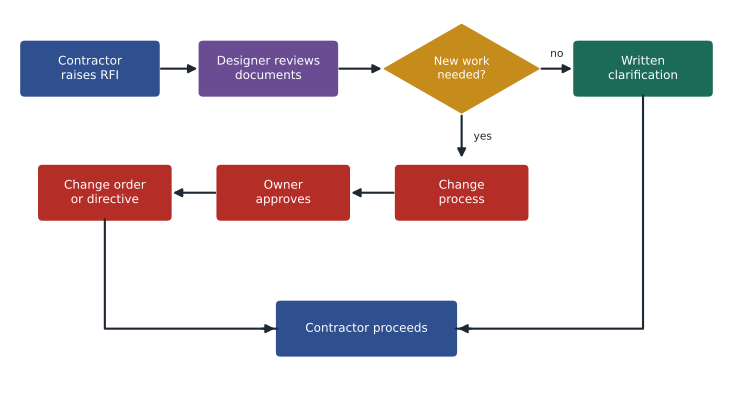
A request for information, or RFI, is the contractor's formal question about the documents. RFIs arise when the drawings and specifications conflict, when they are unclear, when site conditions differ from what the documents show, or when the contractor proposes an alternative. Each RFI should state the question clearly, refer to the drawings and specification sections involved, and, ideally, suggest a solution. The designer answers in writing within the time the contract allows.
An RFI answer must be careful about cost and time. If the answer simply clarifies what the documents already require, it costs the owner nothing. If the answer requires something not in the documents, it is a change, and it must go through the change process. Answers that slip new work into a clarification invite later claims. On Harbourview, Tomasz asks whether the cable tray on the second floor can run above the ducts rather than below them, because a duct is lower than the drawings show. Daniel confirms with the mechanical engineer that the duct is where the mechanical drawings put it, and that the tray can run above with the clearances in the specification. The answer is a clarification, with no cost and no change in scope.
Site visits and field reports
The designer visits the site at the intervals set in the services agreement, observes the work and writes a field report after each visit. A field report records the date, weather where it matters, people present, the areas observed, the progress seen, any work that does not appear to meet the documents, and actions required. Photos with locations add a great deal. Field reports go to the owner and the contractor, usually through the architect or contract administrator, and they become part of the project record.
Observing work early prevents expensive problems. Daniel's first visit to the second floor finds cables lying on ceiling grid instead of in their supports. The fix at that point takes a day. Had it been found at final inspection, after the ceiling tiles were in, it would have taken two weeks and disrupted the other trades. He also checks the firestopping at the first few penetrations against the approved listed systems, because getting the method right early avoids repeating the same mistake across the building.
Changes to the work
Changes are a normal part of construction. They arise from owner requests, design errors or omissions, unexpected site conditions and changes in codes or requirements. Every construction contract sets a process for changes, and following it protects everyone. The usual steps are: the need for a change is identified; the designer prepares a description, sometimes called a proposed change or change notice, with any revised drawings and specifications; the contractor prices it in money and time; the owner approves it; and a change order is issued to amend the contract. When work must proceed before the price is agreed, the contract usually allows a change directive that instructs the contractor to proceed, with the price settled later.
Each change should be described completely, so that the contractor can price it without guessing, and the price should be checked against the estimate and the contract's rules for markups. The designer reviews the contractor's price and recommends acceptance or negotiation to the owner. All changes go in a change log that records the number, description, cause, price, time effect and status.
Worked problem
Pricing a change
Ines's new imaging room needs 18 new horizontal links in Category 6A F/UTP, a screened system, at an agreed unit price of 310 dollars per link for material and labour, plus a new rack-mounted 24-port screened panel at 1,450 dollars. The contract allows a markup of 0.10 on the subcontractor's cost for the general contractor. What is the price of the change?
Show solution
- Links: 18 × 310 = 5,580.
- Panel: 1,450.
- Subcontractor cost: 5,580 + 1,450 = 7,030.
- Markup: 7,030 × 0.10 = 703.
- Total: 7,030 + 703 = 7,733.
Answer: 7,733 dollars. Daniel checks the unit price against the bid breakdown and recommends the change for approval.
Change control and the documents
A change is not complete when it is approved. The designer must also update every affected document: the drawings, the outlet schedule, the bill of materials, the test plan and the labelling scheme. Lesson 6 described what happened at Harbourview when a change order added a room but nobody added its links to the test plan: nine links went untested until acceptance. After that, Lakehead Signal's change checklist requires every approved change to update the outlet schedule and test plan on the same day, and to be shown in the next revision of the drawings with a revision cloud.
Worked problem
Effect of changes on the budget
The cabling subcontract at award was 1.42 million dollars. By the end of construction, approved changes add 61,800 dollars and credits remove 12,300 dollars. What is the final subcontract value, and what share of the award value did net changes represent?
Show solution
- Net change: 61,800 − 12,300 = 49,500.
- Final value: 1,420,000 + 49,500 = 1,469,500.
- Share: 49,500 / 1,420,000 = 0.035.
Answer: 1,469,500 dollars, with net changes of about 0.035 of the award value, a modest figure for a building of this kind.
Payment applications
Contractors are usually paid monthly for work completed. The contractor submits a payment application showing the value of work done against a schedule of values, which breaks the contract into parts. The architect or contract administrator certifies the payment, often relying on each designer to confirm the progress of their own discipline. Daniel compares the cabling contractor's claimed progress with what he saw on site and in the test results. If the application claims that the third floor is complete but no test results have been submitted, he recommends paying only for the work he can confirm.
Keeping the record
Construction administration generates a large record: submittal logs, RFI logs, field reports, change logs, meeting minutes, test reviews and correspondence. This record is the evidence of what was asked, answered, approved and observed. It supports the record drawings, it protects the owner and designer if disputes arise, and it is the basis for the lessons-learned review. Lakehead Signal keeps every project record in a shared folder with a fixed structure, and Daniel's habit of logging everything the day it happens saves him hours at closeout.
Common mistakes
MistakeAnswering questions verbally on site.
InsteadConfirm every answer in writing through the contract's channels.
MistakeTreating a reviewed submittal as approval of a deviation.
InsteadIdentify deviations separately and approve them through the change process.
MistakeAdding new work in an RFI answer.
InsteadSend new work through the change process with a price.
MistakeApproving a change without updating the documents.
InsteadUpdate drawings, schedules, test plans and labels for every change.
MistakeCertifying payment for work not seen.
InsteadRecommend payment only for work confirmed on site or by test results.
Summary and key terms
- Construction administration includes submittal review, RFIs, site visits, changes, payment review and acceptance.
- The designer observes and interprets but does not direct means and methods or change the contract without authority.
- Submittals are reviewed for compliance within contract time limits and logged.
- RFIs are answered in writing; answers that add work become changes.
- Changes follow a defined process from description to pricing, approval and change order.
- Every change updates every affected document, and the full construction record is kept.
- Construction administration
- The design team's work from contract award to final completion.
- RFI
- A request for information, the contractor's formal question about the documents.
- Field report
- A written record of a site visit and its observations.
- Change order
- A document that amends the contract for a change in work, price or time.
- Change directive
- An instruction to proceed with a change before its price is agreed.
- Schedule of values
- A breakdown of the contract value used to measure progress for payment.
Practice problems
Work each problem on paper first, then reveal the answer to check.
Who is responsible for construction means and methods?
Show answer
The contractor.
What should an RFI include?
Show answer
A clear question, references to the documents and ideally a suggested solution.
A change adds 10 links at 300 dollars each with a 0.10 markup. What is the price?
Show answer
3,300 dollars.
Why visit the site early in construction?
Show answer
To find problems while they are cheap to fix.
What must happen after a change is approved?
Show answer
Every affected document is updated.
What does a schedule of values do?
Show answer
It breaks the contract into parts so progress can be measured for payment.
Lesson quiz · 5 questions
Score 60% or more to complete this lesson.
Create a free account to save your progress, take quizzes and earn a certificate.