
RCDD-116 · Lesson 12 of 12 · 23 min
Commissioning and handover
▶ Video coming soon A video version of this lesson is on the way.
The clinic at Harbourview opens to patients on a Monday in September. On the Friday before, Ines Kowalczyk's network team spends the day plugging in switches, wireless access points, nurse call stations and imaging workstations, and every one of them comes up on the first try. Ines tells Roz that in twenty years she has never opened a building where that happened. Roz credits the commissioning process that started more than a year earlier. This last lesson follows the cabling from installation to the day the owner takes over, and looks back over the whole course.
What commissioning is
Commissioning is a quality process that verifies and documents that a building's systems are designed, installed, tested and able to be operated and maintained to meet the owner's project requirements. It is broader than testing. Testing proves that each part performs; commissioning proves that the systems work together and that the owner's staff can run them. Commissioning is common for mechanical and electrical systems, and it is increasingly applied to ICT infrastructure and the systems that depend on it, such as security, audiovisual and building automation.
In Canada, CSA Z320 describes building commissioning, and many owners also follow ASHRAE Guideline 0 and related standards. Large projects often hire an independent commissioning authority who reports to the owner. For the cabling, the commissioning authority usually relies on the ICT designer's review of testing and documentation, and adds checks of how the cabling supports the active systems.
Commissioning across the project
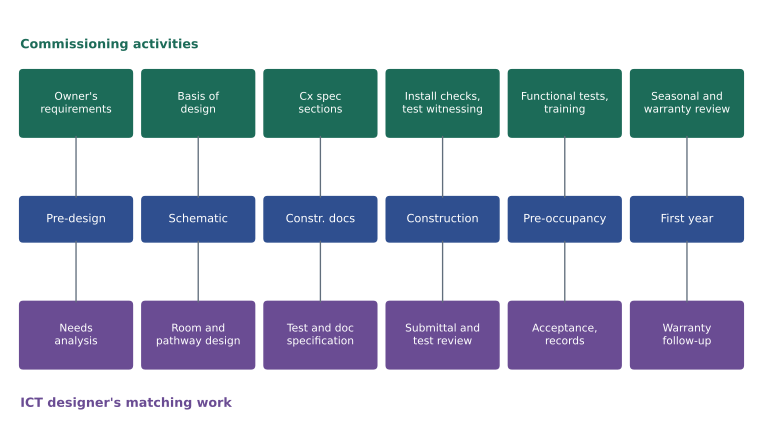
Commissioning starts in pre-design, not at the end of construction. The owner's project requirements, described in lesson 7, set the targets. The basis of design explains how the design meets them. During design, the commissioning authority reviews the documents for commissioning requirements and writes them into the specification, often in a Division 01 section and in a section such as 27 08 00 for communications. During construction, it observes installation, witnesses tests and tracks issues. At the end, it verifies functional performance, confirms training and documentation, and writes a commissioning report.
Pre-functional checks
Before systems are tested together, each part is checked to confirm it is installed and ready. For the cabling, pre-functional checks confirm that every link has passed certification, that the telecommunications rooms are finished and clean, that power, cooling and lighting in the rooms work, that the bonding infrastructure is complete and tested, and that labels and records are in place. Checklists for these items are often filled in by the contractor and verified by sampling by the designer or commissioning authority.
Environmental conditions in the telecommunications rooms deserve particular attention, because network equipment arrives soon after the cabling is finished. Daniel checks that each room's cooling holds the specified temperature with a load bank or with the equipment running, that the dedicated circuits are labelled and on the correct panels, that the emergency power transfers correctly where specified, and that the rooms are free of construction dust, which can damage equipment and clog filters.
Functional testing
Functional testing verifies that the systems do what the owner needs. For ICT, that means connecting active equipment and confirming end to end that each service works across the cabling. A typical approach takes a sample of outlets of each type and confirms that a device connected there reaches the network at the expected speed, receives the expected Power over Ethernet class, and appears on the expected switch port according to the records. Wireless coverage is verified with a survey. Systems that depend on the cabling, such as cameras, access control and nurse call, are tested by their own trades, and the ICT designer helps trace any problems back to the cabling or forward to the equipment.
The first year of operation
Handover is not the end of the designer's involvement on many projects. Owners often ask the designer to return during the first year to review how the infrastructure is working, to check that the records are being kept current, and to help with warranty issues. Some commissioning plans include a review near the end of the contractor's warranty period, so that defects can be reported while they are still covered. The designer can also gather lessons from the users: which outlets are unused, which spaces needed more, where wireless coverage is weak. Those lessons improve the next design.
The first year also tests the owner's change process. Every change made during that year, from a moved outlet to a new rack of equipment, either keeps the records current or starts their decay. An owner who updates drawings and the database with every change will have accurate records for decades; one who does not will be back to investigation within a few years. Ines makes record updates part of every work order, and her team reviews the database monthly against a sample of patch panels.
Seasonal and deferred checks
Some checks cannot be done at handover. Cooling in telecommunications rooms may need to be verified in the hottest month of the year, under full equipment load. Wireless coverage may need to be checked again once furniture and people fill the building, because both absorb radio signals. Outside plant may need to be inspected after the first winter to confirm that maintenance holes stay dry and that frost has not moved anything. A commissioning plan should list these deferred checks with dates and responsible parties, and the designer should follow them through.
Measuring success
How does an owner know that a cabling project succeeded? The clearest measures are practical ones. Did the active equipment come up on time? How many cabling faults were reported in the first year, and how many were caused by the cabling rather than by cords or equipment? How long does it take a technician to trace a link from the records? How many moves, additions and changes were made without opening a ceiling to find out what was there? Lakehead Signal asks owners these questions at the warranty review and records the answers with the project's lessons learned. For Harbourview, the answers were three cabling faults in the first year, all of them damaged cords, and an average tracing time of under five minutes.
Worked problem
Sizing a functional test sample
Harbourview has 1,412 horizontal links. The commissioning plan samples one in every 20 links of each type, with at least 5 of every type. The links include 1,180 data outlets, 196 wireless access point cables and 36 camera outlets. How many links are sampled?
Show solution
- Data outlets: 1,180 / 20 = 59.
- Wireless cables: 196 / 20 = 9.8, so 10.
- Cameras: 36 / 20 = 1.8, which is below the minimum, so 5.
- Total: 59 + 10 + 5 = 74 links.
Answer: 74 links are tested end to end with active equipment. Any failure expands the sample for that type.
The functional tests on Harbourview's clinic floor find one real problem: two nurse call stations fail to receive power. The cabling passed certification, and the switch ports are configured correctly. Tracing the links with the records shows that the stations were patched to a switch that does not supply Power over Ethernet, because the patching schedule listed the wrong switch. The fix takes five minutes, and the patching schedule is corrected. The records made the problem easy to find.
Training
An owner cannot run a system its staff do not understand. Training for the cabling infrastructure is usually short but important. It should cover the identifier scheme and how to read labels, how to use the record drawings and the cable database, how to add, move or change a link while keeping the records current, how to make warranty claims, how to maintain the telecommunications rooms, and the rules for working near firestopping and bonding. Training should be recorded, with attendance lists and materials handed over, and ideally recorded on video for future staff.
Closeout documents
At closeout, the contractor and designer deliver the documents the owner will rely on for the life of the system. Lesson 5 described the documentation set; the closeout package gathers it with everything else the owner needs.
- Record drawings, in native and PDF formats.
- Outlet, link and backbone schedules, and the cable database in an editable format.
- Test results for every link and strand, in native tester files and summaries.
- Product data and approved submittals.
- The warranty schedule and the manufacturer warranty certificate.
- Operation and maintenance information, including the identifier scheme and labelling rules.
- Training records and materials.
- A list of spare parts, labels and materials handed over, and where they are stored.
- The commissioning report and any open issues with their owners and dates.
Worked problem
Counting closeout binders
The owner wants printed copies of the test summaries as well as the files. Each binder holds 400 pages, and each page of the summary lists 25 copper links or 12 fibre strands. Harbourview has 1,412 copper links and 240 fibre strands. How many binders are needed for one printed set?
Show solution
- Copper pages: 1,412 / 25 = 56.5, so 57 pages.
- Fibre pages: 240 / 12 = 20 pages.
- Total pages: 57 + 20 = 77.
- Binders: 77 / 400 = 0.19, so 1 binder.
Answer: One binder holds the printed summaries. The full native files, with every plot, stay digital.
Handover
Handover is the point at which the owner takes responsibility for operating the system. It usually follows substantial completion and the acceptance described in lesson 3. A formal handover meeting brings together the owner's staff, the designer, the contractor and the commissioning authority to walk through the closeout package, confirm open items and their deadlines, and agree who to call for warranty work. Keys, access cards, spare stock and passwords for any managed equipment change hands at the same time.
Open items rarely disappear entirely by handover. A short list of minor deficiencies, delayed deliverables or seasonal tests is normal. What matters is that each item has a description, an owner and a date, and that someone follows them through. Daniel keeps Harbourview's open items list for the first year, and he visits the building ten months after opening for the warranty review, walking the telecommunications rooms with Ines and checking that the records have been kept up to date. Two rooms have new equipment that is not on the rack elevations, and Ines adds a step to her change process.
Looking back over the course
This course has followed Harbourview from the field to the handover meeting. The first five lessons covered how installed cabling is proven and recorded: copper certification and fibre testing, acceptance and warranties, administration and labelling, and the documentation set. The next five covered how a design is created and delivered: the design process, needs analysis and scope, drawings, specifications and bills of materials, and cost estimating with value engineering. The last two covered construction administration and change control, and commissioning and handover.
Together, these topics are what turn technical knowledge into a working building. An RCDD must know how cabling performs, which earlier courses in this program covered, but also how to define what an owner needs, put it into documents a contractor can build from, check that it was built correctly and hand it over so that it keeps working. Daniel, who came to the firm as a field technician pulling and terminating cable, now writes the specifications that crews like Tomasz's follow. He books his RCDD exam for the spring, and Roz tells him the hardest part of the job is already behind him: learning to see the whole project, not just the piece in front of him.
Common mistakes
MistakeTreating commissioning as a test at the end.
InsteadStart commissioning with the owner's project requirements in pre-design.
MistakeHanding over rooms full of construction dust.
InsteadClean the rooms and verify power and cooling before equipment arrives.
MistakeTesting active services on every outlet.
InsteadSample by outlet type, and expand the sample when failures appear.
MistakeSkipping training because the cabling is passive.
InsteadTrain staff on identifiers, records, changes, warranty claims and room care.
MistakeLeaving open items without owners and dates.
InsteadRecord every open item with a responsible party and a deadline.
Summary and key terms
- Commissioning verifies that systems meet the owner's project requirements and can be operated and maintained.
- It runs from pre-design through occupancy, matched by the ICT designer's work at each stage.
- Pre-functional checks confirm each part is ready; functional tests confirm services work end to end.
- Training gives the owner's staff the knowledge to run and maintain the infrastructure.
- The closeout package gathers drawings, schedules, test results, warranties, operations information and training records.
- Handover transfers responsibility, with open items tracked to completion.
- Commissioning
- A quality process verifying that systems meet the owner's project requirements.
- Commissioning authority
- The person or firm who leads the commissioning process for the owner.
- Pre-functional check
- A check that a component is installed and ready before functional testing.
- Functional testing
- Testing that systems work together to deliver the required services.
- Closeout package
- The set of documents and materials delivered to the owner at completion.
- Handover
- The transfer of responsibility for operating the system to the owner.
Practice problems
Work each problem on paper first, then reveal the answer to check.
When does commissioning begin?
Show answer
In pre-design, with the owner's project requirements.
How many links are sampled from 600 data outlets at one in 20?
Show answer
30.
What should training on the cabling cover?
Show answer
Identifiers, records, changes, warranty claims, room care, firestopping and bonding.
Name three items in a closeout package.
Show answer
Record drawings, test results and the warranty schedule, among others.
What must every open item at handover have?
Show answer
A description, a responsible party and a date.
Why check room cooling before equipment arrives?
Show answer
So equipment runs within its limits from the first day.
Lesson quiz · 5 questions
Score 60% or more to complete this lesson.
Create a free account to save your progress, take quizzes and earn a certificate.