
RCDD-116 · Lesson 1 of 12 · 25 min
Copper field testing and certification
▶ Video coming soon A video version of this lesson is on the way.
Six weeks before the clinic floors of Harbourview open, Tomasz Wiercinski's crew finishes terminating the last of 1,412 horizontal cables. The contractor's technicians start certifying links the same afternoon, two testers working floor by floor. On the third day Tomasz calls Lakehead Signal: forty-one links on the second floor have failed, and his technician thinks the tester is wrong. Roz sends Daniel to site with one instruction: find out whether the cabling or the test is at fault before anyone re-terminates a single jack. This lesson gives Daniel the tools to answer that question.
Why copper links are certified
A structured cabling system is designed to standards, built by people and accepted on evidence. Field certification is the evidence. A certification tester measures every link against the limits for its category, stores the results and produces a report that says pass or fail for each one. The owner, the designer and the manufacturer all rely on that report: the owner to accept the work and pay for it, the designer to confirm that what was built matches what was specified, and the manufacturer to grant its extended warranty.
Certification is different from two simpler kinds of test. A verification tester, sometimes called a continuity or wire-map tester, checks that each conductor connects to the correct pin at the far end and finds opens, shorts and split pairs. It says nothing about how the link performs at high frequencies. A qualification tester measures whether a link can carry a particular network application, such as 1 gigabit or 10 gigabit Ethernet, but it does not compare the link with a cabling standard. Only a certification tester measures the full set of parameters across the full frequency range of the category, so only certification proves that a Category 6A link is a Category 6A link.
Permanent link and channel
The standards define two test configurations, and choosing the right one is the first decision in any test plan. The permanent link is the fixed part of the cabling: the horizontal cable from the patch panel in the telecommunications room to the outlet in the work area, including a consolidation point if there is one. It excludes the patch cords and equipment cords, because those are moved and replaced over the life of the building. The channel is the complete end-to-end path that equipment will use: the permanent link plus the patch cord at the panel and the cord at the work area, and any cross-connect jumpers.
New installations are almost always certified as permanent links. The permanent link is what the contractor installed and is responsible for, and it will stay in the walls for twenty years or more while cords come and go. Permanent link limits are also stricter in the sense that matters: they leave room in the performance budget for the cords that will be added later. A channel test, by contrast, proves only that a particular combination of link and cords works today. Most manufacturer warranty programs therefore require permanent link results for every link, and channel testing is used mainly for troubleshooting or for links where the owner supplies the cords at the time of testing.
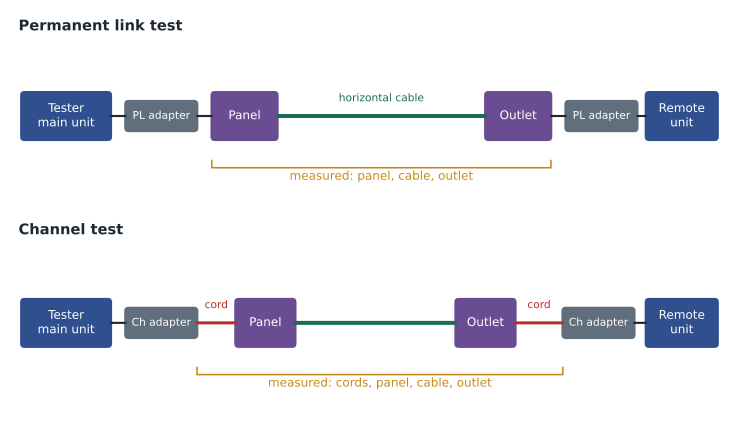
Each configuration uses its own adapters on the tester. Permanent link adapters have a precision test cord whose effects the tester removes from the measurement, so that the result reflects only the installed link and its end connectors. Channel adapters plug the user's own cords into a precision jack on the tester, and the mated connection at the tester is excluded instead. Using the wrong adapter, or selecting the wrong test limit for the adapter fitted, is one of the most common causes of false failures and false passes.
What a certification tester measures
ANSI/TIA-568.2 sets the performance limits for balanced twisted-pair cabling, and the testers themselves must meet the accuracy requirements of ANSI/TIA-1152. ISO/IEC 11801 and IEC 61935-1 play the same roles internationally, and CSA standards in the T5 series align with them in Canada. A full autotest measures the following parameters over the frequency range of the category, which is 500 MHz for Category 6A.
| Parameter | What it shows | Typical cause of a failure |
|---|---|---|
| Wire map | Each conductor reaches the correct pin; no opens, shorts, reversed or split pairs. | Termination error at a jack or panel. |
| Length | Electrical length of the longest pair, from propagation delay and the cable's rated speed. | Long route or excess slack; often informational only. |
| Insertion loss | How much signal is lost from end to end. | Long link, high temperature, poor cable or wrong category. |
| NEXT and PSNEXT | Crosstalk from other pairs measured at the same end. | Untwisting at terminations, poor connectors, crushed cable. |
| ACRF and PSACRF | Crosstalk measured at the far end, relative to the received signal. | Same causes as NEXT, often at the far end. |
| Return loss | Signal reflected back by changes in impedance. | Kinks, tight bends, tight cable ties, mismatched components. |
| Propagation delay and delay skew | Time for the signal to travel, and the difference between pairs. | Very long links or mixed cable types. |
| DC loop and resistance unbalance | Conductor resistance and the balance between conductors in a pair. | Poor terminations; matters for Power over Ethernet. |
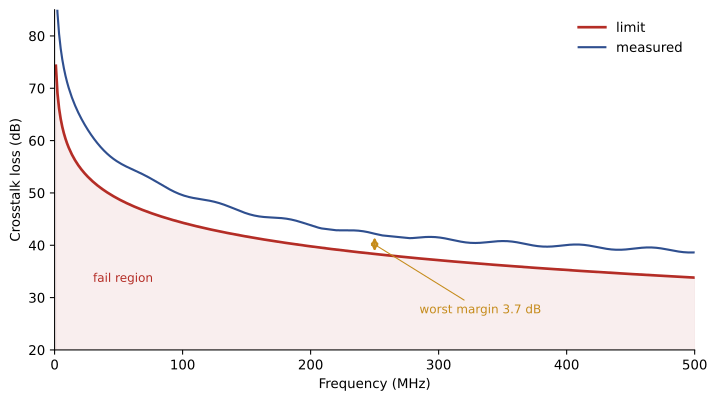
The tester reports each parameter as a worst-case value and as a margin: the distance in decibels between the measured value and the limit at the frequency where the two come closest. A positive margin means the link passes that parameter with room to spare; a negative margin means it fails. The overall result is a pass only if every parameter passes. Margin is the most useful single number in a test report, because it shows how close a link came to failing even when it passed.
Marginal results and tester accuracy
No field tester is perfectly accurate, so the standards recognize that a result very close to the limit cannot be called with confidence either way. When a measurement falls within the tester's accuracy of the limit, the tester flags it, typically with an asterisk: a marginal pass or a marginal fail. Whether a marginal pass is acceptable is a contract question, not a technical one. Many specifications, and many manufacturer warranty programs, reject marginal passes and require a clean pass on every link. The designer should state the rule clearly in the specification so that nobody argues about it on site.
Tester accuracy is described by levels in ANSI/TIA-1152 and IEC 61935-1. Testing Category 6A needs a tester rated to the level for that category, and the adapters must be rated too. Testers also need regular factory calibration, usually once a year, and the reference settings must be checked at the start of each day, as the manufacturer directs. A test report should show the tester model, serial number, software version, calibration date and adapter types, so that the results can be trusted later.
Setting up a test correctly
Most bad test results come from bad setup rather than bad cabling. Before the first link is tested on a project, the test plan should fix the following settings, and the designer should review the first day's results to confirm them.
- The correct limit, such as TIA Category 6A permanent link, matching the specified category and configuration.
- The correct cable type, so that the tester uses the right nominal velocity of propagation to calculate length.
- The correct adapters, in good condition, with their test cords replaced at the interval the manufacturer recommends.
- Result storage with the agreed link identifiers, so that every result can be matched to a label and a drawing.
- A current calibration certificate and a successful daily reference or self-test.
The identifier setting deserves particular care. Tens of thousands of results are useless if they cannot be matched to the links they describe. Daniel's specification for Harbourview requires the contractor to load the outlet identifiers from the outlet schedule into the tester before testing, so that every saved result already carries the identifier that is printed on the faceplate and the patch panel.
Diagnosing failures
Modern certification testers locate the source of a failure as well as report it. For crosstalk and return loss, the tester can plot where along the link the problem occurs, usually showing a peak at the distance of the fault. A NEXT failure at zero metres points to the panel end; a failure at the far end of the link points to the outlet; a return loss peak in the middle of the link points to damage in the cable itself, such as a kink, a crush or a staple. Wire map failures name the pins involved, and length results longer than the drawings show point to excess slack or an unexpected route.
Daniel starts with the forty-one second-floor failures. All of them fail NEXT, and the tester's diagnostic plots show the fault within half a metre of the main unit, at the patch panel end. All of them were terminated by the same technician on the same day. Under a magnifier, the pairs at the back of the panel jacks are untwisted for 25 to 30 millimetres, far more than the jack manufacturer allows. The tester is right. Tomasz has the jacks re-terminated, and all forty-one links pass with margins similar to the rest of the floor.
Worked problem
Reading a margin from a test result
A Category 6A permanent link has a worst-case NEXT of 42.6 dB at one frequency, where the limit is 38.9 dB. (The numbers in these examples are illustrative; real limits come from the standard and are built into the tester.) What is the margin, and does the link pass this parameter?
Show solution
- For NEXT, a larger number is better, because it means less crosstalk.
- Margin = measured − limit = 42.6 − 38.9 = 3.7 dB.
- The margin is positive, so the link passes NEXT.
Answer: A margin of 3.7 dB, a pass. If the tester's accuracy at that frequency were larger than the margin, the result would be flagged as marginal.
Worked problem
Insertion loss margin
The same link has a worst-case insertion loss of 41.2 dB at the top of its frequency range, against a limit of 43.8 dB. What is the margin?
Show solution
- For insertion loss, a smaller number is better.
- Margin = limit − measured = 43.8 − 41.2 = 2.6 dB.
- The link passes insertion loss with 2.6 dB to spare.
Answer: A margin of 2.6 dB. Testers always report margins so that positive means passing, whichever direction the parameter runs.
Length, temperature and the 90-metre rule
Length is the parameter most often misunderstood. The tester calculates length from the propagation delay and the cable's rated velocity, so its result depends on the velocity setting, and the four pairs, which have slightly different twist rates, give slightly different lengths. In current TIA limits, length is reported for information and is not itself a pass or fail criterion; insertion loss, which length mainly drives, is the criterion that matters. Many specifications still require links to be no longer than 90 metres, however, because that is the design limit. If a link passes insertion loss but measures 92 metres, the specification decides whether it is accepted.
Temperature matters too. Insertion loss rises with temperature, and a link tested in a cool building in winter may have less margin in a hot ceiling in summer. Links that pass with very small insertion loss margins and run through hot spaces deserve a second look, which is one reason designers like to see healthy margins rather than bare passes.
Alien crosstalk and Power over Ethernet checks
For Category 6A, crosstalk between neighbouring cables, called alien crosstalk, also matters at 10 gigabit speeds. Testing every link for alien crosstalk takes far too long, so standards and manufacturers rely on design of the cable and on sample testing of the most exposed links, such as those in the middle of long, tightly packed bundles. A specification can require a small sample to be tested this way, but most projects rely on the manufacturer's qualified system instead.
Power over Ethernet adds a different concern. Unequal resistance between the two conductors of a pair, or between pairs, causes uneven current and can saturate the transformers in equipment. That is why recent testers report DC resistance unbalance within pairs and between pairs, and why specifications for PoE-heavy designs, such as the PoE lighting on Harbourview's third floor, should call for those measurements to be saved with the rest of the autotest.
The test report
The deliverable from certification is a complete set of saved results, usually in the tester manufacturer's native file format plus a summary in a common format such as a PDF. The designer should specify both. The native files let anyone open a result later and see the full detail and plots; the summary lets the owner read the totals without special software. A good summary lists every link identifier, its result, its worst margin and its length, and totals the passes and failures by room and floor. Results should be submitted in batches during construction, not all at once at the end, so that problems like the second-floor terminations are found while the crew is still on site.
Common mistakes
MistakeUsing a channel test to accept a new installation.
InsteadCertify new work as permanent links; use channel tests for troubleshooting or where cords are part of the scope.
MistakeAccepting marginal passes without saying so in the specification.
InsteadState whether marginal results are acceptable before testing begins.
MistakeBlaming the tester for a run of failures.
InsteadCheck setup first, then use the tester's diagnostics to locate the fault.
MistakeTreating a verification tester as proof of category performance.
InsteadOnly a certification tester measures every parameter over the full frequency range.
MistakeAccepting results without identifiers or calibration data.
InsteadRequire saved results with link identifiers, tester serial number and calibration date.
Summary and key terms
- Certification measures every parameter of a link against the limits for its category and is the evidence for acceptance and warranty.
- New installations are certified as permanent links; channels include the cords and are tested mainly for troubleshooting.
- ANSI/TIA-568.2 sets the limits and ANSI/TIA-1152 sets tester accuracy; ISO/IEC 11801 and IEC 61935-1 are the international equivalents.
- Margin is the gap between the measured value and the limit; positive means pass.
- Results within the tester's accuracy of the limit are marginal, and the specification should say whether they are accepted.
- Most failures come from setup or termination workmanship, and the tester's diagnostics show where along the link the fault lies.
- Certification
- Testing a link against every parameter limit for its category.
- Permanent link
- The installed cabling from panel to outlet, excluding cords.
- Channel
- The complete path including patch cords and equipment cords.
- Margin
- The difference between a measured value and its limit at the worst frequency.
- Marginal result
- A result within the tester's accuracy of the limit, flagged with an asterisk.
- NVP
- Nominal velocity of propagation, the cable's signal speed as a fraction of the speed of light.
Practice problems
Work each problem on paper first, then reveal the answer to check.
Which configuration is used to certify a newly installed horizontal link?
Show answer
The permanent link.
A link's worst NEXT is 40.1 dB against a limit of 41.0 dB. What is the margin?
Show answer
−0.9 dB, a failure.
Why are cords left out of the permanent link?
Show answer
They are replaced over the building's life, so the fixed cabling is tested on its own with room left for cords.
What does a return loss peak in the middle of a link suggest?
Show answer
Damage in the cable, such as a kink or crush.
Which standard sets accuracy requirements for TIA field testers?
Show answer
ANSI/TIA-1152.
Why should results be submitted in batches during construction?
Show answer
So problems are found and fixed while the crew is still on site.
Lesson quiz · 5 questions
Score 60% or more to complete this lesson.
Create a free account to save your progress, take quizzes and earn a certificate.