
RCDD-113 · Lesson 6 of 12 · 20 min
Lightning and power-fault hazards
▶ Video coming soon A video version of this lesson is on the way.
Before he could choose protectors and surge devices, Daniel needed to understand what they were protecting against. Roz gave him the clinic group's incident report for the August storm and a map showing where the service provider's copper cable ran on poles along the road and then underground to the existing building. 'Protection design starts with the hazard,' she said. 'What energy could reach the building, by what path, and how big could it be? Then you decide where to stop it.'
Two kinds of event cause most of the damage to ICT systems from outside the building: lightning, and faults on nearby electrical power lines. Both produce voltages far higher than ICT equipment can withstand. They differ in how long they last, how they couple into cables and what kind of protection deals with them best.
How lightning reaches ICT systems
A lightning flash carries a very large current for a very short time. Typical return strokes reach peak currents of tens of thousands of amperes, with a median for first strokes often given as about 30 kA, and rise to that peak in a few microseconds before decaying over tens to hundreds of microseconds. A single flash often has several strokes. The energy is enormous, but most of the damage to electronics comes not from a direct hit on equipment, which is rare, but from the voltages that a strike creates on conductors nearby.
There are four main ways lightning energy reaches ICT equipment. A direct strike to the building or to an antenna mast sends current through the building's lightning protection system and structure to earth. A strike to an overhead cable or to the ground near a buried cable injects current into the cable's shield and conductors, which then carries it into the building. A strike nearby induces voltage in cables through the magnetic field of the stroke current, even without any contact. And a strike anywhere near the building raises the potential of the local earth, so that the building's grounding system and a remote reference connected by a long cable are suddenly far apart in voltage.
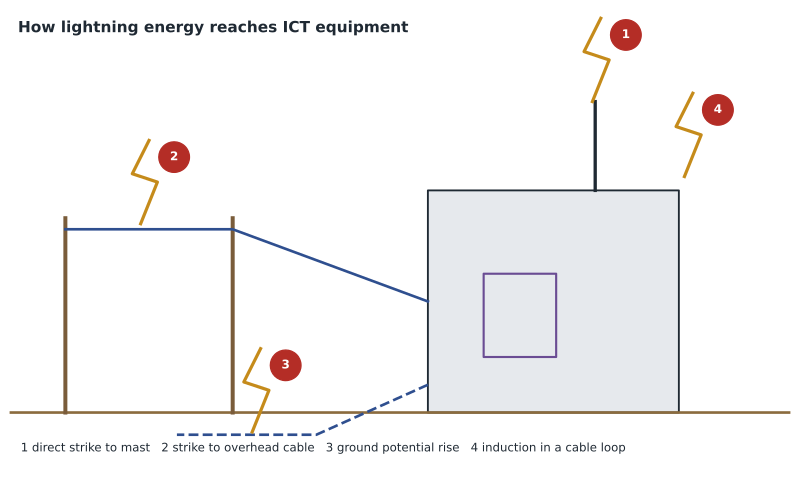
Ground potential rise
Ground potential rise is the mechanism that most often surprises people. When lightning current flows into the earth through a building's grounding electrodes, the voltage of those electrodes rises relative to remote earth by roughly the current multiplied by the grounding system's resistance to earth. Even a good grounding system with a resistance of a few ohms rises tens of thousands of volts for the microseconds the current flows. Everything bonded to the building's grounding system rises with it, which is fine for things entirely inside the building. The danger is to anything that connects the building to somewhere else.
A copper telephone pair from the service provider's central office, a coaxial cable from a remote antenna, or a data cable from another building is referenced to a distant ground. When the local building rises tens of thousands of volts, that difference appears across the equipment where the cable terminates. That is the voltage that destroyed the switch port in the existing clinic building. The entrance protector's job, covered in lesson 7, is to clamp the conductors of incoming cables to the local bonding network so that they rise with the building instead of holding the equipment across the gap.
# Illustrative ground potential rise and inductive voltage during a strike
I_peak = 30_000          # A, a typical first-stroke peak
R_ground = 5.0           # ohms, building grounding system resistance to remote earth
gpr = I_peak * R_ground
print("ground potential rise:", gpr, "V")

# Voltage along a bonding conductor from inductance: V = L * di/dt
L_per_m = 1.0e-6         # henries per m, a common estimate for a single straight conductor
length_m = 6.0           # the existing building's looping protector bond
di_dt = 10_000 / 1e-6    # A per second: 10 kA rising in 1 microsecond, a share of the stroke current
v_lead = L_per_m * length_m * di_dt
print("voltage along a 6 m bond:", v_lead, "V")
print("same bond at 1 m:", L_per_m * 1.0 * di_dt, "V")ground potential rise: 150000.0 V voltage along a 6 m bond: 60000.0 V same bond at 1 m: 10000.0 V
The numbers in the code are illustrative, but they make two points. First, ground potential rise in a strike is in the range of a hundred thousand volts or more, even for a good grounding system, so the goal cannot be to keep the building at earth potential; it is to keep everything in the building together. Second, the inductance of a bonding conductor matters as much as its resistance. A 6-metre looping protector bond can develop tens of thousands of volts along its own length while carrying a surge, which is why the bonding conductors from protectors must be short and straight.
Power-fault hazards
The second family of hazards comes from the electrical power system. Telecommunications and power cables often share poles, trenches and building entrances, and a failure in the power system can put power-frequency voltage on telecommunications conductors. These events last much longer than lightning, from a fraction of a second to many seconds, until the power system's protection clears the fault, and they can carry enough energy to start fires.
Power contact, also called power cross, is direct contact between a power conductor and a telecommunications conductor, for example when a power line falls onto a telecommunications cable during a storm or a cable is damaged in a shared trench. The telecommunications conductor is then energized at the power line's voltage. Power induction occurs when a power line carrying a large fault current runs parallel to a telecommunications cable for some distance; the fault current's magnetic field induces a voltage along the cable. And ground potential rise from a power fault occurs near substations and power plants, where fault current flowing into the earth raises the local ground potential in the same way lightning does, but for longer.
| Hazard | Typical duration | How it couples | Main concern |
|---|---|---|---|
| Lightning, direct or nearby | Microseconds per stroke | Direct current injection, induction, ground potential rise | Very high voltage; equipment damage; shock |
| Power contact | Until the power protection clears, often fractions of a second to seconds | Direct contact with energized power conductors | Fire, shock, sustained overcurrent |
| Power induction | Duration of a power fault | Magnetic coupling along parallel routes | Sustained induced voltage |
| Power-fault ground potential rise | Duration of a power fault | Fault current into the earth near substations | Large voltage between local and remote grounds |
Because power faults last much longer, protectors must deal with them differently. A device that can divert a lightning surge for a few microseconds may overheat and fail if power-frequency current flows through it for seconds. That is why primary protectors include features that fail safely under sustained current and why fuse links or fine-gauge cable sections at the entrance are used to open the circuit under a power contact. Lesson 7 covers how protector designs handle both.
Exposure
Codes treat cables differently depending on whether they are exposed to these hazards. A communications circuit is generally considered exposed if it is subject to lightning strikes or to accidental contact with power conductors operating above a certain voltage. Cables that run outdoors, overhead or underground between buildings are usually exposed. Cables that remain entirely inside one building and never leave it are usually not. The Canadian Electrical Code's Section 60 and the definitions in Section 0 set out the exact conditions, and the AHJ and the service provider can say whether a particular cable is considered exposed.
The practical result is that every metallic conductor entering a building from outside needs to be assessed. At Harbourview, that meant the service provider's copper entrance cable, the coaxial cables from the rooftop antennas, a copper alarm circuit from a remote gate controller in the parking lot and, potentially, the campus link to the existing clinic building. The provider's fibre cable with a metallic armour also needed attention, because the armour is a conductor even if the fibres are not.
Assessing the risk
How much protection is enough depends on the risk. International and national standards give methods for assessing lightning risk to structures and their services, considering the local frequency of lightning, the size and height of the structure, the length and type of cables connected to it and the consequences of failure. In Canada, lightning protection systems for buildings are covered by CSA B72, and risk assessment methods based on the IEC 62305 series are widely used. The electrical engineer normally decides whether the building needs a lightning protection system; the RCDD makes sure the ICT design is coordinated with it.
For ICT systems, the consequences of failure often decide the matter. A hospital's nurse call and patient monitoring network, a college's emergency notification system and the clinic's health records servers all have high consequences. Harbourview's owner wanted a high level of protection, and the electrical engineer specified a lightning protection system for the roof with down conductors bonded to the building's grounding electrode system. Daniel's job was to make sure the rooftop antenna mast and its cables were bonded into that system and into the telecommunications bonding network.
Local lightning frequency matters too. Lightning detection networks record how many flashes reach the ground per square kilometre each year, and that flash density varies widely across North America, from very low in the far north and along parts of the Pacific coast to many times higher in the south-east of the United States. The Lake Superior region where Harbourview sits has moderate summer thunderstorm activity. A designer should look up the published flash density for the site rather than assume, because it feeds directly into the risk assessment and into the owner's decisions.
Antennas deserve a special mention. A rooftop mast is often the highest point on a building and the most likely point of a direct strike. Its coaxial cables run from the top of the mast straight into the building's ICT spaces. Bonding the mast to the lightning protection system and to the building steel, bonding the cable shields at the top of the mast and again where they enter the building, and fitting coaxial protectors at the entry are the basic steps; lessons 7 and 8 cover them.
Reducing the hazard at the source
The most effective protection is to avoid bringing a hazard into the building at all. Optical fibre without metallic members carries no current, so an all-dielectric fibre cable between buildings eliminates the conductive path for ground potential rise and power faults. Where metal cannot be avoided, routing cables underground rather than overhead reduces exposure to direct strikes and power contact, and keeping telecommunications and power cables apart in shared trenches reduces power contact and induction.
Daniel applied that principle across Harbourview. The campus link became all-dielectric fibre. The parking gate alarm circuit became a fibre link with a small media converter at the gate, powered locally, which eliminated a long copper run across an open lot. The rooftop antenna cables could not be fibre all the way, because the antennas need coaxial feeds, so they would be bonded at the top and protected where they entered the building. The service provider's copper cable would still need a primary protector, and lesson 7 picks up there.
Worked problem
Explaining the storm damage
Using the ideas in this lesson, explain the most likely sequence of events that damaged the switch port in the existing clinic building.
Show solution
- Lightning struck near the overhead section of the service provider cable or near the building, injecting current into the cable and raising the building's ground potential.
- The entrance protector diverted current from the copper pairs, but its bonding conductor was long and looped, so its inductance allowed a large voltage to develop along it. The protector side of the bond rose well above the building's grounding system.
- The second-floor telecommunications room had no SBB, so the rack and the switch were connected to the building only through power cords, while the incoming copper and the cabling to the first floor were referenced elsewhere.
- The difference between the switch's power ground and its data ports exceeded the port's withstand voltage, and current flowed through the switch.
Answer: Ground potential rise and induced voltages, combined with a long protector bond and an unbonded telecommunications room, put a large voltage across the switch.
Common mistakes
MistakeTrying to keep the building at earth potential during a strike.
InsteadAccept that the building rises and bond everything inside so it rises together.
MistakeTreating only overhead cables as exposed.
InsteadAssess every metallic conductor that leaves the building, including underground and inter-building cables.
MistakeDesigning protection only for lightning.
InsteadInclude power contact, induction and power-fault ground potential rise, which last much longer.
MistakeAccepting metallic inter-building links by default.
InsteadUse all-dielectric fibre where possible to remove the conductive path.
Summary and key terms
- Lightning strokes have peak currents of tens of kiloamperes and rise in microseconds; most ICT damage comes from induced and ground-potential voltages.
- Ground potential rise makes the building rise relative to remote earth; cables to remote grounds carry that difference into equipment.
- The inductance of a bonding conductor can develop very large voltages; keep protector bonds short and straight.
- Power contact, induction and power-fault ground potential rise last much longer than lightning and can cause fires.
- Codes define when a circuit is exposed; every metallic conductor leaving the building must be assessed.
- Removing metal from a route, for example with all-dielectric fibre, removes most of its risk.
- Ground potential rise
- The rise in voltage of a grounding system relative to remote earth while current flows into the earth through it.
- Power contact
- Direct contact between a power conductor and a telecommunications conductor.
- Power induction
- Voltage induced in a telecommunications cable by fault current in a parallel power line.
- Exposed circuit
- A circuit subject to lightning or to accidental contact with power conductors, as defined by the code.
- Lightning protection system
- Air terminals, conductors and grounding electrodes that carry a direct strike to earth.
Practice problems
Work each problem on paper first, then reveal the answer to check.
What are the four ways lightning energy reaches ICT equipment?
Show answer
Direct strike, strike to an incoming cable, induction and ground potential rise.
Why is a long protector bond dangerous during a surge?
Show answer
Its inductance lets a large voltage develop along it, so the protector rises above the building reference.
How do power faults differ from lightning in their effect on protectors?
Show answer
They last much longer, so protectors must handle sustained current or open the circuit safely.
What is the simplest way to remove the hazard on an inter-building link?
Show answer
Use all-dielectric optical fibre.
Lesson quiz · 5 questions
Score 60% or more to complete this lesson.
Create a free account to save your progress, take quizzes and earn a certificate.