
RCDD-113 · Lesson 1 of 12 · 23 min
Why bonding and grounding matter for ICT
▶ Video coming soon A video version of this lesson is on the way.
The call came in on a Monday morning in late August. Over the weekend a line of thunderstorms had crossed the lake, and the Harbourview Health & Learning Centre, still in design at Lakehead Signal Design Group, was not the building in trouble. The trouble was at the clinic group's existing building across the road, the one the new centre would connect to by a 400-metre campus link. Two wireless access points were dead, a network switch in the second-floor telecommunications room had a scorched port, and the nurse call gateway kept rebooting. Nobody had been hurt, but the clinic had spent Sunday on paper charts.
Rosalind Achterberg, RCDD, the principal designer at Lakehead Signal, drove over with Daniel Oyelaran. Daniel had spent five years installing structured cabling before moving into design, and he was preparing to sit the RCDD exam in the spring. Roz wanted him to see what a building looks like when bonding and grounding have been treated as somebody else's problem. Within an hour they had found the likely story: the incoming copper service had a protector, but its bonding conductor ran more than six metres in a looping path to a water pipe that had been partly replaced with plastic. The telecommunications room on the second floor had no busbar at all. Equipment racks were bolted to a painted floor and connected to nothing but the power cords of the equipment in them.
'This is the course in one picture,' Roz said, standing in the doorway of the room. 'Every piece of metal in here was at a different voltage for a few microseconds on Saturday night. The equipment sat in the middle of those differences, and the current took the shortest path it could find, which was through the switch.' This course follows Daniel through the bonding, grounding, power and protection design for Harbourview, using the existing building's failures as a set of lessons in what not to do.
Three jobs: safety, protection and performance
Bonding and grounding in an information and communications technology system do three different jobs, and a good design keeps all three in view. The first is life safety. Telecommunications cables enter buildings from outside plant that can be struck by lightning, touched by a fallen power line or exposed to induced voltage from a nearby power line during a fault. Without a path to carry that energy safely to earth and without bonding to keep metal at the same potential, a person touching a rack, a cable shield or a phone could become part of the circuit. Codes exist first to prevent that.
The second job is equipment protection. Electronics fail when the voltage between two of their connections exceeds what their insulation and components can survive. That voltage is often not the voltage on any one conductor but the difference between two references, for example between the ground of a power supply and the shield of a data cable connected to another building. Bonding reduces those differences. Protectors and surge protective devices limit how high they can climb and divert the energy before it reaches sensitive circuits.
The third job is signal performance. Modern ICT systems are built from high-speed digital electronics and radio equipment that are sensitive to electrical noise. A poor bonding network can let noise currents flow along cable shields, couple into balanced pairs, raise error rates and cause problems that look like faulty equipment. A low-impedance, well-organized bonding network gives noise currents a better path than the signal conductors and keeps equipment references close together.
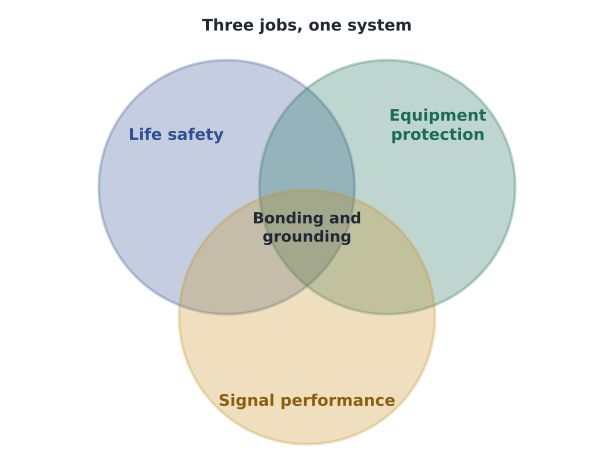
These jobs sometimes pull in different directions. For safety, a code may require that a conductor be connected to the building's grounding electrode system by a short, direct path. For performance, some equipment makers once asked for an 'isolated' or 'dedicated' ground that was not connected to anything else. Those isolated grounds caused many of the worst failures of the 1980s and 1990s, because during a lightning strike the isolated system and the building steel could differ by thousands of volts. Current industry practice, reflected in the telecommunications bonding standards, is that every ICT bonding network must be connected to the building's electrical grounding system at a single, controlled point, and that safety always comes first.
Grounding versus bonding
People often use 'grounding' to mean everything in this course, but the two words describe different things, and the difference matters on the exam and on site. Grounding, which Canadian practice and international standards often call earthing, connects an electrical system or a piece of equipment to the earth, usually through a grounding electrode such as a ground rod, a ground ring, a building's concrete-encased steel or a metal water pipe that runs underground. Bonding connects metal parts to each other so that they stay at nearly the same potential, whether or not that potential is close to the earth's.
An airplane in flight shows why bonding matters more than grounding for many ICT problems. The airplane has no connection to the earth at all, yet the people and electronics inside are protected from a lightning strike because the airframe is bonded into one conductive shell. Current flows over the outside, and everything inside rises and falls in voltage together. A well-bonded building behaves in a similar way. During a lightning strike the whole building may rise thousands of volts above remote earth for a few microseconds. If all its metal rises together, nothing inside sees a dangerous difference.
| Term | What it connects | Main purpose |
|---|---|---|
| Grounding (earthing) | A system or equipment to the earth through an electrode | Gives fault and lightning current a path to earth; limits voltage relative to earth |
| Bonding | Metal parts to each other | Keeps parts at nearly the same potential; provides a low-impedance path for fault current |
| Equipment grounding conductor | Equipment enclosures back to the source of power | Carries ground-fault current so the breaker or fuse opens quickly |
| Telecommunications bonding network | ICT busbars, racks, pathways and shields to the building grounding electrode system | Equalizes potential across the ICT system and provides a controlled path to ground |
Why the electrical system alone is not enough
Daniel asked the obvious question during the drive back. 'Every piece of equipment in that room plugs into a grounded receptacle. Doesn't the equipment grounding conductor in the power cord already bond it?' Roz's answer is one every RCDD should be able to give. The equipment grounding conductor is designed to carry fault current at power frequency, 60 hertz, long enough for a breaker to trip. It is sized for that job and it follows the route of the branch circuit, which may be tens of metres long and loop back to a panel on another floor. At the frequencies present in a lightning surge or a fast electrical transient, that long conductor has significant inductance and therefore high impedance. Two racks plugged into two different panels may be connected only through a long loop of wire that behaves almost like an open circuit for a few microseconds.
The telecommunications bonding network supplements the equipment grounding conductors. It provides short, direct, purpose-built connections between the places where ICT equipment and cables meet: the entrance facility where outside cables arrive, the equipment room, every telecommunications room and the data room. It ties those places together with a backbone conductor sized for the job and connects the whole network to the building's grounding electrode system at one point near the electrical service. It does not replace any part of the electrical code's grounding requirements. It adds to them.
What the RCDD designs, and what others design
On a building project the electrical engineer designs the power distribution and the electrical grounding system: the service, the grounding electrode system, the panels, the branch circuits and their equipment grounding conductors. On Harbourview that engineer is Priya Raman. The RCDD designs the telecommunications bonding network that connects to it, specifies the busbars, conductors and connections, and coordinates the location of the primary bonding busbar and the conductor that connects it to the electrical service. Protectors at the entrance facility, surge protection on ICT equipment, the power and backup power needs of telecommunications spaces, and the documentation of all of it are shared ground, and the drawings must show clearly who is responsible for what.
'Coordination is half the job,' Roz told Daniel. 'If the electrical drawings say ‘telecommunications ground by others’ and the telecommunications drawings say ‘ground per electrical’, nobody installs it.' On Harbourview she wanted the electrical drawings to show the electrical side, including the conductor from the service equipment to the primary bonding busbar and the busbar's location, and the telecommunications drawings to show everything downstream, with matching notes and a single detail that both disciplines referenced.
The installer may also be split. In many jurisdictions the conductor that connects the ICT bonding network to the building's electrical grounding must be installed by a licensed electrician, while the cabling contractor installs the busbars and bonding conductors within telecommunications spaces. Tomasz Wiercinski, the cabling contractor's foreman for Harbourview, has done both kinds of work and knows that the handoff point between trades is where things go missing. The specifications have to say who installs each part.
Codes, standards and the authority having jurisdiction
Three kinds of document govern this work, and an RCDD must know which is which. Codes are legal requirements adopted by a government. In Canada, the Canadian Electrical Code, Part I, published by CSA Group as CSA C22.1 and adopted with amendments by each province and territory, contains the requirements for grounding and bonding in Section 10 and for communication systems in Section 60. Those requirements are the minimum for safety.
Standards describe good practice for performance and reliability. The main one for this course is ANSI/TIA-607, the generic telecommunications bonding and grounding standard for customer premises, now in its E revision, published in 2024. Canadian designers also meet CSA T527, the Canadian standard on bonding and grounding for telecommunications in commercial buildings, which has historically been harmonized with the TIA work, and some owners reference the international standard ISO/IEC 30129. Standards become requirements when a contract or specification calls them up. BICSI publications, including the reference manual the RCDD exam is based on, explain how codes and standards fit together in design.
The authority having jurisdiction, or AHJ, is the organization or person responsible for enforcing a code: often an electrical inspector, sometimes a fire official, and for some systems the owner's own engineering department. Where a code allows a choice, or where its meaning is not clear, the AHJ decides. A design that meets the standard but not the code fails inspection. A design that meets the code but ignores the standard may pass inspection and still fail on a stormy Saturday night.
| Document type | Who issues it | Force | Harbourview example |
|---|---|---|---|
| Code | Province or territory adopting CSA C22.1 | Legal minimum, enforced by the AHJ | Ontario Electrical Safety Code bonding rules |
| Standard | TIA, CSA, ISO/IEC and other standards bodies | Required when a contract calls it up | ANSI/TIA-607-E in the telecommunications specification |
| Owner standard | The building owner or tenant | Required by contract | The clinic group's IT design standard |
| Manufacturer instruction | Equipment makers | Required for listing and warranty | UPS and protector installation instructions |
The cost of getting it wrong
After the storm, the clinic group's facilities manager asked Lakehead Signal to estimate what the weekend had cost. The equipment was the smallest part: a switch, two access points and a gateway. The larger costs were a day of disrupted clinic operations, overtime for staff to re-enter paper records, an emergency service call and the time of everyone who spent Monday chasing the problem. The largest cost was risk. A nurse call system that reboots unpredictably is a patient-safety problem, and the clinic had no way of knowing it would not happen again in the next storm.
Roz used the exercise to make a point Daniel would hear many times: the bonding and grounding portion of an ICT design is a small fraction of the project cost but protects everything else. A busbar, a few hundred metres of insulated copper conductor and the labour to install them are cheap compared with a single day of lost operation in a hospital, a trading floor or a data centre. Because the work is buried in walls and ceilings, it is also expensive to add after the building is finished.
# Rough comparison of the bonding budget for Harbourview with the cost of one outage day
bonding_items = {
    "primary and secondary busbars": 6 * 450,
    "bonding conductors and lugs": 3200,
    "rack bonding hardware": 14 * 120,
    "installation (hours x rate)": 90 * 95,
}
bonding_total = sum(bonding_items.values())
outage_day = 18 * 8 * 70 + 6500 + 4200   # staff overtime, service call, lost visits
print("bonding budget:", bonding_total)
print("one outage day:", outage_day)
print("ratio:", round(outage_day / bonding_total, 1))bonding budget: 16130 one outage day: 20780 ratio: 1.3
The numbers in the code are illustrative, but the proportion is typical of what Roz had seen on other projects: one bad day can cost more than the entire bonding installation. That argument helps when value engineering puts the bonding budget on the list of things to cut.
How this course is organized
The rest of the course follows the order in which Daniel worked through the Harbourview design. Lesson 2 sets out the vocabulary, because codes, standards, electricians and equipment makers use different names for the same parts. Lessons 3 to 5 build the telecommunications bonding infrastructure from the primary bonding busbar down to individual racks and cable trays. Lessons 6 to 8 turn to protection: the hazards from lightning and power faults, the protectors required where cables enter the building, and surge protective devices on power and data circuits. Lessons 9 and 10 cover power distribution for ICT spaces and backup power. Lesson 11 pulls together the Canadian Electrical Code requirements, and lesson 12 covers inspection, testing and documentation.
Throughout, the course cites code rules and standard clauses by number but does not reproduce their text or tables. An RCDD needs to own current editions of the code, the TIA standards and the BICSI reference manual, and to read the actual wording. The aim here is to explain what those documents are trying to achieve, so that the wording makes sense when you read it.
Worked problem
Sorting the clinic failures by job
List the three failures at the existing clinic building after the storm and say which of the three jobs of bonding and grounding each one shows was neglected.
Show solution
- The protector bonding conductor was long and looped to a partly plastic water pipe. That undermines life safety and equipment protection: surge current had a poor path to earth, so voltages rose higher than they should have.
- The second-floor telecommunications room had no busbar. Racks and cable shields there had no low-impedance connection to the rest of the building, which undermines equipment protection.
- Racks sat on a painted floor with only power cords as their connection to ground. During the surge the racks and the cable shields entering them could differ by hundreds of volts, damaging the switch port. That is equipment protection, and before the storm the same weakness probably contributed to noise problems, which is signal performance.
Answer: All three jobs were affected. The missing and poorly routed bonding is a safety issue first and an equipment and performance issue second.
Common mistakes
MistakeTreating 'ground' as one thing that the electrician handles.
InsteadSeparate grounding (to earth) from bonding (between metal parts), and design the telecommunications bonding network as an addition to the electrical system.
MistakeAsking for an isolated, dedicated ICT ground rod.
InsteadConnect every ICT bonding network to the building grounding electrode system at a single, controlled point.
MistakeAssuming power cords bond equipment adequately.
InsteadProvide short, direct bonding conductors; long equipment grounding conductors have high impedance at surge frequencies.
MistakeLeaving the handoff between electrical and telecommunications drawings vague.
InsteadShow who designs and installs each conductor, with matching notes on both sets of drawings.
Summary and key terms
- ICT bonding and grounding serve life safety, equipment protection and signal performance, in that order of priority.
- Grounding connects to earth; bonding connects metal parts together so they stay at nearly the same potential.
- A well-bonded building can rise thousands of volts during a strike without dangerous differences inside it.
- Equipment grounding conductors are sized for 60-hertz fault current and have high impedance at surge frequencies.
- The telecommunications bonding network supplements, never replaces, the electrical grounding system and connects to it at one point.
- Codes (CSA C22.1 as adopted) are legal minimums; standards (ANSI/TIA-607-E, CSA T527) become requirements when a contract calls them up.
- Grounding (earthing)
- Connecting a system or equipment to the earth through a grounding electrode.
- Bonding
- Connecting metal parts together so that they stay at nearly the same electrical potential.
- Equipotential
- At the same electrical potential, so that no voltage exists between the parts.
- Authority having jurisdiction (AHJ)
- The organization or person responsible for enforcing a code and interpreting it where it is unclear.
- ANSI/TIA-607
- The North American standard for telecommunications bonding and grounding in customer premises; the E revision was published in 2024.
- Impedance
- Opposition to current that includes resistance and, at high frequencies, the effect of inductance.
Practice problems
Work each problem on paper first, then reveal the answer to check.
What are the three jobs of an ICT bonding and grounding system?
Show answer
Life safety, equipment protection and signal performance.
Why does a long equipment grounding conductor give poor protection during a surge?
Show answer
Its inductance gives it high impedance at the high frequencies in a surge, so it cannot keep connected equipment at the same potential.
What is wrong with an isolated ICT ground rod?
Show answer
During a strike it can differ from the building grounding system by thousands of volts; ICT bonding must connect to the building system at one point.
In the code example, roughly how many times the bonding budget did one outage day cost?
Show answer
About 1.2 times, using the illustrative figures.
Lesson quiz · 5 questions
Score 60% or more to complete this lesson.
Create a free account to save your progress, take quizzes and earn a certificate.