
RCDD-110 · Lesson 5 of 12 · 18 min
Cabling categories and classes
▶ Video coming soon A video version of this lesson is on the way.
Marcus Feld, the general contractor's project manager, phones Daniel with a cost question. A supplier has offered a 'Category 6 enhanced, 550 MHz' cable at a lower price than the Category 6A the design specifies, and a second supplier says Category 8 would 'future-proof' the clinic floors. Marcus wants to know whether either is a reasonable substitution. Roz listens to the call on speaker and mouths one word to Daniel: 'standards'. A category is not a marketing label. It is a defined set of limits in a published standard, and only components and channels tested against those limits can claim it.
This lesson explains how balanced cabling performance is graded, how the North American categories relate to the international classes, which applications each grade supports, and how a designer chooses. It also explains why mixing components from different grades or different manufacturers is risky, and why a 'better than category' claim may be meaningless.
Who writes the rules
Two families of standards define balanced cabling performance. In North America, the Telecommunications Industry Association publishes the ANSI/TIA-568 series. ANSI/TIA-568.0 covers generic cabling for customer premises, ANSI/TIA-568.1 covers commercial buildings, ANSI/TIA-568.2 covers balanced twisted-pair cabling and components, and ANSI/TIA-568.3 covers optical fibre cabling components. Internationally, ISO/IEC 11801 is published in several parts, with Part 1 setting general requirements and later parts covering offices, industrial premises, homes, data centres and distributed building services. In Canada, designs commonly reference both the ANSI/TIA series and ISO/IEC 11801, alongside the Canadian Electrical Code and CSA standards for safety and flame ratings.
The two families are closely aligned but use different words. TIA uses 'Category' for both components (cable, connectors, cords) and for installed links and channels. ISO/IEC uses 'Category' for components and 'Class' for installed links and channels. So an ISO Class EA channel is built from Category 6A components. Designers working on international projects, or for owners with global standards, must be careful to use the right term and to name the exact standard in specifications.
The current grades
Each grade is defined by a specified frequency range and a full set of transmission limits across that range: insertion loss, NEXT, PS NEXT, ACR-F, return loss, delay, skew and, for the higher grades, alien crosstalk and balance parameters. The frequency range is the easiest number to remember, but it is the full set of limits that defines performance.
| TIA grade | ISO/IEC channel class | Specified frequency range | Typical maximum channel |
|---|---|---|---|
| Category 5e | Class D | 1 to 100 MHz | 100 m, four connections |
| Category 6 | Class E | 1 to 250 MHz | 100 m, four connections |
| Category 6A | Class EA | 1 to 500 MHz | 100 m, four connections |
| (no TIA equivalent) | Class F | up to 600 MHz | 100 m, screened |
| (no TIA equivalent) | Class FA | up to 1,000 MHz | 100 m, screened |
| Category 8 | Class I and Class II | up to 2,000 MHz | 30 m, two connections |
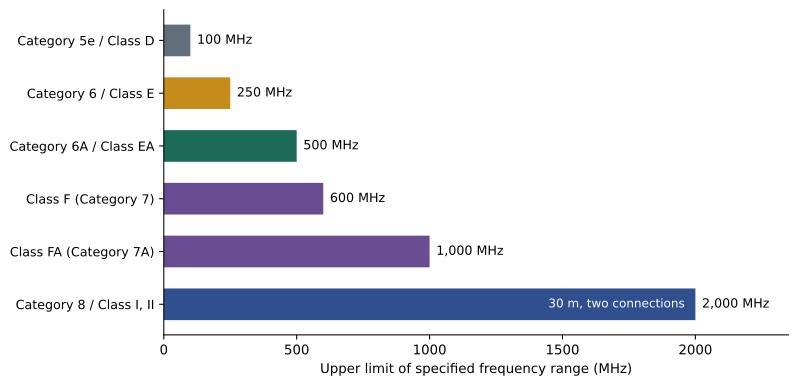
Category 5e remains in the standards as the minimum grade for new horizontal cabling in many documents, but almost no new enterprise design uses it. Category 6 is common where budgets are tight. Category 6A is the most common choice for new commercial buildings and is the minimum recommended in many current guidelines for wireless access points, because modern access points and their uplinks increasingly exceed one gigabit per second and need more power. Category 8 is designed for short links between switches and servers in data centres, not for horizontal cabling to work areas.
Category 7 and 7A, which you may see in marketing or older European specifications, are ISO component categories for Class F and FA channels. They use fully screened construction and often non-RJ45 connectors. TIA never adopted them, and no mainstream Ethernet application was written to use Class F or FA specifically. A product described as 'Category 7' with an ordinary RJ45 plug is not a Class F system, because the RJ45 interface cannot meet Class F limits.
Which applications run on which grade?
IEEE writes the Ethernet standards and defines which cabling classes each application needs. A designer chooses the cabling grade by working backward from the applications the building must support, now and over the life of the cabling. The life of cabling is typically far longer than that of the electronics: fifteen to twenty years is a common design life, which may span four or five generations of switches.
| Application | Usual cabling requirement |
|---|---|
| 1000BASE-T (1 Gb/s) | Category 5e or Class D, 100 m |
| 2.5GBASE-T and 5GBASE-T | Category 5e or 6, 100 m, subject to alien crosstalk conditions |
| 10GBASE-T (10 Gb/s) | Category 6A or Class EA, 100 m |
| 25GBASE-T and 40GBASE-T | Category 8 or Class I/II, 30 m |
| Power over Ethernet up to about 90 W | Any category; bundle heating favours larger conductors and Category 6A |
10GBASE-T over Category 6 deserves special mention, because it is a common question on projects and exams. The application standard and TIA guidance allow 10GBASE-T over some Category 6 channels at reduced lengths, if alien crosstalk is controlled, and give mitigation methods for existing installations. This is a remedy for existing cabling, not a design target. A new design that needs 10GBASE-T should specify Category 6A or Class EA.
The multigigabit applications, 2.5GBASE-T and 5GBASE-T, were written to let existing Category 5e and 6 cabling carry more than one gigabit per second, mainly for wireless access points. They are sensitive to alien crosstalk in large bundles, and the guidance includes ways to assess whether an existing installation will support them.
Components, links and the weakest link
A channel is only as good as its weakest component. A Category 6A cable terminated on Category 6 jacks is, at best, a Category 6 link. The same applies to patch cords. The certification tester tests the installed permanent link or channel against the limits for the grade, and it does not care what the box said. This is why specifications require all components in a channel to be of the same grade.
Many owners also require all components from a single manufacturer, or from a manufacturer's approved partner list, so that the manufacturer will issue a system warranty or performance guarantee covering the installed cabling. Mixing brands may work electrically, because standards-compliant components are designed to interoperate, but it often voids the system warranty and makes it harder to trace the cause of a failure. A designer should know the owner's warranty requirements before writing the specification.
Claims that a product exceeds a category, such as 'Category 6 enhanced' or '600 MHz Category 6A', describe the manufacturer's own testing beyond the standard's specified frequency range. No application uses the extra range, and a tester can only certify against the published limits. These claims are not a reason to choose one product over another unless the manufacturer guarantees the extra headroom as margin within the specified range.
Conductor size and cord types
Most horizontal cable uses solid copper conductors of 23 or 24 AWG. Solid conductors give lower loss and stable performance in permanent installations but are not designed to be flexed repeatedly. Patch and equipment cords use stranded conductors, which are more flexible but have higher loss. Standards therefore allow cords to have more insertion loss per metre than horizontal cable and include a derating factor in channel calculations. Reduced-diameter cords, often 28 AWG, are popular in dense patch fields because they are thinner and easier to manage. Current TIA standards recognize them with a lower maximum total cord length in the channel, because their loss is higher.
Larger conductors matter for Power over Ethernet. A 23 AWG conductor has lower resistance than a 24 AWG conductor, so it heats less when carrying PoE current. In large bundles carrying high-power PoE, this can make the difference between staying within temperature limits and having to reduce bundle sizes or link lengths.
Unscreened and screened grades
Each grade can be built as unscreened twisted pair (U/UTP) or with a foil or braid screen. Category 6A is available in both forms; Category 8 is screened. Screening changes how a cable behaves in noisy environments and in large bundles, but only if it is properly bonded. Lesson 11 compares the options in detail. For this lesson, the key point is that the grade is defined by the transmission limits, not by whether the cable is screened. A U/UTP Category 6A channel and an F/UTP Category 6A channel must meet the same limits.
Choosing a grade at Harbourview
Daniel prepares a short answer for Marcus. The design requires Category 6A components throughout, from a single manufacturer's warranted system, because the owner requires 10GBASE-T to every workstation for at least fifteen years and wants high-power PoE for access points and some displays. 'Category 6 enhanced' cannot be certified as Category 6A and would not support 10GBASE-T at full length, so it is not an acceptable substitution. Category 8 is designed for 30 m data centre links and is not suitable for horizontal cabling to clinic workstations. It would be more expensive, larger and less flexible, with no benefit for the applications the owner needs. The on-site data room might use Category 8 for a few short switch-to-server links if the network designer asks for 25GBASE-T or 40GBASE-T, which is a separate decision.
Exam focus: reading a grade requirement
Questions about categories and classes usually test three things: which frequency range goes with which grade, which grade an application needs, and the rule that a channel performs at the level of its weakest component. Memorize the pairs Category 5e and Class D at 100 MHz, Category 6 and Class E at 250 MHz, Category 6A and Class EA at 500 MHz, and Category 8 with Classes I and II at 2,000 MHz over 30 m. Remember that Classes F and FA use Category 7 and 7A components and have no TIA equivalent.
Also be ready for questions about cords and conductor size. Stranded cords have more loss per metre than solid horizontal cable, which is why standards limit total cord length in a channel. Reduced-diameter cords have even more loss and are allowed only with a shorter total cord length. When a question describes a channel with long or thin cords, check whether the total still fits within the channel model.
Worked problem
A channel with long cords
A Category 6A channel has a 90 m permanent link. The owner wants a 5 m equipment cord at each end, both of standard stranded construction. Assume the standard channel model allows a total of 10 m of cords with a 90 m permanent link. Does this channel fit the model?
Show solution
- Total cord length: 5 + 5 = 10 m.
- Permanent link: 90 m. Total channel: 100 m.
- The cords are within the 10 m allowance, so the channel fits the standard model.
Answer: Yes, exactly at the limit. If the cords were reduced-diameter types with a lower allowance, or if one cord were 7 m, the permanent link would have to be shortened.
Finally, remember that a category on a box is a claim about the components, and a category on a test report is a measured result for an installed link. Owners should ask for both: certified components from a recognized manufacturer, and field certification of every installed link.
Common mistakes
MistakeUsing Category and Class interchangeably.
InsteadTIA uses Category for components and installed cabling; ISO/IEC uses Category for components and Class for links and channels.
MistakeAssuming a higher frequency claim means better performance for every application.
InsteadApplications use only the specified frequency range. Extra range beyond the standard is not tested or used.
MistakeSpecifying Category 8 for horizontal cabling.
InsteadCategory 8 is a 30 m, two-connector data centre channel. It is not intended for 100 m horizontal links.
MistakeMixing grades in one channel.
InsteadA channel performs at the level of its weakest component. Specify the same grade throughout.
Summary and key terms
- TIA defines Categories 5e, 6, 6A and 8; ISO/IEC defines component Categories and channel Classes D, E, EA, F, FA, I and II.
- Each grade is a full set of transmission limits over a specified frequency range, not just a frequency number.
- Category 6A or Class EA is the usual choice for new commercial horizontal cabling and the target for 10GBASE-T at 100 m.
- Category 8 supports 25 and 40 gigabit twisted-pair applications over 30 m channels in data centres.
- A channel performs at the level of its weakest component, and owners often require a single-manufacturer warranted system.
- Category
- A TIA grade for balanced cabling components and installed cabling, or an ISO/IEC grade for components.
- Class
- An ISO/IEC grade for installed balanced cabling links and channels.
- Specified frequency range
- The range of frequencies over which a standard sets transmission limits for a grade.
- System warranty
- A manufacturer's guarantee covering an installed cabling system built from its components by an approved installer.
- Stranded conductor
- A conductor made of many fine wires, used in flexible cords, with higher loss than solid conductor.
- U/UTP
- Unscreened cable with unscreened pairs.
Practice problems
Work each problem on paper first, then reveal the answer to check.
Which ISO/IEC channel class corresponds to TIA Category 6A?
Show answer
Class EA.
Can a link built with Category 6A cable and Category 6 jacks be certified as Category 6A?
Show answer
No. The channel performs at the level of its weakest component, so at best it meets Category 6.
What is the maximum Category 8 channel length?
Show answer
30 m with two connections, intended for data centre links.
Lesson quiz · 5 questions
Score 60% or more to complete this lesson.
Create a free account to save your progress, take quizzes and earn a certificate.