
RCDD-110 · Lesson 1 of 12 · 24 min
Signals, bandwidth and data rates
▶ Video coming soon A video version of this lesson is on the way.
Daniel Oyelaran spent five years pulling, terminating and testing structured cabling before he moved into the design office at Lakehead Signal Design Group in Thunder Bay. He can punch down a jack in his sleep and read a certification report at a glance. What he has never had to do is explain why a cable passes or fails. On his first morning on the Harbourview Health and Learning Centre project, Roz Achterberg, the firm's principal designer and an RCDD for more than twenty years, hands him a single page from the owner's requirements: 'Support 10 gigabits per second to every clinic workstation and every classroom display for at least fifteen years.' She asks him one question. 'What does a cable actually have to do to carry ten gigabits per second?' Daniel realizes he can name the category but not the reason. This course is about the reason.
An RCDD designs infrastructure that has to carry signals the designer will never see: protocols that do not exist yet, equipment that will be replaced three times, and traffic patterns nobody can predict. The only way to design for that future is to understand the physics that every signal must obey. Transmission principles are the part of the RCDD body of knowledge that connects a requirement such as 'ten gigabits' to a measurable property of a channel, such as bandwidth, loss, noise and crosstalk. Once you see those connections, the rest of cabling design stops being a list of rules to memorize and becomes a set of choices you can defend.
What a signal is
A signal is a physical quantity that changes over time to carry information. In copper cabling the quantity is a voltage between two conductors. In optical fibre it is the power of light. In wireless systems it is an electromagnetic field radiating through space. The information is not the voltage or the light itself; it is the pattern of change. A steady voltage carries no information at all, because a receiver learns nothing from a value it could have predicted. Everything a designer does to a channel either preserves those patterns or blurs them.
Signals are often described as analogue or digital. An analogue signal can take any value within a range, like the voltage from a microphone. A digital signal represents information as a sequence of symbols drawn from a small set. In practice, every signal on a wire or fibre is analogue at the physical level. A 'digital' Ethernet signal is a carefully shaped analogue waveform that the receiver samples and decides between a few allowed levels. That is why digital systems still care about noise and distortion: if the waveform is blurred enough, the receiver chooses the wrong level and a bit error results.
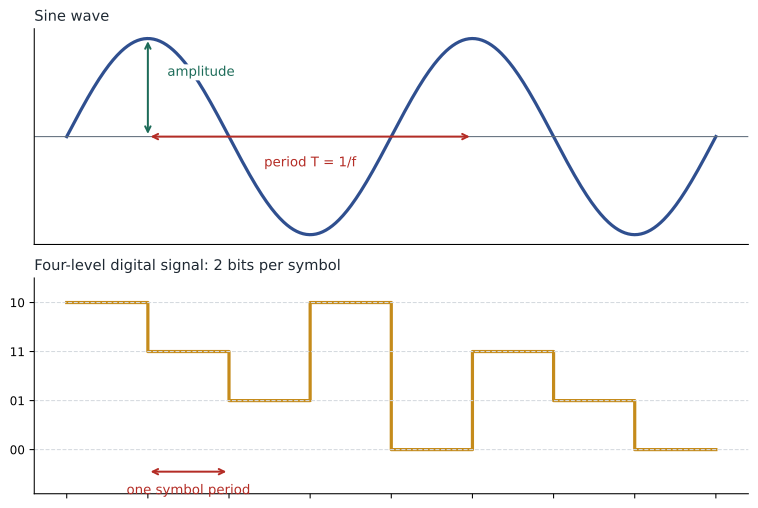
Frequency, period and wavelength
The simplest signal is a sine wave. It is described by its amplitude, which is how large the swing is, and its frequency \(f\), which is how many complete cycles occur each second, measured in hertz (Hz). The period \(T\) is the time for one cycle, so \(T = 1/f\). A 100 MHz sine wave completes 100 million cycles per second, and each cycle lasts 10 nanoseconds.
A signal also has a wavelength, the distance it travels during one period. Wavelength depends on how fast the signal moves through the medium: \(\lambda = v/f\), where \(v\) is the velocity of propagation. In free space \(v\) is the speed of light, about \(3 \times 10^{8}\) metres per second. In a twisted-pair cable the signal travels more slowly, typically around two thirds of that speed. Cable makers express this as the nominal velocity of propagation (NVP), a fraction of the speed of light such as 0.68.
Worked problem
Wavelength on a cable
A twisted-pair cable has an NVP of 0.68. What is the wavelength of a 250 MHz signal on the cable?
Show solution
- Find the velocity: \(v = 0.68 \times 3.0 \times 10^{8} = 2.04 \times 10^{8}\) m/s.
- Divide by the frequency: \(\lambda = 2.04 \times 10^{8} / 2.5 \times 10^{8} = 0.816\) m.
Answer: About 0.82 m. A 90 m horizontal cable is more than a hundred wavelengths long at this frequency, which is why cabling must be treated as a transmission line rather than a simple wire.
That last point matters. When a cable is short compared with the wavelength, it behaves like a simple pair of wires. When it is many wavelengths long, the signal behaves like a wave travelling down a guide. Reflections, impedance and timing all start to matter. Every modern category of balanced cabling is designed and tested as a transmission line, which is why the parameters you will meet in later lessons, such as return loss and propagation delay, exist at all.
Bandwidth
Real signals are not single sine waves. A square-edged digital pulse, a voice, or a video stream is a combination of many sine waves at different frequencies. The range of frequencies a signal contains is its spectrum, and the width of that range is its bandwidth. The same word is used for a channel: the bandwidth of a channel is the range of frequencies it can carry without unacceptable loss or distortion.
Designers have to keep three uses of the word apart. Signal bandwidth is the frequency range a transmitted signal occupies. Channel bandwidth, often called the specified frequency range, is the range over which a cabling standard sets performance limits, such as 1 to 500 MHz for Category 6A. And in everyday network talk, 'bandwidth' is often used loosely to mean data rate, as in 'we need more bandwidth to the classroom'. On the exam and in design documents, use bandwidth for frequency, measured in hertz, and data rate for information, measured in bits per second.
A cabling category does not 'have' a data rate. It has a specified frequency range and a set of limits on loss, crosstalk and other impairments across that range. Whether a given application, such as 10GBASE-T, runs over it depends on how the application uses that frequency range. That is why the same Category 6 cable might support 10 gigabits per second over a short distance but not over a full 100 m channel: the application needs more clean bandwidth than the longer channel can provide.
From bandwidth to data rate: symbols and encoding
A transmitter sends information as symbols. The symbol rate, measured in baud or symbols per second, is how many symbols are sent each second. If each symbol can take one of \(M\) distinguishable levels, it carries \(\log_2 M\) bits. The bit rate is therefore the symbol rate multiplied by the bits per symbol. Two levels carry 1 bit per symbol, four levels carry 2 bits, sixteen levels carry 4 bits.
In the 1920s Harry Nyquist showed that a channel of bandwidth \(B\) can carry at most \(2B\) independent symbols per second without them blurring into each other. So the maximum bit rate of a noiseless channel is \(2B \log_2 M\). This explains why application designers keep adding levels: if you cannot get more bandwidth out of a cable, you can send more bits per symbol. 1000BASE-T uses five-level signalling on all four pairs at once, and 10GBASE-T uses sixteen-level signalling with sophisticated coding. Each step packs more information into the same frequency range.
There is a catch. The more levels you use, the closer together they are, and the easier it is for noise to push the received signal onto the wrong level. In 1948 Claude Shannon found the absolute limit. A channel of bandwidth \(B\) with signal-to-noise ratio \(S/N\) (expressed as a plain power ratio, not in decibels) can carry at most \(C = B \log_2(1 + S/N)\) bits per second with arbitrarily few errors. No encoding can beat it.
Worked problem
How much does noise cost?
A channel has 400 MHz of usable bandwidth. What is the Shannon capacity if the signal-to-noise ratio is 1,000, and if it falls to 100?
Show solution
- With \(S/N = 1000\): \(\log_2(1001) \approx 9.97\), so \(C \approx 400 \times 10^{6} \times 9.97 \approx 3.99\) Gb/s.
- With \(S/N = 100\): \(\log_2(101) \approx 6.66\), so \(C \approx 2.66\) Gb/s.
- A tenfold increase in noise cut capacity by about one third.
Answer: About 4.0 Gb/s and 2.7 Gb/s per pair. Real applications run below the Shannon limit, but the lesson holds: capacity depends on clean bandwidth, not on bandwidth alone.
The Shannon formula is the most important idea in this course, because it tells a designer what to protect. Capacity grows with bandwidth and with signal-to-noise ratio. Everything that attenuates the signal reduces S. Everything that couples unwanted energy into the pair, such as crosstalk from neighbouring pairs, alien crosstalk from neighbouring cables, and interference from motors and lighting, increases N. A cabling standard is, in effect, a guarantee that the signal-to-noise ratio across the specified frequency range will stay above the level the target applications need.
| Quantity | Symbol | Unit | What it describes |
|---|---|---|---|
| Frequency | f | hertz (Hz) | Cycles per second of a sine wave |
| Bandwidth | B | hertz (Hz) | Width of a range of frequencies |
| Symbol rate | Rs | baud | Symbols sent per second |
| Bit rate | Rb | bits per second | Information sent per second |
| Signal-to-noise ratio | S/N | ratio or dB | Signal power compared with noise power |
Baseband, broadband and multiplexing
Most structured cabling carries baseband signals: the transmitted waveform occupies the frequency range starting near zero, and one signal uses the medium at a time in each direction. Broadband systems, such as cable television on coaxial cable, shift many signals to different carrier frequencies so they share one medium. This is frequency-division multiplexing. Wireless systems and optical networks use similar ideas. Coarse and dense wavelength-division multiplexing in fibre send several wavelengths of light, each carrying its own signal, down a single strand.
Twisted-pair Ethernet uses a different trick to reach high data rates: it sends signals in both directions on all four pairs at the same time. Each transceiver subtracts its own transmitted signal from what it hears, using a technique called echo cancellation, and uses digital signal processing to cancel predictable crosstalk from the other three pairs in the same cable. These techniques are powerful, but they can only cancel what they can predict. Noise from outside the cable, including alien crosstalk from adjacent cables in a bundle, cannot be cancelled this way. That is why Category 6A cabling has limits on alien crosstalk that earlier categories did not.
Duplex, latency and timing
A link can be simplex (one direction only), half duplex (both directions, but one at a time) or full duplex (both directions at once). Modern Ethernet over twisted pair and fibre is full duplex. On fibre, full duplex usually means two strands, one for each direction, although bidirectional optics can use two wavelengths on a single strand.
Latency is the time a signal takes to cross a channel. For cabling it is dominated by propagation delay, which depends on length and NVP. A 100 m channel with an NVP of 0.68 has a delay of about 490 nanoseconds. Cabling standards limit propagation delay and also delay skew, the difference in delay between the fastest and slowest pairs in a cable. Skew matters because applications that split data across four pairs must reassemble it at the far end. If one pair arrives much later than the others, the receiver cannot line the symbols up.
Worked problem
Propagation delay
Estimate the propagation delay of a 90 m permanent link with an NVP of 0.69.
Show solution
- Velocity: \(v = 0.69 \times 3.0 \times 10^{8} = 2.07 \times 10^{8}\) m/s.
- Delay: \(t = d/v = 90 / 2.07 \times 10^{8} \approx 4.35 \times 10^{-7}\) s.
Answer: About 435 ns, comfortably within the limits set for a full 100 m channel.
Design thinking: from requirement to channel
Back at Harbourview, Roz shows Daniel how to translate the owner's sentence into design requirements. 'Ten gigabits to every workstation' means the horizontal channels must support 10GBASE-T, which in turn means a channel rated to at least 500 MHz with controlled alien crosstalk: Category 6A or ISO Class EA. 'For fifteen years' means the design should leave margin for applications that might need more power, such as higher-power Power over Ethernet, which heats cable bundles and raises their loss. 'Every classroom display' raises the question of whether some displays will be fed by video-over-IP systems with their own bandwidth needs.
None of that comes from memorizing a table. It comes from understanding that each application needs a certain amount of clean bandwidth, that the channel delivers it only if loss and noise stay within limits, and that every later choice in the design, from pathway fill to separation from power, either protects or erodes that margin. Daniel writes the requirement chain at the top of his notebook: application, data rate, frequency range, signal-to-noise ratio, channel limits. It will appear again in every lesson of this course.
Common mistakes
MistakeTreating bandwidth and data rate as the same thing.
InsteadBandwidth is a range of frequencies in hertz; data rate is information in bits per second. Encoding links the two.
MistakeAssuming a category guarantees a data rate at any length.
InsteadA category guarantees transmission limits over a specified frequency range for a defined channel. Applications are then specified to run over particular channel classes and lengths.
MistakeUsing decibel values of S/N directly in the Shannon formula.
InsteadConvert decibels to a plain power ratio first; the formula needs the ratio.
MistakeForgetting that a long cable is a transmission line.
InsteadAt hundreds of megahertz a horizontal cable is many wavelengths long, so impedance, reflections and delay all matter.
Summary and key terms
- A signal carries information as a pattern of change in a physical quantity: voltage, light or an electromagnetic field.
- Frequency and period are reciprocals; wavelength depends on the velocity of propagation, which in cable is a fraction of the speed of light (NVP).
- Bandwidth is a range of frequencies. Data rate is bits per second. Symbol rate times bits per symbol gives data rate.
- Nyquist limits symbol rate to twice the bandwidth; Shannon limits capacity by both bandwidth and signal-to-noise ratio.
- Cabling standards protect capacity by limiting loss and noise across a specified frequency range, and by limiting delay and skew.
- Bandwidth
- The width of a range of frequencies, measured in hertz.
- Baud
- A unit of symbol rate: one symbol per second.
- Nominal velocity of propagation (NVP)
- The speed of a signal in a cable as a fraction of the speed of light.
- Signal-to-noise ratio (S/N)
- The power of the wanted signal divided by the power of noise, as a ratio or in decibels.
- Shannon capacity
- The maximum error-free data rate a channel of given bandwidth and signal-to-noise ratio can support.
- Delay skew
- The difference in propagation delay between the fastest and slowest pairs in a cable.
Practice problems
Work each problem on paper first, then reveal the answer to check.
What is the period of a 500 MHz sine wave?
Show answer
\(T = 1/f = 1/(5 \times 10^{8}) = 2\) ns.
A transmitter sends 800 million symbols per second using 16 levels. What is the raw bit rate?
Show answer
\(\log_2 16 = 4\) bits per symbol, so \(800 \times 10^{6} \times 4 = 3.2\) Gb/s.
A channel has 100 MHz of bandwidth and S/N of 255. What is its Shannon capacity?
Show answer
\(\log_2 256 = 8\), so \(C = 100 \times 10^{6} \times 8 = 800\) Mb/s.
Lesson quiz · 5 questions
Score 60% or more to complete this lesson.
Create a free account to save your progress, take quizzes and earn a certificate.