
PWR-520 · Lesson 8 of 12 · 24 min
Review: boilers and codes
▶ Video coming soon A video version of this lesson is on the way.
For the review of boilers and codes, Morwenna invited Grazyna Wolanski across from Cantwell. Grazyna had spent the autumn teaching Okonkwo the same material at the Third Class level (PWR-330, PWR-340), and she brought her code binder, with its owner's checklist taped inside the cover. "At First Class the questions are the same subjects," Grazyna said, "but they ask you to decide, not just describe. You won't be asked what a safety valve is. You'll be asked whether the valves on a boiler are adequate, what you'd do about a thinned shell, or how you'd organize the plant's inspection program. Paper 1B-1 is legislation and codes, 1B-3 is inspection, maintenance and repair, and 1A-3 and 1A-4 cover combustion, water treatment and plant operation. This material runs through all four."
This lesson reviews the boiler operation, combustion and water chemistry of PWR-330 and the codes, materials, inspection and safety management of PWR-340, with the design and integrity material of PWR-510, at the level of judgment expected of a candidate for the highest certificate or license. Worked problems check a boiler efficiency by the heat-loss method and the safety valve capacity for a planned package boiler.
Boilers and their operation
The boiler questions at this level assume the student knows the equipment and ask about its design, operation and failure. The main threads from PWR-330 are these.
- Types and circulation: firetube and watertube; natural, controlled and once-through circulation; why circulation weakens as pressure rises; the gas path from furnace to stack; and, from lesson 1 of this course, the design choices for supercritical, fluidized bed and heat recovery units.
- Burner management: the BMS prevents unsafe light-off, supervises the flame, trips fuel on unsafe conditions and is kept separate from combustion control; purge, trial for ignition, safety shutoff valves with a vent between them, and proof of closure are the core.
- Combustion control: positioning and fully metered systems, cross-limiting so that air leads fuel on increases and lags on decreases, excess air set just above the CO knee, oxygen and CO trim, and furnace draft control.
- Flue gas analysis and emissions: wet and dry measurement, correction to a reference oxygen, the main pollutants and their controls, and continuous emission monitoring.
- Efficiency: the direct and heat-loss methods, the dominant losses for gas firing, the HHV and LHV bases, and the fuel saved by an improvement.
- Startup, cycling and shutdown: warm-up limits, chemistry hold points, superheater and economizer protection, cycling damage, controlled cooling and layup.
- Upsets and emergencies: low and high water, tube failures, flame failures and furnace explosions, loss of fans, feed, fuel or power, with the written order of response.
Grazyna's point about decisions showed in the case studies she brought: boiler 1's flame failure on October 20, which led Cantwell to trend scanner signals; boiler 3's layup pitting, which led to a revised layup procedure and a review of all seasonal procedures; and boiler 2's stack temperature rise, still an open case awaiting its fire-side inspection (PWR-330, PWR-340). For each, a First Class answer would set out the evidence, the possible causes and how to distinguish them, the immediate actions, the longer-term changes and how their effectiveness would be checked.
Worked problem
Checking a boiler efficiency by the heat-loss method
Cantwell's October test of boiler 1 found these losses, in points per 100 of the higher heating value: dry flue gas 5.9, moisture from hydrogen in the fuel 11.3, moisture in the air 0.1, carbon monoxide 0.01 and radiation and convection 0.6 (PWR-330). Find the efficiency, compare it with the input-output figure of 0.825, and estimate the gas saved per year if the dry gas loss could be cut by 1.0 point on a boiler using 3.0 million m³ of gas a year.
Show solution
- \[\eta = 100 - (5.9 + 11.3 + 0.1 + 0.01 + 0.6) = 100 - 17.91 = 82.09 \;\to\; 0.821\]
- \[\text{Fuel saved} = F_1 \left(1 - \frac{\eta_1}{\eta_2}\right) = 3.0 \times 10^6 \times \left(1 - \frac{0.821}{0.831}\right) = 36{,}100 \text{ m}^3\text{/yr}\]
Answer: The heat-loss result, 0.821, agrees with the input-output figure of 0.825 within the uncertainty of the meters, as PWR-330 showed, and it also shows where the heat goes: more than three fifths of the loss is the moisture from burning hydrogen, which no burner adjustment can recover without a condensing economizer. The dry gas loss is the one an operator can influence, through excess air and stack temperature; a point of it is worth about 36,000 m³ of gas a year on this boiler.
Water treatment and steam purity
From PWR-330 and lesson 4 of this course, the water chemistry threads are: pretreatment, reverse osmosis and demineralization; condensate polishing; the choice between reducing and oxidizing all-volatile treatment, oxygenated treatment and phosphate or caustic drum treatment; steam purity limits and silica's rising distribution ratio with pressure; the corrosion mechanisms, FAC, under-deposit corrosion, corrosion fatigue and pitting; deposit measurement and chemical cleaning; and instrumentation and action levels. A First Class answer on chemistry ties each measurement to the damage it prevents: cation conductivity to hydrogen damage and turbine stress corrosion cracking, iron to FAC and deposits, oxygen to pitting and FAC, silica to turbine deposits.
Codes and legislation
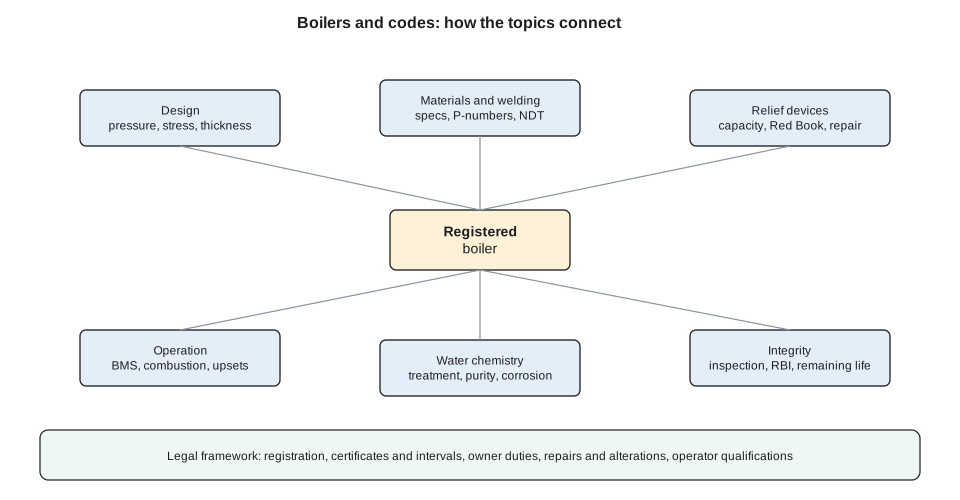
The code threads come from PWR-340 and PWR-510. Construction codes, the ASME Boiler and Pressure Vessel Code and B31 piping codes as adopted through CSA B51 in Ontario, govern equipment until it enters service; in-service codes such as the National Board Inspection Code and the API codes govern inspection, repair, alteration and assessment afterward. The Technical Standards and Safety Act and its regulations set the legal framework: registration of designs and equipment, certificates of inspection and their maximum intervals, the owner's duties, the qualifications of operating engineers and the rules for repairs and alterations by registered organizations. In Alberta, ABSA administers the Pressure Equipment Safety Regulation and accepts owner-user quality programs that allow qualified owners to manage much of their own inspection.
- Design: design pressure and temperature, allowable stress from Section II Part D, joint and ligament efficiencies, corrosion and manufacturing allowances, and the teaching thickness relations that the code's own formulas refine (PWR-340, PWR-510).
- Materials: specifications and grades traced to mill test reports, P-numbers, the progression from carbon steel through chromium-molybdenum and Grade 91 to stainless steels with temperature, creep and the long-term damage mechanisms.
- Welding and inspection: Section IX procedure and welder qualification, essential variables, preheat and post-weld heat treatment, and the NDT methods and their limits.
- Relief devices: safety and relief valves, set pressure, accumulation and blowdown, certified capacity, the National Board Red Book and VR repair, and the rule that relief must cover every credible overpressure scenario.
- Integrity management: a register, damage mechanism reviews, inspection plans, corrosion rates and remaining life, risk-based inspection and fitness-for-service assessment (lesson 7 of PWR-510).
Worked problem
Safety valve capacity for a planned package boiler
Anselm's expansion study proposes two package boilers of 4.25 kg/s (15,300 kg/h) each (PWR-510, a plan). If each boiler is designed for 1,600 kPa gauge and fitted with two safety valves set at that pressure, with 3 in 100 accumulation, estimate the minimum flow area each valve needs using Napier's relation with a coefficient of 0.975 and a derating factor of 0.9, as in PWR-340. Use atmospheric pressure of 101.3 kPa.
Show solution
- \[P_1 = 1{,}600 \times 1.03 + 101.3 = 1{,}749.3 \text{ kPa abs}\]
- \[A = \frac{W}{k\,K\,P_1} = \frac{15{,}300}{0.005252 \times 0.8775 \times 1{,}749.3} = 1{,}898 \text{ mm}^2 \qquad \text{each valve} \approx 949 \text{ mm}^2 \;(34.8 \text{ mm diameter})\]
Answer: The real selection is made from the manufacturer's certified capacities in the National Board Red Book at the boiler's set pressure, and the rules for power boilers also govern the number of valves, the second valve's set pressure, and the capacity required where there is a superheater. The estimate tells the designer roughly what size of valve to expect and gives the chief engineer a check on the vendor's proposal. The design pressure itself is a plan value for the study; the final figure will come from Marrowby's required steam pressure and the line losses.
Process safety and its management
PWR-340's process safety lessons reach beyond boilers: process safety management programs, hazard analysis and management of change, and incident investigation. At First Class level they appear on the safety, loss and environmental program management paper as questions of design and leadership: how would you set up a management of change procedure, what would your hazard analysis of a new auxiliary boiler cover, how would you investigate a near miss so that the root causes are found. Grazyna's answer outline for any such question had five parts: purpose and scope, the steps of the process, roles and authorities, records, and how the program is audited and improved. "If you can't say how you'd know the program is working," she said, "you haven't finished the answer."
The owner and the chief
Every code and safety question at this level comes back to the duties of the owner and the chief engineer. The law places the duty to keep equipment safe on the owner; the owner relies on the chief engineer to run the systems that do it; and the inspector or regulator checks that those systems work. Grazyna's owner's checklist, taped inside her binder, was the last thing she showed Anselm: registration and certificates current, inspections scheduled within their maximum intervals, relief devices serviced and recorded, repairs and alterations only by qualified organizations under the proper code, operators qualified for the plant's rating, procedures current and followed, incidents reported and investigated, and records that would let an inspector see all of it in an hour.
A decision question: a thinning deaerator
Grazyna set Anselm a question of the kind she expected on the inspection paper, using Cantwell's own deaerator storage tank (PWR-340). The general shell readings and the readings at the condensate return inlet had been taken years apart, and she asked him to say what the readings meant and what he would do.
Worked problem
Remaining life at two locations
The deaerator storage tank's general shell condition monitoring locations read 9.6 mm in 2016 and 9.1 mm in 2026. At the condensate return inlet they read 9.1 mm in 2022 and 8.4 mm in 2026. The minimum required thickness is 6.0 mm. Find the corrosion rate and remaining life at each location and the latest date for the next inspection of the inlet if it is set at half the remaining life.
Show solution
- \[\text{Shell: } r = \frac{9.6 - 9.1}{10} = 0.05 \text{ mm/yr} \qquad RL = \frac{9.1 - 6.0}{0.05} = 62 \text{ yr}\]
- \[\text{Inlet: } r = \frac{9.1 - 8.4}{4} = 0.175 \text{ mm/yr} \qquad RL = \frac{8.4 - 6.0}{0.175} = 13.7 \text{ yr} \qquad \tfrac{1}{2} RL = 6.9 \text{ yr}\]
Answer: The shell is in no danger, but the inlet is thinning three and a half times faster, which points to a local mechanism such as impingement or flow-accelerated corrosion where the condensate enters. Half the remaining life would put the next inlet inspection in about 2032, but the jurisdiction's maximum interval and the uncertainty in a rate based on two readings both argue for sooner. Anselm's answer, which Grazyna marked well, was to inspect the inlet at the next scheduled internal inspection within the regulatory interval, add condition monitoring locations around and downstream of the inlet, find out why the rate was high by checking the condensate pH and the inlet's design, and consider an impingement baffle or a more resistant material if the cause was confirmed. That matched what Cantwell had already planned, including the question to its water treatment supplier about condensate pH.
The example shows what examiners mean by judgment. The arithmetic takes two minutes; the marks come from recognizing that two readings give an uncertain rate, that a local rate is a sign of a local mechanism, that the jurisdiction's limit and the calculated interval must both be respected, and that a corrective action should address the cause as well as the symptom.
Combustion and emissions questions
Combustion questions at this level usually join three steps: a combustion calculation from the fuel analysis, a link to the flue gas measurement, and a judgment about operation or emissions. A typical question gives a fuel gas composition and a measured stack oxygen, and asks for the excess air, the flue gas flow, the efficiency effect and whether a NOx reading corrected to the reference oxygen meets a limit. The methods are all in PWR-310 and PWR-330: the oxygen and air required per unit of fuel, the dry gas balance for excess air, the correction (20.9 − O₂ref) ÷ (20.9 − O₂meas), and the heat-loss terms. Grazyna's warning was about bases: wet and dry, volume and mass, higher and lower heating value, and actual and reference oxygen. Most lost marks on combustion questions come from mixing two bases in one line, not from the chemistry. She suggested writing the basis in brackets after every number until it became a habit, as she had done herself when she wrote her own papers.
Common mistakes
MistakeDescribing equipment when the question asks for a decision.
InsteadState the decision, the evidence for it and how it would be checked.
MistakeQuoting an efficiency without its basis.
InsteadState HHV or LHV and the method; reconcile direct and heat-loss results.
MistakeSizing a safety valve with gauge pressure in Napier's relation.
InsteadUse absolute relieving pressure, including accumulation, and select from certified capacities.
MistakeTreating the inspector as responsible for the equipment.
InsteadThe owner is responsible; the inspector verifies.
MistakeAnswering a program question with only its steps.
InsteadCover purpose, steps, roles, records and how the program is audited and improved.
MistakeSeparating chemistry from damage mechanisms.
InsteadTie each chemistry measurement to the damage it prevents.
Summary and key terms
- Boiler questions at this level ask for design, operating and failure judgments drawn from types, BMS, combustion control, efficiency, startup and emergency response.
- The heat-loss method gives Cantwell boiler 1 an efficiency of about 0.821 (ca) or 0.828 (us) and shows that moisture from hydrogen dominates the losses.
- Fuel saved by an efficiency improvement is the fuel used times one minus the ratio of the old to the new efficiency.
- Water chemistry answers tie each measurement to the damage it prevents.
- Construction codes govern until service; in-service codes and the jurisdiction's law govern inspection, repair and alteration, with the owner responsible.
- Safety valve flow area is estimated from Napier's relation at absolute relieving pressure, then selected from certified capacities.
- Program questions are answered with purpose, steps, roles, records and audit.
- Heat-loss method
- Finding boiler efficiency by subtracting the measured losses from one.
- Construction code
- A code that governs design, fabrication, inspection and testing of new equipment.
- In-service code
- A code that governs inspection, repair, alteration and assessment of equipment in service.
- Accumulation
- The pressure rise above set pressure while a safety valve relieves at full capacity.
- Certified capacity
- The relieving capacity of a valve design certified by testing and listed for use.
- Owner's checklist
- A summary of the owner's legal duties for registered equipment, used to check compliance.
Practice problems
Work each problem on paper first, then reveal the answer to check.
Losses 6.4, 11.1, 0.1 and 0.8 points. Heat-loss efficiency?
Show answer
About 0.816.
A boiler uses 2.0 million m³/yr at 0.80. Fuel saved by raising efficiency to 0.83?
Show answer
About 72,300 m³/yr.
Relieving 9,000 kg/h at 1,035 kPa gauge set, 3 in 100 accumulation. Napier area with K = 0.8775?
Show answer
About 1,670 mm² in total.
Who is responsible for keeping a registered boiler safe?
Show answer
The owner, through the chief engineer; the inspector verifies.
Lesson quiz · 5 questions
Score 60% or more to complete this lesson.
Create a free account to save your progress, take quizzes and earn a certificate.