
PWR-520 · Lesson 12 of 12 · 23 min
Capstone: running a cogeneration plant
▶ Video coming soon A video version of this lesson is on the way.
For the last session of the course, Morwenna did not teach. She handed Anselm a folder labelled "A day as chief" and told him that for the next two hours he was Keswold's chief engineer. The folder held a winter day assembled from the plant's own records of the past year: real operating data, real calls, real problems, rearranged into a single day and given times. "Nothing in here is invented," she said, "but it never all happened on one day. If you can run this day, you can run the plant. I'll play everyone who calls you." Liesl sat in as the shift supervisor on duty, and Ingeborg took the reliability engineer's part.
This capstone draws on the whole power engineering program. It follows the exercise hour by hour through the decisions a chief engineer makes on an ordinary day that stops being ordinary: reading the plant at handover, checking whether the water plant can keep up, answering the grid operator, handling a gas turbine trip that cuts off the steam host, reporting and investigating, and turning the day's lessons into changes. Two worked examples check the makeup water balance and the heat delivered to the steam host.
06:30: reading the plant
The day began, as Morwenna's days do, with the night shift's log, the overnight alarm summary and the plant's key numbers. It was a cold January morning, about −15 °C. The gas turbine was at 44 MW with its inlet heating on, the duct burners were firing, the HRSG was making about 22.0 kg/s of steam, the steam turbine was at 17 MW, and Marrowby was taking 6.0 kg/s at 1,200 kPa. Overnight, the night crew had logged a chattering low-level alarm on the condensate return tank, one of the top ten nuisance alarms in Liesl's count (lesson 5); a slightly high feedwater iron reading on the grab sample; and the usual morning call from Marrowby about the day's production plan, which included a full shift on the new cooking line trial.
Anselm's first decisions were small and quick. The chattering alarm went to the instrument technician with a request to check the level transmitter's damping and the alarm deadband through the normal management of change, not to be shelved. The iron reading went to the chemistry lead with a request for a repeat sample and a look at the condensate return, since high iron in the return often means corrosion in the customer's piping. He then asked a question Morwenna had hoped for: how much of Marrowby's steam was coming back as condensate, and could the water plant keep up with a full production day?
08:00: can the water plant keep up?
Worked problem
Makeup water balance
Marrowby returns about 70 in 100 of the steam it takes as condensate (a figure from the plant's records). The HRSG's continuous blowdown is about 1 in 100 of steam flow. The reverse osmosis unit is fed 10 m³/h at a recovery of 0.75 (PWR-330). At 6.0 kg/s to Marrowby and 22.0 kg/s of steam, find the makeup water required and compare it with the RO unit's output.
Show solution
- \[\dot m_{mu} = 6.0 \times 0.30 + 0.01 \times 22.0 = 1.80 + 0.22 = 2.02 \text{ kg/s} \;(7.3 \text{ m}^3\text{/h})\]
- \[\dot m_{RO} = 10 \times 0.75 = 7.5 \text{ m}^3\text{/h} \;(2.08 \text{ kg/s}) \qquad \text{margin} = 2.08 - 2.02 = 0.06 \text{ kg/s}\]
Answer: On a full production day the RO unit runs almost flat out, with a margin of about 3 in 100. The demineralized water tank covers short gaps, but any loss of condensate return, an RO membrane problem or a polisher regeneration at the wrong time could leave the plant short of makeup. Anselm noted two consequences: the water plant is a hidden constraint on Marrowby's planned expansion, which would add steam demand and therefore makeup (PWR-510), and the condensate return fraction is worth money, since every kilogram returned is a kilogram not treated, heated or sent to the sewer. He added a second RO train or a larger unit to the expansion study's list of questions and asked Marrowby's plant engineer for a joint look at their condensate losses.
10:30: the grid operator calls
Mid-morning, the grid operator's control room asked Keswold to raise its reactive output from both generators to help hold voltage during a transmission outage elsewhere on the system. Liesl raised the steam turbine generator from 4 to 10 Mvar, as she had on October 28 (PWR-320), and the gas turbine generator by a similar amount. Anselm's role was to confirm that both machines were within their capability curves (lesson 6), that the field currents and stator temperatures stayed in range, and that the log recorded the request, the time and the response for the plant's compliance records. It took ten minutes and would have been unremarkable except for what came next.
14:10: the gas turbine trips
At 14:10 the gas turbine tripped on a flame detector fault in one combustor. The exhaust flow collapsed, the HRSG pressure began to fall, and within a few minutes the steam turbine was following its inlet pressure down. Liesl's crew carried out the trip procedure: they confirmed that the fuel valves had closed and the duct burners had tripped, held the HRSG drum level as the pressure fell, kept the steam turbine on its inlet pressure control until it tripped on low steam pressure, and then put it on turning gear. Both generator breakers opened correctly, and the plant's auxiliaries transferred to the grid supply without a hitch.
The harder problem was across the road. Marrowby needs steam continuously and starts shutting its cookers after about twenty minutes without it (PWR-510). Keswold has no standby boiler; that is exactly what the expansion study recommends adding in 2028 (a plan). Anselm had perhaps fifteen minutes to decide whether the gas turbine could be restarted in time, and to tell Marrowby either way.
Worked problem
What the steam host loses
Marrowby takes 6.0 kg/s of steam from the extraction at about 1,200 kPa and 283 °C (h ≈ 3,009.8 kJ/kg), and its condensate returns at about 60 °C (h ≈ 251.4 kJ/kg). Find the heat delivered to Marrowby, the energy over a full day, and the steam lost in twenty minutes without supply.
Show solution
- \[\dot Q = 6.0 \times (3{,}009.8 - 251.4) = 16{,}550 \text{ kW} \qquad E_{day} = 16.55 \times 24 = 397 \text{ MWh}\]
- \[m_{20} = 6.0 \times 1{,}200 = 7{,}200 \text{ kg}\]
Answer: Keswold delivers about 16.5 MW of heat to Marrowby, almost as much as the steam turbine's electrical output, and the whole of Marrowby's production depends on it. Twenty minutes without supply is only about 7 tonnes of steam, which no accumulator or pipe volume at Keswold could cover; the answer has to be a standby boiler, as the expansion study concluded.
Anselm's decisions, which he spoke aloud for Morwenna, came in order. First, safety: the plant was stable and safe, so nothing needed to be rushed. Second, information: the flame detector fault was a single failed detector, confirmed by the instrument technician, and the gas turbine manufacturer's procedure allowed a restart after replacing it and a successful test. Third, the customer: he called Marrowby's plant engineer at 14:16, told him that steam would be lost for at least an hour, and recommended that Marrowby begin its own controlled shutdown of the cookers rather than wait and risk spoiled product. Fourth, the grid: Liesl had already notified the grid operator of the trip as the market rules require, and Anselm confirmed the expected return time. Fifth, the restart: once the detector was replaced, the gas turbine was restarted on its normal procedure, not a rushed one, and the HRSG and steam turbine were brought back in sequence. Steam returned to Marrowby at 16:05.
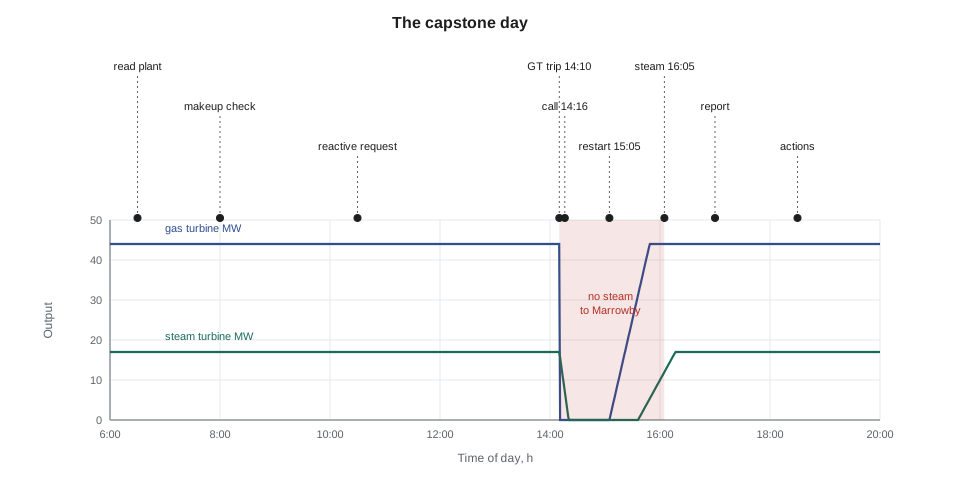
Morwenna stopped the exercise to ask one question: "Why didn't you ask Liesl to restart the gas turbine straight away and try to beat the twenty minutes?" Anselm's answer was the one she wanted. A fast restart after an unexplained trip risks a second trip, a hot gas path problem or damage that the LTSA would not cover; the cause had to be understood first; and Marrowby was better served by a clear, early warning and a planned shutdown than by an uncertain promise. The cost of the lost production would be real, and it was the strongest evidence yet for the standby boilers.
17:00: reporting and investigating
By the end of the afternoon, Anselm had a short list of things to do before he went home. The owner needed a preliminary report the same day: what happened, the effect on generation and on Marrowby, the cause as far as known, and the actions taken. The trip was a forced outage that would affect the plant's availability figures and might affect its capacity obligations and its steam contract's availability terms, so the commercial manager needed to know. The flame detector fault went to the LTSA provider with the data from the trip, because the manufacturer tracks such failures across its fleet. And an investigation was opened with Ingeborg as lead, scaled to the event: not a full root cause analysis for a single failed detector, but enough to find out why the detector failed, whether others of the same batch were at risk, and why one detector's failure tripped the whole unit.
The trip was one of the real events behind the folder, from the previous winter. In the exercise the investigation took a few minutes; in real life it took a week, and it found that the combustor's flame detection logic required both detectors on one combustor to agree, and that a single failed detector had been treated as a loss of flame. The manufacturer offered a logic change that would alarm on a single detector failure and trip only on a confirmed loss of flame. In the exercise Anselm put the change through management of change, with the LTSA provider and the BMS's safety requirements reviewed, because a change to a burner management function is a change to a safety function; Morwenna told him afterwards that the real change had gone through the same review and been installed during the fall outage.
18:30: turning the day into improvements
Morwenna's final question was what Anselm would change at Keswold as a result of the day. His list had five items, each with an owner and a date.
- Standby steam for Marrowby: bring forward the expansion study's recommendation, with the day's lost production as part of the case (owner: Anselm; the study goes to the owner in February 2027, a plan).
- Water plant capacity: add makeup water capacity to the expansion scope, and work with Marrowby on condensate return (owner: chemistry lead).
- Flame detection logic: review and implement the manufacturer's change through management of change (owner: Ingeborg; already done after the real event).
- Trip communication: a one-page procedure for calling Marrowby, the grid operator and the owner after any trip, with the information each needs and the person who calls (owner: Liesl, as incoming shift supervisor).
- Alarm and chemistry follow-ups: close the chattering alarm and the iron reading through their normal processes and check that they were not early signs of something larger (owners: instrument technician and chemistry lead).
"That's the job," Morwenna said, closing the folder. "Most days are the morning: read the plant, fix the small things before they become big ones, keep the customers and the grid informed. Some days are the afternoon. What makes a good chief is that the morning work is what lets you handle the afternoon calmly, and that you turn every afternoon into a better morning."
The program in one plant
The capstone day touched almost every course in the program: boiler and HRSG operation and chemistry (PWR-120, PWR-220, PWR-330), steam turbines and generators (PWR-230, PWR-320), controls, alarms and safety functions (PWR-240, PWR-420, lesson 5), codes and process safety (PWR-340), electrical systems and the grid (PWR-410, lesson 6), management of change, investigations and people (PWR-420, PWR-510), and the economics and planning of the expansion study (PWR-510). That breadth is what the highest certificate or license is meant to recognize: not a specialist in any one system, but an engineer who understands how all of them work together and who can be trusted to run the whole plant.
What the exercise was really testing
Afterwards, Morwenna explained what she had been watching for. It was not whether Anselm knew the trip procedure, which Liesl's crew carried out without him; it was whether he stayed at the level of the chief: making sure the crew had what they needed, keeping the people outside the fence informed, protecting the equipment and the long-term agreement, and thinking about what the event meant for the plant's future. A chief who takes over the board in an upset leaves no one to do the chief's work. The crew runs the plant; the chief runs everything around it. Anselm wrote that sentence at the top of the page of notes he planned to keep for his first year in the job.
Common mistakes
MistakeShelving a nuisance alarm to quiet it.
InsteadFix the cause through management of change; shelving hides the next real alarm.
MistakeAssuming the water plant has plenty of capacity.
InsteadCheck makeup against return losses and blowdown on the heaviest day.
MistakeRushing a restart after an unexplained trip.
InsteadUnderstand the cause first; a second trip or damage costs more than the wait.
MistakeTelling the steam host steam will be back soon without knowing.
InsteadGive a clear, early, honest estimate so the customer can shut down in a controlled way.
MistakeInvestigating every event at full scale, or none at all.
InsteadScale the investigation to the event, but always find out why it happened and whether it could recur.
MistakeEnding the day without assigning actions.
InsteadGive each improvement an owner and a date, and follow it up.
Summary and key terms
- A chief engineer's day starts with reading the plant and fixing small problems before they grow.
- On a full production day, Keswold's makeup water need of about 2.0 kg/s or 16,000 lb/h uses almost all of the RO unit's output.
- Keswold delivers about 16.5 MW of heat to Marrowby; twenty minutes without steam is too much to store, so standby supply needs a boiler.
- After a trip, the order is safety, information, the customer, the grid and a controlled restart once the cause is known.
- Reporting and investigation are scaled to the event, and changes to safety functions go through management of change.
- Every significant day ends with improvements that have owners and dates.
- The highest certificate or license recognizes an engineer who understands how the whole plant works together.
- Forced outage
- An unplanned removal of a unit from service because of a failure or trip.
- Makeup water
- Treated water added to the cycle to replace losses such as unreturned condensate and blowdown.
- Condensate return fraction
- The share of steam delivered to a user that comes back as condensate.
- Steam host
- The industrial customer that takes steam from a cogeneration plant.
- Scaled investigation
- An investigation whose depth matches the actual and potential severity of the event.
Practice problems
Work each problem on paper first, then reveal the answer to check.
Steam to host 5.0 kg/s, return 0.80, blowdown 0.01 of 20.0 kg/s. Makeup?
Show answer
1.20 kg/s.
Steam h 2,950 kJ/kg, condensate h 335 kJ/kg, 4.0 kg/s. Heat delivered?
Show answer
About 10.5 MW.
Name the order of priorities after a trip that cuts off a steam host.
Show answer
Safety, information, the customer, the grid, then a controlled restart once the cause is known.
Why should a change to flame detection logic go through management of change?
Show answer
It changes a burner management safety function.
Lesson quiz · 5 questions
Score 60% or more to complete this lesson.
Create a free account to save your progress, take quizzes and earn a certificate.