
PWR-520 · Lesson 7 of 12 · 26 min
Review: applied mechanics and thermodynamics
▶ Video coming soon A video version of this lesson is on the way.
With the new material covered, Morwenna turned the sessions into review. She had kept her own First Class study notes from years ago, a binder of worked problems with a page of formulas at the front, and she gave Anselm a blank copy of the formula page and asked him to fill it in from memory before they started. "The 1A-1 and 1A-2 papers are thermodynamics and applied and fluid mechanics, and they are calculation papers," she said. "Every question expects you to know which principle applies, write the right equation, get the steam properties right and finish with a number and a sentence about what it means. This review is about doing that fast and without slips."
This lesson reviews the mechanics, strength of materials, thermodynamics, heat transfer and fluid mechanics of the Third and Second Class courses (PWR-310 and PWR-410), and the design calculations of PWR-510, at the level a First Class or chief engineer candidate is expected to handle. It sets out the core relations, the habits that prevent errors, and three worked problems drawn from Keswold: the high pressure section of the steam turbine, a thin cylinder check and a gas turbine and combined cycle comparison.
Mechanics and strength of materials
The mechanics questions at this level are rarely about new principles; they combine familiar ones. A rigging problem uses resolution of forces and sling angles; a shaft problem uses torque, power and shear stress; a vessel problem uses hoop and longitudinal stress; a pipe support problem uses thermal expansion and bending. The core relations from PWR-310 and PWR-410 are the ones to know without looking them up.
| Topic | Core relations |
|---|---|
| Statics | Sum of forces and sum of moments each zero; sling leg tension W / (2 sin θ) for two symmetrical legs |
| Dynamics | F = ma; ω = 2πN / 60; centripetal force mω²r; kinetic energy ½mv² and ½Iω² |
| Stress and strain | σ = F / A; ε = ΔL / L; E = σ / ε; shear τ = F / A (double shear uses twice the area) |
| Thermal stress | Free growth αLΔT; fully restrained stress EαΔT |
| Thin cylinders and spheres | Hoop PD / 2t; longitudinal PD / 4t; sphere PD / 4t |
| Shafts | Power = Tω; shear stress 16T / πd³ for a solid shaft |
| Fatigue and creep | Linear damage sum of n / N; Larson-Miller T (C + log t) |
Morwenna's three habits for mechanics questions were the same ones Grazyna had taught Okonkwo at the Third Class level (PWR-310): draw the free body diagram first, write the units on every line, and estimate the answer before calculating it. At this level she added a fourth: state the assumption. A thin cylinder formula assumes the wall is thin compared with the diameter; a thermal stress formula assumes full restraint; a Larson-Miller estimate assumes a constant C. An examiner rewards an answer that says what it assumes.
Worked problem
Checking a drum by the thin cylinder relation
A steam drum has an inside diameter of 1,500 mm and a wall thickness of 40 mm, at a design pressure of 7,000 kPa gauge (teaching values, PWR-510). Find the hoop and longitudinal stresses by the thin cylinder relations, and comment on whether the thin wall assumption is reasonable.
Show solution
- \[\sigma_h = \frac{P D}{2 t} = \frac{7.0 \times 1{,}500}{2 \times 40} = 131 \text{ MPa} \qquad \sigma_l = \frac{P D}{4 t} = 66 \text{ MPa}\]
Answer: The ratio of thickness to diameter is about 1 in 37, so the thin wall relation is a fair approximation; the code's own formulas, which use the mean or outside diameter and add corrections, govern the actual design (PWR-340, PWR-510). The hoop stress is close to the allowable stress of a common drum plate, which is why drums of this size and pressure are made of thick plate, and why their nozzles, where stress concentrates, are the focus of fatigue checks.
Thermodynamics
The thermodynamics questions turn on a few principles: the first law for closed systems and for steady flow, the second law in the form of entropy and isentropic efficiency, the properties of steam and gases, and the analysis of cycles. PWR-310 covered the Rankine cycle, steam tables, the Mollier diagram and gas laws; PWR-410 added reheat and regeneration, gas turbines and combined cycles, refrigeration and heat pumps, exergy and plant heat rate.
- Steady flow energy equation: q − w = h₂ − h₁ for most equipment, with kinetic and potential energy usually negligible except in nozzles.
- Isentropic efficiency: for a turbine, actual enthalpy drop over isentropic drop; for a pump or compressor, isentropic work over actual work.
- Steam properties: decide first whether the state is compressed, wet or superheated by comparing with saturation values; use absolute pressures; interpolate carefully or use the formulation the examination allows.
- Cycle efficiency: net work over heat added; heat rate is its reciprocal in plant units; reheat raises the mean temperature of heat addition and dries the exhaust; regeneration raises the feedwater temperature.
- Gas cycles: T₂ / T₁ = (p₂ / p₁)^((k − 1)/k) for isentropic compression; ideal Brayton efficiency depends only on pressure ratio; combined cycle efficiency is η_g + (1 − η_g) η_b.
- Second law: lost work is T₀ times entropy generated; exergy is the useful work potential relative to the surroundings.
Worked problem
The high pressure section of Keswold's steam turbine
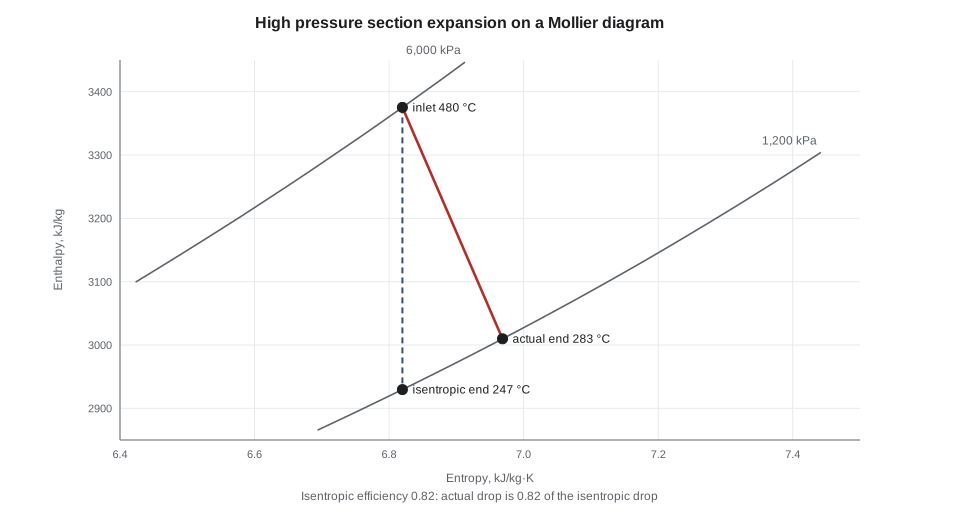
Steam enters Keswold's steam turbine at 6,000 kPa absolute and 480 °C and expands through the high pressure section to the extraction point at 1,200 kPa absolute. After the fall outage the section's isentropic efficiency is about 0.82 (PWR-320). Find the extraction temperature and the section's power with 22.0 kg/s flowing. Use IAPWS-IF97 properties.
Show solution
- \[h_1 = 3{,}375.2 \text{ kJ/kg} \qquad s_1 = 6.8198 \text{ kJ/kg·K}\]
- \[\text{At } 1{,}200 \text{ kPa and } s = s_1: \; T_{2s} = 247.3 \text{ °C} \qquad h_{2s} = 2{,}929.6 \text{ kJ/kg}\]
- \[h_2 = 3{,}375.2 - 0.82 \times (3{,}375.2 - 2{,}929.6) = 3{,}009.8 \text{ kJ/kg} \qquad T_2 = 283.3 \text{ °C}\]
- \[P = 22.0 \times (3{,}375.2 - 3{,}009.8) = 22.0 \times 365.4 = 8{,}038 \text{ kW}\]
Answer: The calculated extraction temperature, about 283 °C, matches what the plant measured after the outage (PWR-410), and it confirms that the section's efficiency recovered from about 0.80 to about 0.82 with the outage work. The high pressure section produces about 8.0 MW of the turbine's output at this flow. A drop in efficiency would show up first as a rise in extraction temperature at the same inlet conditions, which is why the operators trend it.
Gas turbines and combined cycles
Gas turbine questions combine gas properties with cycle analysis. The ideal Brayton cycle gives an efficiency that depends only on the pressure ratio and the ratio of specific heats; real compressor and turbine efficiencies introduce an optimum pressure ratio for efficiency and another for specific work (PWR-410). Combined cycle questions then add the bottoming steam cycle.
Worked problem
Keswold's gas turbine and combined cycle
Keswold's gas turbine has a pressure ratio of about 12 (PWR-320). Find the ideal Brayton efficiency with k = 1.4, and compare it with the actual corrected efficiency of 0.34 measured after the October wash. Then estimate the unfired combined cycle efficiency if the bottoming cycle converts 0.21 of the heat it receives into electricity.
Show solution
- \[\eta_{Brayton} = 1 - r_p^{-(k-1)/k} = 1 - 12^{-0.2857} = 0.508\]
- \[\eta_{cc} = \eta_g + (1 - \eta_g)\,\eta_b = 0.34 + 0.66 \times 0.21 = 0.48\]
Answer: The actual gas turbine reaches about two thirds of the ideal figure, a typical ratio for an industrial gas turbine of this size and pressure ratio, because of compressor and turbine losses, cooling air and pressure losses. The combined figure of about 0.48 agrees with PWR-410's analysis of Keswold unfired: a single-pressure HRSG and moderate steam conditions limit what the bottoming cycle can recover. Large combined cycle plants with three pressure levels and reheat reach about 0.6 or more on the lower heating value.
Heat transfer and fluid mechanics
Heat transfer questions at this level usually involve a heat exchanger: find the duty from an energy balance, the log mean temperature difference, the overall coefficient from film, wall and fouling resistances, and the area; or use the effectiveness and number of transfer units when outlet temperatures are unknown (PWR-410). Fluid mechanics questions combine continuity, Bernoulli, the Darcy-Weisbach friction relation, pump power and NPSH, and the affinity laws for pumps and fans.
| Topic | Core relations |
|---|---|
| Conduction | Q = kAΔT / x; cylinder 2πkLΔT / ln(r₂ / r₁) |
| Convection and radiation | Q = hAΔT; Q = εσA(T_s⁴ − T_a⁴) |
| Heat exchangers | Q = UA ΔT_lm; effectiveness ε = Q / Q_max; NTU = UA / C_min |
| Continuity and Bernoulli | Q = AV; p/ρg + V²/2g + z constant along a streamline |
| Pipe friction | h_f = f (L / D)(V² / 2g); fittings K V² / 2g |
| Pumps and fans | Power ρgQH / η; flow ∝ N, head ∝ N², power ∝ N³ |
| Suction | NPSHa must exceed NPSHr with margin |
Morwenna's advice was to recognize the type of problem in the first minute: is it an energy balance, a rate equation, a property lookup or a combination? Many long questions are three short ones joined together. Writing a one-line plan at the top of the answer, such as "energy balance for duty, LMTD, then area", keeps the work organized and earns marks for method even if an arithmetic slip spoils the final number.
Common slips at this level
- Gauge and absolute pressure confused in steam tables, gas laws, Napier's relation and NPSH.
- Temperature scales: Celsius or Fahrenheit used where kelvin or rankine are needed, in gas laws, radiation, Carnot efficiency and Larson-Miller.
- Diameter and radius swapped in area, shaft stress and thin cylinder relations.
- Per unit mass and total confused when a mass flow is applied, or forgotten.
- Isentropic efficiency inverted, by dividing actual by isentropic work for a compressor.
- Units of power: kW and kJ/kg mixed without the mass flow, or Btu/h not converted to kW with 3,412.
- Logarithms: natural and base-10 mixed in LMTD and Larson-Miller.
Anselm added a line to his formula page for each slip he made during the review, the same error log Grazyna had recommended to Okonkwo (PWR-310).
A regenerative heating check
Feedwater heating questions appear on almost every thermodynamics paper because they test the energy balance, the steam properties and the idea of regeneration together. The method is always the same: draw the heater with every stream, mark the known states, and write one energy balance for the heater. For an open (direct contact) heater, the outlet is saturated liquid at the heater pressure, and the fraction of the outlet flow that must be bled from the turbine follows directly from the balance (PWR-410).
Worked problem
Bleed fraction for an open heater
Steam is bled from a turbine at 500 kPa absolute and 250 °C to an open feedwater heater. Condensate enters the heater at 40 °C, and the heater outlet is saturated liquid at 500 kPa. Find the fraction of the heater outlet flow that is bled steam. Use IAPWS-IF97 properties and neglect the small effect of pressure on the condensate enthalpy beyond that included in the property formulation.
Show solution
- \[h_{bleed} = 2{,}961.1 \qquad h_{in} = 168.0 \qquad h_{out} = h_f(500 \text{ kPa}) = 640.2 \text{ kJ/kg} \;\; (151.8 \text{ °C})\]
- \[y = \frac{h_{out} - h_{in}}{h_{bleed} - h_{in}} = \frac{640.2 - 168.0}{2{,}961.1 - 168.0} = 0.169\]
Answer: About a sixth of the feedwater leaving the heater arrives as bled steam. That steam does less work in the turbine, but its latent heat is returned to the cycle instead of being rejected in the condenser, and the boiler starts adding heat at a higher temperature. An examiner will often follow this with a request for the cycle efficiency with and without the heater, so it pays to lay the answer out so that each enthalpy can be reused.
How the calculation papers are marked
A long calculation answer is usually marked in parts: the correct principle and equation, correct property values, correct working, the final answer with units, and a short interpretation. A candidate who writes the right equation and properties, makes one arithmetic slip and states a sensible conclusion can still earn most of the marks; one who writes a correct final number without showing how it was reached may earn very few. Morwenna marked Anselm's practice answers the same way, with a tick for each part, so that he could see where his marks were coming from and where they were leaking away. By the end of the review, his marks were leaking mostly from the final sentence, which he tended to skip when time was short. He started writing it first, as a placeholder, and filling it in when the number was known.
Common mistakes
MistakeStarting a calculation before deciding what principle applies.
InsteadWrite a one-line plan: energy balance, rate equation, property lookup or a combination.
MistakeUsing gauge pressure in steam tables and gas laws.
InsteadConvert to absolute pressure first, every time.
MistakeLeaving the answer as a bare number.
InsteadFinish with a sentence on what the result means for the plant.
MistakeUsing the thin cylinder relation without checking the wall ratio.
InsteadState the assumption and note that the code's formulas govern design.
MistakeApplying the ideal Brayton efficiency to a real gas turbine.
InsteadReal component efficiencies, cooling and losses cut it to about two thirds.
MistakeReworking the same mistakes in every practice session.
InsteadKeep an error log and add a check for each slip to the formula page.
Summary and key terms
- Mechanics questions combine familiar relations: statics, dynamics, stress and strain, thermal stress, thin cylinders, shafts, fatigue and creep.
- Thermodynamics questions rest on the steady flow energy equation, isentropic efficiency, correct steam and gas properties and cycle analysis.
- Keswold's high pressure section expands from 480 to about 283 °C at an isentropic efficiency of 0.82, producing about 8 MW at 22.0 kg/s.
- The ideal Brayton efficiency at a pressure ratio of 12 is about 0.51; the real gas turbine reaches 0.34, and the unfired combined cycle about 0.48.
- Heat exchanger and fluid problems use energy balances, LMTD or effectiveness-NTU, Darcy-Weisbach, pump power, NPSH and the affinity laws.
- A one-line plan, units on every line, stated assumptions and an error log prevent most slips.
- Free body diagram
- A sketch of a body with every external force and moment acting on it.
- Isentropic efficiency
- The ratio of actual to ideal work for a turbine, or ideal to actual for a pump or compressor.
- Steady flow energy equation
- The first law for an open system with constant flows: q − w = Δh plus kinetic and potential terms.
- Mollier diagram
- A chart of enthalpy against entropy for steam.
- Combined cycle efficiency
- Gas turbine efficiency plus the bottoming cycle's share of the remaining heat.
- Error log
- A record of each mistake made in practice and the check that prevents it.
Practice problems
Work each problem on paper first, then reveal the answer to check.
A 1,200 mm drum, 32 mm wall, at 5,000 kPa gauge. Hoop stress?
Show answer
About 94 MPa.
Ideal Brayton efficiency at a pressure ratio of 16 with k = 1.4?
Show answer
About 0.547.
Turbine: h₁ 3,300, h₂s 2,800 kJ/kg, efficiency 0.85. Actual h₂?
Show answer
2,875 kJ/kg.
Gas turbine efficiency 0.38, bottoming cycle 0.30. Combined efficiency?
Show answer
About 0.566.
Lesson quiz · 5 questions
Score 60% or more to complete this lesson.
Create a free account to save your progress, take quizzes and earn a certificate.