
PWR-520 · Lesson 4 of 12 · 22 min
Advanced water chemistry and corrosion
▶ Video coming soon A video version of this lesson is on the way.
Ingeborg Haverlund joined the session with two things: the laboratory's photographs of the economizer recirculation elbow that the fall outage's flow-accelerated corrosion scan had caught (PWR-510), and a short length of tube cut from the high pressure evaporator during the same outage for deposit analysis. Keswold's water treatment supplier had asked for the tube sample as part of the steam purity review planned for after the outage (PWR-330). "Most of what goes wrong with boiler tubes starts with water chemistry," Ingeborg said. "By the time it shows up as a tube failure, the chemistry has been wrong for a long time."
PWR-330 covered water treatment, the chemistry programs and steam purity. This lesson goes deeper into the corrosion mechanisms that chemistry is meant to prevent, especially in heat recovery steam generators, and into the guidance documents and monitoring a chief engineer relies on to keep a cycle chemistry program on track. It covers flow-accelerated corrosion in single-phase and two-phase flow, the under-deposit mechanisms of hydrogen damage, acid phosphate corrosion and caustic gouging, corrosion fatigue and pitting, deposit measurement and chemical cleaning, film-forming substances and cycle chemistry instrumentation.
Corrosion in the steam-water cycle
Carbon steel in water at boiler temperatures is protected by a thin layer of magnetite, a black iron oxide that forms on the metal surface and slows further corrosion. Almost every boiler tube corrosion mechanism involves damage to, or dissolution of, that layer. In the feedwater and condensate system, the protective oxide is magnetite under reducing conditions or a more stable, reddish hematite-rich layer under oxidizing conditions. In the boiler, the oxide must survive heat flux, boiling, local concentration of chemicals and the movement of water and steam.
Cycle chemistry is therefore organized around a few aims: keep the protective oxides stable; keep corrosion products from being transported into the boiler, where they deposit; keep contaminants such as chloride, sulphate and organics out of the cycle, or neutralize them; and keep the steam pure enough that nothing deposits in the turbine. The international and industry guidance for doing this comes mainly from the IAPWS technical guidance documents on volatile treatments, phosphate and caustic treatments, steam purity, film-forming substances and cycle chemistry instrumentation, and from EPRI's cycle chemistry guidelines for fossil and combined cycle plants. Plants adapt that guidance into their own chemistry manuals with normal limits and action levels for each parameter.
Flow-accelerated corrosion in detail
PWR-510 described the Keswold elbow and the accidents at Surry and Mihama. Single-phase FAC occurs in flowing water; two-phase FAC occurs in wet steam, where the liquid film on the wall dissolves the oxide. The rate depends on five groups of factors.
- Material: chromium content above about 0.1 in 100 sharply reduces FAC, and low-alloy steels with 1¼ or 2¼ chromium are essentially immune; molybdenum and copper also help slightly.
- Temperature: single-phase FAC peaks at about 130 to 150 °C (270 to 300 °F) and two-phase FAC at about 180 °C (360 °F) (typical); both fall away at higher and lower temperatures.
- Chemistry: a higher pH at temperature reduces the solubility of magnetite; oxidizing conditions form a more protective oxide in all-ferrous systems; reducing agents such as hydrazine, once common, make FAC worse.
- Hydrodynamics: high velocity and turbulence at elbows, tees, reducers, orifices and downstream of control valves thin the boundary layer and speed up mass transfer.
- Geometry and flow quality: in two-phase flow, the steam quality and the way droplets strike the wall decide where the liquid film is thinnest and fastest.
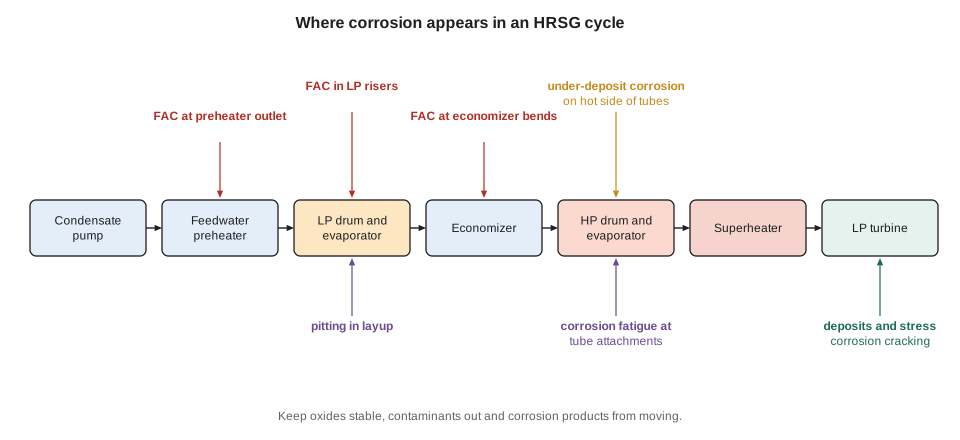
In an HRSG, the economizers, the low pressure evaporator and its risers, the feedwater lines and the drains are the main FAC areas; the low pressure drum often runs at exactly the temperature at which FAC is worst. The signs are a black, shiny surface with a scalloped or orange peel texture in single-phase flow and a tiger-striped pattern in two-phase flow. Plants measure total iron in feedwater and drum water to watch corrosion product transport; a well-run all-ferrous cycle on oxidizing treatment typically keeps feedwater iron below about 2 to 5 µg/kg (typical).
Worked problem
How much steel is moving?
Keswold's HRSG is fed about 20.0 kg/s of feedwater for 8,000 hours a year. Estimate the mass of iron carried into the boiler each year if total iron in the feedwater is 3 µg/kg, and if it rises to 15 µg/kg.
Show solution
- \[m_{Fe} = 20.0 \times 3 \times 10^{-9} \times 8{,}000 \times 3{,}600 = 1.73 \text{ kg/yr} \qquad m_{Fe,15} = 8.64 \text{ kg/yr}\]
Answer: A few kilograms of iron a year sounds small, but it does not spread evenly. Most of it settles as porous oxide deposits on the hottest tubes of the high pressure evaporator, where heat flux is greatest, and at fivefold the iron the deposits build five times faster. The iron comes from somewhere, too: every kilogram is steel that has left the economizer, feedwater piping and low pressure circuits, often from a few FAC-prone fittings. Rising feedwater iron is both an early warning of FAC and a forecast of deposit-related tube damage.
Under-deposit corrosion
Porous deposits on a heated tube act like a wick. Water flows into them and boils at the hot metal surface, leaving its dissolved solids behind, so the liquid in contact with the tube can become hundreds or thousands of times more concentrated than the bulk boiler water. What happens next depends on what concentrates.
- Hydrogen damage occurs when the concentrated liquid is acidic, typically after condenser cooling water leaks bring in chlorides, or after acid contamination from a demineralizer regeneration. Corrosion under the deposit produces atomic hydrogen, which diffuses into the steel, reacts with carbon to form methane at the grain boundaries and cracks the metal from within. The tube may fail with a thick-edged window fracture and little visible wall loss, and failures often appear in groups after a single contamination event.
- Caustic gouging occurs when the concentrated liquid is strongly alkaline, typically from sodium hydroxide overfeed or from caustic regenerant. The caustic dissolves the magnetite and the steel beneath it, leaving smooth, irregular gouges filled with deposit.
- Acid phosphate corrosion occurs in phosphate-treated drum boilers when phosphate hides out: it precipitates on hot tube surfaces at high load and returns to the water at low load. If the treatment uses phosphate blends with low sodium-to-phosphate ratios, the hidden-out deposits react with the steel to form iron phosphate compounds, and the tube corrodes under a hard, layered deposit. Modern guidance uses trisodium phosphate alone, at low concentrations, for this reason, which is what Keswold's HRSG drum runs on (PWR-330).
All three depend on two conditions together: deposits on a heated surface and a chemical that can concentrate. Controlling deposits, by keeping corrosion product transport low and cleaning the boiler when deposits become too heavy, removes one of the conditions; controlling contaminants and treatment chemicals removes the other.
Corrosion fatigue and pitting
Corrosion fatigue is cracking caused by cyclic stress in a corrosive environment; the combination produces cracks at much lower stresses and fewer cycles than either alone. In boilers and HRSGs it appears at tube-to-header welds, attachments, supports and other places where thermal or mechanical cycling strains the tube, often worsened by oxygen during startups and by pH depressions. The cracks are typically blunt, wedge-shaped and filled with oxide. Plants that cycle daily, as many combined cycle units now do, see more of it, and HRSG design guides call for flexible tube arrangements, careful attachment design and good chemistry during startup.
Pitting happens mostly when the boiler is out of service: oxygen dissolved in water left in the tubes, or in moist air, attacks the steel at weak points in the oxide and forms deep, localized pits. Cantwell's boiler 3 pitting during its summer layup (PWR-340) is a textbook case. Pits are dangerous out of proportion to their size, because they reduce the wall locally and act as starting points for corrosion fatigue cracks when the boiler returns to service. Layup practice, wet with chemical treatment and nitrogen capping or dry with dehumidified air, is the defence.
Measuring deposits and deciding when to clean
A boiler cannot be cleaned on every outage; chemical cleaning is expensive, carries its own risks and removes some sound metal along with the deposit. The decision is based on deposit loading, the mass of deposit per unit of internal tube surface, measured on tube samples cut from the most heavily loaded area, usually the hot side of the high pressure evaporator near the highest heat flux. The sample is split, the deposit is removed from a measured area by scraping or chemical dissolution, and it is weighed and analysed.
Worked problem
Deposit loading on Keswold's sample
The laboratory removed 0.52 g of deposit from a 25.0 cm² area on the hot side of Keswold's evaporator tube sample. Express the deposit loading in g/m².
Show solution
- \[DWD = \frac{0.52 \text{ g}}{25.0 \times 10^{-4} \text{ m}^2} = 208 \text{ g/m}^2\]
Answer: Guidance on when to consider chemical cleaning of HRSG high pressure evaporators is commonly expressed in the range of about 200 to 400 g/m² for the hot side of the most heavily loaded tubes (typical); the right threshold depends on the guideline used, the tube location, the deposit's composition and whether any under-deposit damage has been found. Keswold's sample sits at the lower edge of the range after six years of operation, so cleaning is not yet needed, but the trend matters more than the single number. Ingeborg proposed another sample at the next major outage, and the deposit's analysis, mostly iron oxide with little copper, phosphate or silica, confirmed that the feedwater iron was the source.
A chemical cleaning is planned like a major project: a specialist contractor, a procedure chosen for the deposit (often a chelant or an inhibited acid), test coupons, monitoring of iron and metal loss during the clean, safe handling and disposal of large volumes of waste, rinsing and passivation, and an inspection afterwards. Done badly, a clean can cause the very damage it is meant to prevent.
Film-forming substances and amines
Film-forming amines and related film-forming substances are organic compounds that adsorb onto metal surfaces and form a thin, water-repellent layer. They are increasingly used in cycling plants and during layup, where they can reduce corrosion and corrosion product transport, and the IAPWS guidance on film-forming substances describes how to apply and monitor them. They are not a substitute for good basic chemistry: a plant should start with the right volatile treatment and pH, understand how the product behaves in its own cycle, and monitor for any decomposition products, which can raise cation conductivity and complicate steam purity monitoring. Morwenna's rule was that any new chemical in the cycle goes through management of change, with the water treatment supplier, the turbine manufacturer and the LTSA provider all asked first.
Cycle chemistry instrumentation
Continuous on-line instruments, checked against grab samples, are the plant's eyes on its chemistry. The IAPWS guidance describes a minimum set of key instruments that every plant should have and use.
- Cation conductivity (conductivity after cation exchange) of condensate, feedwater, drum water and steam detects anionic contaminants such as chloride and sulphate and the acids from organic breakdown. It is the single most important purity measurement.
- Specific conductivity and pH of feedwater show that the treatment chemical is at the right level.
- Dissolved oxygen at the condensate pump discharge and the economizer inlet shows air in-leakage and the effect of oxidizing or reducing treatment.
- Sodium in condensate and steam detects condenser leaks and carryover at very low levels.
- Silica in the polisher outlet, drum and steam, the three-line trend Ingeborg is assembling for the steam purity review (PWR-330), guards against turbine deposits.
- Phosphate in drum water, for phosphate-treated boilers, by on-line analyser or routine grab samples.
The instruments are only useful if their samples are representative: sample lines must be short, stainless, continuously flowing at the right velocity and cooled to a stable temperature, and the readings must be trended, alarmed and acted on. Each plant's chemistry manual sets action levels, typically three, that escalate from investigating within days, to correcting within hours, to shutting down promptly if a severe contamination cannot be corrected. A chief engineer must make sure operators know that a chemistry action level can justify taking a unit off line, and that they will be backed when they do.
Common mistakes
MistakeMeasuring only pH and conductivity and calling the chemistry fine.
InsteadUse cation conductivity, oxygen, sodium and silica, and trend corrosion product iron.
MistakeAssuming all carbon steel corrodes equally by FAC.
InsteadChromium content, temperature, pH, oxygen and turbulence decide the rate; target the susceptible locations.
MistakeContinuing to run through a condenser leak because conductivity is only slightly high.
InsteadFollow the action levels; acidic contamination with deposits can cause hydrogen damage within hours.
MistakeChemically cleaning on a fixed schedule.
InsteadClean on measured deposit loading, composition and damage, from samples at the worst locations.
MistakeAdding a new treatment chemical on a supplier's recommendation alone.
InsteadPut it through management of change and consult the turbine manufacturer and service providers.
MistakeIgnoring the boiler while it is out of service.
InsteadLay it up wet or dry with a defined procedure; pits formed in layup start cracks later.
Summary and key terms
- Corrosion in the cycle mostly involves damage to protective magnetite or hematite oxide layers; chemistry aims to keep them stable, keep contaminants out and keep corrosion products from moving.
- FAC depends on chromium content, temperature, pH and oxidizing conditions, turbulence and flow quality; feedwater iron is an early warning.
- Under-deposit mechanisms, hydrogen damage, caustic gouging and acid phosphate corrosion, need both heated deposits and a concentrating chemical.
- Corrosion fatigue cracks cycling components; pitting forms mainly during poor layup and seeds later cracking.
- Deposit loading from tube samples at the worst location, with composition and damage, decides when to clean; cleaning is a major, risky project.
- Film-forming substances can help cycling plants but need management of change and monitoring.
- Key instruments, especially cation conductivity, oxygen, sodium and silica, with representative sampling and action levels, keep the program on track.
- Magnetite
- The black iron oxide that protects carbon steel in boiler water.
- Single-phase FAC
- Flow-accelerated corrosion in flowing liquid water.
- Two-phase FAC
- Flow-accelerated corrosion under the liquid film in wet steam flow.
- Hydrogen damage
- Internal cracking of steel by hydrogen produced in acidic under-deposit corrosion.
- Phosphate hideout
- Loss of phosphate from boiler water onto hot surfaces at high load and its return at low load.
- Corrosion fatigue
- Cracking from cyclic stress combined with a corrosive environment.
- Deposit loading
- Mass of deposit per unit of internal tube area, used to decide on chemical cleaning.
- Cation conductivity
- Conductivity measured after a cation exchange column, sensitive to anionic contaminants.
- Action level
- A chemistry limit beyond which defined corrective actions must be taken within a set time.
Practice problems
Work each problem on paper first, then reveal the answer to check.
Feedwater 12.0 kg/s for 7,000 h/yr with 5 µg/kg iron. Iron to the boiler per year?
Show answer
About 1.51 kg.
0.80 g of deposit from 32.0 cm². Deposit loading?
Show answer
250 g/m².
Which mechanism produces thick-edged window failures with little wall loss?
Show answer
Hydrogen damage.
Name the most important single purity instrument.
Show answer
Cation conductivity.
Lesson quiz · 5 questions
Score 60% or more to complete this lesson.
Create a free account to save your progress, take quizzes and earn a certificate.