
PWR-520 · Lesson 3 of 12 · 24 min
Nuclear and renewable generation in the grid
▶ Video coming soon A video version of this lesson is on the way.
Keswold sells most of its electricity into a grid where it is a small player. On a typical day in Ontario, about half of the province's electricity comes from nuclear stations, a large share from hydroelectric plants, and the rest from natural gas, wind, solar and a growing fleet of batteries. "A First Class engineer should know how the rest of the grid works," Morwenna told Anselm. "Partly because the examiners ask about it, and partly because what happens to nuclear and wind decides what's asked of plants like ours: when we run, how fast we ramp and what we're paid for."
This lesson covers, at textbook level, how nuclear power plants produce steam and how their steam cycles differ from fossil plants; the main reactor types in North America; small modular reactors; the characteristics of wind, solar and storage; and how the grid manages a changing mix through capacity, flexibility and inertia. Worked examples compare a nuclear steam cycle with Keswold's, find a wind farm's capacity factor and estimate how fast frequency falls after a large unit trips.
Steam from fission
A nuclear power plant is a steam plant whose heat source is a reactor instead of a furnace. In the reactor, uranium nuclei absorb neutrons and split, releasing energy as heat and more neutrons that sustain a chain reaction. A moderator slows the neutrons so that they are more likely to cause further fissions, a coolant carries the heat away, and control devices absorb neutrons to hold the reaction steady or shut it down. After shutdown, the decay of fission products continues to produce heat, a few percent of full power at first and falling over hours and days, so the reactor must be cooled continuously even when it is not producing electricity. Removing decay heat reliably is the central safety problem of nuclear plant design.
Nuclear plants are designed and operated under a separate regulatory regime: in Canada, the Canadian Nuclear Safety Commission licenses them under the Nuclear Safety and Control Act; in the United States, the Nuclear Regulatory Commission licenses them under federal law. Operators of the reactor side hold licences from that regulator, not from the provincial or state boiler authority. The conventional side of the plant, the turbine, condenser and feedwater system, is still a steam plant, and its pressure equipment and operators work to familiar codes.
CANDU reactors
The CANDU (Canada Deuterium Uranium) reactor uses heavy water, water in which the hydrogen is the heavier deuterium isotope, as both moderator and coolant. Heavy water absorbs so few neutrons that the reactor can run on natural uranium, which needs no enrichment. Instead of one large pressure vessel, the fuel sits in several hundred horizontal pressure tubes that pass through a large tank of cool, low-pressure heavy water moderator called the calandria. Pressurized heavy water coolant flows through the tubes, picks up heat from the fuel bundles and carries it to steam generators, where it boils ordinary light water on the secondary side. Fuelling machines load and remove fuel bundles while the reactor is at power, so a CANDU unit does not shut down for refuelling.
Ontario's nuclear fleet is all CANDU: Bruce, with eight units, is one of the largest nuclear sites in the world; Darlington has four units, whose refurbishment finished in 2026; and Pickering, the oldest, has been preparing its later units for refurbishment. Refurbishment replaces the pressure tubes, feeder pipes and other components that age with neutron exposure and heat, giving each unit about another thirty years of operation.
Pressurized and boiling water reactors
Most of the world's reactors, and all of the operating reactors in the United States, use ordinary light water as moderator and coolant, with uranium enriched to a few percent of the fissile isotope uranium-235. Two designs dominate.
- A pressurized water reactor (PWR) holds its core in a thick steel reactor pressure vessel. Primary coolant at about 15.5 MPa (2,250 psia) is kept from boiling by a pressurizer, a vessel with electric heaters and sprays that holds a steam bubble and sets the system pressure. Reactor coolant pumps circulate the water through the core and through two to four steam generators, where it boils secondary feedwater into steam for the turbine. The primary and secondary systems are separate, so the turbine side is not radioactive in normal operation.
- A boiling water reactor (BWR) lets the water boil in the core at about 7 MPa (1,000 psia) and sends the steam directly to the turbine after separators and dryers inside the vessel. The design is simpler, with no steam generators or pressurizer, but the turbine handles slightly radioactive steam and its hall is shielded and controlled accordingly.
Both are refuelled during outages every 18 to 24 months, typically, when part of the core is replaced. In the United States, about 94 reactors operate at more than fifty sites (2026), most licensed to run for sixty years and some for eighty; two large new units at Vogtle in Georgia entered service in 2023 and 2024, and the Palisades plant in Michigan, shut in 2022, has been preparing to restart.
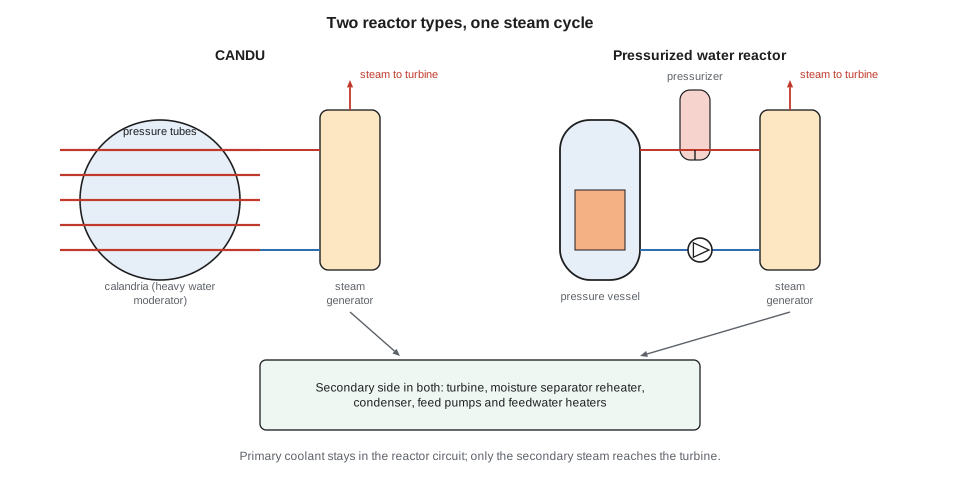
The nuclear steam cycle
Because water-cooled reactors cannot run their coolant much above about 320 °C (610 °F), their steam generators make saturated steam at modest pressure, typically about 4.5 to 7 MPa (650 to 1,000 psia). Without superheat, the steam becomes wet early in its expansion, and nuclear turbines are designed for it: very large, slow-running low pressure sections, moisture separator reheaters between the high and low pressure turbines that remove water and reheat the steam with live steam, and blading and casings designed to resist erosion. Large nuclear units commonly run at half speed, 1,800 r/min on a 60 Hz grid, to keep the enormous last-stage blades within safe stresses.
Worked problem
A saturated steam cycle
Compare the ideal Rankine efficiency and turbine exhaust quality for dry saturated steam at 5.0 MPa expanding to 10 kPa with Keswold's main steam conditions of 6.0 MPa and 480 °C to the same condenser pressure. Include pump work. Use IAPWS-IF97 properties.
Show solution
- \[h_1 = 2{,}794.2 \qquad s_1 = 5.9737 \qquad x_2 = \frac{5.9737 - 0.6492}{7.4997} = 0.710 \qquad h_2 = 191.8 + 0.710 \times 2{,}392.1 = 1{,}890.1\]
- \[w_p = 5.0 \qquad \eta = \frac{(2{,}794.2 - 1{,}890.1) - 5.0}{2{,}794.2 - 191.8 - 5.0} = 0.346\]
- \[\text{Keswold conditions: } x_2 = 0.823 \qquad \eta = 0.381\]
Answer: Even ideally, the saturated cycle is less efficient, and its exhaust would be almost thirty percent water, far too wet for any turbine blading. That is why nuclear turbines separate moisture and reheat between their sections, and why the net efficiency of large water-cooled nuclear units is typically only about 0.33 to 0.35 (typical). For a nuclear plant, fuel cost is a small part of the cost of electricity, so lower efficiency matters less than reliability and high output.
Small modular reactors
Small modular reactors (SMRs) are reactors of up to about 300 MWe designed to be built from factory-made modules, with simpler systems and greater reliance on passive safety features, such as natural circulation and gravity-driven cooling, that need no pumps or operator action. Ontario Power Generation is building the first of four planned BWRX-300 units at the Darlington site: a 300 MWe boiling water reactor with natural circulation in the core. It received its licence to construct in 2025, the reactor building's basemat was placed in 2026, and the first unit is planned to connect to the grid around the end of the decade. Other provinces and utilities are watching its cost and schedule closely.
For power engineers, SMRs matter in two ways. Their conventional steam cycles need operators and maintainers with the same skills as any other steam plant, and some designs, especially high-temperature reactors, could one day supply process steam to industrial users in place of fired boilers or cogeneration plants like Keswold.
Wind, solar and storage
Wind turbines and solar photovoltaic panels convert the energy of wind and sunlight directly into electricity, with no fuel and no steam. Their output varies with the weather and the time of day, so they are described as variable resources, and their annual output is described by the capacity factor, the energy actually produced divided by what the plant would produce running at full rated output all year.
Worked problem
A wind farm's capacity factor
A wind farm has 30 turbines rated at 4.2 MW each and produced 380,000 MWh last year. Find its capacity factor, and compare its average output with Keswold's net output.
Show solution
- \[CF = \frac{380{,}000}{30 \times 4.2 \times 8{,}760} = \frac{380{,}000}{1{,}103{,}760} = 0.344\]
Answer: The 126 MW wind farm produces an average of about 43 MW, slightly less than Keswold's annual net generation of about 429,000 MWh (PWR-510). Its output, however, ranges from zero to full output depending on the wind, while Keswold's is set by its owner's dispatch and its steam host. Typical capacity factors are about 0.30 to 0.45 for modern onshore wind, about 0.15 to 0.25 for solar in North America, and above 0.90 for nuclear units (typical).
- Inverter-based resources. Solar panels, batteries and most modern wind turbines connect to the grid through power electronic inverters rather than synchronous generators. Inverters can respond very quickly, but they do not inherently provide the spinning mass and fault current of a synchronous machine unless they are designed and set to do so.
- Battery storage, mostly lithium-ion, charges from the grid when power is cheap or plentiful and discharges when it is needed, typically for two to four hours at full output (typical). Batteries also provide fast frequency response and reserves.
- Pumped storage hydroelectric plants pump water uphill to a reservoir and release it through turbines later; they remain the largest form of grid storage.
- Hydroelectric plants with reservoirs are flexible, low-emission sources that can follow load quickly, and they dominate the grids of regions with large rivers, such as much of Canada and the Pacific Northwest.
Running a grid with a changing mix
A grid must balance generation and load every second, keep enough capacity available for the peak, and keep frequency and voltage within narrow limits. As variable resources grow and older thermal units retire, three needs become more important.
- Capacity: enough dependable supply for the highest demand, which in winter-peaking regions may be a cold, still evening when solar is zero and wind is low. Grid operators run capacity auctions or procurements to secure it, and they discount variable resources by their expected contribution at peak.
- Flexibility: the ability to ramp up and down as load and variable output change, start quickly and run at low load. Gas turbines, hydroelectric plants and batteries supply most of it; some nuclear units can reduce output when there is a surplus of supply, but they usually run at full power.
- Inertia and frequency response: synchronous generators store kinetic energy in their rotating masses and release it automatically when frequency falls, slowing the decline after a unit trips. Governors then add power within seconds (PWR-320). A grid with less spinning mass sees frequency fall faster, so grid operators now also buy fast frequency response from batteries and require inverter-based resources to ride through disturbances (lesson 6).
The inertia constant H of a generator is the kinetic energy stored in its rotor at rated speed divided by its rated power, in seconds; typical values are about 2 to 9 seconds for thermal units (typical). For a whole grid, the initial rate of change of frequency after a sudden loss of generation depends on the lost power and the total stored energy.
Worked problem
How fast does frequency fall?
A grid has 10,000 MW of synchronous generation online with an average inertia constant of 4 seconds when a 500 MW unit trips. Estimate the initial rate of change of frequency on a 60 Hz system. Repeat for an average inertia constant of 2.5 seconds, as might occur with more inverter-based resources online.
Show solution
- \[RoCoF = \frac{500 \times 60}{2 \times 4 \times 10{,}000} = 0.375 \text{ Hz/s} \qquad RoCoF_{H = 2.5} = \frac{500 \times 60}{2 \times 2.5 \times 10{,}000} = 0.60 \text{ Hz/s}\]
Answer: With less inertia, frequency falls 60 in 100 faster, leaving less time for governors to respond before frequency reaches the level at which underfrequency load shedding begins. That is why grid operators track system inertia, why fast-acting resources are valued, and why every generator, including Keswold's, must stay online through the disturbance instead of tripping and making it worse.
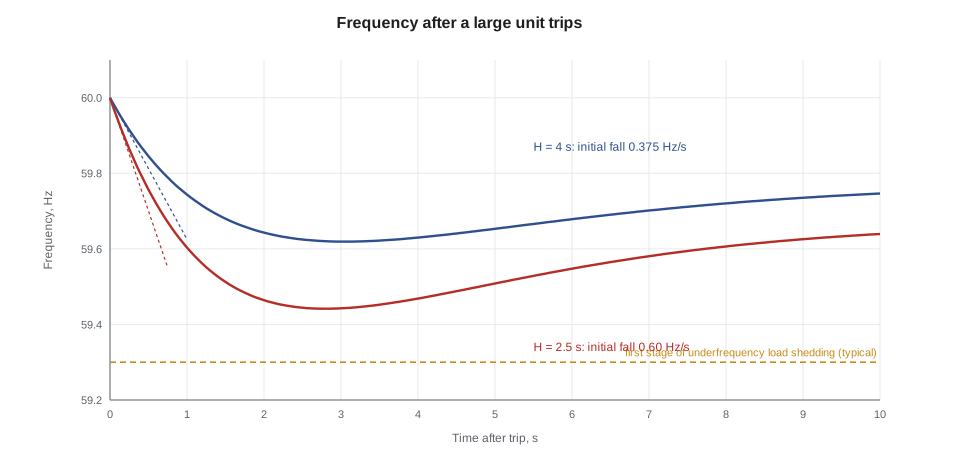
For Keswold, the changing grid shows up in its dispatch: under Ontario's renewed market, prices vary by location and hour, and on mild, windy nights with surplus nuclear and hydro output prices can fall close to zero. Keswold's steam contract with Marrowby keeps it running, but its electrical output is worth much less at those times, which is one reason the expansion study looked at electric boilers that could use cheap off-peak power (PWR-510).
Common mistakes
MistakeAssuming a shut-down reactor needs no cooling.
InsteadDecay heat continues after shutdown and must be removed reliably for days.
MistakeThinking CANDU reactors use enriched uranium in a single pressure vessel.
InsteadCANDU uses natural uranium in horizontal pressure tubes within a heavy water calandria.
MistakeComparing wind and nuclear by nameplate capacity alone.
InsteadCompare annual energy through capacity factor, and dependable capacity at peak.
MistakeExpecting nuclear turbines to look like fossil turbines.
InsteadSaturated steam needs moisture separator reheaters and large, slow low pressure sections.
MistakeIgnoring inertia when the generation mix changes.
InsteadLess spinning mass means faster frequency decline; fast response and ride-through matter more.
Summary and key terms
- Nuclear plants make steam from fission heat; decay heat after shutdown makes continuous cooling the central safety requirement.
- CANDU reactors use heavy water and natural uranium in pressure tubes, with on-power refuelling; PWRs and BWRs use light water and enriched uranium in pressure vessels.
- Water-cooled reactors make saturated steam, giving lower cycle efficiency and very wet exhaust that requires moisture separator reheaters.
- Small modular reactors such as the BWRX-300 aim for factory-built modules and passive safety; the first at Darlington is planned for around the end of the decade.
- Wind and solar are variable, inverter-based resources described by capacity factor; batteries and pumped storage shift energy in time.
- A changing mix makes capacity at peak, flexibility and inertia more important; the rate of change of frequency rises as inertia falls.
- Moderator
- A material that slows neutrons so they cause fission more readily.
- Decay heat
- Heat produced by radioactive decay of fission products after a reactor shuts down.
- Calandria
- The tank of heavy water moderator through which a CANDU reactor's pressure tubes pass.
- Pressurizer
- A PWR vessel with heaters and sprays that controls primary system pressure.
- Moisture separator reheater
- A vessel between turbine sections that removes water from steam and reheats it.
- Capacity factor
- Annual energy produced divided by the energy at full rated output for the whole year.
- Inertia constant
- Stored rotational kinetic energy at rated speed divided by rated power, in seconds.
- Inverter-based resource
- A generator or storage device connected to the grid through power electronics.
Practice problems
Work each problem on paper first, then reveal the answer to check.
A 100 MW solar farm produced 175,000 MWh in a year. Capacity factor?
Show answer
About 0.200.
A 20,000 MW grid with H = 5 s loses 1,000 MW. Initial RoCoF at 60 Hz?
Show answer
0.30 Hz/s.
Why can a CANDU reactor use natural uranium?
Show answer
Heavy water absorbs very few neutrons, so enrichment is not needed.
Why do nuclear turbines need moisture separator reheaters?
Show answer
Saturated inlet steam becomes very wet during expansion; the MSR removes water and reheats the steam.
Lesson quiz · 5 questions
Score 60% or more to complete this lesson.
Create a free account to save your progress, take quizzes and earn a certificate.