
PWR-520 · Lesson 11 of 12 · 22 min
Exam technique for long-answer papers
▶ Video coming soon A video version of this lesson is on the way.
Anselm had written multiple-choice papers for his Third Class certificate and essay papers for Second Class years ago, and he assumed the First Class papers would feel the same as the Second Class 2A papers. Morwenna corrected him gently. "Every First Class paper is long answer," she said. "Eight of them, three and a half hours each, five questions out of seven. The examiner isn't checking whether you recognize the right answer; they're reading how you think. Technique matters more at this level than at any other." This lesson is the one she gave him on how to write them.
This lesson sets out the structure and rules of the examinations for the highest certificate or license, how to plan study across them, and how to write long answers that earn marks: reading and choosing questions, budgeting time, structuring descriptive and calculation answers, using sketches, and checking. Worked examples budget the time in a paper and check Anselm's qualifying experience.
The examinations
In Ontario, TSSA administers the First Class Power (Operating) Engineer examinations on the national syllabus set by SOPEEC, the Standardization of Power Engineer Examinations Committee. There are eight examinations, each essay style, each 3½ hours, each with seven questions of which the candidate answers five; only the first five questions attempted are marked, and some papers have mandatory questions, so the introduction to each paper must be read. The pass mark is 65 in 100 on each paper. A failed paper may be rewritten after 60 days, and after passing any paper the candidate must obtain the certificate within five years or rewrite it. Since June 14, 2021, candidates may write the papers while they are still gaining their qualifying experience.
| Paper | Subject |
|---|---|
| 1A-1 | Applied thermodynamics and plant cycles |
| 1A-2 | Principles of applied and fluid mechanics |
| 1A-3 | Applied engineering technologies: metallurgy, corrosion, combustion, advanced water treatment |
| 1A-4 | Power plant operations: energy management, efficiency, construction, commissioning, retrofitting |
| 1B-1 | Legislation and codes for industrial equipment |
| 1B-2 | Safety, loss and environmental program management |
| 1B-3 | Inspection, maintenance and repair practices |
| 1B-4 | Business and workforce management |
Qualifying experience
TSSA's guideline requires 4,800 hours as a chief operating engineer in a second-class plant or as a second-class operating engineer in a first- or second-class plant, reduced to 3,360 hours after an approved full-time First Class program. At least a third of the qualifying experience must be in operating boilers at a registered plant, and no more than a third may be maintenance of regulated equipment. Morwenna had Anselm check his log against those rules early, so that any shortfall could be made up while he studied.
Worked problem
Checking the experience log
Anselm's log for the last 30 months records 5,460 hours as a second-class operating engineer at Keswold, a first-class plant, of which 2,350 were in operating the HRSG and auxiliary boiler systems and 1,010 in maintenance of regulated equipment (PWR-510). Check his experience against the guideline.
Show solution
- \[\text{Total: } 5{,}460 \ge 4{,}800 \qquad \text{Boilers: } \frac{2{,}350}{5{,}460} = 0.43 \ge 0.33 \qquad \text{Maintenance: } \frac{1{,}010}{5{,}460} = 0.18 \le 0.33\]
Answer: Anselm already meets the hour requirement and both proportion rules, so his certificate depends only on passing the eight papers. Because the papers and experience may now be completed concurrently, he could have written them earlier; Morwenna's advice was to keep the log signed and up to date anyway, because TSSA will ask for it when he applies and the chief must certify it.
Planning the study
Morwenna's study plan for Anselm, which he adopted for 2027 and 2028 (a plan), had four features.
- One paper at a time, in a sensible order: start with a subject he knows well to build confidence and technique, then alternate a calculation paper with a descriptive one, so that the calculation skills do not fade while he writes the management papers.
- Fixed weekly hours: about eight to ten hours a week, protected on his shift rotation, with a longer block in the fortnight before each paper.
- Past-style questions under exam conditions: at least six full timed questions before each paper, marked by Morwenna or Grazyna, with the error log from lesson 7.
- Notes in his own words: a set of one-page summaries for each subject, written from the course and from the plant, that he could reread in the last week instead of the textbook.
Reading and choosing questions
The first ten minutes of a long-answer paper decide much of the result. Read the whole paper, including the introduction, and note any mandatory questions. Read every question fully, including all its parts; many questions have three or four parts with different mark weights, and a question whose first part looks easy may end with a part the candidate cannot answer. Choose the five questions that offer the most marks the candidate can actually earn, mark the order in which to answer them, and start with the strongest to build confidence and time.
Because only the first five questions attempted are marked, a candidate must not start a sixth question as a spare: it will not be marked, and if it is started before one of the chosen five, it may displace a better answer. Crossing out a started question does not always prevent it from counting as attempted, so the safest rule is to decide before writing and not to change course except for a strong reason.
Budgeting time
Worked problem
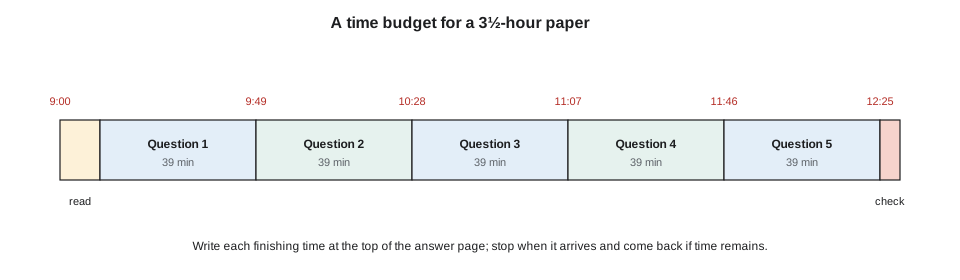
A time budget for a 3½-hour paper
A paper allows 210 minutes for five questions of equal weight. Allowing 10 minutes for reading and choosing and 5 minutes for a final check, how much time should each question get, and what should a candidate do when the time for a question runs out?
Show solution
- \[t_q = \frac{210 - 10 - 5}{5} = 39 \text{ min per question}\]
Answer: Write the finishing time for each question at the top of the answer page and stop when it arrives, leaving space to come back. The first marks on any question are the easiest to earn and the last are the hardest, so a candidate who spends an hour perfecting one answer and leaves the fifth question blank loses far more than one who writes five solid answers. If a question has weighted parts, divide its time in proportion to their marks.
Writing a descriptive answer
A descriptive question asks the candidate to describe, explain, compare, discuss or outline. Each verb asks for something different: describe asks what something is and how it works; explain asks why; compare asks for similarities and differences on the same points; discuss asks for advantages, disadvantages and a judgment; outline asks for the main points without detail. A good answer does what the verb asks, in a structure the examiner can follow.
- Start with a direct answer in one or two sentences, so the examiner knows at once that the candidate understands the question.
- Use headings or numbered points that follow the parts of the question, and keep each point to a short paragraph.
- Give a reason with each statement: not just "the deaerator removes oxygen" but "the deaerator removes oxygen, which would otherwise cause pitting in the economizer and boiler".
- Use examples from real plants, briefly, to show practical understanding; Keswold and Cantwell gave Anselm a ready supply.
- Finish with a conclusion that answers the question's judgment, where it asks for one.
For management questions, the management system elements of lesson 10 give a ready structure: scope, roles, procedures, training, records, monitoring, audit and improvement. For equipment questions, a common structure is purpose, construction, operation, protection, maintenance and common problems.
Writing a calculation answer
Calculation answers are marked for method as well as result, as lesson 7 showed. Write the given data with units, a one-line plan, the equations used before substituting, each substitution on its own line with units, the result underlined or boxed with units, and a one-sentence comment. Where a property comes from tables, say which table and at what conditions. Where an assumption is made, such as neglecting kinetic energy or assuming a thin wall, state it. If an earlier part's answer is needed for a later part and the candidate is unsure of it, carry it forward anyway and say so; examiners usually give follow-through marks for correct method on a wrong carried value.
Sketches
Every First Class paper is described as "essay, sketch, describe", and many questions explicitly ask for a sketch. A good sketch is large, clear and labelled; it shows the principle rather than every bolt; it uses arrows for flows and labels for every stream and component; and it is referred to in the text. A sketch can carry a large part of the marks for a description of equipment, and it is often faster than words. Anselm practised a set of standard sketches until he could draw each in three minutes: an HRSG flow path, a deaerator, a safety valve, a BMS gas train, a cascade control loop, a generator protection one-line, a condenser and air removal system, and a Rankine cycle on T-s and h-s diagrams.
Checking and the last week
The final minutes are for checking that each answer is numbered correctly, that units are present on every result, that no part has been missed and that the five answers chosen are the five on the page. In the last week before a paper, Morwenna's advice was to stop learning new material, reread the one-page summaries and the error log, do one timed question a day, sleep properly and arrive early. "You know enough," she told Anselm. "The last week is about being able to show it."
A model descriptive answer
Morwenna gave Anselm a practice question and then showed him the answer she would have written, so that he could see the structure at full length. The question was: "Explain why the low pressure evaporator circuits of a heat recovery steam generator are prone to flow-accelerated corrosion, and describe the program you would put in place to manage the risk." It carried 20 marks, so it deserved its full 39 minutes.
Her answer opened with a direct statement: low pressure evaporator circuits are prone to FAC because they combine the three conditions FAC needs, carbon steel with little chromium, water or wet steam at the temperature range where FAC is fastest, and high turbulence at bends and risers, and because their chemistry is often the least well controlled in the cycle. Then came the explanation under three headings.
- Material: the low pressure circuits are usually built of plain carbon steel because their pressure and temperature are modest, and plain carbon steel with very little chromium is the most susceptible to FAC.
- Temperature and flow: the low pressure drum often runs close to the temperature at which two-phase FAC is fastest, and the risers carry a steam-water mixture at high velocity, with tight bends at the headers where the liquid film is thinnest and fastest.
- Chemistry: the pH at temperature in the low pressure circuit may be lower than in the feedwater because volatile alkalizing agents such as ammonia partition into the steam, leaving the water less protected, and reducing conditions make the magnetite layer more soluble.
A sketch of the HRSG flow path with the susceptible locations marked followed, and then the program, structured as a management system: scope, covering every carbon steel component in the low pressure, economizer and feedwater circuits; a susceptibility ranking of locations by material, temperature, velocity and geometry; ultrasonic thickness measurement at the highest-ranked locations at each major outage, with grids fine enough to find local thinning; corrosion rates and remaining life calculated from repeated readings, with replacement before the minimum thickness; chemistry control, with the pH at temperature raised where needed and oxidizing all-volatile treatment in an all-ferrous system, monitored through feedwater and drum iron; replacement of the worst fittings with chromium-molybdenum steel; records of every reading and replacement; and an annual review of the program's results. The answer closed with a conclusion: FAC is well understood and preventable, and the accidents that have occurred, such as those at Surry and Mihama, happened where locations were left out of the program, so the program's completeness matters as much as its methods.
Anselm noted that the answer was about 550 words with a sketch, that every statement came with a reason, and that it used the plant's own experience, the economizer recirculation elbow, only once and briefly. He wrote four more model answers on other subjects in the same style over the following weeks, and Morwenna marked each against the same pattern: direct opening, structured explanation, sketch, program or procedure, conclusion.
Common mistakes
MistakeStarting to write before reading the whole paper.
InsteadRead every question and the introduction; choose five and plan their order.
MistakeStarting a sixth question as a spare.
InsteadOnly the first five attempted are marked; decide before writing.
MistakeSpending an hour on one answer.
InsteadKeep to about 39 minutes per question and come back if time remains.
MistakeIgnoring the verb in the question.
InsteadDescribe, explain, compare, discuss and outline ask for different answers.
MistakeLeaving out sketches to save time.
InsteadA clear, labelled sketch often earns marks faster than words.
MistakeWriting only the final number in a calculation.
InsteadShow data, plan, equations, substitution, result with units and a comment.
Summary and key terms
- TSSA's First Class certificate needs eight essay papers of 3½ hours, five of seven questions each, 65 in 100 to pass each, with rewrites after 60 days and the certificate within five years.
- Experience is 4,800 hours, or 3,360 after an approved program, with at least a third on boilers and no more than a third in maintenance; Anselm's log meets the rules.
- A study plan takes one paper at a time, protects weekly hours, uses timed practice and builds one-page summaries.
- The first ten minutes are for reading and choosing; about 39 minutes per question follows.
- Descriptive answers do what the verb asks, with a direct opening, headings, reasons, examples and a conclusion.
- Calculation answers show data, plan, equations, substitutions, result with units and a comment; sketches are large, clear and labelled.
- SOPEEC
- The Standardization of Power Engineer Examinations Committee, which sets the common power engineer syllabi used by most Canadian jurisdictions.
- NIULPE
- The National Institute for the Uniform Licensing of Power Engineers, which sets national power engineer standards and examinations in the United States.
- Mandatory question
- A question that every candidate must answer on a paper that has one.
- Follow-through marks
- Marks given for correct method applied to a wrong value carried from an earlier part.
- Time budget
- A plan that allots the examination time among questions in proportion to their marks.
- Error log
- A record of each mistake made in practice and the check that prevents it.
Practice problems
Work each problem on paper first, then reveal the answer to check.
A paper allows 180 minutes for four equal questions, with 10 minutes reading and 6 minutes checking. Time per question?
Show answer
41 minutes.
A question has parts worth 8, 6 and 6 marks and 40 minutes. Time for the first part?
Show answer
16 minutes.
What does the verb 'discuss' ask for?
Show answer
Advantages, disadvantages and a judgment.
Why should a candidate not start a sixth question as a spare?
Show answer
Only the first five attempted are marked, so it may displace a better answer and will not count.
Lesson quiz · 5 questions
Score 60% or more to complete this lesson.
Create a free account to save your progress, take quizzes and earn a certificate.