
PWR-520 · Lesson 1 of 12 · 26 min
Advanced boiler and combustion design
▶ Video coming soon A video version of this lesson is on the way.
Anselm's First Class course had reached the half-way point, and the second half of the syllabus looked very different from the first. The earlier papers asked how to run a plant; the later ones asked why it had been built the way it was, and what a chief engineer would choose if the plant were being built again. Morwenna Faulds started their evening session in Keswold's training room by drawing two lines on the whiteboard, one for Keswold's heat recovery steam generator and one for the coal-fired utility unit where she had spent the first fifteen years of her career, before Ontario's last coal units closed in 2014. "Same water, same steel, same physics," she said. "Very different design decisions. If you understand why each one was made, the exam questions on boiler design stop being a list to memorize."
This lesson builds on the survey of large industrial and utility boilers in PWR-330. It looks at boiler design from the designer's side: why higher pressures and temperatures pay, how supercritical once-through units differ from drum units in design and control, how circulating fluidized bed boilers burn difficult fuels and capture sulphur in the furnace, how burners and furnaces are designed to keep nitrogen oxides low, and how oxy-fuel combustion and other newer approaches change the furnace for carbon capture. Two worked examples put numbers on the efficiency gain from supercritical conditions and on the limestone a fluidized bed needs.
Why designers push pressure and temperature up
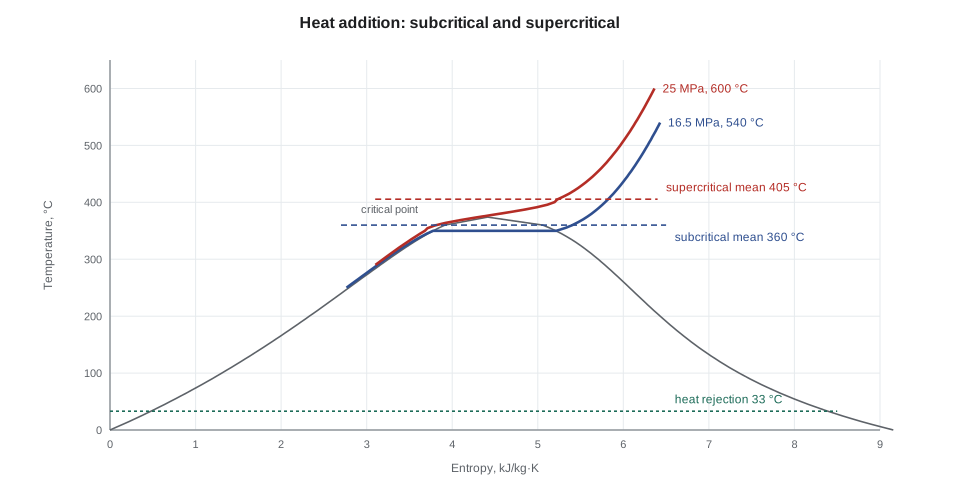
Every steam cycle is limited by the temperatures at which it takes in and rejects heat. A useful way to see the effect of boiler conditions is the mean temperature of heat addition, the temperature at which a reversible process would take in the same heat with the same entropy change. It is found from the steam properties alone, as the heat added per kilogram divided by the entropy gained. The higher the mean temperature of heat addition, the closer the cycle can come to the Carnot limit set by the condenser temperature (PWR-410).
Raising the pressure lifts the temperature at which most of the heat goes in, because the boiling plateau moves up; raising the main steam temperature adds heat at the top of the cycle; and adding reheat, as PWR-410 showed, adds a second block of heat at high temperature. Feedwater heating raises the temperature at which the boiler starts to add heat. Each step needs stronger, more expensive materials and more complex controls, so the designer stops where the extra efficiency no longer pays for itself.
Worked problem
Subcritical against supercritical
Compare the mean temperature of heat addition and the ideal efficiency limit for two main steam conditions, without reheat: a subcritical unit at 16.5 MPa and 540 °C with feedwater at 250 °C, and a supercritical unit at 25 MPa and 600 °C with feedwater at 290 °C. Take the heat rejection temperature as 33 °C. Use IAPWS-IF97 properties.
Show solution
- \[\text{Subcritical: } h_{in} = 1{,}086.2,\; s_{in} = 2.7646 \qquad h_{out} = 3{,}406.5,\; s_{out} = 6.4298\]
- \[T_m = \frac{2{,}320.3}{3.6652} = 633.1 \text{ K} \;(359.9\text{ °C}) \qquad \eta_{ideal} = 1 - \frac{306.15}{633.1} = 0.516\]
- \[\text{Supercritical: } h_{in} = 1{,}280.0,\; s_{in} = 3.1016 \qquad h_{out} = 3{,}493.7,\; s_{out} = 6.3638\]
- \[T_m = \frac{2{,}213.7}{3.2623} = 678.6 \text{ K} \;(405.4\text{ °C}) \qquad \eta_{ideal} = 1 - \frac{306.15}{678.6} = 0.549\]
Answer: Moving to supercritical conditions raises the mean temperature of heat addition by about 45 K and the ideal limit by about three points. Real cycles fall well short of these ideal figures because of turbine and pump losses and stack and other boiler losses, but the gap between the two conditions survives: as PWR-330 noted, modern supercritical coal units reach net efficiencies of about 0.42 to 0.45 on the higher heating value against about 0.35 to 0.38 for older subcritical units (typical), with reheat contributing part of the difference. For a unit burning millions of tonnes of fuel a year, three points of efficiency repay a great deal of expensive alloy steel.
Designing a once-through supercritical boiler
Above the critical pressure, about 22.1 MPa (3,200 psia), water does not boil; it changes continuously from a dense liquid to a light vapour. A drum is useless, because there is no interface at which to separate steam from water, so supercritical boilers are once-through: the feed pump pushes the water through the economizer, the furnace wall tubes and the superheaters in a single pass, and the point at which the fluid becomes superheated moves along the circuit with the firing rate and feedwater flow.
- Furnace walls. Without natural circulation, the wall tubes must carry enough flow to cool themselves at every load. Early designs used vertical tubes with very high mass flux; many modern units wrap the lower furnace in spiral tubes that wind around the furnace at a shallow angle, so each tube passes through hot and cooler zones and picks up a similar amount of heat. Others use vertical tubes with rifled bores, which keep a water film on the tube wall at lower flow.
- Minimum load and startup. At low load the flow through the walls must stay above a minimum, typically about a quarter to a third of full flow (typical), so the unit starts on a startup system with a separator vessel and either a drain to the condenser or a circulating pump. Below the minimum, the boiler runs like a drum unit, with the separator acting as a small drum; above it, the separator runs dry and the unit is in once-through mode.
- Control. The firing rate and the feedwater flow must be matched closely, because there is no drum to buffer them. Main steam temperature is held mainly by the ratio of fuel to feedwater, measured by the temperature at the separator outlet or at an intermediate point, with spray attemperation only as trim. The coordinated control system that runs the boiler and turbine together is the subject of lesson 5.
- Water chemistry. A once-through unit has no blowdown, so every impurity that enters with the feedwater either deposits in the boiler or goes to the turbine. Feedwater must be extremely pure, with full-flow condensate polishing and all-volatile or oxygenated treatment, as PWR-330 explained and lesson 4 discusses further.
- Materials. At 25 to 30 MPa (3,600 to 4,400 psi) and 600 °C (1,100 °F) or more, the superheater, reheater and main steam pipe need creep-strength-enhanced ferritic steels such as Grade 91 and Grade 92, austenitic stainless steels in the hottest tube banks, and in the newest advanced ultra-supercritical designs nickel alloys at temperatures above 700 °C (1,300 °F). Grade 91 in particular is unforgiving: its strength depends on a precise heat treatment, and welds made or treated badly can fail by creep far sooner than the code life (PWR-340).
Circulating fluidized bed boilers
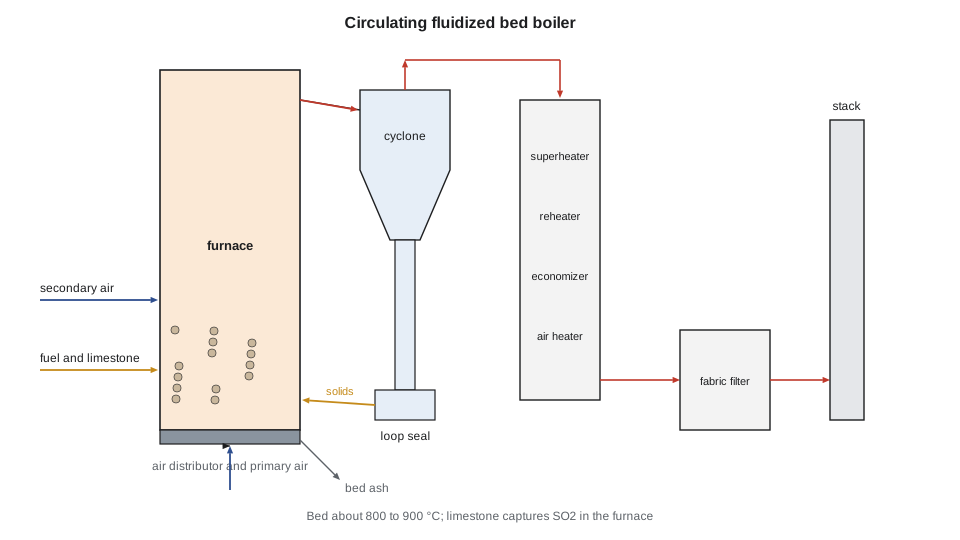
A fluidized bed burns fuel in a hot mass of sand, ash and limestone held in suspension by air blown up through a distributor at the bottom of the furnace. In a circulating fluidized bed (CFB), the air velocity is high enough to carry the solids up through the whole furnace; cyclones at the furnace outlet separate them from the flue gas, and a loop seal returns them to the lower furnace. The solids may circulate dozens of times before they leave as ash, and their large heat capacity gives the CFB its character.
- Low, even furnace temperature, about 800 to 900 °C (1,500 to 1,650 °F), well below the temperature at which most ash melts. Slagging is rare, and thermal nitrogen oxides, which form mainly above about 1,500 °C (2,700 °F), are low.
- Fuel flexibility. The hot bed dries and ignites fuels that would not burn in a pulverized fuel flame: high-ash and high-moisture coals, petroleum coke, bark, wood waste, sludge and mixtures of them. Many pulp and paper mills, including the one where Anselm and Grazyna worked, have replaced old stoker boilers with fluidized beds.
- In-furnace sulphur capture. Limestone fed with the fuel calcines to lime in the bed and reacts with sulphur dioxide to form calcium sulphate, which leaves with the ash. The bed temperature is close to the best for this reaction, so a CFB can capture most of the sulphur without a separate scrubber.
- Penalties. Fans must push air through a deep bed, so auxiliary power is higher; the circulating solids erode tubes, especially where the bed meets the refractory and in the cyclones; and the large mass of hot refractory and solids makes startups slow.
Not all of the lime reacts, because the outer layer of each particle turns to sulphate and blocks the inside, so a CFB is fed more calcium than the chemistry alone requires. The ratio of calcium in the limestone to sulphur in the fuel, on a molar basis, is the Ca/S ratio, typically about 2 to 3 for high sulphur capture (typical). Each extra unit of limestone adds to the ash to be handled and to the carbon dioxide released by calcination, so operators tune the limestone feed to the emission limit, not beyond it.
Worked problem
Limestone for a circulating fluidized bed
A CFB burns 10.0 kg/s of coal containing 1.8 in 100 sulphur by mass. It is fed limestone that is 92 in 100 calcium carbonate at a Ca/S molar ratio of 2.2, and it captures 92 in 100 of the sulphur. Find the limestone feed and the sulphur dioxide leaving the stack. Use molar masses of 32.06 for sulphur, 100.09 for calcium carbonate and 64.06 for sulphur dioxide.
Show solution
- \[\dot m_{ls} = \frac{10.0 \times 0.018}{32.06} \times 2.2 \times \frac{100.09}{0.92} = 1.344 \text{ kg/s} \;(4.84 \text{ t/h})\]
- \[\dot m_{SO_2} = 10.0 \times 0.018 \times (1 - 0.92) \times \frac{64.06}{32.06} = 0.0288 \text{ kg/s} \;(104 \text{ kg/h})\]
Answer: The unit needs almost 5 tonnes of limestone an hour, and without capture it would emit about 1,295 kg/h of sulphur dioxide instead of about 104. Raising the Ca/S ratio would cut emissions further but at a growing cost in limestone, ash disposal and calcination carbon dioxide, which is why the limestone feed is trimmed by the continuous emission monitor rather than set high and left.
Designing for low nitrogen oxides
Nitrogen oxides form in flames by three routes. Thermal NOx forms when nitrogen and oxygen from the air combine at high temperature, and rises steeply with peak flame temperature and the time spent there. Fuel NOx forms from nitrogen bound in the fuel, and dominates in coal, heavy oil and biomass flames. Prompt NOx forms in small amounts in fuel-rich parts of hydrocarbon flames. PWR-330 described the post-combustion controls, selective catalytic and non-catalytic reduction; the designer's first tools act inside the furnace.
- Air staging. Burners are run with less than the theoretical air, so that fuel nitrogen is released in an oxygen-poor zone where it forms nitrogen gas rather than NOx; the rest of the air enters later through overfire air ports above the burners to complete combustion.
- Fuel staging and reburn. Part of the fuel is injected above the main flame to create a fuel-rich zone that reduces NOx already formed, followed by burnout air.
- Low-NOx burners shape the mixing of fuel and air so that each flame has a fuel-rich core and a slower supply of air, lowering peak temperatures and fuel NOx.
- Flue gas recirculation returns cooled flue gas to the combustion air, diluting the oxygen and lowering the flame temperature; it is common on gas-fired package boilers, which have little fuel nitrogen.
- Lean premixed combustion, as in the dry low-NOx combustors of Keswold's gas turbine (PWR-320), mixes fuel and air thoroughly before the flame so that no part of it burns at the stoichiometric peak temperature.
Each method has a price. Staging leaves more unburned carbon in coal ash and more carbon monoxide if the overfire air is poorly mixed; reducing zones near the furnace walls can cause severe fireside corrosion of the tubes, where sulphur compounds attack the steel under a reducing atmosphere; flue gas recirculation adds fan power and can reduce flame stability; and lean premix flames are prone to combustion dynamics and flashback, especially with hydrogen in the fuel (PWR-510). The design is always a balance between NOx, carbon monoxide, unburned carbon, tube life and stability.
Furnace design decisions
Furnace size and shape are set by what the furnace has to do to the fuel and the gas. For coal, the furnace must be tall and wide enough that ash particles have cooled below their softening temperature before they reach the closely spaced superheater tubes, or they will stick and build slag. Designers express this through the heat release rates: the heat input per unit of furnace volume and per unit of the cross-section at the burner level. Low-rank coals with low ash fusion temperatures need large, cool furnaces; natural gas, which has no ash, allows a furnace that is a fraction of the size for the same output. That is why a gas-fired package boiler can be shipped on a truck and a coal-fired utility boiler of the same steam output is a building in its own right.
The designer also sets the furnace exit gas temperature, which divides the work between the radiant furnace walls and the convective superheater, reheater and economizer banks. A higher exit temperature means a smaller furnace but more slagging risk and hotter superheater tubes; a lower one means a larger, more expensive furnace. The arrangement of the convective banks, their tube spacing and the sootblowers that keep them clean all follow from the fuel's ash behaviour.
A heat recovery steam generator is designed the other way round. Its heat source, the gas turbine exhaust at about 545 °C (1,013 °F) at Keswold, is fixed by the turbine, has no ash and carries plenty of oxygen. There is no furnace in the usual sense; the designer's choices are the number of pressure levels, the pinch and approach temperatures and the amount of supplementary firing (PWR-320, PWR-410). Keswold's duct burners can raise steam output from about 18.7 to 22.0 kg/s (148,300 to 175,000 lb/h), and the HRSG's tube materials and attemperator were chosen for that fired duty.
Oxy-fuel combustion and capture-ready design
In oxy-fuel combustion, fuel is burned in nearly pure oxygen mixed with recirculated flue gas instead of air. Without the nitrogen of the air, the flue gas is mostly carbon dioxide and water vapour; once the water is condensed, the carbon dioxide can be compressed for storage with relatively little further cleanup. The recirculated gas replaces the nitrogen as a diluent, keeping flame temperatures and heat transfer similar to an air-fired furnace. Burning natural gas in oxygen needs about 4.0 kg of oxygen for each kilogram of methane, and producing that oxygen in an air separation unit takes a large share of the plant's output, so oxy-fuel plants have so far been demonstrations rather than commercial fleets.
The alternative is post-combustion capture, in which an amine solvent absorbs carbon dioxide from ordinary flue gas and releases it again when heated with low pressure steam, the subject of PWR-510's decarbonization lesson. Either way, a plant designed today may be asked to add capture later, so designers consider capture readiness: space for an absorber and compressor, a flue gas path that can be diverted, and steam extraction points sized for a stripper reboiler. Keswold's site plan reserves space north of the HRSG for a future auxiliary boiler (PWR-510); Morwenna pointed out that space is the cheapest thing to reserve and the most expensive thing to find later.
Choosing among designs
Morwenna closed the session by asking Anselm how he would choose between the designs if Keswold's owner ever built a larger plant. His answer, which she accepted, started with the fuel and the duty rather than with the boiler. A large baseload unit burning solid fuel justifies supercritical conditions and a large furnace; a plant burning wood waste, sludge and other awkward fuels needs a fluidized bed; a gas-fired cogeneration plant with a gas turbine is best served by an HRSG; and a steam user with an uncertain future, like Marrowby Foods, is best served by small, flexible package boilers that can be replaced or supplemented as the fuel and the carbon rules change. In every case, the efficiency gain has to be weighed against capital cost, materials risk, operating flexibility and the skill of the people who will run it.
Common mistakes
MistakeAssuming higher steam pressure always pays.
InsteadEach step up in pressure and temperature costs alloy steel, control complexity and maintenance; the designer stops where the efficiency gain no longer pays.
MistakeRunning a once-through boiler below its minimum wall flow.
InsteadBelow the minimum, run on the startup system with the separator; low wall flow overheats the tubes.
MistakeFeeding extra limestone to a CFB as a safety margin.
InsteadTrim limestone to the emission limit; extra limestone adds ash, cost and calcination carbon dioxide.
MistakeTreating NOx control as a burner-only problem.
InsteadCombine burner design, staging and post-combustion controls, and watch carbon monoxide, unburned carbon and fireside corrosion.
MistakeThinking a heat recovery steam generator is designed like a fired boiler.
InsteadAn HRSG's design follows from the gas turbine exhaust: pressure levels, pinch, approach and supplementary firing.
MistakeLeaving capture readiness until a carbon rule arrives.
InsteadReserve space and connection points at the design stage, when they are cheap.
Summary and key terms
- The mean temperature of heat addition, found from steam properties, shows why higher pressures, temperatures and reheat raise cycle efficiency.
- Supercritical once-through boilers have no drum; they need minimum wall flow, a startup separator system, close control of the fuel to feedwater ratio, very pure water and creep-resistant alloys.
- Circulating fluidized beds burn difficult fuels at low, even temperatures and capture sulphur in the furnace with limestone, at the price of fan power, erosion and slow starts.
- Thermal, fuel and prompt NOx are limited by air and fuel staging, low-NOx burners, flue gas recirculation and lean premixed combustion, each with side effects to manage.
- Furnace size and exit gas temperature follow from the fuel's ash behaviour; an HRSG's design follows from the gas turbine exhaust.
- Oxy-fuel and post-combustion capture both carry large energy penalties; capture readiness reserves space and connections at the design stage.
- Mean temperature of heat addition
- Heat added per unit mass divided by the entropy gained; the temperature of an equivalent reversible heat addition.
- Once-through boiler
- A boiler with no drum in which feedwater is pumped through the evaporating and superheating sections in a single pass.
- Startup separator
- A vessel that separates water from steam during low-load operation of a once-through boiler.
- Circulating fluidized bed
- A furnace in which fuel burns in a bed of solids carried up by air and returned by cyclones.
- Ca/S ratio
- The molar ratio of calcium fed as limestone to sulphur in the fuel.
- Overfire air
- Combustion air admitted above the burners to complete burnout after a fuel-rich zone.
- Fireside corrosion
- Attack on boiler tube outer surfaces by combustion products, often under reducing conditions.
- Oxy-fuel combustion
- Burning fuel in oxygen and recirculated flue gas to produce a flue gas rich in carbon dioxide.
Practice problems
Work each problem on paper first, then reveal the answer to check.
Heat added 2,500 kJ/kg with entropy gain 3.80 kJ/kg·K. Mean temperature of heat addition?
Show answer
About 658 K (385 °C).
A CFB burns 5.0 kg/s of fuel with 1.0 in 100 sulphur at Ca/S 2.5 with limestone 0.95 CaCO3. Limestone feed?
Show answer
About 0.411 kg/s.
Why do supercritical boilers need a startup system?
Show answer
Below the minimum wall flow the tubes would overheat; the separator lets the unit run like a drum boiler at low load.
Name the three formation routes of NOx.
Show answer
Thermal, fuel and prompt.
Lesson quiz · 5 questions
Score 60% or more to complete this lesson.
Create a free account to save your progress, take quizzes and earn a certificate.