
NUC-320 · Lesson 10 of 12 · 23 min
CNSC radiation protection regulations
Earlier lessons quoted pieces of the Radiation Protection Regulations as they arose. This lesson puts them in order. The class's assignment is practical: Marcel gives them a short incident report from a contractor's radiography job at a pipe fabrication shop near Oshawa and asks them to find every regulatory obligation it triggered, who was responsible, and what the licensee had to report. To do that, they need to know how the Canadian framework fits together.
The legal framework
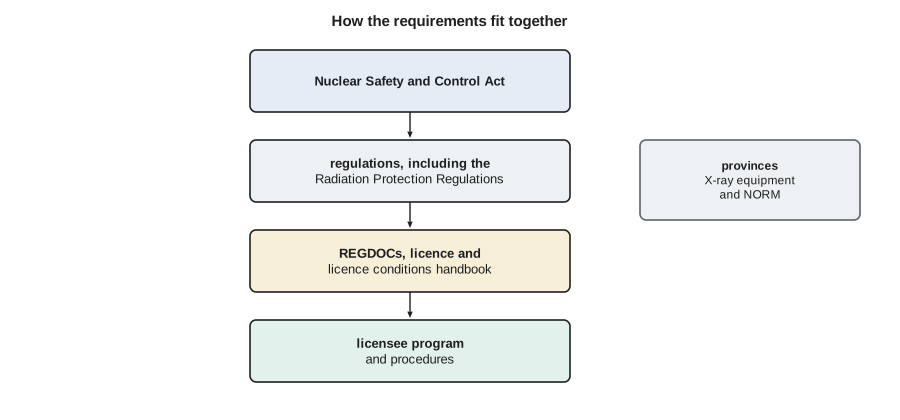
Nuclear energy in Canada is under federal jurisdiction. The Nuclear Safety and Control Act, in force since 2000, created the Canadian Nuclear Safety Commission (CNSC) and gives it authority to regulate the development, production and use of nuclear energy and nuclear substances, and the equipment and information associated with them, to protect health, safety, security and the environment. Under the Act sit regulations made by the Commission, and under them licences issued to each facility or user, each with a licence conditions handbook.
| Instrument | Role in radiation protection |
|---|---|
| Nuclear Safety and Control Act | creates the CNSC and the licensing system; sets offences and powers |
| General Nuclear Safety and Control Regulations | general obligations of licensees and workers, reporting, records |
| Radiation Protection Regulations (SOR/2000-203) | the program, dose limits, dosimetry, labelling and signs, emergencies |
| Class I Nuclear Facilities Regulations | licensing of reactors and other large facilities |
| Nuclear Substances and Radiation Devices Regulations | licensing of sources and devices; exemption and clearance levels |
| Packaging and Transport of Nuclear Substances Regulations, 2015 | transport, aligned with IAEA transport rules |
| Regulatory documents (REGDOCs) | requirements and guidance, such as REGDOC-2.7.1 Radiation Protection |
| Licence and licence conditions handbook | site-specific conditions, action levels and compliance criteria |
Not every source of radiation is federal. X-ray machines used in medicine, dentistry and industry are regulated by the provinces; in Ontario, for example, under occupational health and safety and healing arts legislation. Naturally occurring radioactive material outside the nuclear fuel cycle is managed by provinces and territories using the Canadian NORM Guidelines. Health Canada sets guidelines for radon and drinking water and maintains the National Dose Registry.
The Radiation Protection Regulations, section by section
| Provision | Requirement |
|---|---|
| Radiation protection program (s. 4) | keep doses ALARA through management control, training, exposure control and planning for unusual situations |
| Ascertaining doses (s. 5) | determine doses by direct measurement or, where not practical, by estimation |
| Action levels (s. 6) | if a licence action level is reached: investigate, correct, notify the Commission |
| Obligation to inform NEWs (s. 7) | tell each NEW in writing of the status, risks, limits and dose levels |
| Licensed dosimetry (s. 8) | use a licensed dosimetry service for NEWs with a reasonable probability of receiving more than 5 mSv in a year |
| Pregnant and breastfeeding NEWs (s. 11) | accommodate to meet the 4 mSv pregnancy limit and to limit intakes while breastfeeding |
| Dose limits (ss. 13, 14) | effective and equivalent dose limits, as in lesson 2 |
| Emergencies (s. 15) | during the control of an emergency, doses to those taking part limited to 500 mSv effective and 5000 mSv to the skin, with volunteers informed of risks |
| Exceeding a limit (ss. 16, 17) | notify, remove the person from work that adds dose, investigate; the Commission may authorize return to work |
| Labelling and signs (ss. 20 to 23) | radiation warning symbol on containers and devices; signs at areas above 25 µSv/h or with significant quantities |
| Records | records of doses and of information given to NEWs, kept as required |
The 2020 amendments, in force from 2021, lowered the lens of the eye limit for NEWs from 150 to 50 mSv, added the obligation to accommodate breastfeeding workers, clarified the requirements for selecting and using radiation instruments, and added an explicit duty to inform workers of their duties and risks in emergencies.
Worked problem
Working through the radiography incident
A radiographer's iridium-192 source failed to retract fully during a shot. His electronic dosimeter alarmed; his passive dosimeter later showed 6 mSv. His assistant was not a NEW and received an estimated 0.4 mSv. Which obligations apply?
Show solution
- The radiographer is a NEW; 6 mSv is within the 50 mSv limit, but the licence almost certainly sets an action level for such an event, and an unplanned exposure of this kind is reportable under the licence and the General Nuclear Safety and Control Regulations.
- Because NEWs in radiography can exceed 5 mSv a year, his dose must be measured by a licensed dosimetry service (s. 8), and it goes to the National Dose Registry.
- The assistant should not have been a non-NEW in a radiography crew; 0.4 mSv is within the public limit of 1 mSv, but the licensee must review why a non-NEW was exposed and correct the practice.
- The licensee must investigate the equipment failure, take corrective action and report to the CNSC within the time set by its licence.
Answer: Several obligations at once: dose ascertainment, action level investigation, reporting and corrective action, and a review of worker designation. None of the limits was exceeded, but the event still requires a full regulatory response.
# Compliance check under the Radiation Protection Regulations (doses in mSv).
history = {2021: 8.5, 2022: 12.0, 2023: 21.0, 2024: 9.0, 2025: 6.0}   # one five-year dosimetry period, 2021 to 2025
ANNUAL, FIVE_YEAR = 50.0, 100.0
ACTION_LEVEL = 10.0          # illustrative licence action level per year

total = 0.0
for year, d in sorted(history.items()):
    total += d
    flags = []
    if d > ANNUAL: flags.append('exceeds annual limit')
    if d >= ACTION_LEVEL: flags.append('action level reached: investigate and notify')
    print(f"{year}: {d:5.1f} mSv  running five-year total {total:5.1f}  {'; '.join(flags) or 'ok'}")
print(f"five-year dosimetry period total {total:.1f} of {FIVE_YEAR:.0f} mSv; "
      f"remaining {FIVE_YEAR - total:.1f} mSv")

# Radiography incident: who is affected?
for who, nev, dose in (('radiographer', True, 6.0), ('assistant', False, 0.4)):
    limit = ANNUAL if nev else 1.0
    print(f"{who:12s} NEW={nev!s:5s} dose {dose:4.1f} mSv of {limit:4.1f} mSv limit "
f"({100*dose/limit:4.0f} % of limit)")2021: 8.5 mSv running five-year total 8.5 ok 2022: 12.0 mSv running five-year total 20.5 action level reached: investigate and notify 2023: 21.0 mSv running five-year total 41.5 action level reached: investigate and notify 2024: 9.0 mSv running five-year total 50.5 ok 2025: 6.0 mSv running five-year total 56.5 ok five-year dosimetry period total 56.5 of 100 mSv; remaining 43.5 mSv radiographer NEW=True dose 6.0 mSv of 50.0 mSv limit ( 12 % of limit) assistant NEW=False dose 0.4 mSv of 1.0 mSv limit ( 40 % of limit)
Regulatory documents and expectations
Regulations state requirements in general terms; regulatory documents add detail. REGDOC-2.7.1 describes expectations for the radiation protection program: application of ALARA, worker dose control, radiation protection training, monitoring of the workplace, and estimation of public dose. REGDOC-2.7.2 covers dosimetry, including the ascertainment and recording of doses and requirements for dosimetry services. REGDOC-2.10.1 covers nuclear emergency preparedness and response, the subject of lesson 11. Licensees state in their licence application how they meet each relevant document, and the CNSC inspects against those commitments.
Compliance and enforcement
The CNSC verifies compliance through inspections, desktop reviews of reports, and event follow-up. Its tools range from requests for information and orders to administrative monetary penalties, licence amendments and prosecution. For nuclear power plants it publishes an annual regulatory oversight report rating each station in its safety and control areas, including radiation protection. Workers also have obligations under the General Nuclear Safety and Control Regulations: to follow procedures, use protective equipment and report hazards and events.
Obligations of workers
The General Nuclear Safety and Control Regulations place obligations on workers as well as licensees. Every worker must use equipment, devices, clothing and procedures as required by the licence, comply with measures established by the licensee to protect the environment and the health and safety of persons, promptly report to the licensee or a supervisor any situation that could lead to an increase in radiation levels or an unauthorized release, any failure of equipment that may impair safety, and any act of sabotage, theft or loss, and not tamper with or render ineffective any safety device. Workers who see a problem have both the right and the duty to report it.
Exceeding a dose limit
If a dose limit may have been exceeded, sections 16 and 17 of the Radiation Protection Regulations set out what happens. The licensee must immediately notify the person concerned and the Commission, investigate to determine the magnitude of the dose and the causes, identify and take any action needed to prevent a recurrence, and remove the person from any work likely to add to the dose until the Commission authorizes a return. A worker whose dose has exceeded a limit can return to work only with that authorization and with any conditions the Commission sets, such as a reduced dose allowance for the rest of the dosimetry period.
Worked problem
Applying the five-year limit
A NEW received 12, 18, 25 and 22 mSv in the first four years of a five-year dosimetry period. What is the most the licensee may allow in year five, and what would ALARA and action levels suggest?
Show solution
- Total so far: \(12 + 18 + 25 + 22 = 77\) mSv.
- Remaining under the five-year limit: \(100 - 77 = 23\) mSv.
- The annual limit of 50 mSv is not the constraint; the five-year limit allows only 23 mSv.
- Doses this high would have reached most stations' action levels in each year, triggering investigations long before year five.
Answer: No more than 23 mSv, and in practice far less. A record like this would point to a work assignment problem that the program should have corrected early.
Transport and sealed sources
Radiation protection obligations follow radioactive material when it leaves a facility. The Packaging and Transport of Nuclear Substances Regulations, 2015, adopt the IAEA transport regulations and require packages to be labelled with their category and transport index, and carriers to have a radiation protection program when doses to transport workers could exceed set levels. Sealed sources, such as radiography and calibration sources, are licensed under the Nuclear Substances and Radiation Devices Regulations, which require inventories, leak testing at set intervals and secure storage, and the CNSC maintains a national sealed source registry for high-activity sources.
| Situation | Main Canadian requirement |
|---|---|
| Worker may exceed the public limit | designate as NEW and inform in writing |
| NEW may exceed 5 mSv in a year | licensed dosimetry service |
| Action level reached | investigate, correct, notify the Commission |
| Dose limit may be exceeded | notify, investigate, remove from dose-adding work |
| Area above 25 µSv/h | post signs with the radiation warning symbol |
| Shipping a source | package, label and document under the transport regulations |
Reading a licence
A station's operating licence is short; its licence conditions handbook is long. For radiation protection the handbook lists the compliance verification criteria: which REGDOCs and CSA standards apply and in which versions, the action levels and their values, the reporting requirements and their timelines, and the documents in which the licensee describes its program. An engineer joining a licensee should read the radiation protection section of the handbook early, because it is the practical definition of what the company has promised the regulator.
Marcel's radiography case ends with one more lesson: the contractor's licence required an action level for any unplanned exposure of a radiographer above 1 mSv in a single event. The company had reported the equipment failure but not the action level, an omission the CNSC treated as a separate non-compliance. Knowing the licence matters as much as knowing the regulations.
Federal and provincial overlap in practice
Occupational health and safety at a nuclear power plant is itself split. The CNSC regulates radiation protection and nuclear safety, while conventional hazards such as falls, electrical safety and confined spaces are under provincial occupational health and safety law for most provincially regulated employers, including Ontario Power Generation. Station procedures combine both sets of requirements, and joint inspections or memoranda of understanding between regulators help avoid gaps. A confined space entry into a contaminated tank, for example, must satisfy the provincial confined space rules and the CNSC-licensed radiation protection program at the same time.
Summary and key terms
- The Nuclear Safety and Control Act creates the CNSC and the licensing system; regulations, REGDOCs and licences add detail.
- The Radiation Protection Regulations set the program, dose ascertainment, action levels, NEW information, dosimetry, limits and signs.
- Licensed dosimetry is required for NEWs likely to exceed 5 mSv in a year.
- Emergency doses are limited to 500 mSv effective and 5000 mSv to the skin for those controlling an emergency.
- The 2020 amendments lowered the NEW lens limit to 50 mSv and added breastfeeding accommodation.
- X-ray equipment and NORM are provincially regulated.
- Nuclear Safety and Control Act
- The federal statute governing nuclear energy and substances in Canada.
- REGDOC
- A CNSC regulatory document setting requirements and guidance.
- Licence conditions handbook
- A document accompanying a licence that sets out compliance criteria.
- Nuclear energy worker
- A person with a reasonable probability, in the course of work, of a dose above the public limit.
- Licensed dosimetry service
- A dosimetry provider licensed by the CNSC to measure and record doses.
- National Dose Registry
- Health Canada database of occupational doses across employers.
Practice problems
Work each problem on paper first, then reveal the answer to check.
Which body regulates dental X-ray units in Ontario?
Show answer
The province, not the CNSC.
When must a licensee use a licensed dosimetry service?
Show answer
For NEWs with a reasonable probability of more than 5 mSv in a one-year period.
What is the emergency effective dose limit for people controlling an emergency?
Show answer
500 mSv.
What three steps follow when an action level is reached?
Show answer
Investigate, take corrective action, notify the Commission.
What did the 2020 amendments change for the lens of the eye?
Show answer
The NEW limit fell from 150 to 50 mSv per year.
Which REGDOC covers radiation protection programs?
Show answer
REGDOC-2.7.1.
Lesson quiz · 5 questions
Score 60% or more to complete this lesson.
Create a free account to save your progress, take quizzes and earn a certificate.