
NUC-320 · Lesson 6 of 12 · 23 min
Neutron shielding
Neutrons are the part of radiation protection where intuition fails most often. Lead, the default shield for gamma rays, does almost nothing to slow fast neutrons. A thin sheet of cadmium or a few centimetres of borated plastic can stop slow neutrons completely, yet produce penetrating gamma rays as it does so. And the best neutron shield of all is ordinary water. This lesson gives Hana's class the physics to make sense of that, with the shielding around reactors and around the neutron sources used to calibrate instruments as the main examples.
Where neutron doses come from
At a power station, neutrons come mainly from the reactor core during operation and leak through the reactor shielding in small numbers; from spent fuel, through spontaneous fission of curium and other actinides and through (α,n) reactions in the oxide fuel; and from sealed neutron sources used for instrument calibration, reactor start-up and well logging. Common sealed sources are americium-241 mixed with beryllium, in which alpha particles knock neutrons out of beryllium, and californium-252, which emits neutrons by spontaneous fission.
| Source | Approximate neutron output | Mean energy |
|---|---|---|
| Am-Be | about 6 × 10⁴ n/s per GBq of Am-241 | about 4 MeV |
| Cf-252 | about 2.3 × 10¹² n/s per gram | about 2 MeV (fission spectrum) |
| Fission in a reactor core | about 2.4 neutrons per fission | about 2 MeV at birth |
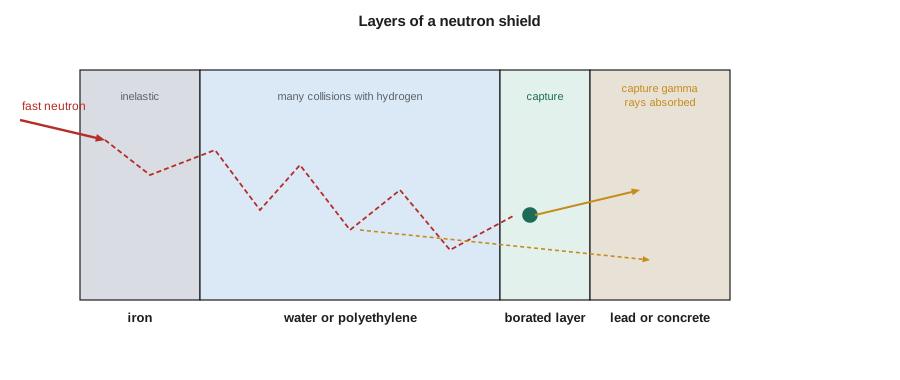
Neutrons carry no charge and interact only with nuclei, so their behaviour depends on the energy. Fast neutrons, above about 0.1 MeV, lose energy mainly by elastic scattering. Slow or thermal neutrons, near 0.025 eV at room temperature, are readily captured by many nuclei. Shielding therefore works in two stages: slow the fast neutrons down, then absorb them, and finally deal with the gamma rays that capture produces.
Slowing down: why hydrogen wins
In an elastic collision, a neutron loses the most energy when it hits a nucleus of similar mass, as one billiard ball stops another. A head-on collision with hydrogen can transfer all of the neutron's energy; a collision with lead, about 200 times heavier, removes at most about 2 %. The average logarithmic energy loss per collision, \(\xi\), is 1 for hydrogen, about 0.16 for carbon and about 0.01 for lead, so a neutron slows from 2 MeV to thermal energy in about 18 collisions with hydrogen but more than 1000 with lead. Hydrogen-rich materials, water, polyethylene, paraffin and the water bound in concrete, are therefore the backbone of neutron shields.
Heavy and medium elements still help. Fast neutrons above about 1 MeV can scatter inelastically from iron or lead, leaving the nucleus excited and losing a large step of energy at once; the excited nucleus then emits a gamma ray. A layer of iron in front of a hydrogenous shield is therefore effective at degrading the highest-energy neutrons, which hydrogen handles less well because its scattering cross section falls at high energy.
Absorbing slow neutrons
Once thermal, neutrons diffuse until they are captured. Ordinary hydrogen captures them with a cross section of about 0.33 barn and emits a 2.2 MeV gamma ray. Boron-10, with a cross section of about 3840 barns, captures them far more readily in the reaction \(^{10}\text{B}(n,\alpha)^{7}\text{Li}\), which releases mostly an alpha particle and a lithium nucleus, both stopped immediately, with a soft 0.48 MeV gamma ray in most reactions. Adding boron to polyethylene or concrete therefore removes thermal neutrons quickly and greatly reduces the hard 2.2 MeV capture gamma rays from hydrogen. Cadmium also absorbs thermal neutrons strongly but emits energetic capture gamma rays; gadolinium is used in some fuel and pool applications.
Removal cross sections
Full neutron transport calculations are done with computer codes. For hand estimates of thick shields, engineers use the removal cross section \(\Sigma_R\). The idea is that in a thick hydrogenous shield, any fast neutron that has one significant collision is effectively removed from the penetrating fast flux, because it is quickly slowed down and absorbed. The fast neutron dose behind the shield then falls roughly exponentially:
| Material | Approximate Σ_R (cm⁻¹) | Comment |
|---|---|---|
| Water | 0.10 | excellent moderator; must be contained |
| Polyethylene | 0.12 | compact; flammable; often borated |
| Ordinary concrete | 0.08 to 0.09 | depends on water content; drying in hot areas reduces it |
| Iron | 0.16 | degrades fast neutrons by inelastic scattering; needs hydrogen behind it |
| Lead | 0.12 | works only in combination with hydrogenous material |
The removal method only works when there is enough hydrogen in or behind the shield to finish the slowing down; a pure iron or lead shield cannot be treated this way. Concrete's neutron performance depends on its bound water, which is why concrete in high-temperature regions near a reactor may be specified with extra hydrogen or boron, and why its water content is checked over the life of the plant.
Worked problem
A calibration source store
The radiation measurement team keeps a 37 GBq Am-Be calibration source. The fast neutron dose rate at 1 m without shielding is about 0.03 mSv/h. How thick a polyethylene shield is needed to bring the neutron dose rate at 1 m down to 1 µSv/h?
Show solution
- Required reduction: \(30/1 = 30\).
- Thickness: \(x = \ln 30 / 0.12 = 3.40/0.12 = 28\) cm.
- Add boron to the outer few centimetres to absorb the thermalized neutrons, and a thin lead layer or some concrete for the capture gamma rays and the source's own 60 keV gamma rays.
Answer: About 30 cm of borated polyethylene, a typical size for a source storage container. The estimate should be checked with a neutron survey meter after installation.
# Neutron shielding estimates (approximate data, rounded).
import math
XI = {'hydrogen': 1.0, 'carbon': 0.158, 'iron': 0.0353, 'lead': 0.00963}
E0, Eth = 2.0e6, 0.025          # eV
for el, xi in XI.items():
    print(f"collisions to thermalize in {el:8s}: {math.log(E0/Eth)/xi:7.0f}")

# Unshielded Am-Be source: fluence rate and dose rate at 1 m
A_GBq = 37.0
S = 6.0e4 * A_GBq               # neutrons per second
r = 100.0                       # cm
phi = S / (4 * math.pi * r**2)  # n/(cm2 s)
h = 390e-12                     # Sv cm2, approximate ambient dose equivalent coefficient for Am-Be
Hdot = phi * h * 3600 * 1000    # mSv/h
print(f"S = {S:.2e} n/s, fluence rate at 1 m = {phi:.1f} n/cm2/s, dose rate = {Hdot:.3f} mSv/h")

# Removal attenuation for a thick hydrogenous shield
SIGMA_R = {'water': 0.10, 'polyethylene': 0.12, 'concrete': 0.085}   # 1/cm
target = 0.001                  # mSv/h at 1 m
for m, sr in SIGMA_R.items():
    x = math.log(Hdot / target) / sr
    print(f"{m:12s}: {x:5.1f} cm to reach {1000*target:.0f} uSv/h")

# Thermal versus fast neutrons: same fluence, very different dose
for name, coeff in (('thermal', 10e-12), ('1 MeV', 420e-12)):
print(f"{name:8s}: {coeff*1e12:4.0f} pSv cm2 -> {coeff*1e4*3600*1e3:.3f} mSv/h at 1e4 n/cm2/s")collisions to thermalize in hydrogen: 18 collisions to thermalize in carbon : 115 collisions to thermalize in iron : 516 collisions to thermalize in lead : 1890 S = 2.22e+06 n/s, fluence rate at 1 m = 17.7 n/cm2/s, dose rate = 0.025 mSv/h water : 32.1 cm to reach 1 uSv/h polyethylene: 26.8 cm to reach 1 uSv/h concrete : 37.8 cm to reach 1 uSv/h thermal : 10 pSv cm2 -> 0.360 mSv/h at 1e4 n/cm2/s 1 MeV : 420 pSv cm2 -> 15.120 mSv/h at 1e4 n/cm2/s
From neutron fluence to dose
Neutron dose is not measured in the same way as gamma dose. Instruments and calculations convert neutron fluence, the number of neutrons crossing unit area, into dose with energy-dependent conversion coefficients. For ambient dose equivalent, the coefficient is roughly 10 pSv·cm² for thermal neutrons, rising to about 400 pSv·cm² near 1 MeV and higher at a few MeV. A fast neutron is therefore about forty times more effective per neutron than a thermal one, which is why thermalizing neutrons inside the shield matters so much even before they are absorbed.
For an unshielded point source emitting \(S\) neutrons per second, the fluence rate at distance \(r\) follows the inverse square law, and the dose rate is the fluence rate times the conversion coefficient for the source spectrum. The program in this lesson uses this to check the 0.03 mSv/h quoted for the Am-Be source.
Reactor neutron shielding
In a CANDU reactor, the calandria vessel is surrounded by a steel shield tank filled with light water, and the end shields at each face of the reactor are steel boxes containing steel balls and water. Together with the heavy water moderator, they reduce the neutron leakage to levels that the concrete reactor vault walls can then handle. Heavy water itself is a good moderator but a poor absorber, which is why the reactor needs separate shielding outside the moderator.
Penetrations through reactor shields are designed with special care because neutrons stream along gaps far more readily than photons through the same gaps. Cable trays and pipes crossing the biological shield use bent or stepped paths, and joints between shield blocks are offset. Even small gaps in a neutron shield can create local doses many times the design value, as surveys during commissioning regularly reveal.
Activation
Neutrons that are captured leave behind radioactive nuclei. Cobalt-59 in steel becomes cobalt-60; sodium in concrete becomes sodium-24; europium and cobalt traces in concrete become long-lived europium-152 and cobalt-60, which matter at decommissioning. Shield and structural materials near the core are therefore selected with low levels of cobalt and other activating impurities, and activation is one of the main sources of the dose that workers receive during maintenance. Source reduction, discussed in lesson 3, begins with these material choices.
In CANDU reactors, tritium is produced by neutron capture in the deuterium of the heavy water moderator and coolant. That activation product is the main reason tritium is the dominant internal dose hazard at Canadian stations, as lesson 7 explains.
Protecting people from neutrons
For workers, neutron exposures are uncommon outside reactor buildings at power and areas around spent fuel casks and neutron sources. Where they occur, neutron dosimeters, such as bubble detectors, track-etch dosimeters or albedo dosimeters, are worn alongside photon dosimeters, and area surveys use moderated neutron survey meters (remmeters), both covered in NUC-310. Because neutron dosimetry is less accurate than photon dosimetry, protection programs often apply conservative correction factors and keep neutron doses especially low.
Spent fuel and transport casks
Spent fuel combines the two shielding problems of lessons 5 and 6. Its gamma radiation is intense, and its neutron emission, from spontaneous fission of curium-242 and curium-244 and from (α,n) reactions in the oxide, grows with burnup. Dry storage and transport casks therefore use layered designs: thick steel or a steel and lead body for gamma shielding, a layer of borated resin or concrete for neutrons, and often fins or air channels for heat removal, since the fuel still produces decay heat. Cask surface dose rates are limited by transport regulations, and storage pads are arranged so that the casks shield one another and the site boundary dose stays low.
CANDU fuel is natural uranium with low burnup, so its neutron source is weaker than that of light water reactor fuel, and dry storage modules at Canadian stations are concrete structures holding baskets of fuel bundles after years of cooling in the pools.
Worked problem
Water as a shield in a fuel pool
Fuel pools keep several metres of water above the fuel. Using a rough attenuation of a factor of ten for every 40 cm of water for the most penetrating fission product gamma rays, how much is the dose rate reduced by 3 m of water above the fuel?
Show solution
- Number of tenth-value layers: \(300/40 = 7.5\).
- Reduction: \(10^{7.5} \approx 3 \times 10^{7}\).
Answer: A reduction of tens of millions, which is why workers can stand on the pool deck above fuel that would be lethal in minutes in air. The water also shields neutrons and removes heat.
For the calibration source store in the example, the class also checks the gamma dose. Americium-241 emits a 60 keV gamma ray, easily stopped by a few millimetres of lead, but the hydrogen capture in the polyethylene adds 2.2 MeV photons that the lead barely touches. That is why the outer layer is borated: boron absorbs the neutrons before hydrogen can, and the remaining capture gamma dose is checked with a gamma survey meter alongside the neutron measurement. A neutron shield that is checked only with a neutron meter is only half checked.
Summary and key terms
- Fast neutrons are slowed mainly by collisions with hydrogen; lead and iron alone are poor neutron shields.
- Iron degrades the highest-energy neutrons by inelastic scattering; hydrogen then moderates; boron absorbs thermal neutrons.
- Hydrogen capture gives 2.2 MeV gamma rays; boron capture mostly gives short-range alpha and lithium particles.
- For thick hydrogenous shields, fast neutron dose falls roughly as e^{−Σ_R x}.
- Fluence-to-dose coefficients rise about forty times from thermal to 1 MeV neutrons.
- Neutron capture activates shield and structural materials; low-cobalt materials reduce future dose.
- Thermal neutron
- A neutron in thermal equilibrium with its surroundings, about 0.025 eV at room temperature.
- Moderation
- Slowing neutrons by elastic collisions, most effectively with hydrogen.
- Removal cross section
- An effective cross section describing exponential attenuation of fast neutrons in thick hydrogenous shields.
- Capture gamma ray
- A gamma ray emitted when a nucleus absorbs a neutron.
- Borated polyethylene
- Polyethylene containing boron to absorb thermalized neutrons.
- Activation
- Production of radioactive nuclei by neutron capture.
Practice problems
Work each problem on paper first, then reveal the answer to check.
About how many collisions with hydrogen slow a 2 MeV neutron to 0.025 eV?
Show answer
ln(8 × 10⁷) ≈ 18.
Why add boron to a polyethylene shield?
Show answer
To absorb thermal neutrons and suppress the 2.2 MeV capture gamma rays from hydrogen.
Σ_R = 0.10 cm⁻¹. What thickness of water reduces fast neutron dose by 100?
Show answer
ln 100/0.10 = 46 cm.
Why is a pure lead shield poor for fast neutrons?
Show answer
Each collision removes only about 2 % of the neutron's energy.
How does concrete drying affect neutron shielding?
Show answer
It loses hydrogen, reducing its moderating and removal ability.
Why does activation matter for maintenance dose?
Show answer
Activated corrosion products such as cobalt-60 are the main gamma sources workers face.
Lesson quiz · 5 questions
Score 60% or more to complete this lesson.
Create a free account to save your progress, take quizzes and earn a certificate.