
NUC-320 · Lesson 11 of 12 · 23 min
Emergency preparedness
Radiation protection is mostly about routine work done carefully. Emergency preparedness is about the rare day when it is not routine. For this session the class joins an exercise at Meridian Nuclear Engineering's emergency operations centre, where Dr. Vasquez acts as the dose assessment lead and Hana runs the plume projection program. The scenario is a severe accident at a reactor unit with a release of noble gases and iodine to the atmosphere. The exercise tests whether the people inside the station, the off-site authorities and the public would be protected if it ever happened for real.
What can go wrong
Radiological emergencies range from small and local to very large. A spill of a radioactive solution in a laboratory, a radiography source stuck outside its container, a lost sealed source, a transport accident, a fire in a building storing radioactive material and, at the far end, a severe reactor accident with damage to the fuel and failure of containment. Each needs a plan scaled to the hazard. The principles are the same: protect people from deterministic effects at once, reduce stochastic risk as far as reasonably possible, and do not cause more harm with the response than the radiation itself would cause.
The lessons of past accidents shape modern plans. At Chernobyl in 1986 the lack of timely protective action and the failure to restrict contaminated milk led to many thyroid cancers in children from radioiodine. At Fukushima Daiichi in 2011 the evacuation itself, especially of elderly and hospital patients, caused deaths and great hardship, while the radiation doses to the public were mostly low. Both events show that protective actions must be prompt where they matter, but proportionate and well planned, with attention to vulnerable people.
Protective actions
| Action | What it does | When used |
|---|---|---|
| Sheltering in place | buildings reduce dose from the passing cloud and from deposited material | short releases; when evacuation would be riskier |
| Evacuation | removes people from the path of the release | when projected doses are high and time allows |
| Iodine thyroid blocking (KI) | saturates the thyroid with stable iodine so radioiodine is not taken up | shortly before or at the start of exposure to radioiodine |
| Food and water restrictions | prevents ingestion of deposited radionuclides | after deposition, especially of iodine and caesium |
| Relocation | longer-term removal from areas of high deposition | weeks to months after the release |
| Decontamination | reduces long-term dose in affected areas | recovery phase |
Iodine thyroid blocking with potassium iodide (KI) is effective only for radioiodine and only if taken close to the time of exposure, ideally a few hours before or at its start; taken a day later it gives little protection. That is why plans near nuclear plants pre-distribute KI tablets to households, schools and businesses, so that they are on hand when an instruction is given. KI does nothing against other radionuclides or external dose.
Planning zones
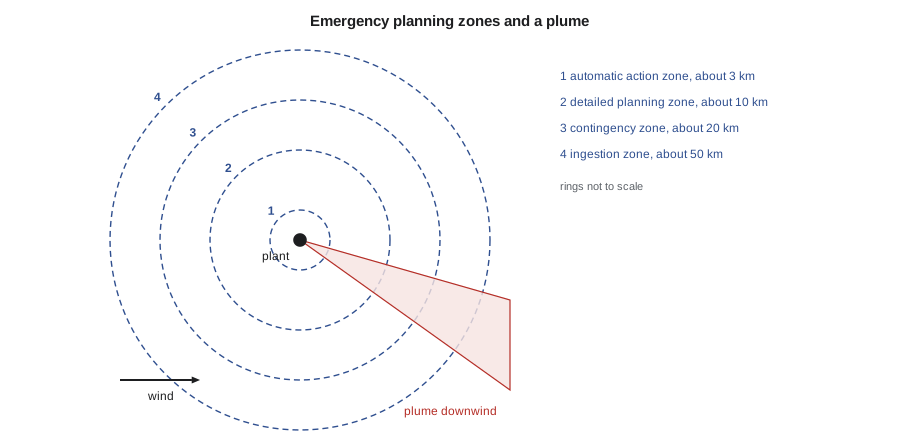
In Ontario, the Provincial Nuclear Emergency Response Plan (PNERP), with implementing plans for each station including Darlington, divides the area around a nuclear power plant into zones. An automatic action zone close to the plant, of about 3 km, has protective actions taken by default from plant conditions. A detailed planning zone of about 10 km, which includes it, has detailed arrangements for sheltering, evacuation and iodine thyroid blocking. A contingency planning zone of about 20 km covers very unlikely severe accidents, with no default measures, and an ingestion planning zone of about 50 km protects food and drinking water. Under the CNSC's REGDOC-2.10.1, KI tablets are pre-distributed to residences and institutions in the detailed planning zone and made available to residents of the wider zone on request.
Intervention levels
Decisions to shelter, evacuate or distribute KI are guided by projected doses, the dose that would be received if no action were taken. Because there is uncertainty in any projection and the actions themselves carry risks and costs, the criteria are set in terms of dose averted or projected over a period, and are guides for decision makers rather than limits.
| Protective action | Generic criterion (approximate) |
|---|---|
| Sheltering or evacuation | about 100 mSv effective dose projected in the first week (international generic criteria adopted by Health Canada) |
| Iodine thyroid blocking | about 50 mSv equivalent dose to the thyroid projected in the first week |
| Relocation | about 100 mSv effective dose in the first year |
| Food, milk and water | operational levels in Bq/kg and Bq/L derived from about 10 mSv per year |
Projecting doses from a release
In an emergency, dose assessment staff estimate where the release will go and what doses it will give, using the source term from the plant, weather data and atmospheric dispersion models. The simplest model is the Gaussian plume. For a continuous ground-level release of \(Q\) becquerels per second in a wind of speed \(u\), the air concentration on the plume centreline at ground level a distance \(x\) downwind is
where \(\sigma_y\) and \(\sigma_z\) are the horizontal and vertical spreads of the plume, which grow with distance and depend on atmospheric stability. Multiplying the time-integrated concentration by a breathing rate and an inhalation dose coefficient gives the internal dose; multiplying it by a cloud-immersion dose coefficient gives the external dose from noble gases. Real systems use more advanced models with terrain, changing weather and deposition, but the Gaussian plume shows the key behaviour: concentrations fall roughly as the inverse of distance to a power between 1.5 and 2, and stable night-time weather with light winds gives the highest doses at a distance.
Worked problem
A plume projection
An exercise release of iodine-131 is 1 × 10¹¹ Bq/s for 2 hours at ground level, wind 3 m/s, neutral stability. At 3 km, the plume spreads are about σ_y = 210 m and σ_z = 77 m. Estimate the centreline inhalation dose to an adult, with a breathing rate of 3.3 × 10⁻⁴ m³/s and an inhalation dose coefficient for the thyroid of about 1.5 × 10⁻⁷ Sv/Bq, and compare with KI criteria.
Show solution
- \(\chi = 10^{11}/(\pi \times 210 \times 77 \times 3) = 6.6 \times 10^{5}\) Bq/m³.
- Time-integrated concentration over 7200 s: \(4.7 \times 10^{9}\) Bq·s/m³.
- Inhaled: \(4.7 \times 10^{9} \times 3.3 \times 10^{-4} = 1.6 \times 10^{6}\) Bq.
- Thyroid dose: \(1.6 \times 10^{6} \times 1.5 \times 10^{-7} \approx 0.23\) Sv, about 230 mSv to the adult thyroid; a child's would be higher.
Answer: Well above the KI criterion of about 50 mSv to the thyroid, so iodine thyroid blocking and sheltering or evacuation would be recommended in the downwind sectors at 3 km. The numbers are illustrative exercise values.
# Gaussian plume projection for a ground-level release (illustrative exercise values).
import math

def sigmas(x):
    """Briggs open-country spreads for neutral (class D) conditions, x in metres."""
    sy = 0.08 * x / math.sqrt(1 + 0.0001 * x)
    sz = 0.06 * x / math.sqrt(1 + 0.0015 * x)
    return sy, sz

Q = 1e11          # Bq/s of I-131
u = 3.0           # m/s
T = 7200.0        # s, release duration
BR = 3.3e-4       # m3/s adult breathing rate (light activity)
DCF_THY = 1.5e-7  # Sv/Bq thyroid equivalent dose per Bq inhaled (illustrative)
KI_CRIT = 0.050   # Sv thyroid, approximate criterion for iodine thyroid blocking

for x in (1000, 3000, 5000, 10000, 20000):
    sy, sz = sigmas(x)
    chi = Q / (math.pi * sy * sz * u)          # Bq/m3 on the centreline
    H = chi * T * BR * DCF_THY                 # Sv to the adult thyroid
    rec = 'KI and shelter or evacuate' if H > KI_CRIT else 'below KI criterion'
    print(f"x = {x/1000:5.1f} km  sy = {sy:6.0f} m  sz = {sz:5.0f} m  chi = {chi:9.2e} Bq/m3  "
          f"thyroid {1000*H:7.1f} mSv  {rec}")

# Doubling the wind speed halves the concentration
sy, sz = sigmas(3000)
print("ratio chi(u=6)/chi(u=3) =", round((Q/(math.pi*sy*sz*6)) / (Q/(math.pi*sy*sz*3)), 2))x = 1.0 km sy = 76 m sz = 38 m chi = 3.67e+06 Bq/m3 thyroid 1306.4 mSv KI and shelter or evacuate x = 3.0 km sy = 210 m sz = 77 m chi = 6.57e+05 Bq/m3 thyroid 234.1 mSv KI and shelter or evacuate x = 5.0 km sy = 327 m sz = 103 m chi = 3.16e+05 Bq/m3 thyroid 112.5 mSv KI and shelter or evacuate x = 10.0 km sy = 566 m sz = 150 m chi = 1.25e+05 Bq/m3 thyroid 44.6 mSv below KI criterion x = 20.0 km sy = 924 m sz = 216 m chi = 5.33e+04 Bq/m3 thyroid 19.0 mSv below KI criterion ratio chi(u=6)/chi(u=3) = 0.5
Emergency workers
People who respond to an emergency, plant staff, firefighters, police and ambulance crews, may need to accept higher doses to save lives, prevent a severe accident from getting worse or protect large populations. Plans set guidance for those doses, require that volunteers be informed of the risks, and provide dosimetry, protective equipment, KI and briefings.
Under section 15 of the Radiation Protection Regulations, the effective dose to persons taking part in the control of an emergency is limited to 500 mSv, and the equivalent dose to the skin to 5000 mSv, except for actions to save lives, where informed volunteers may exceed it. Station plans set lower turn-back doses for most tasks.
Classification and response
Station emergency plans classify events into graded categories so that the right level of response is called at once, and notify the province, which leads the off-site response under the PNERP, and the CNSC. The provincial emergency operations centre directs public protective actions, informed by the station's dose projections and by field monitoring teams who measure dose rates and collect air, water and soil samples.
Exercises are where plans are proved. The Meridian Nuclear Engineering exercise ends with a debrief in which Hana's group reports that the plume program gave its first projection eighteen minutes after the release started, but that the weather feed lagged by half an hour and the initial projection had to be corrected when field teams reported dose rates twice the prediction in one sector. The corrective action is to move field team deployment earlier in the procedure. That kind of finding, small and concrete, is exactly why exercises are held.
Public information
In every emergency, people need clear, consistent and timely information: what has happened, what they should do and why. Plans therefore include pre-written public messages, arrangements for a joint information centre where the licensee and the authorities speak with one voice, and outreach before any emergency so that residents near a plant know how they will be alerted and what sheltering means. After Fukushima, surveys showed that fear and distrust caused much of the harm; honest communication about doses, including saying plainly when doses are low, is part of protection.
Worked problem
How much does sheltering help?
A plume of noble gases and iodine passes over a town for 2 hours. Outdoors, the projected effective dose is 12 mSv. A typical house reduces cloud-immersion dose by a factor of about 0.6 and inhalation dose by about 0.5 if windows and ventilation are closed. If half the outdoor dose is from immersion and half from inhalation, what is the dose to a person sheltering indoors?
Show solution
- Immersion: \(6 \times 0.6 = 3.6\) mSv.
- Inhalation: \(6 \times 0.5 = 3.0\) mSv.
- Total indoors about 6.6 mSv; ventilating the house after the plume has passed avoids trapping contaminated air.
Answer: Sheltering cuts the dose roughly in half for a short release. Large concrete buildings protect much better than wood-frame houses. The factors used here are illustrative.
Recovery after an emergency is planned too. Once a release has ended, monitoring maps the deposited activity, food and water restrictions are applied or lifted on the basis of measurements, and decisions on relocation and return balance the dose averted against the harm of keeping people away from their homes. International guidance now treats recovery as an existing exposure situation, with reference levels, typically in the range of 1 to 20 mSv per year, used to guide cleanup rather than as limits.
For the Meridian Nuclear Engineering class, the exercise's final lesson is personal: each of them now has a defined emergency role, a dosimeter and a briefing card, and knows where to report if the real alarm ever sounds.
Summary and key terms
- Emergencies range from local spills and stuck sources to severe reactor accidents; plans are graded to the hazard.
- Protective actions include sheltering, evacuation, iodine thyroid blocking, food and water restrictions and relocation.
- KI protects only the thyroid, only against radioiodine and only if taken close to the time of exposure.
- Planning zones around power plants allow fast, pre-planned action close in and food and water protection farther out.
- Projected-dose criteria guide decisions; they are not limits, and actions must not cause more harm than they avert.
- Emergency worker doses are controlled by guidance, informed volunteers and turn-back doses; exercises test the plans.
- Protective action
- An action to reduce dose to the public in an emergency, such as sheltering or evacuation.
- Projected dose
- The dose expected if no protective action is taken.
- Iodine thyroid blocking
- Taking stable iodine, usually potassium iodide, to prevent thyroid uptake of radioiodine.
- Emergency planning zone
- An area around a facility for which detailed emergency arrangements are made.
- Gaussian plume
- A dispersion model in which concentration across a plume follows normal distributions.
- Turn-back dose
- A dose at which an emergency worker leaves the task unless authorized otherwise.
Practice problems
Work each problem on paper first, then reveal the answer to check.
Why must KI be taken early?
Show answer
It blocks uptake only if the thyroid is saturated before or as radioiodine arrives.
Name two lessons from Fukushima for protective actions.
Show answer
Evacuation itself can harm vulnerable people; actions must be proportionate and well planned.
Doubling the wind speed in the Gaussian plume formula does what to the concentration?
Show answer
Halves it.
Why are night-time light winds the worst case at a distance?
Show answer
Stable air spreads the plume slowly, keeping concentrations high.
Is a projected-dose criterion a limit?
Show answer
No; it is a guide for decision makers balancing the benefit and harm of an action.
What does a field monitoring team do?
Show answer
Measures dose rates and samples air, water and soil to check and correct projections.
Lesson quiz · 5 questions
Score 60% or more to complete this lesson.
Create a free account to save your progress, take quizzes and earn a certificate.