
NUC-320 · Lesson 1 of 12 · 23 min
Biological effects of radiation
Hana Okoye's six months with the station radiation measurement team at the Darlington CANDU station ended with an unexpected request. Marcel Thibodeau, who leads that team, has been asked to run the radiation protection training for a new class of engineers at Meridian Nuclear Engineering, and he wants Hana as his co-instructor. "You know how we measure it," he tells her. "Now the class needs to know why we bother, how much is too much, and how we keep doses low." Dr. Teodora Vasquez agrees to lend Hana for one more term, on one condition: the course must end with a real shielding design that the core physics group can check. This course follows that training, from the biology of radiation damage to the concrete walls of a storage room.
Every rule in radiation protection rests on what radiation does to living tissue. Dose limits, posted areas, shielding thicknesses and emergency plans are all ways of keeping the biological effects described in this lesson either impossible or very unlikely. An engineer who understands the biology can explain a rule to a worker, judge when a rule is conservative, and recognize when a situation is genuinely dangerous.
How radiation damages cells
Ionizing radiation deposits energy in tissue by ejecting electrons from atoms and molecules. A single gamma photon or beta particle leaves a sparse track of ionizations, while an alpha particle or a recoil proton from a fast neutron leaves a dense track over a short distance. The quantity that describes this density is the linear energy transfer (LET), the energy deposited per unit length of track. Gamma rays and electrons are low-LET radiation; alpha particles and neutrons are high-LET.
The critical target in a cell is DNA. Radiation can break DNA directly, when the track passes through the molecule, or indirectly, when it ionizes water nearby and produces reactive free radicals such as the hydroxyl radical, which then attack the DNA. For low-LET radiation most damage is indirect. Cells repair single-strand breaks quickly and accurately. Double-strand breaks, and clusters of damage close together, are harder to repair and are much more common along dense high-LET tracks. That is the main reason an alpha particle does more biological harm than a gamma ray depositing the same energy.
A damaged cell has several possible fates. The damage may be repaired correctly, leaving no effect. The cell may die, either at once or when it next tries to divide. Or the damage may be misrepaired, leaving a mutation that the cell survives and passes on to its descendants. Cell death and mutation lead to the two very different kinds of health effect that radiation protection is built around.
Deterministic effects: tissue reactions
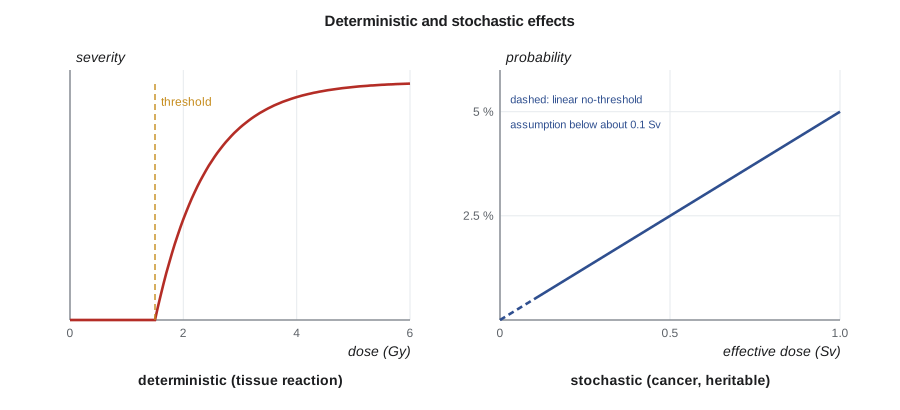
When enough cells in an organ are killed, the organ stops working properly. These effects are called deterministic effects, or tissue reactions in current ICRP terminology. They share three features. They have a threshold dose below which they do not occur, because tissues can lose some cells without harm. Above the threshold, their severity increases with dose. And they usually appear within hours to weeks of a large dose, although some, such as cataracts, take years.
| Effect | Approximate threshold (acute dose) | Notes |
|---|---|---|
| Temporary drop in blood cell counts | about 0.5 Gy to the whole body | detectable by blood tests, recovers |
| Acute radiation syndrome | about 1 Gy to the whole body | nausea, then marrow failure at higher doses |
| Death of half an untreated population | about 3.5 to 4 Gy to the whole body | medical care raises this substantially |
| Skin reddening (erythema) | about 2 Gy to the skin | burns and ulceration at much higher doses |
| Cataract (vision-impairing) | about 0.5 Gy to the lens | appears years later; basis for lower lens limits |
| Malformation of the embryo or fetus | about 0.1 Gy in early pregnancy | most sensitive weeks 8 to 15 for brain development |
These thresholds are far above anything a worker should receive in normal operation. They matter in three situations: accidents with large sources, such as an industrial radiography source handled by someone who does not recognize it; medical procedures, where skin doses from long fluoroscopy can approach the threshold; and severe reactor accidents, where emergency workers may approach them. The 2011 change in the ICRP's view of cataract threshold, from several gray to about 0.5 Gy, is the reason both Canadian and international limits on lens dose were lowered in the last decade.
Dose rate matters for deterministic effects. The same total dose delivered over months causes far less harm than if delivered in minutes, because cells repair damage and tissues repopulate between exposures. Thresholds in the table are for brief, acute exposures.
Stochastic effects: cancer and heritable effects
A cell that survives with a mutation may, after further changes over years, give rise to a cancer. If the cell is a germ cell, the mutation could in principle be passed to children. These are stochastic effects, meaning random effects. Their key feature is that dose affects the probability of the effect, not its severity. A cancer caused by radiation is no worse than one with another cause, and nothing distinguishes it. Stochastic effects appear after long latent periods, from a few years for leukaemia to decades for most solid cancers.
Most of what is known about radiation cancer risk comes from the Life Span Study of survivors of the 1945 atomic bombings in Japan, a cohort of about 120 000 people followed since the early 1950s, supported by studies of medical patients and nuclear workers. These studies show a clear increase in cancer risk at doses above about 100 mSv. Below about 100 mSv, the excess risk is too small to measure against the large natural rate of cancer, which affects roughly two in five people over a lifetime.
The ICRP combines these data into a nominal risk coefficient. Its 2007 recommendations, ICRP Publication 103, give a detriment-adjusted risk of about 5.5 % per sievert for cancer in the whole population and about 4.1 % per sievert for adult workers, with heritable effects adding about 0.2 %. The total, about 5 % per sievert, is the figure most often used. These coefficients apply to populations and to low doses accumulated over time; they are tools for comparing options and setting limits, not predictions for individuals.
The linear no-threshold model
Because cancer risk cannot be measured below about 100 mSv, radiation protection has to assume something about it. The international system assumes that risk is proportional to dose all the way down to zero. This is the linear no-threshold (LNT) model. It is a prudent assumption for protection purposes, not a proven law of biology. Some scientists argue that cells' repair and defence mechanisms make low doses less harmful than the line predicts; others argue that some effects might make them more harmful. The ICRP, the national regulators in Canada and most scientific bodies keep the LNT model because it is simple, cautious and allows doses from different sources to be added.
The LNT model has two practical consequences that run through this whole course. First, there is no dose that is completely safe, so even doses well below limits should be kept as low as reasonably achievable. That is the ALARA principle of lesson 3. Second, the model must not be misused. Multiplying a tiny dose by a huge number of people to predict a number of deaths is not justified, and the ICRP itself advises against it. Collective dose is a tool for comparing protection options, not a way to count casualties.
Worked problem
Putting a risk coefficient to work
A worker receives 2 mSv in a year from outage work. Using a nominal coefficient of 5 % per sievert, what is the estimated added lifetime risk of fatal cancer, and how does it compare with the natural risk?
Show solution
- Risk \(= 0.05\ \text{Sv}^{-1} \times 0.002\ \text{Sv} = 1.0 \times 10^{-4}\), or 1 in 10 000.
- The natural lifetime risk of dying from cancer is about 1 in 4 in Canada.
- The added risk changes the worker's total from about 25 % to about 25.01 %.
Answer: About 1 in 10 000 added risk, a very small increase on a large baseline. The estimate is useful for comparing work methods, not for predicting whether this worker will be harmed.
# Nominal risk estimates for protection purposes (ICRP 103 coefficients, rounded).
RISK_WORKER = 0.041 + 0.001   # per sievert, adult workers: cancer plus heritable (rounded)
RISK_PUBLIC = 0.055 + 0.002   # per sievert, whole population

def risk(dose_mSv, coeff):
    return coeff * dose_mSv / 1000.0

for d in (1, 2, 20, 100):
    r = risk(d, RISK_WORKER)
    print(f"{d:4d} mSv to a worker -> added lifetime risk {r:.1e}  (about 1 in {round(1/r):,})")

# Collective dose: the same 20 person-mSv spread two ways
for people, each in ((2, 10.0), (200, 0.1)):
    S = people * each   # person-mSv
    print(f"{people:4d} workers x {each:5.1f} mSv = {S:.0f} person-mSv; "
          f"nominal expected cases {risk(S, RISK_WORKER):.4f}")
print("Equal collective dose gives equal nominal detriment; it is a tool for comparing options,")
print("not a prediction that anyone in the larger group will be harmed.")1 mSv to a worker -> added lifetime risk 4.2e-05 (about 1 in 23,810) 2 mSv to a worker -> added lifetime risk 8.4e-05 (about 1 in 11,905) 20 mSv to a worker -> added lifetime risk 8.4e-04 (about 1 in 1,190) 100 mSv to a worker -> added lifetime risk 4.2e-03 (about 1 in 238) 2 workers x 10.0 mSv = 20 person-mSv; nominal expected cases 0.0008 200 workers x 0.1 mSv = 20 person-mSv; nominal expected cases 0.0008 Equal collective dose gives equal nominal detriment; it is a tool for comparing options, not a prediction that anyone in the larger group will be harmed.
Natural and medical background
Everyone is exposed to radiation from natural sources: cosmic rays, radioactive potassium and carbon in the body, uranium and thorium in rocks and soil, and above all radon gas, which seeps into buildings and delivers a dose to the lungs from its short-lived decay products. Medical imaging, especially CT scans, adds a large and growing share.
In Canada the average dose from natural background is about 1.8 mSv per year, with large regional variation; radon is the largest part, and some homes have radon levels well above the Health Canada guideline of 200 Bq/m³. Medical exposures add roughly 1 mSv on average. A worker at Darlington who receives 1 mSv in a year from work is therefore receiving less than the natural background in many parts of the country.
Background comparisons help people understand doses, but they need care. A dose from work is added to background, not instead of it, and the fact that a dose is similar to background does not make it zero-risk under the LNT model. Used honestly, the comparison is a sense of scale, not an argument that a dose does not matter.
Who is more sensitive
Sensitivity varies. Children and the developing fetus are more sensitive to stochastic effects than adults, both because their cells divide more and because they have longer to live in which a cancer can appear. The ICRP's whole-population risk coefficient is higher than the adult worker coefficient for that reason. Women have a somewhat higher lifetime cancer risk per unit dose than men, mainly from breast and thyroid cancer. These differences are why the public limit is lower than the worker limit, why pregnant workers have a special limit, and why emergency plans give priority to protecting children's thyroids from radioiodine.
Tissues also differ. Rapidly dividing tissues, such as bone marrow, the lining of the gut and the skin, show deterministic damage first. For stochastic effects, the most sensitive organs include the bone marrow, colon, lung, stomach and breast. Lesson 2 shows how these differences become the tissue weighting factors that let doses to different organs be added into a single effective dose.
Internal and external sources
The biological effect of a dose does not depend on whether the source is outside or inside the body; a gray is a gray. What changes is which radiation matters. Alpha particles, which cannot penetrate the outer layer of dead skin, are harmless outside the body but very damaging inside it, for example when plutonium or radon progeny are inhaled. Beta particles mainly threaten the skin and lens from outside but irradiate whole organs from inside. Gamma rays and neutrons penetrate deeply from outside. At a CANDU station, tritium is the classic internal hazard: its weak beta radiation cannot get through skin from outside, but tritiated water vapour is breathed in and absorbed through the skin and spreads through all body water. Lesson 7 deals with internal dose in detail.
What the class takes away
Marcel closes the first session with three points that the rest of the course builds on. At high doses, radiation causes predictable tissue damage, so the first duty of protection is to make those doses impossible in normal work and to plan for them carefully in emergencies. At low doses, the only effect is a small added probability of cancer, assumed proportional to dose, so the second duty is to keep every dose as low as reasonably achievable. And because the effects of low doses cannot be seen, protection depends on measuring and recording dose accurately, which is where the counting rooms of the previous course come in.
Hana adds a practical point from her time on shift. Workers rarely ask about Gy and Sv. They ask whether a job is safe, whether their dose will affect their children, and why they are being asked to stand behind a lead blanket for a five-minute task. A good radiation protection engineer answers those questions plainly, with numbers when they help, and never claims more certainty than the science provides.
Summary and key terms
- Radiation damages DNA directly and through free radicals; double-strand breaks and clustered damage, common for high-LET radiation, are hardest to repair.
- Deterministic effects (tissue reactions) have thresholds, typically above 0.5 Gy, and severity rises with dose.
- Stochastic effects (cancer, heritable effects) have a probability that rises with dose, with a nominal coefficient of about 5 % per sievert.
- Below about 100 mSv, risk is too small to measure; protection assumes the linear no-threshold model.
- Collective dose compares options; it should not be used to predict deaths from tiny individual doses.
- Children, the fetus and some tissues are more sensitive, which shapes limits and emergency priorities.
- Linear energy transfer
- Energy deposited per unit length of a charged-particle track; high for alpha particles and neutron recoils.
- Deterministic effect
- A tissue reaction caused by cell killing, with a threshold dose and severity rising with dose.
- Stochastic effect
- An effect such as cancer whose probability, not severity, increases with dose.
- Linear no-threshold model
- The assumption that stochastic risk is proportional to dose down to zero.
- Nominal risk coefficient
- The detriment-adjusted probability of harm per unit effective dose used for protection.
- Background radiation
- Dose from natural sources such as radon, cosmic rays and radionuclides in the body and ground.
Practice problems
Work each problem on paper first, then reveal the answer to check.
Which kind of effect has a threshold?
Show answer
Deterministic effects (tissue reactions).
Estimate the added cancer risk from 20 mSv using 5 % per Sv.
Show answer
0.05 × 0.02 = 1 × 10⁻³, or 1 in 1000.
Why does an alpha particle cause more harm per gray than a gamma ray?
Show answer
Its dense track produces more double-strand breaks and clustered damage that cells cannot repair well.
Why were lens dose limits lowered?
Show answer
Newer evidence put the cataract threshold near 0.5 Gy, much lower than once thought.
Give one misuse of collective dose.
Show answer
Multiplying tiny individual doses by huge populations to predict a number of deaths.
Why is tritium an internal rather than external hazard?
Show answer
Its low-energy beta radiation cannot penetrate the dead outer layer of skin, but it is absorbed into body water.
Lesson quiz · 5 questions
Score 60% or more to complete this lesson.
Create a free account to save your progress, take quizzes and earn a certificate.