
NUC-320 · Lesson 9 of 12 · 23 min
Radiation protection programs
Everything in the first eight lessons has to be organized, resourced, documented and checked, or it will not happen consistently. That organization is the radiation protection program. For the ninth session, Marcel brings in the station's radiation protection manager, who describes her job as making sure that the right people do the right things, every time, and can prove it. The class's task for the week is to review the program for a new facility that Meridian Nuclear Engineering is designing: a small laboratory for testing irradiated materials samples from the Darlington CANDU station.
What a program contains
A radiation protection program is the set of management arrangements, procedures, people and equipment that a licensee uses to control radiation exposure. Programs differ in size, from a single radiation safety officer at a hospital to a department of a hundred people at a multi-unit station, but their elements are the same.
| Element | What it covers |
|---|---|
| Management commitment and organization | policy, responsibilities, the authority to stop work, resources |
| ALARA program | dose targets, job planning, reviews, committees, lessons learned |
| Dosimetry | external and internal dose measurement, records, reporting |
| Radiological surveys and monitoring | dose rates, contamination, airborne activity, instruments and calibration |
| Access control and work control | zoning, posting, radiation work permits, locked high-dose areas |
| Training and qualification | general awareness, worker training, technician qualification, refreshers |
| Radioactive material control | source inventory, labelling, transfers, waste, release of materials |
| Public protection | effluent control, environmental monitoring, dose to the public |
| Emergency arrangements | response to spills, high doses, lost sources and site emergencies |
| Self-assessment, audit and improvement | performance indicators, audits, event reports, corrective actions |
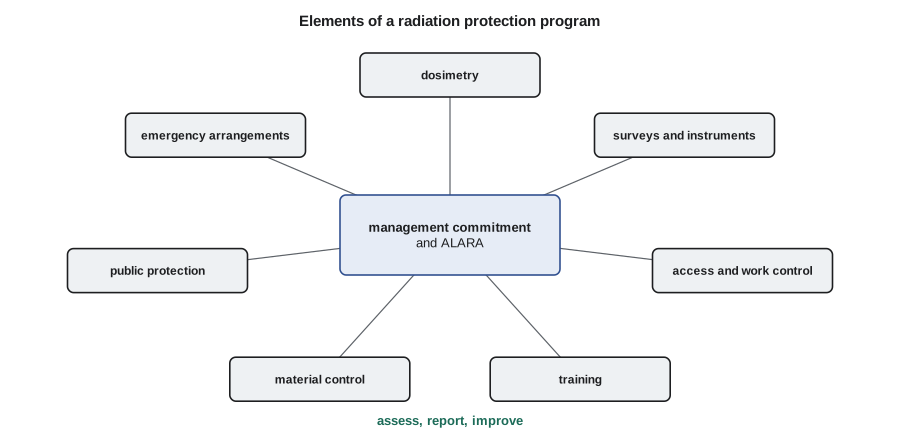
In Canada, the Radiation Protection Regulations require each licensee to implement a radiation protection program, and the CNSC's REGDOC-2.7.1, Radiation Protection, sets out its expectations for the program's content. The CNSC evaluates each licensee's performance in radiation protection as one of its safety and control areas and reports the ratings publicly for nuclear power plants.
Roles and responsibilities
Responsibility for radiation safety lies with line management, not only with the protection department. The plant manager is responsible for the safety of the work; supervisors are responsible for planning jobs with ALARA in mind and for their crews' behaviour; workers are responsible for following procedures, wearing dosimeters and reporting problems. The radiation protection organization provides expertise, monitoring, independent oversight and the authority to stop work that is unsafe. Programs fail when this division is blurred, for example when supervisors treat dose as the protection department's problem.
Canadian regulations define a nuclear energy worker (NEW) as a person who, in the course of business or occupation, is required to perform duties in circumstances where there is a reasonable probability of receiving a dose above the public limit. Licensees must inform each NEW in writing of that status, the risks associated with radiation, the applicable dose limits and their own doses, and must inform female NEWs of their rights and obligations regarding pregnancy.
Dosimetry and dose records
Every program needs reliable dose records, because they are how compliance is shown and how workers know their exposure. External dosimeters are issued and read by a licensed or accredited dosimetry service; internal doses are assessed from bioassay; and the results are combined into each worker's annual and lifetime record. Electronic personal dosimeters provide real-time readings for work control, but the legal dose of record usually comes from the passive dosimeter or a qualified electronic system.
In Canada, dosimetry services must be licensed by the CNSC, and doses of nuclear energy workers are reported to the National Dose Registry maintained by Health Canada, which keeps a lifetime dose history for each worker across employers.
Worked problem
Program indicators for a year
A station's dosimetry records for a year show 2400 monitored workers with these annual doses: 1900 below 1 mSv, 380 from 1 to 5 mSv, 110 from 5 to 10 mSv, and 10 from 10 to 15 mSv. Estimate the collective dose and average dose, using the midpoints of each band and 0.3 mSv for the lowest band.
Show solution
- Collective dose \(= 1900 \times 0.3 + 380 \times 3 + 110 \times 7.5 + 10 \times 12.5\).
- \(= 570 + 1140 + 825 + 125 = 2660\) person-mSv, about 2.7 person-Sv.
- Average dose \(= 2660/2400 = 1.1\) mSv per monitored worker.
Answer: About 2.7 person-Sv in total and 1.1 mSv on average. The ten workers above 10 mSv would be reviewed against the station's action level and individual dose targets.
# Dose distribution statistics for a year of station dose records (banded data).
bands = [   # (lower mSv, upper mSv, representative dose mSv, number of workers)
    (0, 1, 0.3, 1900),
    (1, 5, 3.0, 380),
    (5, 10, 7.5, 110),
    (10, 15, 12.5, 10),
]
N = sum(b[3] for b in bands)
S = sum(b[2] * b[3] for b in bands)            # person-mSv
print(f"monitored workers {N}, collective dose {S:.0f} person-mSv ({S/1000:.2f} person-Sv)")
print(f"average dose {S/N:.2f} mSv")
for lo, hi, d, n in bands:
    print(f"  {lo:2d}-{hi:2d} mSv: {n:5d} workers, {100*n/N:5.1f} % of workers, {100*d*n/S:5.1f} % of collective dose")

# Individual check against an illustrative action level
action_level = 10.0   # mSv per year, illustrative station value
records = {'W-1047': 12.8, 'W-2210': 9.6, 'W-0815': 11.1, 'W-3302': 4.2}
for w, d in sorted(records.items()):
    flag = 'investigate and report' if d >= action_level else 'ok'
print(f"{w}: {d:5.1f} mSv {flag}")monitored workers 2400, collective dose 2660 person-mSv (2.66 person-Sv) average dose 1.11 mSv 0- 1 mSv: 1900 workers, 79.2 % of workers, 21.4 % of collective dose 1- 5 mSv: 380 workers, 15.8 % of workers, 42.9 % of collective dose 5-10 mSv: 110 workers, 4.6 % of workers, 31.0 % of collective dose 10-15 mSv: 10 workers, 0.4 % of workers, 4.7 % of collective dose W-0815: 11.1 mSv investigate and report W-1047: 12.8 mSv investigate and report W-2210: 9.6 mSv ok W-3302: 4.2 mSv ok
Action levels
A distinctive feature of the Canadian system is the action level. Under section 6 of the Radiation Protection Regulations, a licensee may specify action levels in its licence, a dose or other parameter that, if reached, may indicate a loss of control of part of the radiation protection program. If an action level is reached, the licensee must investigate, identify and take corrective action, and notify the CNSC within a set time. Stations typically set action levels for individual effective dose well below the limit, and also for skin dose, intakes and other indicators.
Surveys and instruments
A program must define what is surveyed, how often, with which instruments, and what is done with the results. Routine surveys cover dose rates, contamination and airborne activity in work areas on set frequencies; job coverage surveys accompany radiological work; and special surveys follow unusual events. Instruments must be calibrated, checked with a source before use and maintained, as NUC-310 described, and their calibration records are part of the program's evidence. Survey results feed postings, work permits, ALARA planning and trends.
Training
Training is graded to the role. Everyone entering a controlled area receives basic radiation protection training on the hazards, the rules and how to read postings. Workers who handle radioactive material or work in contaminated areas receive deeper training with practical exercises such as dressing and undressing. Radiation protection technicians, who provide job coverage and surveys, complete formal qualification programs with supervised practice and examinations, and often requalify periodically. Training effectiveness is checked by observing work, not only by passing a test.
Assessment and improvement
Programs improve through feedback. Performance indicators, such as collective dose against target, personnel contamination events, unplanned exposures and survey backlog, are tracked and reviewed by management. Independent audits check that procedures are followed and remain adequate. Events are reported and investigated for root causes, and corrective actions are tracked to completion. Industry organizations share operating experience between stations, so that a lesson learned at one plant does not have to be repeated at another.
The class's review of the laboratory design finds three gaps. The draft program had no clear owner for the source inventory, no defined frequency for contamination surveys of the sample hot cell and no arrangement for the laboratory's staff to receive the station's bioassay sampling. Hana's write-up recommends fixing all three before the operating licence application, noting that each one maps directly to an element in the program table.
Records and reporting
Records are the program's memory. They include dose records for each worker, survey records for each area and job, instrument calibration records, source inventories and leak test results, training records, radiation work permits, ALARA reviews, audit reports and event investigations. Each type has a retention period set by regulation or licence, from a few years for routine surveys to the life of the facility for worker doses and decommissioning-relevant records. Electronic systems make records searchable but must be protected against loss and unauthorized change, because a dose record that cannot be trusted is worse than none.
Reporting runs in two directions. Workers receive their own doses regularly, at least annually and on request, and when they leave an employer. The regulator receives the reports required by the licence and the regulations: doses above action levels or limits, unplanned exposures, lost or stolen sources, significant contamination events and the annual performance reports. Timely, honest reporting is itself a regulatory requirement, and regulators treat a late or incomplete report as a separate failure from the event that prompted it.
| Record | Why it matters |
|---|---|
| Worker dose history | shows compliance with annual and multi-year limits; informs future work assignments |
| Survey records | show what conditions were when a job was done; support investigations |
| Instrument calibration | shows that every reading came from a working, calibrated instrument |
| Source inventory and leak tests | shows that every sealed source is accounted for and intact |
| Training and qualification | shows that people had the competence their tasks required |
| Event investigations | shows what was learned and what was changed |
Contractors and transient workers
Outages bring hundreds of contract workers to a station for a few weeks. They may have worked at several other stations in the same year, so the program must obtain their dose history before they start, issue dosimetry on arrival, train them in local rules and practices, and report their doses back to them and to the national records when they leave. A transient worker who receives a modest dose at each of several stations can approach an action level without any single station seeing a high dose, which is why national dose registries and dose history checks matter.
Worked problem
A transient worker's dose history
A contract welder arrives for an outage having already received 4.2 mSv this year at two other stations. The host station's annual action level is 10 mSv and its planning constraint for outage contractors is 8 mSv per year. How much dose may the outage plan assign to her?
Show solution
- Room under the planning constraint: \(8 - 4.2 = 3.8\) mSv.
- Room under the action level: \(10 - 4.2 = 5.8\) mSv.
- The planning constraint is the tighter of the two.
Answer: No more than about 3.8 mSv, and ALARA planning should aim well below that. Without her dose history the station might have planned up to 8 mSv.
Finally, a program is only as strong as the people who run it. Radiation protection staff need the authority to stop work, the independence to report problems without fear, and enough numbers to cover outages without exhaustion. Regulators look at staffing, qualification and the relationship between protection staff and operations managers as closely as at procedures, because the best written program fails if the people meant to apply it are too few or too easily overruled.
Self-assessment in practice
Many stations use a yearly self-assessment against the program table, rating each element and listing actions. The class tries it on the laboratory design: each student scores one element from one to four with evidence, and the group compares scores. The exercise shows quickly where documents exist but practice is unproven, such as a training plan with no field observation or a survey schedule with no defined instrument. Those gaps become the program's first year of improvement actions.
Summary and key terms
- A radiation protection program is the organized system of management, people, procedures and equipment for controlling exposure.
- Line management owns safety; the protection organization provides expertise, monitoring, oversight and authority to stop work.
- Programs must be documented, implemented and reviewed periodically, and regulators inspect them.
- Dose records from licensed or accredited services are kept for life and reported to national registries.
- Action levels or investigation levels trigger investigation before limits are approached.
- Training is graded to the role; performance indicators, audits and event reviews drive improvement.
- Radiation protection program
- The documented arrangements a licensee uses to control radiation exposure.
- Nuclear energy worker
- In Canada, a person whose work gives a reasonable probability of a dose above the public limit.
- Action level
- A specified dose or parameter that, if reached, may indicate loss of control and requires investigation.
- Dose of record
- The official dose assigned to a worker for compliance and records.
- Performance indicator
- A tracked measure of program effectiveness, such as collective dose or contamination events.
- Radiation protection technician
- A qualified person who performs surveys and provides radiological job coverage.
Practice problems
Work each problem on paper first, then reveal the answer to check.
Name four elements of a radiation protection program.
Show answer
For example dosimetry, surveys, access and work control, training, material control, public protection, emergency arrangements, audit.
Who is responsible for radiation safety on a job?
Show answer
Line management and the workers, with the protection organization providing expertise and oversight.
Why are dose records kept for a worker's lifetime?
Show answer
To show compliance, support health studies and give each worker a complete exposure history across employers.
What should happen when an action level is reached?
Show answer
Investigation, corrective action and notification of the regulator.
Collective dose 1.8 person-Sv across 1500 workers: average dose?
Show answer
1.2 mSv.
How is training effectiveness best checked?
Show answer
By observing work in the field, not only by test results.
Lesson quiz · 5 questions
Score 60% or more to complete this lesson.
Create a free account to save your progress, take quizzes and earn a certificate.