
NUC-320 · Lesson 2 of 12 · 25 min
Dose quantities and limits
On the second morning Marcel writes four words across the whiteboard: gray, sievert, equivalent, effective. "Half the arguments I have heard in twenty years came from people using these words loosely," he says. A contractor once reported a dose in gray to a regulator; a manager once added a skin dose to a whole-body dose and called the total an effective dose. This lesson sets out the quantities carefully, then the limits that are written in them.
Absorbed dose
The starting point is physical. The absorbed dose \(D\) is the energy deposited by ionizing radiation per unit mass of material:
The unit is the gray (Gy). Absorbed dose applies to any material and any radiation, and it is what deterministic thresholds are written in. It says nothing about which radiation delivered the energy, which matters for stochastic risk.
Equivalent dose and radiation weighting
To account for the greater harm done by dense tracks, the absorbed dose averaged over an organ or tissue \(T\) is multiplied by a radiation weighting factor \(w_R\). The result is the equivalent dose:
The unit is the sievert (Sv), which has the same dimensions as the gray but a different meaning.
| Radiation | w_R in ICRP 103 | Comment |
|---|---|---|
| Photons (gamma, X-rays) | 1 | reference radiation |
| Electrons and muons (beta) | 1 | includes beta particles from tritium and cobalt-60 |
| Protons | 2 | mainly relevant to cosmic and accelerator fields |
| Alpha particles, fission fragments, heavy ions | 20 | dense tracks |
| Neutrons | 2.5 to about 20 | continuous function of energy, highest near 1 MeV |
The Canadian Radiation Protection Regulations set out the weighting factors to be used in schedules attached to the regulations, so that every licensee calculates doses the same way.
Effective dose and tissue weighting
Organs differ in their sensitivity to cancer. To combine doses to different organs into a single number that reflects total stochastic risk, each equivalent dose is multiplied by a tissue weighting factor \(w_T\), and the products are added:
| Tissues | w_T each (ICRP 103) | Sum |
|---|---|---|
| Red bone marrow, colon, lung, stomach, breast, remainder tissues | 0.12 | 0.72 |
| Gonads | 0.08 | 0.08 |
| Bladder, oesophagus, liver, thyroid | 0.04 | 0.16 |
| Bone surface, brain, salivary glands, skin | 0.01 | 0.04 |
The effective dose \(E\), also in sieverts, is the quantity in which the main dose limits are written. A uniform whole-body dose of 1 mSv gives an effective dose of 1 mSv; a dose of 10 mSv to the thyroid alone gives an effective dose of only \(0.04 \times 10 = 0.4\) mSv. Effective dose is a protection quantity: it is meant for setting limits, comparing options and demonstrating compliance, not for estimating the risk to a particular person, for which organ doses and age and sex specific models are better.
Worked problem
Effective dose from a partial-body exposure
During a steam generator job, a worker's lungs receive an equivalent dose of 2.0 mSv from an inhaled particle and the whole body receives a uniform 0.8 mSv from external gamma. Find the effective dose.
Show solution
- External: uniform, so it contributes \(0.8\) mSv directly.
- Internal: lung only, \(w_T = 0.12\), so \(0.12 \times 2.0 = 0.24\) mSv.
- Total \(E = 0.8 + 0.24 = 1.04\) mSv.
Answer: About 1.0 mSv. The lung dose of 2 mSv is not added in full, because the lung carries only 12 % of the whole-body risk.
Operational quantities: what dosimeters measure
Effective dose cannot be measured directly; it needs the dose to every organ inside the body. Instruments and dosimeters are therefore calibrated in operational quantities defined by the International Commission on Radiation Units and Measurements (ICRU), which are measurable and designed to give a reasonable, usually slightly conservative, estimate of effective dose.
| Quantity | Used for | Meaning |
|---|---|---|
| H*(10), ambient dose equivalent | area survey meters | dose equivalent at 10 mm depth in a reference sphere |
| Hp(10), personal dose equivalent | whole-body dosimeters | dose equivalent at 10 mm depth in the body under the dosimeter |
| Hp(0.07) | skin and extremity dosimeters | at 0.07 mm, the depth of the sensitive skin layer |
| Hp(3) | lens dosimeters | at 3 mm, the depth of the lens of the eye |
For penetrating gamma radiation, the reading of a whole-body dosimeter in Hp(10) is taken as the effective dose from external exposure. For weakly penetrating radiation, such as beta particles, the shallow quantity Hp(0.07) is the one that matters, and it is compared with the skin limit. Because lens dose limits were lowered, lens dosimeters reading Hp(3) are now used in some high-beta work areas.
Committed dose
A radionuclide taken into the body keeps irradiating tissue until it decays or is excreted. The committed effective dose is the total effective dose that an intake will deliver over the following 50 years for an adult, assigned in full to the year of intake. Lesson 7 shows how it is calculated with dose coefficients. Assigning the whole committed dose at once makes internal and external doses directly comparable and means limits are not exceeded later by an old intake.
The dose limits
With the quantities defined, the limits can be stated. They are set so that deterministic effects are prevented completely and stochastic risk is kept at a level that society accepts for workers and for the public.
| Person | Effective dose limit | Period |
|---|---|---|
| Nuclear energy worker (NEW) | 50 mSv | one-year dosimetry period |
| Nuclear energy worker | 100 mSv | five-year dosimetry period |
| Pregnant NEW who has informed the licensee in writing | 4 mSv | balance of the pregnancy |
| Any other person, including the public | 1 mSv | calendar year |
| Organ or tissue | Nuclear energy worker | Any other person |
|---|---|---|
| Lens of an eye | 50 mSv per year | 15 mSv per year |
| Skin (averaged over the most exposed 1 cm²) | 500 mSv per year | 50 mSv per year |
| Hands and feet | 500 mSv per year | 50 mSv per year |
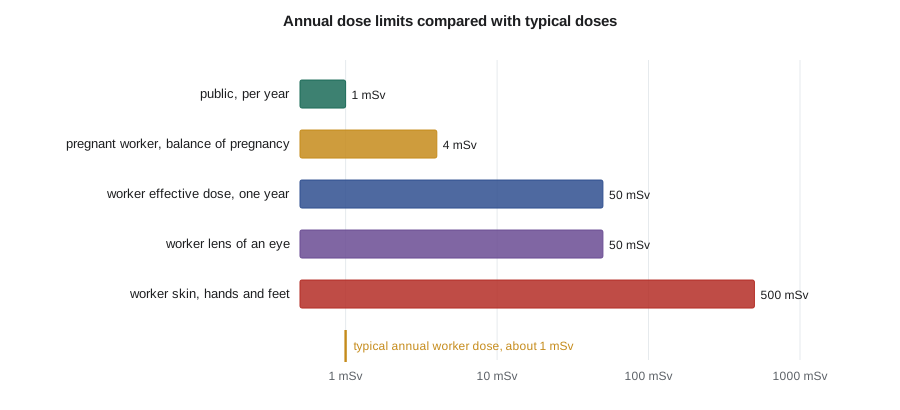
The five-year limit is the one that matters most in practice at Canadian stations: a worker could receive 50 mSv in one year only if the other four years together stayed under 50 mSv. Licensees also set their own action levels, well below the limits, which trigger investigation and reporting to the CNSC when exceeded.
Worked problem
Checking a worker against the limits
A worker's record shows external Hp(10) of 3.2 mSv, a committed effective dose from tritium of 0.6 mSv, Hp(0.07) to the skin of 14 mSv and an extremity ring dose of 40 mSv for the year. Is she within the limits?
Show solution
- Effective dose \(= 3.2 + 0.6 = 3.8\) mSv, against 50 mSv: within the limit.
- Skin: 14 mSv against 500 mSv: within the limit; it is not added to the effective dose.
- Extremity: 40 mSv against 500 mSv: within the limit.
Answer: All limits are met with large margins. Note that skin and extremity doses are compared with their own limits and are never added to the effective dose.
# Equivalent and effective dose with ICRP 103 weighting factors, then a check against limits.
W_R = {'photon': 1.0, 'electron': 1.0, 'proton': 2.0, 'alpha': 20.0}
W_T = {'red marrow': 0.12, 'colon': 0.12, 'lung': 0.12, 'stomach': 0.12, 'breast': 0.12,
       'remainder': 0.12, 'gonads': 0.08, 'bladder': 0.04, 'gullet': 0.04, 'liver': 0.04,
       'thyroid': 0.04, 'bone surface': 0.01, 'brain': 0.01, 'salivary glands': 0.01, 'skin': 0.01}
print("sum of tissue weighting factors =", round(sum(W_T.values()), 2))

def equivalent(absorbed_mGy):
    """absorbed_mGy: dict radiation -> mGy averaged over the organ"""
    return sum(W_R[r] * d for r, d in absorbed_mGy.items())

# Steam generator example: uniform 0.8 mSv external gamma plus 2.0 mSv to the lung from an inhaled particle
H = {t: 0.8 for t in W_T}              # uniform gamma: every tissue 0.8 mSv
H['lung'] += equivalent({'alpha': 0.1})  # 0.1 mGy alpha to lung = 2.0 mSv
E = sum(W_T[t] * H[t] for t in W_T)
print(f"lung equivalent dose {H['lung']:.2f} mSv; effective dose {E:.2f} mSv")

# Thyroid-only dose
print(f"25 mSv to the thyroid only -> effective dose {0.04 * 25:.2f} mSv")

# Annual record check (mSv): limits for a worker; skin and extremity are separate
record = {'effective': 3.2 + 0.6, 'skin Hp(0.07)': 14.0, 'extremity': 40.0, 'lens (ICRP)': 3.5}
limits = {'effective': 50.0, 'skin Hp(0.07)': 500.0, 'extremity': 500.0, 'lens (ICRP)': 50.0}
for q in record:
print(f"{q:13s} {record[q]:6.1f} mSv of {limits[q]:5.0f} ({100*record[q]/limits[q]:4.1f} % of limit)")sum of tissue weighting factors = 1.0 lung equivalent dose 2.80 mSv; effective dose 1.04 mSv 25 mSv to the thyroid only -> effective dose 1.00 mSv effective 3.8 mSv of 50 ( 7.6 % of limit) skin Hp(0.07) 14.0 mSv of 500 ( 2.8 % of limit) extremity 40.0 mSv of 500 ( 8.0 % of limit) lens (ICRP) 3.5 mSv of 50 ( 7.0 % of limit)
Common confusions
Marcel ends with the mistakes he sees most. Adding skin or extremity doses to effective dose double-counts risk and breaks the definition. Reporting a neutron dose in gray when the limit is in sieverts leaves out the radiation weighting factor of up to 20. Using effective dose to describe a medical patient's individual risk ignores age and sex. Treating the dose limit as the target forgets that the limit is the edge of the acceptable region, not its centre; under ALARA, doses should be far below it. And forgetting the committed dose from an intake can make a worker appear to have room left under a limit that has in fact already been used.
Dose rate, dose and the units on the meter
Instruments add their own source of confusion. A survey meter shows a dose rate, in µSv/h or mSv/h, while a dosimeter accumulates a dose. A worker who stands for 12 minutes beside a valve reading 0.5 mSv/h receives 0.1 mSv; the meter never shows that number. Older instruments may read in units of exposure, the roentgen, which measures ionization in air rather than dose in tissue. For gamma rays in the energy range of most reactor work, 1 R corresponds to about 8.7 mGy in air and close to 10 mSv in tissue, so the old rule of thumb that one roentgen is about one rem, or 10 mSv, is adequate for field estimates but not for records.
Canadian practice uses SI units throughout: becquerel, gray and sievert. Records and reports to the CNSC and the National Dose Registry are always in millisieverts, and any instrument still reading in older units is converted before results are recorded.
A further distinction is between dose to a person and the reading of a dosimeter on that person. A dosimeter worn on the chest measures Hp(10) at the chest. If the worker leans over a source, the head and hands may receive more than the chest, which is why extremity rings, head dosimeters and multiple whole-body dosimeters are used in non-uniform fields such as steam generator entries. Where several whole-body dosimeters are worn, the program specifies how they are combined into an effective dose, often with weighting schemes for front and back or for different body regions.
Worked problem
Converting a United States style record
A contractor's record from another plant lists 380 mrem deep dose and 1.2 rem shallow dose for a year. Express both in SI units and say which limit each is compared with.
Show solution
- Deep dose: \(380\ \text{mrem} = 0.38\ \text{rem} = 3.8\) mSv; compared with the effective dose limit.
- Shallow dose: \(1.2\ \text{rem} = 12\) mSv; compared with the skin limit of 500 mSv.
- The shallow dose is not added to the deep dose.
Answer: 3.8 mSv effective and 12 mSv to the skin, both small fractions of their limits.
Summary and key terms
- Absorbed dose (Gy) is energy per mass; equivalent dose (Sv) applies the radiation weighting factor; effective dose (Sv) applies tissue weighting factors.
- Operational quantities Hp(10), Hp(0.07), Hp(3) and H*(10) are what dosimeters and survey meters measure.
- Committed dose from an intake is assigned in full to the year of intake.
- Worker effective dose limits are 50 mSv in a year; public limits are 1 mSv in a year.
- Skin, extremity and lens doses have their own limits and are not added to effective dose.
- Limits are boundaries, not targets: ALARA keeps doses well below them.
- Absorbed dose
- Energy deposited per unit mass, in gray (J/kg).
- Equivalent dose
- Organ absorbed dose multiplied by the radiation weighting factor, in sievert.
- Effective dose
- Sum of organ equivalent doses weighted by tissue weighting factors, in sievert.
- Radiation weighting factor
- Multiplier reflecting the biological effectiveness of a radiation type, from 1 to 20.
- Tissue weighting factor
- Fraction of whole-body stochastic detriment attributed to an organ.
- Personal dose equivalent
- Operational quantity Hp(d) measured by a dosimeter at depth d in the body.
Practice problems
Work each problem on paper first, then reveal the answer to check.
A 0.5 mGy dose of 1 MeV-region neutrons with w_R = 20 gives what equivalent dose?
Show answer
10 mSv.
The thyroid alone receives 25 mSv. What is the effective dose?
Show answer
0.04 × 25 = 1.0 mSv.
Which operational quantity is compared with the skin limit?
Show answer
Hp(0.07).
Why is committed dose assigned to the year of intake?
Show answer
So internal and external doses can be compared and limits are not exceeded later by an earlier intake.
A worker has 46 mSv over four years. How much may she receive in year five under a 100 mSv five-year limit and a 50 mSv annual limit?
Show answer
50 mSv by the annual limit, which is also within the 54 mSv remaining under the five-year limit; ALARA would keep it far lower.
What is wrong with adding a 30 mSv extremity dose to a 2 mSv whole-body dose?
Show answer
Extremity dose has its own limit and is not part of effective dose.
Lesson quiz · 5 questions
Score 60% or more to complete this lesson.
Create a free account to save your progress, take quizzes and earn a certificate.