
NUC-320 · Lesson 10 of 12 · 22 min
NRC 10 CFR 20 and DOE rules
Earlier lessons quoted pieces of 10 CFR Part 20 as they arose. This lesson puts the United States framework in order. The class's assignment is practical: Marcel gives them a short incident report from a contractor's radiography job at a pipe fabrication shop near Knoxville and asks them to find every regulatory obligation it triggered, who was responsible, and what the licensee had to report. To answer, they need to know who regulates what.
Who regulates
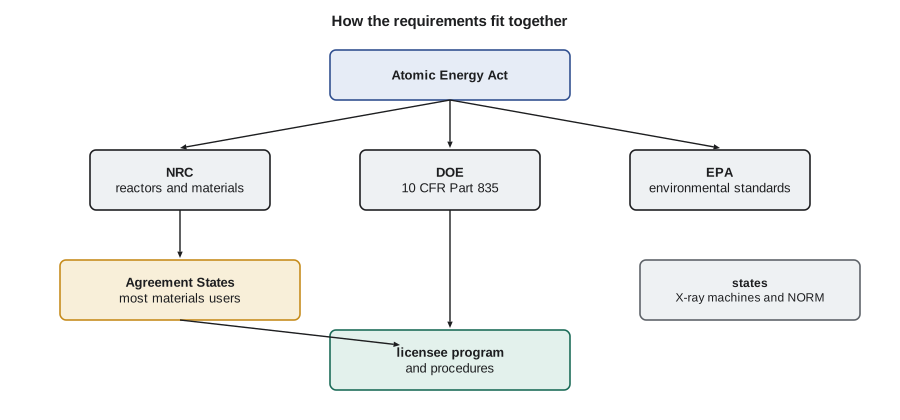
The Atomic Energy Act of 1954 gives the federal government authority over source, byproduct and special nuclear material. The Nuclear Regulatory Commission (NRC) licenses commercial nuclear power reactors, fuel facilities and many users of radioactive materials. Under section 274 of the Act, the NRC may hand its authority over materials licensees to states that sign agreements; Tennessee is one of these Agreement States, so a radiography company in Tennessee is licensed by the state under rules compatible with NRC's, while TVA's reactors remain NRC-licensed. The Department of Energy (DOE) regulates radiation protection at its own facilities, such as Oak Ridge National Laboratory near Knoxville, under 10 CFR Part 835. The Environmental Protection Agency (EPA) sets generally applicable environmental standards, and states regulate X-ray machines and naturally occurring radioactive material.
| Rule | Role in radiation protection |
|---|---|
| 10 CFR Part 19 | notices, instructions and reports to workers; worker rights during inspections |
| 10 CFR Part 20 | standards for protection against radiation: program, limits, surveys, monitoring, posting, records, reports |
| 10 CFR Part 50, Appendix I | ALARA design objectives for power reactor effluents |
| 10 CFR Parts 30 to 39 | licensing of byproduct material, including industrial radiography (Part 34) |
| 10 CFR Part 71 | packaging and transport of radioactive material |
| 10 CFR Part 835 | occupational radiation protection at DOE facilities |
| 40 CFR Part 190 and Part 61 Subpart H | EPA limits on public dose from the fuel cycle and from airborne emissions at DOE sites |
10 CFR Part 20, subpart by subpart
| Subpart | Requirement |
|---|---|
| B, 20.1101 | radiation protection program, ALARA, annual review; constraint of 0.1 mSv (10 mrem) per year on air emissions to the public |
| C, 20.1201 to 20.1208 | occupational dose limits, planned special exposures, minors, embryo or fetus of a declared pregnant woman |
| D, 20.1301 to 20.1302 | public dose limits of 1 mSv (100 mrem) per year and 0.02 mSv (2 mrem) in any hour in unrestricted areas |
| F, 20.1501 to 20.1502 | surveys and individual monitoring for adults likely to exceed 10 % of the limits |
| G, 20.1601 to 20.1602 | control of access to high and very high radiation areas |
| H, 20.1701 to 20.1704 | respiratory protection and controls to restrict internal exposure |
| J, 20.1901 to 20.1906 | caution signs, labels and posting of radiation, high radiation and airborne radioactivity areas |
| L, 20.2101 to 20.2110 | records of surveys, doses and programs |
| M, 20.2201 to 20.2207 | reports of lost material, overexposures and high radiation levels |
| Appendix B | annual limits on intake, derived air concentrations and effluent concentrations |
Two provisions deserve special mention. Planned special exposures, under 20.1206, allow an adult worker in an exceptional situation to receive a dose above the annual limit when alternatives that would avoid it are unavailable or impractical, with written authorization, advance briefing and limits: the dose from planned special exposures in a year may not exceed the annual limit, nor five times the annual limit over a lifetime. Overexposure reporting, under 20.2202, requires immediate notification of the NRC for a total effective dose equivalent of 0.25 Sv (25 rem) or more and notification within 24 hours for 0.05 Sv (5 rem) or more, with written reports under 20.2203.
DOE facilities: 10 CFR Part 835
At DOE sites, 10 CFR Part 835 sets an occupational limit of 50 mSv (5 rem) total effective dose per year, 150 mSv (15 rem) to the lens and 500 mSv (50 rem) to the skin, extremities and other organs, with a 1 mSv (100 mrem) limit for members of the public in controlled areas. It requires a documented radiation protection program approved by DOE, ALARA, and administrative control levels below the limits. DOE's radiological control standard recommends an administrative control level of 20 mSv (2 rem) per year for each worker, and many sites use lower values.
Worked problem
Working through the radiography incident
A radiographer's iridium-192 source failed to retract fully during a shot. His alarming ratemeter sounded; his passive dosimeter, processed by an NVLAP-accredited processor, later showed 6 mSv (600 mrem). His assistant received an estimated 0.4 mSv (40 mrem). Which obligations apply?
Show solution
- The company is licensed by Tennessee as an Agreement State, under radiography rules compatible with 10 CFR Part 34, which require alarming ratemeters, two-person crews of trained radiographers and assistants, and surveys after each exposure.
- Neither dose exceeds a limit, so the 20.2202 overexposure reports do not apply; but a source disconnect or failure to retract is a reportable equipment event under the radiography rules, with a written report to the regulator.
- The licensee must determine both workers' doses, record them under Subpart L, and provide the workers with their dose reports under Part 19.
- The equipment must be removed from service, investigated and repaired, and the procedures reviewed under the ALARA requirement.
Answer: No limit was exceeded, but the event still requires dose determination, an equipment report, records and corrective action. The applicable rules are the Agreement State's, which mirror the NRC's.
# Compliance check under 10 CFR Part 20 (doses in rem; 1 rem = 10 mSv).
history = {2022: 0.85, 2023: 1.20, 2024: 2.10, 2025: 0.90, 2026: 0.60}   # TEDE per year, rem
ANNUAL = 5.0                 # rem TEDE, 10 CFR 20.1201
ACL = 2.0                    # rem, illustrative administrative control level
for year, d in sorted(history.items()):
    flags = []
    if d > ANNUAL: flags.append('exceeds 20.1201 limit')
    if d > ACL: flags.append('above administrative control level: management review')
    print(f"{year}: {d:4.2f} rem ({10*d:5.1f} mSv)  {'; '.join(flags) or 'ok'}")

def report(tede_rem):
    if tede_rem >= 25: return 'immediate notification (20.2202(a))'
    if tede_rem >= 5: return 'notification within 24 hours (20.2202(b))'
    return 'no overexposure report; record dose and follow license event reporting'

for who, dose in (('radiographer', 0.60), ('assistant', 0.04)):
print(f"{who:12s} {dose:4.2f} rem -> {report(dose)}")2022: 0.85 rem ( 8.5 mSv) ok 2023: 1.20 rem ( 12.0 mSv) ok 2024: 2.10 rem ( 21.0 mSv) above administrative control level: management review 2025: 0.90 rem ( 9.0 mSv) ok 2026: 0.60 rem ( 6.0 mSv) ok radiographer 0.60 rem -> no overexposure report; record dose and follow license event reporting assistant 0.04 rem -> no overexposure report; record dose and follow license event reporting
Inspection and enforcement
The NRC inspects power reactors under the Reactor Oversight Process, in which occupational radiation safety and public radiation safety are two of the cornerstones, and materials licensees under inspection programs scaled to risk. Violations are categorized by severity, from minor issues to civil penalties, orders and license actions, and inspection reports are public. Workers have the right under Part 19 to request an inspection and to talk privately with inspectors, and are protected from discrimination for raising safety concerns.
Workers' rights under Part 19
10 CFR Part 19 gives workers specific rights. Licensees must post the NRC's notice to employees form, together with the regulations and license conditions or a statement of where they can be seen; instruct workers in radiation risks and protective measures; provide each monitored worker with an annual report of dose, and a report on request when the worker leaves; and allow workers to request an NRC inspection and to speak privately with inspectors. Section 211 of the Energy Reorganization Act protects workers who raise safety concerns from retaliation.
Posting, labeling and surveys in practice
Subpart J requires the radiation symbol, in magenta or black on yellow, with the wording appropriate to each area: caution, radiation area; caution or danger, high radiation area; grave danger, very high radiation area; caution, airborne radioactivity area; and caution or danger, radioactive materials. Containers of licensed material above set quantities must be labeled with the nuclides, activities and dates. Subpart F requires surveys that are reasonable to evaluate the magnitude and extent of radiation levels, concentrations and quantities of material, and calibration of the instruments used.
Worked problem
Monitoring and posting decisions
A materials licensee expects a technician to receive 0.8 rem (8 mSv) in a year and a clerk 0.02 rem (0.2 mSv). A storage room measures 6 mrem/h (0.06 mSv/h) at 30 cm from the source shelf. What monitoring and posting is required?
Show solution
- Technician: 0.8 rem is more than 10 % of 5 rem, so individual monitoring is required under 20.1502.
- Clerk: 0.02 rem is less than 10 % of the limits, so monitoring is not required, though many licensees issue dosimeters anyway.
- Storage room: 6 mrem/h at 30 cm exceeds 5 mrem/h, so it is a radiation area and must be posted under 20.1902; it is below the 100 mrem/h high radiation area threshold.
Answer: Monitor the technician, optionally the clerk, and post the storage room as a radiation area.
State programs and compatibility
Agreement States must keep programs adequate to protect public health and safety and compatible with the NRC's, and the NRC reviews each state's program periodically. States usually adopt NRC rules by reference or with small changes, so a radiographer working in several states meets almost identical requirements, but licensees must still follow the rules of the state where the work is done and obtain reciprocity before working in another state. States also regulate X-ray machines, accelerators not covered by the Atomic Energy Act and naturally occurring radioactive material, which the NRC does not.
| Situation | Main United States requirement |
|---|---|
| Adult likely to exceed 10 % of a limit | individual monitoring, 20.1502 |
| Area above 5 mrem in an hour at 30 cm | post as a radiation area, 20.1902 |
| Area above 100 mrem in an hour at 30 cm | high radiation area access controls, 20.1601 |
| TEDE of 5 rem or more in an event | notify the NRC within 24 hours, 20.2202(b) |
| Worker leaves employment | dose report on request, Part 19 |
| Work at a DOE site | 10 CFR Part 835 program and administrative control levels |
Reading a license
A power reactor's operating license and technical specifications, together with its updated final safety analysis report and the radiation protection program description, define what the licensee has committed to. Many of the detailed commitments sit in plant procedures that implement Part 20 and the NRC's regulatory guides. An engineer joining a licensee should learn where each requirement comes from, because a procedure step that traces to a regulation cannot be changed in the same way as one that is only good practice.
Marcel's radiography case ends with one more lesson: the company had reported the equipment failure to the state promptly but had not reviewed the assistant's training records, which turned out to be out of date. The state treated the lapsed training as a separate violation. Knowing the license conditions matters as much as knowing the regulations.
Overlap between agencies in practice
Conventional workplace hazards at an NRC-licensed plant, such as falls, electrical safety and confined spaces, fall under OSHA, while radiation hazards from licensed material fall under the NRC; a memorandum of understanding between the two agencies sets out the division. At DOE sites, worker safety and health more broadly are covered by 10 CFR Part 851 alongside Part 835. A confined space entry into a contaminated tank must therefore satisfy OSHA's confined space standard and the radiation protection program at the same time, and plant procedures combine the two so that workers follow one set of instructions.
Radiation protection professionals in the United States often hold certification from the American Board of Health Physics or, for technicians, the National Registry of Radiation Protection Technologists, which employers and regulators recognize as evidence of competence.
Summary and key terms
- The NRC regulates reactors and materials; Agreement States such as Tennessee regulate most materials users; DOE self-regulates its sites under 10 CFR 835; EPA sets environmental standards.
- 10 CFR Part 20 contains the program, limits, surveys, monitoring, posting, records and reports.
- Individual monitoring is required for adults likely to exceed 10 % of the limits.
- Planned special exposures are limited to the annual limit per year and five times it over a lifetime.
- Doses of 0.25 Sv TEDE need immediate notification; 0.05 Sv within 24 hours.
- DOE recommends a 20 mSv (2 rem) administrative control level per year.
- Agreement State
- A state that has assumed regulatory authority over certain radioactive materials under an agreement with the NRC.
- TEDE
- Total effective dose equivalent, the sum of external deep dose and committed internal dose.
- Planned special exposure
- An authorized dose above the annual limit in exceptional circumstances.
- 10 CFR Part 835
- The DOE rule for occupational radiation protection at its facilities.
- Reactor Oversight Process
- The NRC framework for inspecting and assessing power reactor performance.
- Administrative control level
- A licensee-set dose level below the limit requiring approval to exceed.
Practice problems
Work each problem on paper first, then reveal the answer to check.
Who licenses an industrial radiography company in Tennessee?
Show answer
The state of Tennessee, as an Agreement State.
Which rule governs radiation protection at Oak Ridge National Laboratory?
Show answer
10 CFR Part 835.
When must an adult worker be individually monitored?
Show answer
When likely to receive more than 10 % of an annual limit.
What is the lifetime cap on planned special exposures?
Show answer
Five times the annual limit.
What TEDE requires immediate notification of the NRC?
Show answer
0.25 Sv (25 rem) or more.
Which Part 20 subpart covers posting and labels?
Show answer
Subpart J.
Lesson quiz · 5 questions
Score 60% or more to complete this lesson.
Create a free account to save your progress, take quizzes and earn a certificate.