
NUC-320 · Lesson 7 of 12 · 23 min
Internal dose
External dose stops the moment a worker walks away from the source. Internal dose does not. Once a radionuclide is inside the body, it irradiates tissue until it decays or is excreted, and the worker cannot step back from it. The lesson begins with a case Marcel handled years ago: a mechanic who removed a respirator early to wipe sweat from his face during work on a contaminated pump, and whose routine bioassay the following week showed an intake. The dose was small, but the investigation took a month and changed the station's respirator procedure. Internal dosimetry is how such intakes are measured, assessed and, above all, prevented.
How radionuclides get in
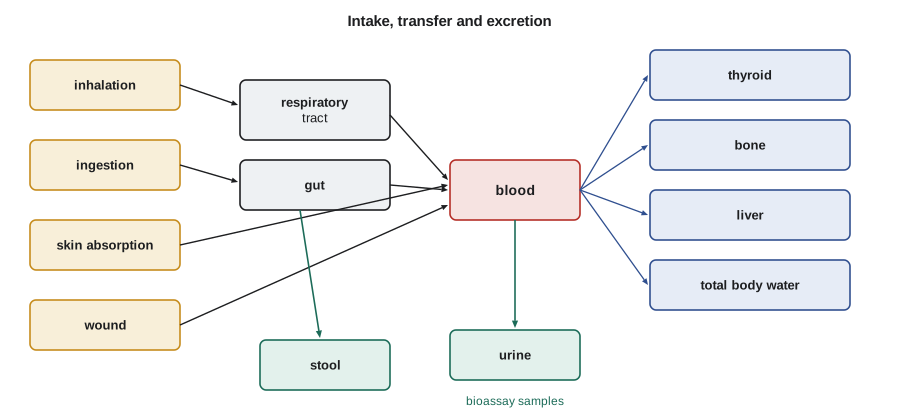
There are four routes of intake. Inhalation of airborne particles, gases or vapours is the most important at nuclear facilities. Ingestion, usually from contaminated hands or food, is uncommon at work but important for the public after accidental releases. Absorption through intact skin is significant for a few substances, above all tritiated water vapour, which is taken up through the skin at a rate comparable with breathing it. Entry through wounds can give a direct and sometimes large intake and requires immediate medical and radiological follow-up.
After intake, the material's fate depends on its chemical form and particle size. Inhaled particles deposit in different parts of the respiratory tract according to their size; small particles reach the deep lung. Soluble material passes quickly into the blood; insoluble material may stay in the lungs for months or years. From the blood, each element goes where its chemistry takes it: iodine to the thyroid, strontium and radium to bone, caesium throughout the soft tissues, and tritiated water into all body water. Excretion through urine, faeces, sweat and breath removes it at rates described by biological half-lives.
Effective half-life
A radionuclide in an organ disappears by two processes at once: radioactive decay, with physical half-life \(T_p\), and biological elimination, with biological half-life \(T_b\). If both are exponential, the effective half-life is
| Nuclide | Physical half-life | Biological half-life (main compartment) | Effective half-life |
|---|---|---|---|
| Tritium as HTO | 12.3 years | about 10 days in body water | about 10 days |
| Iodine-131 | 8.0 days | about 80 days in the thyroid | about 7.3 days |
| Caesium-137 | 30 years | about 110 days in soft tissue (adults) | about 109 days |
| Cobalt-60 | 5.3 years | mixed; months to years in lung for insoluble oxide | months to years |
For tritium the biological half-life controls everything, because the physical half-life is so long. Drinking more fluids shortens the biological half-life of tritiated water by speeding the turnover of body water, which is why workers with a tritium uptake are sometimes advised to increase their fluid intake.
Committed dose and dose coefficients
The committed effective dose \(E(50)\) is the total effective dose delivered over 50 years by an intake, assigned to the year of intake as lesson 2 explained. In practice it is calculated by multiplying the intake \(I\), in becquerels, by a dose coefficient \(e(50)\), in sieverts per becquerel, which the ICRP publishes for each radionuclide, chemical form, route and particle size:
| Nuclide and form | Route | Approximate dose coefficient (Sv/Bq) |
|---|---|---|
| Tritiated water (HTO) | inhalation or ingestion | 1.8 × 10⁻¹¹ |
| Organically bound tritium | ingestion | 4.2 × 10⁻¹¹ |
| Iodine-131 | ingestion | 2.2 × 10⁻⁸ |
| Caesium-137 | ingestion | 1.3 × 10⁻⁸ |
| Cobalt-60, insoluble oxide | inhalation | about 2 × 10⁻⁸ or more |
The dose coefficient for tritiated water is a thousand times smaller than for iodine-131, because tritium's beta particles are so weak and it spreads evenly through the body rather than concentrating in one organ. A tritium intake must be very large to give a significant dose, but at a CANDU station the inventory of tritium in the heavy water systems is large, so tritium is still the main internal hazard.
Annual limits on intake and derived air concentrations
Two derived quantities make internal limits practical. The annual limit on intake (ALI) is the intake that would give a committed dose equal to the annual limit, \(\text{ALI} = 0.02\ \text{Sv} / e(50)\) if a 20 mSv reference is used, or 0.05 Sv for the full annual limit. The derived air concentration (DAC) is the concentration in air that, breathed by a reference worker for a working year of 2000 hours at 1.2 m³/h, would give one ALI:
Canadian licensees work with ICRP dose coefficients and derive their own ALIs and DACs for the nuclides in their facilities; tritium in air at Canadian stations is usually expressed directly in dose units, as µSv/h of tritium uptake rate, measured by tritium-in-air monitors.
Worked problem
A tritium bioassay result
A worker's routine urine sample, taken a few days after work in a vault with tritiated water vapour, shows 120 kBq/L of tritium. Estimate the intake and committed dose with a simple model, and the dose already received if no further intake occurs.
Show solution
- Tritiated water mixes with body water; for a reference adult, body water is about 42 L, and urine tritium concentration equals body water concentration.
- Body content \(\approx 120\ \text{kBq/L} \times 42\ \text{L} = 5.0\) MBq.
- Treating this as a recent single intake, committed dose \(\approx 5.0 \times 10^{6} \times 1.8 \times 10^{-11} = 9 \times 10^{-5}\) Sv, about 0.09 mSv.
- With a 10-day effective half-life, the dose is delivered over a few weeks; doubling fluid intake would roughly halve it.
Answer: About 0.09 mSv. Dosimetry programs refine this with the sampling date, the intake pattern and the full ICRP biokinetic model, but the simple estimate shows the order of magnitude.
# Internal dose: effective half-life, committed dose, a tritium urine estimate and DAC-hours.
import math

def t_eff(tp, tb):
    return 1 / (1 / tp + 1 / tb)

for name, tp, tb in (('tritium (HTO)', 12.3 * 365.25, 10.0), ('I-131 thyroid', 8.02, 80.0), ('Cs-137', 30.1 * 365.25, 110.0)):
    print(f"{name:14s}: effective half-life {t_eff(tp, tb):7.1f} days")

# Committed dose = intake x dose coefficient (approximate ICRP values, Sv/Bq)
e50 = {'HTO': 1.8e-11, 'I-131 ingestion': 2.2e-8, 'Cs-137 ingestion': 1.3e-8}
for k, e in e50.items():
    print(f"1 MBq of {k:17s} -> {1e6*e*1000:7.3f} mSv committed")

# Tritium urine result: body water about 42 L, urine concentration equals body water concentration
C_urine = 120e3            # Bq/L
body = C_urine * 42.0      # Bq
E = body * e50['HTO']
print(f"urine {C_urine/1e3:.0f} kBq/L -> body content {body/1e6:.1f} MBq -> about {E*1000:.3f} mSv")
# Dose still to come falls with the 10-day effective half-life; faster turnover shortens it
for tb in (10.0, 5.0):
    print(f"  biological half-life {tb:4.1f} d -> committed dose {body*e50['HTO']*tb/10*1000:.3f} mSv (scaled)")

# DAC-hours: 1 DAC-h = 1/2000 ALI; with ALI tied to 50 mSv this is 0.025 mSv
dac_hours = 3 * 4.0 + 0.5 * 6.0       # 3 DAC for 4 h, then 0.5 DAC for 6 h
print(f"exposure {dac_hours:.0f} DAC-h -> {dac_hours * 50.0 / 2000:.2f} mSv committed")tritium (HTO) : effective half-life 10.0 days I-131 thyroid : effective half-life 7.3 days Cs-137 : effective half-life 108.9 days 1 MBq of HTO -> 0.018 mSv committed 1 MBq of I-131 ingestion -> 22.000 mSv committed 1 MBq of Cs-137 ingestion -> 13.000 mSv committed urine 120 kBq/L -> body content 5.0 MBq -> about 0.091 mSv biological half-life 10.0 d -> committed dose 0.091 mSv (scaled) biological half-life 5.0 d -> committed dose 0.045 mSv (scaled) exposure 15 DAC-h -> 0.38 mSv committed
Bioassay: measuring what is inside
Internal dose cannot be measured directly; it is inferred from measurements of what is in the body or what leaves it. In vivo measurements count gamma rays from outside the body with whole-body counters, lung counters or thyroid probes, using the detectors described in NUC-310. They work well for gamma emitters such as cobalt-60, caesium-137 and iodine-131. In vitro measurements analyse urine, faeces or breath; they are needed for pure beta and alpha emitters, including tritium, carbon-14, strontium-90 and the actinides. Tritium in urine is measured by liquid scintillation counting, and at CANDU stations routine urine sampling, often weekly or more frequently for workers in tritium areas, is the backbone of internal dosimetry.
Interpreting a bioassay result means working backwards from a measurement on one date to the intake that caused it, using a biokinetic model that predicts the fraction of an intake present in the body, or excreted per day, at each time after intake. The answer depends on when the intake happened, whether it was a single event or chronic, and the chemical form. Uncertainty is far larger than for external dosimetry, often a factor of two or more for insoluble materials. Investigation levels in the bioassay program trigger follow-up sampling and a formal dose assessment.
Preventing intakes
The hierarchy of controls applies just as it does for any hazard. First, contain the material: closed systems, glove boxes, tents with negative pressure around open work, and drying of heavy water systems before maintenance. Second, ventilate: local exhaust at the work point, airflow from clean areas towards contaminated ones, and filtration with HEPA filters. Third, control contamination on surfaces, as lesson 8 describes. Last, protect the individual: respirators for particulates, and for tritium, plastic suits supplied with breathing air, because tritiated water vapour passes through ordinary filters and skin alike.
At Darlington, tritium-in-air monitors give continuous readings in vault and boiler room areas, and workers entering areas above set levels wear plastic suits with supplied air. Dryers remove water vapour from the heavy water system atmospheres to keep tritium releases and worker uptakes low.
Respirators are not free. They reduce comfort and vision, slow work and increase heat stress, so they can raise external dose by lengthening a job. The ALARA balance between external and internal dose is one of the most common practical decisions in radiation protection, and regulations in both countries allow licensees to consider total effective dose when deciding whether a respirator is justified.
Internal dose to the public
The same methods apply to members of the public, with dose coefficients for different age groups. After a release, people may inhale radionuclides from the passing cloud and later ingest them in food and water. Dose coefficients for infants and children are higher per becquerel than for adults for many nuclides, especially iodine-131, because their thyroids are small and active. Environmental monitoring programs, covered in NUC-310, measure concentrations in air, water, milk and produce, and dose assessment combines them with consumption rates and dose coefficients to estimate public dose.
Worked problem
Tritium in drinking water
A member of the public drinks 2 L a day of well water containing 100 Bq/L of tritium for a year. Estimate the committed dose.
Show solution
- Annual intake: \(100 \times 2 \times 365 = 7.3 \times 10^{4}\) Bq.
- Dose: \(7.3 \times 10^{4} \times 1.8 \times 10^{-11} = 1.3 \times 10^{-6}\) Sv, about 1.3 µSv.
Answer: About 1 µSv per year, a tiny fraction of the 1 mSv public limit and of natural background.
Ontario's drinking water standard for tritium is 7000 Bq/L, and the Ontario Drinking Water Advisory Council has recommended a much lower value; measured concentrations near Ontario stations are usually a few to tens of becquerels per litre.
When an intake is suspected
If an intake is suspected, for example after a respirator failure, a contamination on the face or a wound in a contaminated area, the response is prompt. Nasal swabs and facial smears give a quick indication of inhalation; a special bioassay sample, or an in vivo count for gamma emitters, is arranged within hours; and for wounds, the wound is flushed, the activity measured, and a physician consulted about decontamination and, for some radionuclides, medical treatment to speed excretion. The dose assessment that follows records the intake, the method, the assumptions and the uncertainty, and the worker is told the result and what it means.
Marcel's mechanic from the opening of this lesson received a committed dose of about 0.3 mSv from inhaled cobalt-60 oxide. The station changed its procedure so that respirators are removed only at the step-off pad after outer clothing, and installed a cool-air supply for jobs in hot areas so that workers would not be tempted to break the seal of a mask to wipe sweat away.
Summary and key terms
- Intakes occur by inhalation, ingestion, skin absorption and wounds; tritiated water vapour enters through the skin as well as the lungs.
- Effective half-life combines physical decay and biological elimination: 1/T_eff = 1/T_p + 1/T_b.
- Committed dose = intake × dose coefficient; tritiated water has a coefficient of about 1.8 × 10⁻¹¹ Sv/Bq.
- ALI and DAC turn the dose limit into intake and air concentration limits; one DAC-hour is 1/2000 of an ALI.
- Bioassay infers intakes from body content or excretion, with much larger uncertainty than external dosimetry.
- Containment and ventilation come before respirators; respirators can raise external dose.
- Intake
- The activity entering the body by any route.
- Effective half-life
- The half-life of a radionuclide in the body combining decay and biological removal.
- Committed effective dose
- The effective dose delivered over 50 years by an intake, assigned to the year of intake.
- Dose coefficient
- Committed dose per unit intake for a given nuclide, form and route, in Sv/Bq.
- Derived air concentration
- Air concentration that gives one ALI over a working year of 2000 hours.
- Bioassay
- Measurement of radioactivity in the body or its excreta to estimate intake.
Practice problems
Work each problem on paper first, then reveal the answer to check.
T_p = 8 days, T_b = 80 days. Effective half-life?
Show answer
1/(1/8 + 1/80) = 7.3 days.
An intake of 2 MBq of HTO gives what committed dose?
Show answer
2 × 10⁶ × 1.8 × 10⁻¹¹ = 3.6 × 10⁻⁵ Sv, 0.036 mSv.
Why is urine sampling used for tritium rather than whole-body counting?
Show answer
Tritium emits only weak betas and no gamma rays.
How many DAC-hours equal one ALI?
Show answer
2000.
Why can a respirator increase total dose?
Show answer
It slows work and lengthens the time in an external radiation field.
Why does tritiated water vapour require supplied-air plastic suits?
Show answer
It passes through filters and is absorbed through the skin.
Lesson quiz · 5 questions
Score 60% or more to complete this lesson.
Create a free account to save your progress, take quizzes and earn a certificate.