
MSBA-291 · Lesson 9 of 12 · 20 min
Compliance reports
▶ Video coming soon A video version of this lesson is on the way.
Skerry's internal audit team scheduled its annual review of software change management for January 2027, and for the first time the scope included GitHub. The lead auditor, Ottoline Brisbane-Teale, joined a working session in mid-November to explain what she would ask for. Her list was short and uncomfortable. She wanted evidence that GitHub itself was operated securely, evidence that Skerry's own controls in GitHub were designed sensibly, and evidence that those controls had actually worked throughout the year. "I do not want screenshots of settings," she said. "Settings show what you intended. I want records that show what happened."
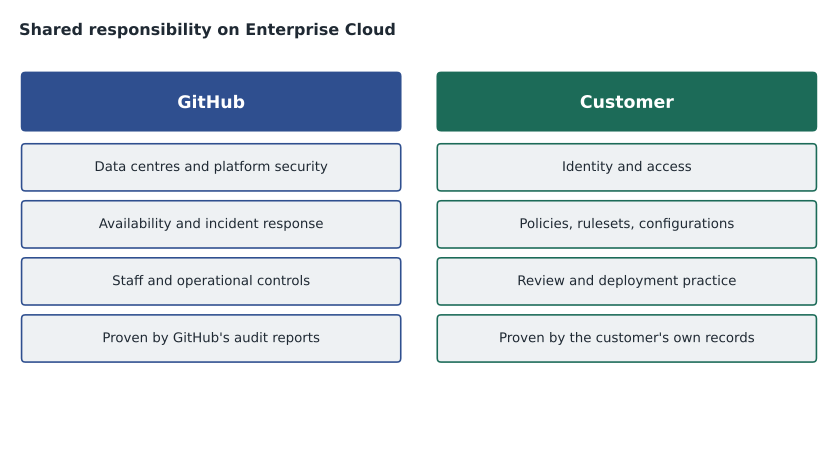
This lesson is about answering that kind of request. It separates the two halves of compliance on a hosted platform: what GitHub is responsible for, which GitHub's own compliance reports cover, and what the customer is responsible for, which the customer must prove with its own evidence.
Shared responsibility
On GitHub Enterprise Cloud, GitHub runs the infrastructure, the application and the operational processes behind them. The customer configures and uses the service: who has access, which policies are set, how code is reviewed and what is deployed. Auditors call this a shared responsibility model. Neither party can prove the other's half.
On Enterprise Server the split moves. The customer runs the appliance, so the customer is responsible for the servers, network, backups, patching and physical security as well as everything above them. GitHub's compliance reports for its cloud services say little about a customer's own appliance. That was one of the reasons Skerry's audit team was pleased to see the store-systems appliance scheduled for retirement in lesson 11.
GitHub's compliance reports
Enterprise owners can download GitHub's compliance reports from the Compliance tab of the enterprise account settings. As of November 2026 GitHub's documentation lists these for Enterprise Cloud:
| Report | What it is | What an auditor uses it for |
|---|---|---|
| SOC 1, Type 2 | An independent auditor's report on controls relevant to customers' financial reporting, tested over a period | Reliance on GitHub for financially significant systems |
| SOC 2, Type 2 | An independent auditor's report on security, availability and related controls, tested over a period | The main evidence that the platform is operated securely |
| ISO/IEC 27001:2022 certification | Certification of GitHub's information security management system | Evidence of a recognized security management standard |
| CSA STAR certification, level 2 | Cloud Security Alliance certification based on independent assessment | Cloud-specific security assurance |
| CSA CAIQ, level 1 | GitHub's answers to the Cloud Security Alliance's standard questionnaire | A quick answer to vendor questionnaires |
| PCI DSS Attestation of Compliance | Attestation related to the payment card industry standard | Context for organizations handling card data |
| Bug bounty quarterly reports | Summaries of GitHub's security research programme | Evidence of ongoing security testing |
| Services continuity and incident management plan | GitHub's continuity and incident processes | Business continuity reviews |
Only enterprise owners can download these reports, so a compliance or audit team usually asks an owner to collect them. Skerry's governance standard made that a named task: each quarter, one enterprise owner downloaded the current reports into a restricted evidence store, so auditors never needed owner access.
Reading a SOC 2 report
A SOC 2 Type 2 report is long, and most of it is useful to an auditor rather than an administrator. Two parts matter to the platform team. The first is the period the report covers, because a Type 2 report tests controls over months; if the report ends in September, an auditor may ask for a bridge letter from the vendor covering the gap since. The second is the list of complementary user entity controls, the controls the vendor assumes its customers operate. They are the vendor's way of saying "this part is your job": typically managing user access, protecting credentials and reviewing activity. Each one should map to something the customer can show.
Worked problem
Mapping a complementary control
A SOC 2 report states that customers are expected to restrict access to authorized personnel and remove access promptly when people leave. What evidence should Skerry provide?
Show solution
- Access is granted through Entra ID groups provisioned by SCIM to managed user accounts, as designed in MSBA-290.
- Removal happens through the same deprovisioning, which suspends the account.
- Evidence of operation: identity provider access reviews, SCIM provisioning logs and audit log events showing suspensions within a day of departure.
- A sample of leavers during the year, each traced from HR record to suspension event.
Answer: Show the provisioning design and then sample leavers, tracing each from their HR departure to the GitHub suspension event in the audit log.
Skerry's own controls
The other half of the audit is the customer's controls. Ottoline's team would test a handful of them, each with a design part and an operating part.
| Control | Design evidence | Operating evidence |
|---|---|---|
| Changes to production code are reviewed | Rulesets requiring pull requests and approvals on default and release branches | Rule insights and audit log events for merges and bypasses over the year |
| Bypasses are exceptional and reviewed | Bypass list limited to the on-call team, pull requests only | List of bypasses with linked incident reviews |
| Access is authorized and removed promptly | SCIM provisioning from Entra ID groups | Sample of joiners and leavers traced to audit events |
| Secrets are kept out of code | Security configurations with push protection, enforced | Push protection blocks and bypasses; secret alert resolution times |
| Third-party code is controlled | Allowed-actions policy, lockfiles required in stores | Policy change events; lockfile verification results |
| Builds are traceable | Artifact attestations on production images | Attestation verification results at deployment |
Look at what the operating column has in common: almost everything comes from the audit log or from reports built on it. A setting proves design. Events prove operation. That is why the audit log streaming set up in MSBA-290, which kept raw events for 13 months in Skerry's security information and event management system, was the single most important compliance decision of the programme. GitHub keeps most audit log events for 180 days and Git events for seven, so without streaming the first half of the audit year would already have been gone.
Worked problem
Checking retention against an audit year
The audit covers January 1 to December 31, 2026, and testing happens in late January 2027. If Skerry relied only on GitHub's own audit log retention of 180 days, which months would still be available at testing time?
Show solution
- 180 days before late January 2027 is late July 2026.
- Events from January to July 2026 would have expired.
- Only about the last six months of the year would remain.
- With 13 months kept in the SIEM, the whole year is available.
Answer: Only roughly August to December 2026; streaming to the SIEM is what preserves the full year.
Building evidence that answers questions
Auditors sample. They do not read every event; they ask for a population, such as every merge to a release branch in the year, then pick 25 and ask for details of each. The platform team's job is to make both steps easy. Skerry built three saved queries in its SIEM over the streamed audit events: every merge to a protected branch with its approvals, every ruleset bypass, and every change to enterprise policies, rulesets and security configurations. Each query produced a population in minutes, and each event carried enough detail to answer a sample question without screenshots.
# Example audit log search on GitHub for recent ruleset bypasses in an organization (web search syntax)
action:repository_ruleset.bypass created:>=2026-11-01

# The same through the REST API for an enterprise
gh api --paginate \
  "/enterprises/skerry/audit-log?phrase=action:repository_ruleset.bypass+created:>=2026-11-01" \
  --jq '.[] | [.created_at, .actor, .repo] | @tsv'
Privacy and data protection
Compliance questions about GitHub are not only about security. A privacy officer will ask what personal data GitHub processes, where and under what terms. For customers, GitHub's terms include a data protection agreement that sets out its obligations as a processor. Personal data in GitHub is mostly about developers: names, email addresses, activity. Customer data, such as the contents of private repositories, should not include personal information about Skerry's own customers, and secret scanning and code review help keep it out.
In Canada, Skerry's privacy officer reviewed GitHub against the federal private-sector privacy law, PIPEDA, and its expectations for service providers handling personal information outside the country. The next lesson covers data residency, which is one tool for privacy requirements but not the only one.
Copilot and AI in the audit scope
Ottoline asked one more question that had not existed a few years earlier: how did the company govern AI-generated code? Skerry's answer drew on earlier work. Copilot policies at enterprise level decided which features and models were allowed, as covered in MSBA-303. Code written with AI help went through the same pull requests, rulesets, code scanning and review as any other code, so the existing controls covered it. And Copilot usage and agent activity events were part of the audit log stream. The auditors accepted that design for the year, with a note to look at agent activity more closely in 2027.
A compliance calendar
Compliance is easier as a routine than as an annual scramble. Skerry's platform and security teams agreed a calendar.
| When | Task | Owner |
|---|---|---|
| Monthly | Review ruleset bypasses and policy changes | Platform team and security |
| Quarterly | Download current compliance reports to the evidence store | An enterprise owner |
| Quarterly | Review owners, app installations and token exceptions | Platform team |
| Quarterly | Test audit log streaming completeness against GitHub's own log for a sample day | Security |
| Annually | Map vendor complementary controls to Skerry evidence | Security and internal audit |
| Annually | Rehearse the audit: produce each population and sample before the auditors ask | Platform team |
Priya's note from the session was that compliance work was mostly about making earlier decisions visible. Every control the auditors wanted had been designed for operational reasons in earlier sessions. The new work was proving that the controls ran.
When the auditor asks about Enterprise Server
For the year being audited, part of Skerry's code still lived on the store-systems appliance, which made one section of the audit more work. GitHub's cloud compliance reports did not cover it, so Skerry had to show its own controls over the appliance: who administered it, how it was patched, how its backups were tested and how access was granted. The honest answer for 2026 was that patching had lapsed and the appliance had left its support window. The audit team recorded a finding, and the migration plan in lesson 11 was accepted as the remediation, with a target date in the first quarter of 2027.
| Evidence area | Enterprise Cloud | Enterprise Server |
|---|---|---|
| Platform security and availability | GitHub's SOC and ISO reports | The customer's own infrastructure controls |
| Patching and upgrades | GitHub | The customer, release by release |
| Backups and recovery | GitHub | The customer, including restore tests |
| Access and configuration in the product | The customer | The customer |
| Audit events | Audit log, streamed by the customer | Audit log and appliance logs, retained by the customer |
Questionnaires and trust
Not every compliance request is an audit. Partners and customers often send security questionnaires asking how Skerry protects its source code. The CSA CAIQ from GitHub's compliance resources answered most questions about the platform. For questions about Skerry's own practice, the team kept a short internal fact sheet drawn from the governance model: identity through managed users and Conditional Access, mandatory reviews through rulesets, secrets blocked by push protection, actions controlled by allowlists and lockfiles, and a year of audit events retained. The franchise partner's questionnaire in lesson 10 took a morning instead of a fortnight.
Common mistakes
MistakeUsing GitHub's SOC 2 report as evidence of the customer's own controls.
InsteadVendor reports cover the platform; customers prove their own controls with their own records.
MistakeOffering screenshots of settings as proof that controls operated.
InsteadProvide events, such as audit log records, over the audit period.
MistakeRelying on GitHub's audit log retention for a year-long audit.
InsteadStream events to long-term storage before they expire.
MistakeGiving auditors enterprise owner access to fetch reports.
InsteadHave an owner place reports in an evidence store.
Summary and key terms
- Compliance on a hosted platform is shared: GitHub proves the platform, the customer proves its own use.
- Enterprise owners can download GitHub's compliance reports, including SOC 1 and SOC 2 Type 2, ISO/IEC 27001:2022 and CSA STAR, from the enterprise Compliance tab.
- A SOC 2 report's period and complementary user entity controls tell the customer what it must prove itself.
- Settings show design; audit log events show operation.
- Streaming the audit log preserves evidence beyond GitHub's 180-day and seven-day retention.
- A compliance calendar turns annual audits into routine work.
- Shared responsibility model
- The division of security and compliance duties between a service provider and its customer.
- SOC 2 Type 2 report
- An independent auditor's report on controls tested over a period.
- Complementary user entity controls
- Controls a vendor's audit report assumes the customer operates.
- Bridge letter
- A vendor statement covering the time between the end of an audit period and today.
- Design evidence
- Evidence that a control is set up correctly.
- Operating evidence
- Evidence that a control actually worked over time.
- Data protection agreement
- Contract terms setting out how a provider processes personal data.
Practice problems
Work each problem on paper first, then reveal the answer to check.
Who can download GitHub's compliance reports for an enterprise?
Show answer
Enterprise owners, from the Compliance tab.
What does a complementary user entity control tell the customer?
Show answer
A control the vendor assumes the customer operates, which the customer must prove.
Why is audit log streaming essential for a year-long audit?
Show answer
GitHub keeps most events for 180 days and Git events for seven, so older evidence would be lost.
Lesson quiz · 5 questions
Score 60% or more to complete this lesson.
Create a free account to save your progress, take quizzes and earn a certificate.