
MSBA-270 · Lesson 1 of 12 · 19 min
The developer role in Power Platform
▶ Video coming soon A video version of this lesson is on the way.
Signe Tavernier-Mbeki is one of two professional developers in Lumenvale's central IT group, and for most of 2026 she had been the person makers came to when a low-code app hit a wall. She built the Student Records custom connector that checks registrar holds, she designed the Dataverse model behind the facilities inspection solution, and in October she led the builder track that produced Facilities Hub and the Field Tech app. In the second half of the fall term Rupert Ellingsworth, the IT governance lead, asked her to run a short series of developer design reviews. The goal was practical: the college had more requests for code than it had developers, and he wanted a shared way of deciding when code was the right answer, how it should be built, and how it would be supported after the person who wrote it moved on. Signe also wanted to sit the new Power Platform developer exam in the new year. This course follows those sessions.
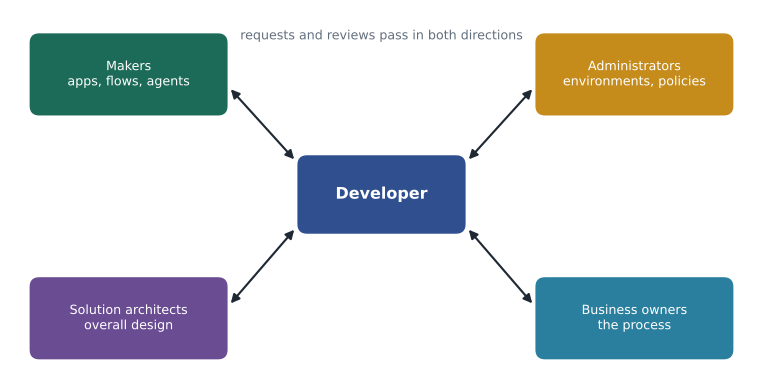
The other developer in the room was Wiremu Quaresma, who had joined central IT from a web agency in the spring. Wiremu knew React, TypeScript and Azure well and had never opened a model-driven app. Maribeth Ferreira-Quon, the registrar champion, joined most sessions because her transcript solution would be the first thing the developers touched, and Kwabena Asante-Lowe came when reporting was on the agenda. That mix is typical. A Power Platform developer rarely works alone; the job sits between makers, administrators, architects and the people who own the business process.
What a Power Platform developer does
Microsoft describes the Power Platform developer as someone who designs, develops, secures and troubleshoots solutions that extend the platform with code. The important word is extend. The platform already gives makers tables, forms, views, business rules, canvas apps, cloud flows, agents and connectors. A developer adds what those tools cannot do on their own, or cannot do well enough: server-side logic that must run every time a row changes, a control that the standard library does not offer, a connector to a system with an unusual API, an integration that moves large volumes of data, or a complete web application written in code and hosted by Power Platform.
In practice the work falls into five areas, and the exam that certifies the role is organized in a similar way.
| Area | Typical work | Example at Lumenvale |
|---|---|---|
| Technical design | Choosing components, placing business logic, planning ALM | Deciding whether work order validation belongs in a business rule or a plug-in |
| User experience | Client scripting, Power Apps component framework controls, code apps, commands | A room picker control for Facilities Hub forms |
| Platform extension | Plug-ins, custom APIs, use of the Dataverse APIs | A plug-in that blocks closing a safety job without a photo |
| Integration | Custom connectors, webhooks, Azure Service Bus, Azure Functions | Sending building alarms from the building management system into Dataverse |
| AI extension | Agents, MCP servers, Microsoft Foundry and Copilot Studio integration | Exposing work order data safely to a maintenance agent |
The AB-400 exam
The certification for this role is Microsoft Certified: Power Platform Developer Associate. Its exam changed in 2026. Exam AB-400, Extending Microsoft Power Platform Solutions with Code and AI, replaced PL-400 on October 16, 2026. Registration for PL-400 closed that day, and candidates who had already booked could still sit it until the end of October. The new exam keeps much of PL-400's core, such as plug-ins, the component framework and ALM, and adds code apps, agents, Model Context Protocol (MCP) servers and Microsoft Foundry. The study guide's skills measured are dated October 16, 2026 and are grouped into four domains.
| Domain | Weight | This course covers it in |
|---|---|---|
| Build Microsoft Power Platform solutions | 15 to 20 percent | Lessons 2, 5, 8 and 11 |
| Extend the user experience | 25 to 30 percent | Lessons 3 and 6 here; MSBA-271 in depth |
| Extend Microsoft Power Platform | 35 to 40 percent | Lessons 4, 6 and 7 here; MSBA-272 in depth |
| Develop integrations | 10 to 15 percent | Lesson 2 here; MSBA-272 and MSBA-273 in depth |
This course is the first of four in the AB-400 program. It sets out the architecture and design thinking the exam tests in its first domain and that every later course relies on. MSBA-271 covers the user experience in detail, MSBA-272 covers plug-ins, custom APIs and connectors, and MSBA-273 covers integration and AI. MSBA-279 is the exam readiness course. Like other associate certifications, the Developer Associate must be renewed each year through a free online assessment on Microsoft Learn; the exam itself is passed with a scaled score of 700 out of 1,000.
Developers and makers
The most common mistake a new Power Platform developer makes is to treat the platform as a database with a user interface and to write code for everything. Wiremu did this in his first week. Asked to make a form field required only for safety jobs, he started writing a JavaScript web resource. Maribeth showed him a business rule that did the same thing in two minutes, with no code to maintain and with logic that also runs on the server when the scope is set to Entity. The point was not that code is bad. It is that every line of code is something the college must test, document, secure and update for years, and that low-code features are maintained by Microsoft.
Signe put the rule plainly at the first session: configure first, extend second, and write code only where it earns its place. Lesson 5 turns that rule into a decision process. For now it is enough to see that a developer's value is often in knowing what not to build. The best Power Platform developers spend a surprising amount of time reviewing makers' work, explaining why a flow is slow or a canvas app hits delegation limits, and building small reusable pieces, such as a connector or a component, that make many makers more productive.
| Makers usually | Developers usually |
|---|---|
| Build apps, flows and agents from the tools in the studio | Write C#, TypeScript or JavaScript that extends those tools |
| Configure business rules, views, forms and Power Fx | Write plug-ins, custom APIs and client scripts |
| Use connectors that already exist | Build custom connectors and integrations |
| Work in one environment with a solution | Set up source control, build pipelines and automated tests |
| Ask for help when a limit is reached | Diagnose limits and design around them |
Kinds of code in Power Platform
Code appears in many places, and part of the developer's job is to know which kind runs where. The location matters because it decides what the code can reach, how it is secured and how it fails.
| Code | Language | Where it runs |
|---|---|---|
| Plug-in | C# (.NET) | On the Dataverse server, inside the event pipeline |
| Custom API | C# plug-in behind a defined message | On the Dataverse server, called like a built-in message |
| Client script (web resource) | JavaScript | In the browser, on model-driven forms, views and commands |
| Component framework control | TypeScript | In the browser, inside a model-driven or canvas app |
| Code app | TypeScript with React, Vue or similar | In the browser, hosted by Power Platform |
| Custom connector code | C# script (limited) | In the connector runtime, transforming requests and responses |
| Azure Functions or other services | Any supported language | In Azure, called from flows, connectors or webhooks |
Server-side code, such as plug-ins and custom APIs, runs whatever app or integration changed the data. If a rule must hold no matter how a row is created, through a model-driven form, a canvas app, an import or an external system calling the Web API, it belongs on the server. Client-side code runs only when a person uses a particular app, so it improves the experience but cannot enforce a rule on its own. That distinction comes up again and again in this course.
Professional habits the platform expects
Power Platform rewards the same habits as any other software platform, with a few twists. Code lives in source control, not only in an environment. Solutions are exported and unpacked into files so changes can be reviewed. Builds and deployments are automated through pipelines. Secrets are kept in Azure Key Vault and referenced, not pasted into code. Everything a developer adds is part of a solution with the organization's publisher prefix, which at Lumenvale is lcc. And because makers will keep changing the configuration around the code, the developer documents what the code assumes, such as which columns it reads and which messages it handles.
Signe also insisted on one habit that is specific to the platform: read the limits before designing. Dataverse protects itself with service protection limits, plug-ins have a time limit, canvas apps have delegation limits and flows have action limits. A design that ignores them works in a demonstration and fails in the third week of term when real volume arrives. Lesson 2 covers the limits that matter most.
Worked problem
Routing a request to the right builder
Octavia Brenner-Lau, the facilities operations manager, asks for three changes to Facilities Hub: hide the Contractor section unless the job category is External; stop anyone, in any app, from closing a safety job that has no photo; and show the room on a floor plan when a dispatcher opens a job. Who should build each, and with what?
Show solution
- Hiding a section based on a value is a form behaviour. A business rule can show and hide fields, but not sections, so this needs a small client script on the form, or a redesign that uses a separate tab or form. It is a modest developer task.
- Blocking closure of safety jobs without a photo must hold in every app and integration, so it belongs on the server. A plug-in on the update of the work order, registered before the main operation, can check for a photo and stop the change with a clear message.
- A floor plan is a custom visual. No standard control draws one, so a component framework control or a custom page is needed. That is a larger developer task and needs design work first.
Answer: The first is a short client script, the second a server-side plug-in and the third a code component. None should be done by copying logic into several places.
A week in the role
To give Wiremu a realistic picture, Signe described a typical week from October. On Monday she reviewed a maker's flow that had started failing after the registrar renamed a column, and showed the maker how connection references and solution-aware flows would have caught it earlier. On Tuesday she spent the morning on the Power Platform clinic with Rupert, answering questions from department champions. Wednesday was code: a change to the Student Records connector to add a new hold type, with a unit test and a pull request. Thursday was a design review for the Facilities Work Orders solution, where her main contribution was to stop a canvas app from loading every work order in the college onto every phone. Friday was the CoE meeting and an hour reading the Message center and the Power Platform release plans for changes that would affect the college's solutions. Only one day in five involved writing code, and that was a normal week.
Reading release information is part of the job. Power Platform changes every month, with features moving from preview to general availability, older features deprecated and limits adjusted. A developer who designed a solution around a preview feature, or around a feature announced for retirement, creates work for the organization later. Signe kept a short list of the features each Lumenvale solution depended on and checked it against the release plans twice a year.
Common mistakes
MistakeWriting code because it is familiar.
InsteadCheck business rules, Power Fx, flows and configuration first; code adds maintenance cost for years.
MistakeEnforcing a business rule only in client script.
InsteadPut rules that must always hold on the server, in a plug-in, a business rule with entity scope or a Dataverse constraint.
MistakeBuilding in the default environment without a solution.
InsteadWork in a developer environment, inside a solution with the organization's publisher prefix.
MistakeTreating PL-400 study material as current.
InsteadAB-400 replaced PL-400 on October 16, 2026 and adds code apps, agents, MCP and Foundry.
At the end of the first session Wiremu asked how often Signe actually wrote plug-ins. "Maybe one a month," she said. "Most weeks I am reviewing someone else's flow, or fixing a connector, or telling someone that what they want is already a setting." He looked disappointed for about a second, then asked where the floor plan control would go.
Summary and key terms
- A Power Platform developer extends the platform with code where configuration is not enough, and works closely with makers, administrators, architects and business owners.
- AB-400, Extending Microsoft Power Platform Solutions with Code and AI, replaced PL-400 on October 16, 2026, with four domains weighted from 10 to 40 percent.
- Code runs in different places: plug-ins and custom APIs on the server, client scripts and component controls in the browser, code apps hosted by Power Platform, and services in Azure.
- Rules that must always hold belong on the server; client code improves the experience but cannot enforce rules alone.
- Good practice includes solutions with a publisher prefix, source control, automated pipelines, Key Vault for secrets and design that respects platform limits.
- Power Platform developer
- A professional who designs, builds, secures and troubleshoots code that extends Power Platform.
- Plug-in
- Custom .NET code registered to run on the Dataverse server when a message, such as Create or Update, is processed.
- Client script
- JavaScript added to model-driven apps as a web resource to respond to form, grid and command events.
- Code app
- A web app built with a code-first framework such as React or Vue and hosted and governed by Power Platform.
- Publisher prefix
- The short prefix, such as lcc, that a solution publisher adds to the names of components it creates.
Practice problems
Work each problem on paper first, then reveal the answer to check.
Why should a rule such as "safety jobs need a photo before closing" not rely on client script alone?
Show answer
Client script runs only in the app where it is added; imports, other apps and API calls would bypass it. A server-side check applies to every change.
Which exam does a Power Platform developer take after October 16, 2026?
Show answer
AB-400, Extending Microsoft Power Platform Solutions with Code and AI.
Name three places developer code can run in Power Platform.
Show answer
Any three of: the Dataverse server (plug-ins, custom APIs), the browser (client scripts, component controls, code apps), the connector runtime, or Azure services.
Lesson quiz · 5 questions
Score 60% or more to complete this lesson.
Create a free account to save your progress, take quizzes and earn a certificate.