
MSBA-241 · Lesson 6 of 12 · 18 min
Dataverse as a data source
▶ Video coming soon A video version of this lesson is on the way.
Not everything the contact centre needs lives in BrokerDesk. Three years ago Tomasz's team started logging every service call in a Power Apps app built on Dataverse: who called, about which policy, why, what was done and whether a follow-up was due. By November 2026 the Service Requests table held about 210,000 rows, and representatives often wanted to know things like "Has this client called about this before?" or "What follow-ups are due for me this week?" Yusra's first instinct was to add the table as knowledge. Bram's question was which of those two questions knowledge would actually answer well.
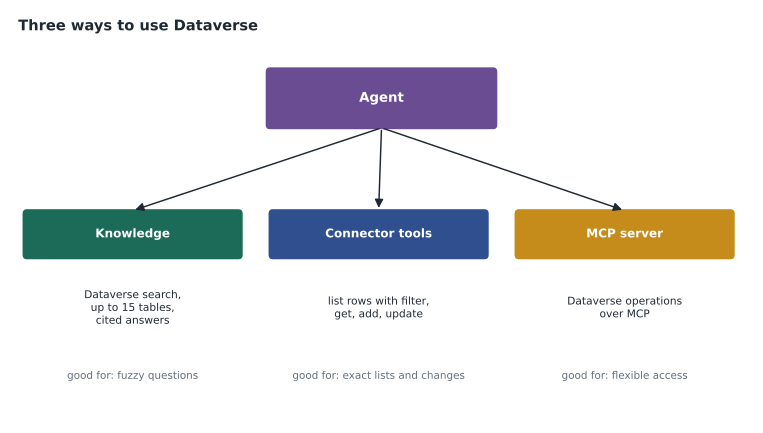
Dataverse can feed an agent in three different ways, and choosing between them is the main skill in this lesson. You can add Dataverse tables as a knowledge source, so the agent searches them and writes generative answers. You can use the Dataverse connector as tools, so the agent runs precise queries and creates or updates rows. And you can use a Dataverse MCP server, which exposes Dataverse operations through MCP. Each fits a different kind of question.
Dataverse tables as knowledge
Adding Dataverse tables as knowledge makes their content searchable by the agent through Dataverse search, the same index that powers search in model-driven apps. You can add up to 15 tables to one Dataverse knowledge source. Copilot Studio retrieves the rows most relevant to the question and the model writes an answer grounded in them, with citations. This suits questions where the user does not know exactly what they are looking for: "What did we tell Birchgrove Smokehouse about its wholesale expansion?" or "Have any clients asked about coverage for e-bike deliveries?"
Several requirements apply, all from Microsoft Learn in November 2026. The environment must have Dataverse search turned on; if you cannot add a table, an administrator needs to enable it. The agent's authentication must be Authenticate with Microsoft; the No authentication and Authenticate manually options are not supported, because search results are trimmed to what the signed-in user can see under their Dataverse security roles. Standard tables are supported; of the virtual tables, only those using the Finance and Operations data provider are. Creating the search index uses Dataverse capacity, which has a cost.
| Setting | What it does | Quillfield example |
|---|---|---|
| Tables (up to 15) | Which tables the agent can search | Service Requests, Follow-ups, Client Notes |
| Synonyms for columns | Other words users use for a column | "qib_reason" also means "why they called", "call reason", "topic" |
| Glossary | Definitions of business terms and acronyms | "Endt" means endorsement; "COI" means certificate of insurance |
| Description | Tells the planner when to use this source | "Past service calls and notes; use for client history questions" |
The synonyms and glossary features are what make Dataverse knowledge useful in practice. Column names in Dataverse are often technical, and business language is full of abbreviations. Microsoft recommends a synonym and description for numeric columns in particular, because a column called qib_daysopen means nothing to the model until you say it is "the number of days the request has been open". Updated glossary terms can take up to 15 minutes to take effect, so do not judge a change in the test pane immediately.
Long text and file columns need extra steps. To make a multiline text column such as Call Notes searchable, mark it as searchable and add it to the table's Quick Find view in Power Apps, then save and publish the view. Microsoft documents searching multiline text and file columns as a preview capability in November 2026. If the knowledge source was added before those columns were configured, the backfill can take up to two days; removing and re-adding the source can speed it up.
Where knowledge falls short
Yusra tested the knowledge source with her two questions. "Has Ridgeline Cartage called about this policy before?" worked well: the agent found three earlier service requests and summarized them with links. "What follow-ups are due for me this week?" did not. The agent returned a few follow-ups it judged relevant, but missed some and included one that was already closed. That is expected. Retrieval finds the most relevant passages for a question; it does not run a filter that guarantees every row meeting exact conditions. For counts, lists with exact criteria, dates and statuses, use tools.
Worked problem
Knowledge or a query?
For each request, decide whether Dataverse knowledge or a Dataverse connector tool is the better fit: (a) "How many open service requests does the Regina office have?" (b) "Has any client asked about drone coverage?" (c) "Mark my follow-up for AU483920 as done." (d) "Summarize what we know about Hendry Logistics' last renewal."
Show solution
- Ask whether the answer must be exact and complete. (a) needs an exact count: tool.
- Ask whether the user is exploring. (b) is a fuzzy search across notes: knowledge.
- Ask whether data changes. (c) updates a row: tool, with confirmation.
- Ask whether a summary of related records is wanted. (d) suits knowledge, perhaps followed by a tool for the latest status.
Answer: (a) tool, (b) knowledge, (c) tool, (d) knowledge. Quillfield's agent ended up with one Dataverse knowledge source for history and two connector tools: "List my open follow-ups" and "Close a follow-up".
The Dataverse connector as tools
The Microsoft Dataverse connector offers operations to list rows, get a row by ID, add a new row, update a row, delete a row, perform bound and unbound actions, and more. As tools, these are precise: "List rows" with a filter returns exactly the rows that meet the condition, sorted and limited as you specify. The skill is to keep the planner from writing filters freely, which it may get wrong, and to give it a narrow, well-described tool instead.
Yusra's "List my open follow-ups" tool did not expose the filter as an input at all. She built it as a small agent flow: the trigger took a number of days ahead (default 7); the flow looked up the signed-in representative's user ID and listed rows from the Follow-ups table where the owner was that user, the status was open and the due date was within the range, selecting only five columns and returning at most 25 rows. The planner's only decision was whether to call it, and with how many days.
Table:          qib_followup
Filter rows:    _ownerid_value eq @{variables('CurrentUserId')}
                and statecode eq 0
                and qib_duedate le @{addDays(utcNow(), triggerBody()?['DaysAhead'], 'yyyy-MM-dd')}
Select columns: qib_name, qib_policynumber, qib_duedate, qib_reason, qib_followupid
Sort by:        qib_duedate asc
Row count:      25
Security works differently for tools than for knowledge. A Dataverse connector action runs with the connection's identity: with end-user credentials, the user's own security roles apply, so a representative cannot list or update rows they could not see in the app. With maker-provided credentials, the maker's access applies, which for Dataverse often means far too much. Quillfield used end-user credentials for both tools.
The Dataverse MCP server
Microsoft also offers a Dataverse MCP server, which exposes Dataverse capabilities, such as listing tables, describing them, reading and creating records, through the Model Context Protocol. An agent with generative orchestration can then decide for itself which table to query and how. That flexibility is the attraction and the risk. It suits exploratory internal agents used by people who understand the data, and developer tools; it suits a contact centre agent less well, because Tomasz wanted predictable behaviour. As with any MCP server, review which tools it exposes in your environment and restrict them to what the agent needs. Users of Microsoft's forums reported in 2026 that pointing the Dataverse MCP server at specific tables was not as fine-grained as some wanted, so check the current documentation for scoping options before relying on it.
Dataverse for the agent's own data
Dataverse is also where Copilot Studio keeps much of an agent's own data: the agent definition, conversation transcripts, and, if you choose, tables you create to store what the agent learns or logs. A common pattern is a small table the agent writes to through a flow, such as Agent Feedback or Escalations, which then feeds a Power BI report. Hamish set up an Escalations table that recorded every time the Policy Service Assistant handed a call to a team lead, with the reason, so the team could see which questions the agent could not yet handle.
Because these tables live in the same environment as the agent, they move with it in a solution and are protected by the same security model. Give the agent's service identity the narrowest role that lets it write to its log tables and nothing else.
Performance and cost
Dataverse knowledge adds index storage to Dataverse capacity, and each generative answer from it is billed at the generative answer rate. Tool calls bill as agent actions, plus flow actions if a flow wraps them. Large tables are not a problem for search, but tools that return many rows are slow and expensive in tokens when the model reads them. Keep result sets small and columns few. For questions that need aggregation over many rows ("average days open by office"), consider a Power BI report or a Fabric data agent rather than asking the language model to add up a long list.
Beyond Dataverse: Fabric data
Some questions belong to analytics data rather than to an operational table. "Which commercial lines clients have had more than three service calls this quarter?" is an aggregation over thousands of rows, and Quillfield's reporting data already lives in Microsoft Fabric, where the finance and operations analysts build their models and reports. Copilot Studio offers two routes to that data. Fabric data agents, which can be connected to a Copilot Studio agent (in preview in November 2026), answer natural-language questions by querying Fabric data. Fabric IQ is Microsoft's semantic layer over Fabric data, which agents can use to ground answers in governed business definitions; the AB-620 outline from December 18, 2026 lists connecting to Fabric IQ as a skill. Both keep the language model from doing arithmetic over long lists, which it does unreliably, by letting a query engine compute the answer.
For the Policy Service Assistant, the team decided that history and follow-ups were enough for the first release. Aggregate questions were routed with a polite answer: "I can show your own follow-ups and a client's history. For office or team totals, use the Contact Centre report in Power BI," with a link. That boundary, written into the instructions, kept the agent honest about what it could do.
Testing Dataverse answers
Test Dataverse knowledge with questions phrased the way staff really talk, including abbreviations and misspellings, and check citations: every answer about a client's history should link to the rows it used. Test as users with different security roles, because trimming is the main protection and the easiest to get wrong if test accounts are too powerful. And test edge cases in the tools: a representative with no open follow-ups, one with more than 25, and a follow-up due today in a different time zone. Yusra found that last one the hard way: the flow compared dates in UTC, so follow-ups due on Friday disappeared from the list on Thursday evening in Saskatoon. Converting the due date to the office time zone in the flow fixed it.
A final design note: whichever route you use, describe the Dataverse source or tool in the same language staff use. The Service Requests table's description in the agent said "Past client calls to the contact centre and what was done about them", not "qib_servicerequest records". Planners and people both understand plain words better, and the description is often what decides whether the agent looks in the right place at all.
Common mistakes
MistakeUsing Dataverse knowledge for exact counts and lists.
InsteadUse a filtered List rows tool for exact, complete results.
MistakeLeaving technical column names unexplained.
InsteadAdd synonyms, descriptions and glossary terms.
MistakeLetting the planner write OData filters.
InsteadFix filters inside a flow and expose only simple inputs.
MistakeChoosing No authentication for an agent with Dataverse knowledge.
InsteadDataverse knowledge requires Authenticate with Microsoft.
MistakeRunning Dataverse tools with the maker's broad access.
InsteadUse end-user credentials so each user's security roles apply.
Summary and key terms
- Dataverse can serve an agent as knowledge, as connector tools or through a Dataverse MCP server.
- A Dataverse knowledge source searches up to 15 tables through Dataverse search, needs Authenticate with Microsoft and trims results to each user's permissions.
- Synonyms, column descriptions and a glossary make Dataverse knowledge understand business language.
- Use filtered connector tools, ideally wrapped in flows, for exact lists, counts and changes.
- Keep results small, use end-user credentials, and use reports or data agents for aggregation.
- Dataverse search
- The index that lets agents and apps search across Dataverse tables.
- Dataverse knowledge source
- A knowledge source that lets an agent search up to 15 Dataverse tables.
- Synonym
- An alternative word that tells the agent what a column means in business language.
- Glossary term
- A definition of a business term or acronym used to interpret Dataverse data.
- List rows
- A Dataverse connector operation that returns rows matching a filter.
- Quick Find view
- A table view whose columns are included in search, used to make long text searchable.
Practice problems
Work each problem on paper first, then reveal the answer to check.
Why did "What follow-ups are due for me this week?" fail as a knowledge question?
Show answer
Retrieval returns relevant rows, not every row meeting exact conditions; an exact list needs a filtered query.
What authentication does an agent need to use Dataverse knowledge?
Show answer
Authenticate with Microsoft, so results can be trimmed to the user's Dataverse permissions.
How many tables can one Dataverse knowledge source include?
Show answer
Up to 15.
Lesson quiz · 5 questions
Score 60% or more to complete this lesson.
Create a free account to save your progress, take quizzes and earn a certificate.