
MSBA-203 · Lesson 10 of 12 · 18 min
Attack simulation training
▶ Video coming soon A video version of this lesson is on the way.
Every control in the workbook so far is technical, and every one of them can be beaten by a convincing message and a hurried person. The September compromise proved it: the coordinator was careful, experienced and busy, and the page she signed in to looked exactly like Microsoft's. Ines did not want a training programme that blamed staff. She wanted one that made people faster at recognizing and reporting attacks, and that told the leadership team whether it was working. Attack simulation training, a Defender for Office 365 Plan 2 feature that the AB-650 exam covers directly, was the tool.
What attack simulation training does
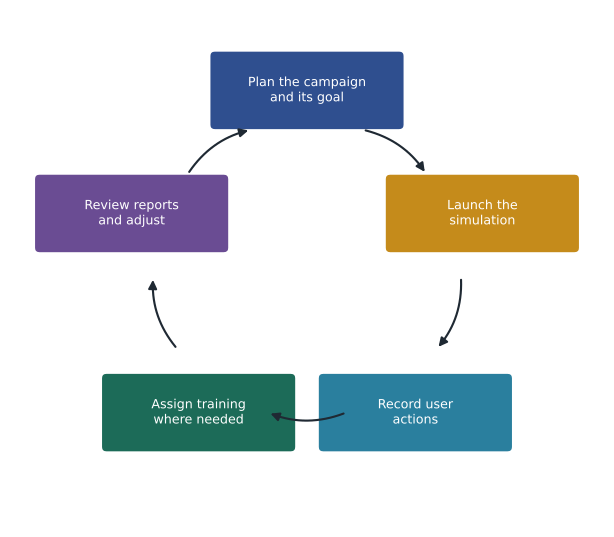
Attack simulation training sends realistic but harmless phishing messages to chosen users, records what each person does, and assigns short training to people who need it. It runs inside the Defender portal, in the email and collaboration area, and uses Microsoft's own infrastructure, so simulation messages are delivered reliably without the allow-list changes that third-party simulation tools need. Its reports show how many people clicked, entered credentials, opened attachments, or reported the message, and how those numbers change over time.
Licensing is per user: everyone targeted by a simulation must hold a licence that includes Defender for Office 365 Plan 2, such as Microsoft 365 E5 or the E5 Security add-on. Corvallin's office staff held only Plan 1 through E3. In October 2026 Teodor started a Defender for Office 365 Plan 2 trial from the portal for the 120 office staff, which gave the team a time-limited window to run its first simulations and gather the evidence the board needed for the 2027 licensing decision. The frontline staff stayed out of scope for now, which the workbook recorded as a gap, not an oversight.
Roles
Two specific roles exist alongside the general security roles. The Attack Simulation Administrator can create and manage every part of a simulation campaign. The Attack Payload Author can create payloads but cannot launch simulations. Teodor held the first role through PIM; Ama held the second, so that she could build payloads that resembled the messages branch staff actually received, while launching campaigns stayed a decision for Teodor and Ines.
Building a simulation
A simulation is assembled from parts, each chosen deliberately:
| Part | What it is | Corvallin's choice for the first simulation |
|---|---|---|
| Technique | The kind of attack being simulated | Credential harvest, because that is what happened in September |
| Payload | The simulated message: sender, subject, body and link | A tenant payload written by Ama: "Your shift schedule for November has been updated", from a look-alike scheduling address |
| Login or landing page | What the user sees after clicking | A simulated sign-in page, then a landing page explaining the simulation |
| Target users | Who receives it | All 120 office staff, excluding IT and those on leave |
| Training | What users who are compromised are assigned | Microsoft training modules on credential harvesting and reporting, due in 14 days |
| End-user notifications | Messages telling users about their training | Microsoft default notifications, with Corvallin's branding |
| Schedule and duration | When it starts and how long it records results | Launch Tuesday, October 27, 2026 at 10:00; record for 7 days |
The techniques Microsoft offers each test a different habit:
| Technique | What it simulates | What it measures |
|---|---|---|
| Credential harvest | A link to a sign-in page that collects credentials | Clicks and credentials entered |
| Malware attachment | An attachment that would run code | Attachments opened |
| Link in attachment | A document containing a phishing link | Attachments opened and links clicked |
| Link to malware | A link to a file on a hosting site | Clicks and downloads |
| Drive-by URL | A link to a web page that would attack the browser | Clicks |
| OAuth consent grant | A link that asks the user to grant an app access to their data | Consents given |
| How-to guide | A teaching message with instructions on spotting phishing | Reports, as practice |
Payloads come from Microsoft's global payload library, which is translated and maintained, or from tenant payloads that the organization writes. Microsoft also offers payloads modelled on real attacks that its threat intelligence has seen recently. Tenant payloads can be more realistic, which makes a simulation more useful, but realism has limits. The workbook banned three things: payloads about pay, benefits or bonuses, which cause real distress when revealed as fake; payloads that impersonate a named client or hospital; and payloads that imitate the agency's own executive director, because staff must be able to trust messages from her.
Before launch: telling the right people
Simulations go wrong when nobody expects them. Before October 27, Teodor told the executive director, the human resources manager and the branch managers, in writing, that a simulation would run in the last week of October, without saying which day or what it would look like. He told the help desk the exact day, so Ama's team would not escalate reports as a real incident. And he told the monitoring partner, so that a burst of reports would not trigger an after-hours call. Users themselves were not warned about the specific simulation, but the staff newsletter had already said that the agency would run practice phishing exercises during the year.
Reports of simulation messages appear in the user reported messages tab and are labelled as simulations, so the team can see the reporting rate without treating each one as a threat.
Reading the results
The first simulation produced numbers that surprised everyone:
| Measure | Result (120 office staff, October 27 to November 3, 2026) |
|---|---|
| Opened the message | 97 |
| Clicked the link | 29 (24 percent) |
| Entered credentials (compromised) | 17 (14 percent) |
| Reported the message | 22 (18 percent) |
| Reported without clicking | 15 |
| Median time to first report | 6 minutes |
Ines's first reaction was to the 17 compromised users. Teodor directed her attention to two other numbers. The report rate of 18 percent, higher than he had expected, meant that roughly one in six staff had both noticed and acted; and the median time to first report of six minutes meant that, in a real attack, the help desk could have started containment before most people had even opened the message. In real attacks the first report matters more than the hundredth click, because one fast report lets the team remove the message from everyone's inbox. The workbook's chosen measures for the leadership report became the report rate and the time to first report, with the compromise rate alongside, not the other way round.
Reports also break results down by department, location and individual. Individual results are sensitive. Corvallin shared them only with each person privately through the assigned training, and shared department results with managers only as numbers, never as names. The human resources manager agreed the rule in writing: simulation results would never be used in performance reviews.
Matching simulations to real threats
The most useful simulations resemble the attacks an organization actually receives. Teodor drew on three sources when choosing techniques and payload themes: the user reported messages tab, which showed what real phishing reaching Corvallin looked like; threat analytics reports on current campaigns; and Microsoft's payloads based on recent real attacks. In autumn 2026 those sources agreed. Real phishing at Corvallin was dominated by fake document-sharing and e-signature notices, fake voicemail and fax alerts, and invoice and payment requests aimed at billing. The simulation plan followed the same mix, with one deliberate exception. The real September attack had relayed an MFA approval, and no simulation can safely reproduce that step, so the training modules assigned after the first simulation covered it in words and pictures instead.
Training and repeat simulations
Users who were compromised were assigned two short Microsoft training modules, each about ten minutes, with a 14-day due date and reminders. By November 17, 15 of the 17 had completed them. Training campaigns can also assign modules to users without a simulation, which Teodor used to give every office staff member one module on reporting messages, because reporting was the behaviour he most wanted to build.
The second simulation, launched on November 17, used a different technique, a link in attachment disguised as a referral form from a fictional community clinic, to avoid teaching people to spot only one kind of message. Results were still coming in when the workbook chapter was finished: early figures showed fewer clicks and a higher report rate, but Teodor wrote that one improvement proves nothing, and that the real test is the trend over a year of varied simulations.
What staff experience
A simulation is a message to colleagues, and how it feels to them decides whether it builds trust or destroys it. Users who click a simulated link see a landing page that explains, in plain language, that the message was a simulation, what clues they could have noticed, and that no harm was done. Ama rewrote Microsoft's default landing page text for Corvallin's audience, shorter and warmer, and added the help desk's number. Users who enter credentials also see the page; their real password is never captured by the simulation, which only records that the field was submitted.
Users who report the simulated message receive feedback too. With user reported settings configured, a person who reports a simulation can see a message thanking them and confirming it was an exercise, which turns reporting into a small success rather than a moment of doubt. Corvallin turned this feedback on, and Ama's team also sent a short personal thank-you to the first ten reporters of each simulation.
Some people react badly anyway. Two office staff wrote to Ines after the first simulation to say they felt tricked. She answered both personally, explaining why the agency ran simulations and that results were private, and offered each a short conversation with Teodor about the September incident. Both later said the explanation helped. The workbook recorded the lesson: explain the purpose before the first simulation, not after it.
How often, and when
Frequency is a balance. Too few simulations and habits fade; too many and staff become cynical or start reporting everything, including real referrals. Microsoft's guidance and common practice point to roughly monthly exposure per user, with techniques varied and timing unpredictable. Timing within the day also matters for fairness. Teodor avoided Monday mornings at the branches, when schedulers deal with weekend changes, and never launched during a known crisis, such as a winter storm when home care visits were being rescheduled. A simulation that lands during a genuine emergency teaches nothing and costs goodwill.
Automation and planning a year
Simulation automations and payload automations let administrators schedule a series of simulations with random techniques, payloads and timing, so that users receive them at unpredictable intervals and the organization does not rely on one person remembering to launch them. Teodor planned an automation for 2027, if licensing allowed, with one simulation a month for each user at a random time, varied techniques, and training assigned automatically to anyone compromised twice in six months.
Worked problem
Choosing what to measure
The board asks for "the phishing failure rate" each month. Teodor has compromise rate, click rate, report rate and time to first report. What should he present, and why?
Show solution
- Compromise rate measures the worst outcome but depends heavily on how convincing each payload is, so it jumps around from month to month.
- Click rate has the same problem and treats a click as a failure even when the user then reported the message.
- Report rate measures the behaviour the organization wants to grow, and it is comparable across different payloads.
- Time to first report shows how quickly the organization as a whole can respond.
- Present all four for transparency, but set targets for report rate and time to first report, and explain why.
Answer: Lead with report rate and time to first report, which track the protective behaviour, and show compromise and click rates as context rather than as the headline.
Common mistakes
MistakeRunning simulations without telling the help desk and partner.
InsteadTell responders the date so simulated reports do not trigger real incident response.
MistakeUsing payloads about pay or bonuses for realism.
InsteadAvoid lures that cause real distress or damage trust in leadership.
MistakePublishing the names of people who clicked.
InsteadKeep individual results private and use department results as numbers only.
MistakeTreating click rate as the only measure.
InsteadTrack report rate and time to first report, which reflect the behaviour that stops attacks.
Summary and key terms
- Attack simulation training sends harmless simulated attacks, records user actions and assigns training; targeted users need Defender for Office 365 Plan 2 licensing.
- A simulation combines a technique, payload, login or landing page, targets, training, notifications and schedule.
- Attack Simulation Administrator and Attack Payload Author separate launching from content creation.
- Report rate and time to first report are the most useful measures; compromise and click rates are context.
- Simulation and payload automations run varied campaigns over time; results must be handled privately and fairly.
- Attack simulation training
- A Defender for Office 365 Plan 2 feature that runs simulated attacks and training.
- Payload
- The simulated message used in a simulation.
- Credential harvest
- A simulation technique that tests whether users enter credentials on a fake sign-in page.
- Report rate
- The share of targeted users who reported a simulated message.
- Training campaign
- An assignment of training modules to users without a simulation.
- Simulation automation
- A scheduled series of simulations with varied techniques and timing.
Practice problems
Work each problem on paper first, then reveal the answer to check.
Why might a high report rate matter more than a falling click rate?
Show answer
One early report lets responders remove a real attack from every inbox, protecting those who would have clicked.
Which role can create payloads but not launch simulations?
Show answer
Attack Payload Author.
Name two kinds of lure Corvallin banned from payloads.
Show answer
Any two of: pay, benefits or bonuses; named clients or hospitals; the agency's own executive director.
Lesson quiz · 5 questions
Score 60% or more to complete this lesson.
Create a free account to save your progress, take quizzes and earn a certificate.