
MSAZ-349 · Lesson 3 of 12 · 21 min
Domain weights
▶ Video coming soon A video version of this lesson is on the way.
On the afternoon of Sunday, November 15, 2026, Nadia and Ama met on a video call with the study guide, the diagnostic results and a calendar. Ama had already worked out how many more correct answers she needed in each group. The next question was how to spend her time. She expected to have about 120 hours for SC-200 between March 1 and September 24, 2027, roughly four and a half hours a week over 27 weeks, after SC-900 in February. Nadia's rule was that the time should follow two things: what the exam weighs, and where Ama is weakest.
This lesson explains the three skill groups and their weights, what a weight range means and does not mean, and how Ama turned weights and diagnostic gaps into a study budget. It also shows how the nine areas inside the groups map to the review lessons that follow.
The three skill groups
The study guide divides SC-200 into three skill groups. Managing a security operations environment carries 40 to 45 parts in 100 of the exam. It covers configuring automation in Defender XDR and Sentinel, configuring the Sentinel SIEM and platform, ingesting data into Sentinel, and configuring detections. Responding to security incidents carries 35 to 40 parts in 100. It covers responding to alerts and incidents in Defender XDR across all the Defender products and Microsoft Purview, responding in Defender for Endpoint, and investigating Microsoft 365 activity. Performing threat hunting carries 20 to 25 parts in 100. It covers detecting threats with Defender XDR, including advanced hunting and threat analytics, and with the Sentinel platform, including hunting queries, KQL jobs, summary rules and notebooks.
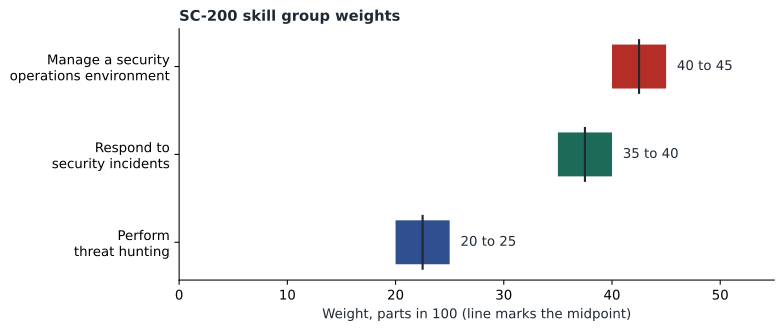
The first group is the largest, and it is broader than its name suggests. It includes Defender for Endpoint settings such as advanced features, device groups, automation levels and attack surface reduction rules, as well as the whole of Sentinel's setup: roles, retention across the analytics, data lake and XDR tiers, connectors, data collection rules, custom tables, threat indicators, analytics rules, anomalies and SOC optimization. Ama's Sentinel sprint in November covered most of the Sentinel half. The Defender half is where her diagnostic misses clustered.
What a weight range means
A weight range describes the share of the exam's questions that may come from a group. If an exam has 50 items, a group weighted 40 to 45 parts in 100 would contribute roughly 20 to 23 of them. The range exists because each candidate's exam is drawn from a larger pool and the exact mix varies. It does not mean that every skill in the group is equally likely, or that every listed skill will appear. A group with eleven bullet points does not get eleven questions.
Weights also say nothing about difficulty. Threat hunting carries the smallest weight, but its questions often require reading a KQL query carefully, which takes longer than recalling a setting. Nadia's estimate, from her own experience and from what colleagues have reported, is that hunting questions take about one and a half times as long as the average item. That affects pacing more than it affects study time, and lesson 11 deals with it.
| Skill group | Weight range | Areas in the study guide | Review lesson |
|---|---|---|---|
| Manage a security operations environment | 40 to 45 | Automation; Sentinel SIEM and platform; data ingestion; detections | Lessons 4 and 5 |
| Respond to security incidents | 35 to 40 | Defender XDR incidents; Defender for Endpoint response; Microsoft 365 investigation | Lesson 6 |
| Perform threat hunting | 20 to 25 | Defender XDR hunting; Sentinel platform hunting | Lesson 7 |
Turning weights into a study budget
A study budget that follows weights alone gives the most time to the largest group. One that follows weaknesses alone gives the most time to the weakest group. Neither is right on its own. Nadia's method combines them: give each group a score equal to its weight multiplied by the gap between Ama's diagnostic result and her target, then share the study hours in proportion to those scores. A heavy group with a small gap and a light group with a large gap can end up with similar time.
Ama used the midpoint of each weight range: 42.5, 37.5 and 22.5. Her gaps, in parts in 100, were the target of 80 minus her diagnostic result: 80 − 68 = 12 for the first group, 80 − 71 = 9 for the second and 80 − 50 = 30 for the third. She also kept a floor: no group gets less than 20 hours, because even a strong area needs revision when an exam is ten months away. The calculation below shows the method with her figures.
hours = 120
floor = 20
groups = {
    "Manage the environment": (42.5, 68),
    "Respond to incidents":   (37.5, 71),
    "Perform threat hunting": (22.5, 50),
}
target = 80

# score = weight x gap to the target
scores = {g: w * (target - d) for g, (w, d) in groups.items()}
total = sum(scores.values())

# every group gets the floor, and the rest is shared by score
spare = hours - floor * len(groups)
for g, s in scores.items():
    share = floor + spare * s / total
print(f"{g:24} score {s:6.1f} hours {share:5.1f}")Manage the environment score 510.0 hours 40.1 Respond to incidents score 337.5 hours 33.3 Perform threat hunting score 675.0 hours 46.6
What this code does
The calculation takes each skill group's exam weight and Ama's gap between her diagnostic result and the 80 in 100 target, and multiplies them to give a score. Every group first receives a floor of 20 hours. The remaining 60 hours are then shared in proportion to the scores, so a group that is both heavily weighted and weak gets the most extra time. The output lists each group's score and its total hours.
The result surprised Ama a little. Threat hunting, the lightest group, gets the most hours, about 47, because its gap is so large. Managing the environment gets about 40, and responding to incidents about 33. Nadia was comfortable with that. 'You will also practise response every week at work,' she said, 'and the environment group overlaps with what you build. Hunting is the one you will not get enough of on shift unless you plan for it.'
The budget is not fixed. Ama will repeat the calculation in early June, after the first practice assessment, using its group results in place of the diagnostic. If her hunting score has risen to 75 by then, the remaining hours will shift back toward the larger groups.
Inside each group: where the questions cluster
Weights describe groups, but Ama studies areas. She went through the nine areas in the study guide and marked each bullet with one of three labels: 'do weekly' for things she does on shift, 'have done' for things she did once during the fall, and 'read only' for things she has only read about. The labels are not a measure of difficulty. They show where reading alone would leave her guessing.
| Area | Do weekly | Have done | Read only |
|---|---|---|---|
| Automation in Defender XDR and Sentinel | Automation rules | Playbooks, attack disruption review | Defender for Endpoint automation levels, custom data collection |
| Sentinel SIEM and platform | Workbooks | Roles, retention tiers | SOC optimization recommendations |
| Ingesting data | Checking connector health | AMA with DCRs, Syslog and CEF via AMA, TI ingestion | Windows Event Forwarding setup, custom log tables |
| Configuring detections | Tuning scheduled rules | NRT rules, MITRE coverage review | Custom detections in Defender XDR, anomalies |
| Incidents in Defender XDR | Triage and assignment | Identity compromise (4196) | Defender for Cloud workload alerts, Purview alerts |
| Defender for Endpoint response | Device timeline | Isolation | Live response, investigation packages |
| Microsoft 365 investigation | Purview Audit search | Content search, Microsoft Graph activity logs | |
| Hunting in Defender XDR | Advanced hunting | Custom detection from a query | Hunting graphs and blast radius, Sentinel graph |
| Hunting on the Sentinel platform | Hunting queries | Notebook session | KQL jobs, summary rules, MCP server |
The 'read only' column became her first priority list. It holds about a dozen skills, and the plan in lesson 11 schedules each one for a hands-on session: in the Harrow & Finch test tenant where possible, or in a Microsoft Learn exercise where the feature is not licensed at Harrow & Finch.
What weights do not tell you
Weights are useful, but they invite two errors. The first is to skip a small area entirely because it seems unlikely to appear. A candidate who never learns Microsoft Graph activity logs may meet two questions on them, and two questions can be the difference between 690 and 710. The second error is to spend all the time on the largest group because it is largest. The first group is broad, and much of it is configuration that Ama will meet at work anyway.
Nadia's summary was simple. 'The weights tell you how much of the exam each group is. Your diagnostic tells you how much of each group you already know. Study the product of the two, and never leave anything on the list at zero.'
How the weights have moved
Weights change when Microsoft revises an exam, and following them over time helps explain what Microsoft wants the role to be. Earlier versions of SC-200 were organized around products: separate groups for Defender for Endpoint, Defender XDR and Sentinel. The current outline is organized around the work: managing the environment, responding and hunting, with products named inside each area. That shift matters for preparation. A candidate who studies product by product may know every Defender for Endpoint setting but still miss a question that asks which product should handle a task, because the question is written from the analyst's point of view.
The October 2026 outline also gives more space to the Sentinel platform than older versions did. Retention across the analytics, data lake and XDR tiers, KQL jobs, summary rules, the Sentinel graph and the MCP server all appear by name. Several of these were new or in preview during 2025, and their presence on the outline signals that Microsoft considers them part of everyday security operations. Ama noticed that her diagnostic misses on hunting were concentrated in exactly these newer items, which is why her plan schedules hands-on time with them rather than more reading.
From hours to weeks
Hours on a spreadsheet only help if they turn into sessions on a calendar. Ama works rotating day shifts, and her realistic study pattern is three sessions a week: one long session of two hours on her day off and two shorter sessions of about an hour and a quarter after shifts. That gives roughly four and a half hours a week, which over 27 weeks from March 1 to the end of August, plus a lighter final three weeks, comes close to the 120 hours in the budget.
Nadia suggested that each week should touch all three groups instead of studying one group for two months and then moving on. Interleaving like this is harder in the moment but tends to produce better retention than blocked study, because each session forces the learner to switch contexts and retrieve knowledge again. In practice, Ama's long session each week goes to her weakest group, threat hunting, until June, and her two short sessions alternate between the other two groups. After the June recalculation, the long session moves to whichever group is then furthest from the target.
| Session | Length | March to May focus | June to August focus |
|---|---|---|---|
| Day off | About 2 hours | Threat hunting, hands-on in the test tenant | Weakest group after the June recalculation |
| After shift 1 | About 1.25 hours | Managing the environment | Mixed review from the error log |
| After shift 2 | About 1.25 hours | Responding to incidents | Timed sets and case studies |
The plan also leaves room for the unexpected. Security operations has busy weeks, and an incident like 4196 can take over several days. Ama's rule is that a missed session is not made up by doubling the next one; instead, the week's lowest-priority topic moves to a buffer week that the plan keeps free in late July.
Worked problem
Checking the hours
Using a floor of 20 hours per group and 120 hours in total, with scores of 510 (42.5 × 12), 337.5 (37.5 × 9) and 675 (22.5 × 30), how many hours does threat hunting receive?
Show solution
- Total score: 510 + 337.5 + 675 = 1,522.5.
- Hours left after the floors: 120 − 3 × 20 = 60.
- Threat hunting's share of those hours: 675 ÷ 1,522.5 ≈ 0.443.
- \[20 + 60 \times 0.443 \approx 46.6\]
- So threat hunting receives about 46.6 hours, managing the environment about 40.1 and responding to incidents about 33.3.
Answer: Threat hunting receives about 46.6 hours, the most of the three groups.
Common mistakes
MistakeA weight of 20 to 25 means hunting questions are unimportant.
InsteadA fifth or more of the exam is hunting, and those items often take longer to answer.
MistakeEvery bullet in the study guide gets at least one question.
InsteadThe weights describe groups; individual skills may or may not appear on a given exam.
MistakeStudy time should follow the weights exactly.
InsteadCombine weights with personal gaps so that weak areas get attention.
MistakeA strong area can be skipped.
InsteadKeep a floor of revision for every group; the exam is months away.
MistakeThe budget is set once and kept.
InsteadRecalculate after each practice assessment using the newer results.
Summary and key terms
- SC-200 has three groups: managing the environment (40 to 45), responding to incidents (35 to 40) and threat hunting (20 to 25).
- A weight range is a share of questions, not a promise about any skill or a measure of difficulty.
- Ama shares her study hours by weight multiplied by gap, with a floor for every group.
- With her diagnostic, threat hunting gets the most hours despite the smallest weight.
- Marking each skill as done weekly, done once or read only shows where hands-on practice is needed.
- Recalculate the budget after each practice assessment.
- Skill group
- One of the three top-level divisions of the study guide, with a weight range.
- Weight range
- The share of exam questions that may come from a skill group.
- Study budget
- A plan for how many hours to spend on each part of the outline.
- Floor
- A minimum number of hours every group receives, however strong the candidate is.
- Gap
- The difference between a current result and the target, in parts in 100.
Practice problems
Work each problem on paper first, then reveal the answer to check.
What are the weight ranges of the three SC-200 skill groups?
Show answer
40 to 45, 35 to 40 and 20 to 25 parts in 100.
Why does threat hunting get the most hours in Ama's budget?
Show answer
Its gap to the target is much larger than the others, which outweighs its smaller exam weight.
Why keep a floor of hours for every group?
Show answer
Every area needs revision before an exam months away, even a strong one.
When will Ama recalculate the budget?
Show answer
In early June, after her first practice assessment.
Which column of Ama's area map became her first priority list?
Show answer
The read-only column, skills she has never done hands-on.
Lesson quiz · 5 questions
Score 60% or more to complete this lesson.
Create a free account to save your progress, take quizzes and earn a certificate.