
MSAZ-349 · Lesson 11 of 12 · 21 min
Timed practice plan
▶ Video coming soon A video version of this lesson is on the way.
Knowing the material and finishing the exam on time are different skills, and the second needs its own practice. Ama's plan from March to September 2027 builds up from untimed study to full timed rehearsals, with two practice assessments as fixed checkpoints and a buffer week for the weeks that work takes over. This lesson sets out the calendar, the pacing method she will use on the day, how she will run each timed set, and how her error log turns practice into the next week's study.
The plan follows one principle from Nadia: time pressure should be introduced gradually and only once the knowledge is there. Timed practice on material a candidate does not yet know measures nothing except the gaps. Timed practice on material a candidate knows measures pace, and pace can be trained.
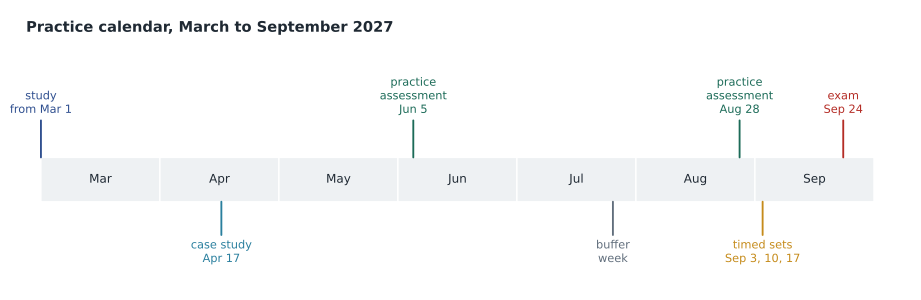
The calendar
From March 1 to the end of May, Ama studies by area using the hours from lesson 3, with short untimed quizzes at the end of each session and her weekly distractor-writing exercise from lesson 9. The first timed element enters on Saturday, April 17, with the practice case study from lesson 10, timed at 18 minutes. On Saturday, June 5, she takes Microsoft's free practice assessment for SC-200 untimed, in one sitting, using a mode that shows explanations if the assessment offers one, and uses its results by skill group to recalculate her study budget. June and July add a timed set of 20 mixed items every other Saturday, at 40 minutes each.
The week of July 26 is the buffer week: nothing new is scheduled, and it absorbs anything that slipped in June and July. On Saturday, August 28, she takes the practice assessment again, this time with its timer, as a full rehearsal. In September, three timed full sets on Fridays, September 3, 10 and 17, copy the exam's length and conditions as closely as she can: 100 minutes, about 50 items, one case study, no notes, at the time of day her exam is booked. The exam is on Friday, September 24, and the week before it holds only light review.
| Date | Activity | Purpose |
|---|---|---|
| From March 1 | Area study with untimed quizzes | Build knowledge by budget |
| April 17 | Timed practice case study, 18 minutes | First timed reading practice |
| June 5 | Practice assessment, untimed | Checkpoint and budget recalculation |
| June and July, alternate Saturdays | Timed mixed sets, 20 items in 40 minutes | Pace on familiar material |
| Week of July 26 | Buffer week | Absorb slipped sessions |
| August 28 | Practice assessment, timed | Full rehearsal |
| September 3, 10 and 17 | Timed full sets, 100 minutes | Exam conditions |
| September 24 | SC-200 exam | The goal |
Pacing on the day
An even pace of two minutes per item is a starting point, not a plan, because items take different amounts of time. Case study questions need reading time first, KQL items take longer than recall items, and a few minutes should be left at the end to revisit marked items. Nadia's method is to set three checkpoints: at a quarter, half and three quarters of the time, the candidate should have reached a known item number. Checkpoints are easier to use than a per-item rate, because a glance at the clock and the item counter is enough.
The calculation below works out Ama's checkpoints for an exam of 50 items with one case study of 6 items, assuming that the case study adds 3 minutes of reading and that she keeps 8 minutes at the end for review. It spreads the remaining time evenly across the items, which is a simplification, and then reports which item she should have reached at each checkpoint, assuming the case study comes in the middle of the exam.
total_minutes = 100
items = 50
case_items = 6
case_reading = 3
review = 8

working = total_minutes - review - case_reading
per_item = working / items
print(f"Minutes per item: {per_item:.2f}")

# assume the case study is items 23 to 28
for minute in (25, 50, 75):
    t = minute
    if t > 23 * per_item:
        t -= case_reading
    reached = int(t / per_item)
print(f"At {minute} minutes: about item {min(reached, items)}")Minutes per item: 1.78 At 25 minutes: about item 14 At 50 minutes: about item 26 At 75 minutes: about item 40
What this code does
The calculation starts from 100 minutes, sets aside 8 minutes at the end for review and 3 minutes for reading the case study, and spreads the rest evenly over 50 items, which gives just under 1.8 minutes each. For each checkpoint at 25, 50 and 75 minutes, it works out how many items Ama should have finished, taking off the case study reading time once she has passed the point where the case study is assumed to begin. It prints the time per item and the item number for each checkpoint.
The result gives Ama three numbers to write on her scratch sheet: about item 14 at 25 minutes, about item 26 at 50 minutes and about item 40 at 75 minutes. If she is two or more items behind a checkpoint, she speeds up by marking any item she cannot answer within two minutes, choosing her best answer and moving on. If she is ahead, she keeps her pace rather than slowing down, because the review minutes at the end are worth more than extra minutes in the middle.
Because the number of items is not published, Ama will look at the item count on the first screen of the exam and recalculate her checkpoints in her head if it differs from 50. The rule is simple: divide the working time by the number of items, and multiply by a quarter, half and three quarters of the total.
Running a timed set
Each timed set copies the exam as far as practice allows. Ama sits at the same desk she will use if she tests online, with a clear desk, her phone in another room and a single sheet of paper. She reads the instruction lines, marks items she is unsure of and answers every item. When the time is up she stops, even mid-item, because the exam will stop her too. Then she scores the set and spends at least as long reviewing it as she spent taking it.
The review has three parts. First, every wrong answer goes in the error log with the reason, using the patterns from lesson 9. Second, every right answer she marked as unsure goes in with a question mark, as lesson 2 described. Third, she compares her pace with the checkpoints: which part of the set was slow, and why? A slow stretch caused by one long KQL item is normal. A slow stretch caused by rereading every question twice is a habit to fix.
The error log
Ama's error log is a simple table with one row per miss or unsure item: date, source, skill group, area, the pattern from lesson 9, the fact or habit that would have prevented the miss, and the date she last reviewed it. Each Sunday she filters the log for the last two weeks and picks the three areas with the most entries; those take the first slot in the next week's sessions. An entry is closed when she has answered two new items on the same point correctly on different days.
| Date | Source | Area | Pattern | Fix |
|---|---|---|---|---|
| June 5 | Practice assessment | Configuring detections | Near-synonym | Grouping joins alerts; suppression pauses the rule |
| June 5 | Practice assessment | Sentinel platform hunting | Near-synonym | KQL job brings lake data in; summary rule keeps aggregates |
| June 12 | Timed set 1 | Defender for Endpoint response | Wrong product | Blocking a hash on devices is an indicator, not DLP |
| June 12 | Timed set 1 | Reading KQL | KQL misreading | has_all needs every term; has_any needs one |
The sample rows show the format, not results; the real entries will come from the real practice. Nadia will look at the log every fortnight from June. Her test of readiness is not a practice score alone but a log in which new entries are rare and old ones stay closed.
Where practice items come from
A timed plan needs a steady supply of practice items, and their source matters. Ama's plan uses five. Microsoft's free practice assessment for SC-200, linked from the certification page, is the closest to the real exam's style and is the anchor for the June and August checkpoints. The knowledge checks at the end of Microsoft Learn modules are short and untimed, and suit the end of a study session. The quizzes and exams from the three SC-200 courses she completed in the fall give a pool of about 120 items she can mix into timed sets, though she knows many of them well by now. Her own items and Renata's, from the distractor-writing exercise, add new items each week. And Nadia will write the three full September sets herself, drawing on her own experience of the exam and on the current study guide, so that Ama meets items she has never seen.
There is one source the plan rules out. Sites that sell or share questions said to be from the live exam break the non-disclosure agreement every candidate accepts, and Microsoft can revoke certifications and ban candidates who use them. They also teach the wrong thing: memorizing answers to particular items does not build the reasoning the exam tests, and items change between versions. Nadia's view is blunter. 'If you need a dump to pass, you are not ready to work a queue at three in the morning.'
Hands-on practice alongside timed sets
Timed sets test recall and reading, but the 'read only' skills from lesson 3 need hands-on time too. Ama's plan pairs each timed set with one hands-on task drawn from the error log. If the June 12 set shows that she confuses indicators and data loss prevention, the next hands-on session creates a file hash indicator in the Harrow & Finch test tenant and watches what happens on a test device. If a set shows that she misreads KQL joins, the session writes three joins of different kinds against the same two tables and compares the rows. The hands-on work happens only in the test tenant or in Microsoft Learn's exercise environments, never in production, and Sunil approves the list of test devices each month.
Microsoft also publishes lab exercises for its SC-200 training course, which walk through tasks such as connecting data sources, creating analytics rules and running hunting queries. They need an Azure subscription and a Microsoft 365 test tenant. Harrow & Finch's test tenant has what most of them need; for features it does not license, such as some Defender for Cloud plans, Ama will use trial licences where Microsoft offers them, or read the documentation and note the gap in her error log as a fact to review rather than a skill she has practised.
Keeping the load sustainable
A study plan that runs for six and a half months alongside rotating shifts has to be sustainable, or it will fail in July. Ama's plan has three rules for that. First, the weekly load is fixed at about four and a half hours, and a busy week reduces it rather than borrowing from the next one. Second, there is no study on the day after a night shift, because recall and reasoning practised while tired are not reliable practice. Third, the last week before the exam is light: two short review sessions of the error log's open entries, one rest day and no new material.
Nadia added a fourth rule after watching colleagues prepare for other exams. 'Do not judge yourself by any single practice score. One bad set is a data point. Three bad sets in a row is a pattern, and that is when we change the plan.' If the August 28 rehearsal comes in well below the target, the plan has a contingency: move the exam to the second half of October, which still falls within the window Ama's manager has set for the certification, and repeat the September sequence.
Worked problem
Checking a checkpoint
On the first screen of her exam, Ama sees 56 items. She keeps 8 minutes for review and assumes one case study with 3 minutes of reading. What is her time per item, and roughly which item should she have reached at 50 minutes, if the case study comes before that point?
Show solution
- Working time: 100 − 8 − 3 = 89 minutes.
- Time per item: 89 ÷ 56 ≈ 1.59 minutes.
- At 50 minutes, with the 3 minutes of case study reading already spent, she has had 47 minutes of answering time.
- \[47 \div 1.59 \approx 29.6\]
- So she should have finished about item 29 at the half-way checkpoint.
Answer: About 1.59 minutes per item, and about item 29 at 50 minutes.
Common mistakes
MistakeTimed practice should start from the first week.
InsteadTime pressure is introduced once the knowledge is there; early timed sets only measure gaps.
MistakeTwo minutes per item is the pacing plan.
InsteadUse checkpoints that allow for case study reading, longer items and review time.
MistakeBeing ahead of pace means slowing down.
InsteadKeep pace and bank the minutes for review.
MistakeReview means reading the right answers.
InsteadLog every miss and every unsure correct answer with its reason and fix.
MistakeA practice score alone shows readiness.
InsteadReadiness also shows in an error log with few new entries.
Summary and key terms
- Build from untimed study to timed sets to full rehearsals over six months.
- Use the practice assessment as checkpoints in June and August, and recalculate the budget after the first.
- Keep a buffer week for work that takes over.
- Pace with three checkpoints, recalculated from the item count on the first screen.
- Run timed sets under exam conditions and review them for at least as long as they took.
- Keep an error log by pattern and close entries only after two correct answers on different days.
- Checkpoint
- An item number to have reached at a set time during the exam.
- Timed set
- A practice set taken under a time limit in exam conditions.
- Buffer week
- A week kept free in a study plan to absorb slipped work.
- Error log
- A record of missed and unsure items with their reasons and fixes.
- Practice assessment
- A free set of sample questions from Microsoft that shows readiness by skill group.
Practice problems
Work each problem on paper first, then reveal the answer to check.
When does Ama take the practice assessment for the first time?
Show answer
Saturday, June 5, 2027, untimed.
Why keep a buffer week?
Show answer
To absorb sessions that slip when work gets busy.
What are Ama's three checkpoints for a 50-item exam?
Show answer
About item 14 at 25 minutes, 26 at 50 minutes and 40 at 75 minutes.
When is an error log entry closed?
Show answer
After two new items on the same point are answered correctly on different days.
What should Ama do if she is two items behind a checkpoint?
Show answer
Mark items she cannot answer within two minutes, choose her best answer and move on.
Lesson quiz · 5 questions
Score 60% or more to complete this lesson.
Create a free account to save your progress, take quizzes and earn a certificate.