
MSAZ-349 · Lesson 10 of 12 · 21 min
Scenario practice
▶ Video coming soon A video version of this lesson is on the way.
This lesson is a full practice case study in the style of an SC-200 case study, written by Nadia for Ama's first timed case study session in April 2027. The organization is fictional and has nothing to do with Harrow & Finch, so that Ama cannot answer from memory of her own environment. The lesson gives the case study's tabs, then seven questions, then a worked answer to each that names the requirement that decides it. Readers should try each question before reading its answer, using the method from lesson 2: list every must, must not and minimize from the requirements before reading any question.
Overview
Tallgrass Prairie Credit Union is a member-owned financial cooperative with 14 branches and about 260 employees. Its head office is in Brandon and its operations centre is in Winnipeg. It has a security team of four: a security manager, two analysts and a security engineer. The credit union subscribes to Microsoft 365 E5 for all staff and uses Microsoft Sentinel with a single workspace connected to the Defender portal. A managed service provider monitors the environment out of hours.
Existing environment
Identity: users are synchronized from an on-premises Active Directory forest to Microsoft Entra ID. Defender for Identity sensors run on all three domain controllers. Devices: 310 Windows 11 laptops and desktops managed by Intune, 28 Windows Server 2022 servers in the operations centre, of which 6 run the core banking integration, and 4 Linux servers that run the online banking web front end. All Windows devices are onboarded to Defender for Endpoint. Network: each branch has a firewall that can send CEF messages; the operations centre has two firewalls and a web application firewall. Sentinel: the workspace collects Entra ID sign-in and audit logs, Microsoft 365 activity and Defender XDR incidents. No Windows Security events or firewall logs are collected yet. Device groups: one device group contains all devices, at the default automation level.
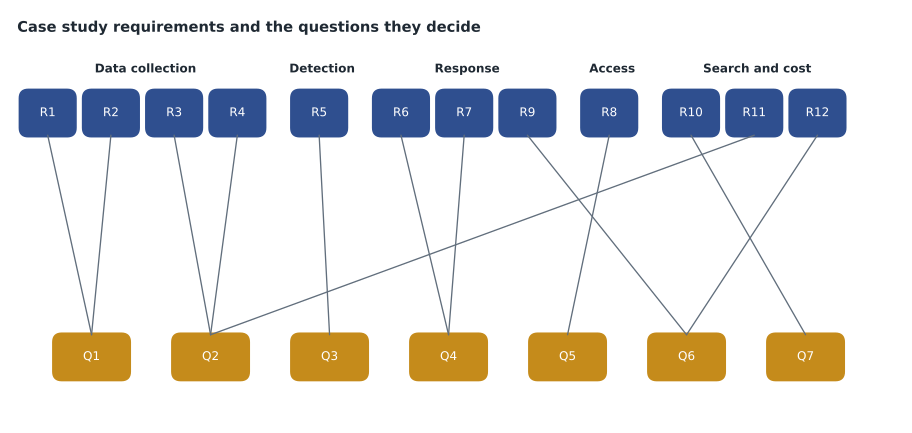
Requirements
The security manager has listed the following requirements. R1: collect Windows Security events from all servers with the least administrative effort. R2: collect only the Common event set from servers, except the core banking integration servers, which must also send PowerShell script block logging events. R3: collect branch firewall logs. R4: firewall logs must be kept for 13 months for the credit union's regulator, but analysts query them only during investigations. R5: an incident must be created within about a minute when any account in the privileged access group signs in from outside the country. R6: automated remediation must not change the core banking integration servers without approval. R7: all other devices must be remediated automatically. R8: the managed service provider must be able to assign and close incidents but must not be able to change analytics rules. R9: when an incident is created for a branch device, a ticket must be opened in the credit union's IT service management tool. R10: analysts must be able to search the last 13 months of firewall logs for a list of addresses and use the results in a workbook. R11: minimize the cost of data collection. R12: use built-in features wherever possible instead of custom code.
Technical constraints
The core banking integration servers must not run any software not approved by the vendor; the vendor approves the Azure Monitor Agent and Defender for Endpoint but no other agent. The Linux servers are in a separate network segment that can reach the operations centre but not the internet directly. The IT service management tool has a REST API and a Logic Apps connector.
Question 1
You need to meet R1 and R2. What should you do? A: Install the Log Analytics agent on all servers and enable the Security Events connector. B: Use the Windows Security Events via AMA connector with two data collection rules: one with the Common event set for all servers, and one with a custom XPath query for PowerShell script block events associated with the six core banking integration servers. C: Configure Windows Event Forwarding from all servers to a collector and send all events. D: Use one data collection rule with the All event set for all servers.
Answer: B. The deciding requirements are R2, which needs different collection for six servers, and the technical constraint that only the Azure Monitor Agent is approved. A uses a retired agent. C collects all events, which breaks R2 and R11, and adds a collector server for only 28 machines, which is more effort than R1 allows. D collects far more than R2 permits. Two data collection rules can be associated with the same machine, so the core banking servers receive both the Common set and the extra PowerShell events.
Question 2
You need to meet R3 and R4 with the least cost. Which two actions should you take? Each correct answer presents part of the solution. A: Deploy a Linux log forwarder with the Azure Monitor Agent and use the CEF via AMA connector. B: Configure the CommonSecurityLog table for the data lake tier with 13 months of retention. C: Keep CommonSecurityLog in the analytics tier for 13 months. D: Send firewall logs to a storage account through a diagnostic setting.
Answer: A and B. R3 needs the logs collected, and branch firewalls send CEF, which the CEF via AMA connector receives through a forwarder. R4 says analysts query the logs only during investigations, which points to the lake tier, and R11 asks for the least cost. C meets retention but at a much higher cost. D is not how CEF devices send data and would leave the logs outside Sentinel.
Question 3
You need to meet R5. Which type of analytics rule should you create? A: A scheduled rule that runs every hour. B: A near-real-time rule. C: An anomaly rule. D: An automation rule that triggers when an alert is created.
Answer: B. The deciding words are 'within about a minute'. A near-real-time rule runs every minute. A scheduled rule's shortest interval is five minutes, and an hourly rule is far too slow. Anomaly rules use Microsoft's behavioural templates and cannot be targeted at a specific group and condition. An automation rule acts on alerts and incidents that already exist; it cannot detect a sign-in.
Question 4
You need to meet R6 and R7. What should you do? A: Set the automation level of the existing device group to Semi, require approval for any remediation. B: Create a device group for the six core banking integration servers with Semi, require approval for any remediation, rank it above the existing group, and set the existing group to Full. C: Turn off automated investigation in advanced features. D: Create a device group for all servers with No automated response.
Answer: B. R6 limits only the six core banking servers; R7 requires automatic remediation everywhere else. A would require approval for all devices, breaking R7. C would stop all automated remediation. D would stop automated response on all 28 servers, not just the six, and 'no automated response' goes further than 'not without approval'. The new group must rank higher so the six servers match it first.
Question 5
You need to meet R8. Which role should you assign to the managed service provider's analysts? A: Microsoft Sentinel Reader. B: Microsoft Sentinel Responder. C: Microsoft Sentinel Contributor. D: Security Administrator in Entra ID.
Answer: B. Responder can assign and close incidents and cannot change rules. Reader cannot change incidents. Contributor can change rules, which R8 forbids. Security Administrator is far wider than needed. In practice the provider's analysts would also need access to the incidents in the Defender portal through Defender's own role-based access, scoped to the right data, but among these options Responder is the one that meets R8.
Question 6
You need to meet R9 and R12. What should you configure? A: An automation rule that runs when an incident is created, with a condition on the branch device tag, and that runs a playbook using the Logic Apps connector for the service management tool. B: An analytics rule that sends an email to the service desk. C: A workbook that lists branch incidents for the service desk to review. D: An Azure Function that polls the incident API every five minutes.
Answer: A. Opening a ticket in another system needs a playbook, and the tool has a Logic Apps connector, which satisfies R12's preference for built-in features over custom code. The automation rule supplies the trigger and the condition. B sends email, not a ticket. C needs people to act. D is custom code and polls rather than reacting.
Question 7
You need to meet R10. What should you do? A: Run a Sentinel hunting query over CommonSecurityLog with a 13-month time range. B: Create a KQL job that queries the lake copy of CommonSecurityLog for the address list and writes results to an analytics table, and point the workbook at that table. C: Create a summary rule over CommonSecurityLog. D: Use Defender XDR advanced hunting over DeviceNetworkEvents.
Answer: B. Because of question 2, the firewall logs are in the lake tier, which hunting queries and workbooks cannot read directly. A KQL job can query 13 months of lake data and write results where the workbook can use them. A summary rule keeps aggregates of recent data going forward and would not search the past 13 months. Advanced hunting's DeviceNetworkEvents covers endpoints, not firewalls, and only 30 days.
| Question | Answer | Deciding requirement or constraint |
|---|---|---|
| 1 | B | R2 and the approved-agent constraint |
| 2 | A and B | R4 and R11 |
| 3 | B | R5, within about a minute |
| 4 | B | R6 limited to six servers, with R7 |
| 5 | B | R8, must not change rules |
| 6 | A | R9 with R12 |
| 7 | B | R10, with lake-tier storage from question 2 |
What the case study teaches
Two features of the case study are typical of real SC-200 case studies. First, questions depend on each other: question 7's answer follows from the storage choice in question 2. A candidate who answers question 2 with the analytics tier would find question 7 easier but would have lost question 2. Answers must be consistent with the whole scenario, not just the question in front of the candidate. Second, every question had at least one option that worked but broke a requirement elsewhere, such as collecting all events or granting Contributor. The requirements list is the answer key, and the candidate's job is to check each option against it.
Ama's result on her own first attempt at this case study, planned for April 2027, will be recorded in her error log with the requirement she missed for each wrong answer, so that her review in May targets the reading habit rather than the product facts.
Timing the case study
In Ama's April session, Nadia will give her 18 minutes for the case study: three minutes to read the overview and environment tabs, three to number the requirements and constraints, and twelve for the seven questions, a little under two minutes each. The reading time is not optional. Candidates who skip straight to the first question read the requirements several times over, once per question, and usually spend more time in total than those who read them once with care.
Ama's scratch sheet for the case study will have three columns: the requirement number, its key word in two or three words, and the questions it decided. By the end, every requirement should have at least one question next to it. A requirement with no question is a signal to check whether one of the answers ignored it, because exam writers rarely include a requirement that decides nothing. In the Tallgrass Prairie case study, R1 to R12 each decide at least one question, and R11 and R12 decide several, because cost and built-in features are tie-breakers across the whole scenario.
The last habit is to stop changing answers once the questions are done. Nadia's experience, and the research on answer changes in multiple-choice tests, suggests that changes made for a clear reason, such as noticing a missed requirement, tend to help, while changes made from a vague feeling tend not to. Ama's rule is to change an answer only when she can name the requirement that makes the new answer better.
Worked problem
Checking an answer against every requirement
Suppose a candidate answered question 4 with option D, a device group for all servers with no automated response. Which requirements does D break, and how would checking the list have caught it?
Show solution
- List the requirements that mention automation: R6 and R7.
- R6 asks for approval before remediation on six servers. D gives no automated response at all, which is stricter than asked but meets R6 for those six.
- R7 asks for automatic remediation on all other devices. D removes it from the other 22 servers, which breaks R7.
- D also breaks the wording of R6, which expects remediation to be possible with approval.
- Checking each option against R6 and R7 in turn would have removed D before choosing.
Answer: D breaks R7 for 22 servers and goes further than R6 asks; checking options against each requirement catches it.
Common mistakes
MistakeEach case-study question can be answered on its own.
InsteadAnswers depend on each other; keep them consistent with the whole scenario.
MistakeAn option that meets the requirement in the question is correct.
InsteadIt must not break any other requirement or constraint.
MistakeStricter is always safer.
InsteadGoing beyond a requirement, such as no automated response instead of approval, can break another requirement.
MistakeCustom code is acceptable if it works.
InsteadWhen a requirement prefers built-in features, a connector or built-in action wins.
MistakeThe technical constraints tab is background.
InsteadConstraints such as approved agents often decide the answer.
Summary and key terms
- Read the requirements and constraints first and number them.
- For each question, name the deciding requirement before choosing.
- Check every option against every relevant requirement, not only the one in the question.
- Keep answers consistent across questions; storage choices affect later hunting answers.
- Prefer built-in features, least privilege and least cost when the requirements ask for them.
- Record misses by the requirement missed, not just by topic.
- Case study
- A long fictional scenario with tabs, followed by several dependent questions.
- Deciding requirement
- The requirement that separates the correct option from the others.
- Technical constraint
- A fixed condition in a case study, such as an approved agent list.
- Requirement map
- A list linking each question to the requirements that decide it.
- Consistency
- Choosing answers that fit together across all questions in a case study.
Practice problems
Work each problem on paper first, then reveal the answer to check.
Why is the Log Analytics agent wrong in question 1?
Show answer
It is retired, and the constraint allows only the Azure Monitor Agent.
Which requirement points firewall logs to the lake tier?
Show answer
R4, with R11 on cost.
Why must the new device group rank above the existing one?
Show answer
Devices match the first group whose rules they meet, in rank order.
Why does question 6 need a playbook?
Show answer
Opening a ticket in another system needs a connection that only a playbook provides.
Why is question 7's answer a KQL job?
Show answer
The logs are in the lake tier, and the workbook needs an analytics table.
Lesson quiz · 5 questions
Score 60% or more to complete this lesson.
Create a free account to save your progress, take quizzes and earn a certificate.