
MSAZ-329 · Lesson 8 of 12 · 21 min
Common distractors
▶ Video coming soon A video version of this lesson is on the way.
A distractor is a wrong option that is written to look right. Good exam writers do not fill questions with nonsense; they offer options that would work in a slightly different scenario, or that solve part of the problem, or that a person with partial knowledge would pick. When Ines and Nikolai sorted her 23 diagnostic mistakes, 15 of them were cases where she had picked an option that was reasonable but not the best fit. 'You did not pick silly answers,' Nikolai said. 'You picked answers that would be fine at Harrow & Finch on a quiet Tuesday. The question wanted the answer for its own company.'
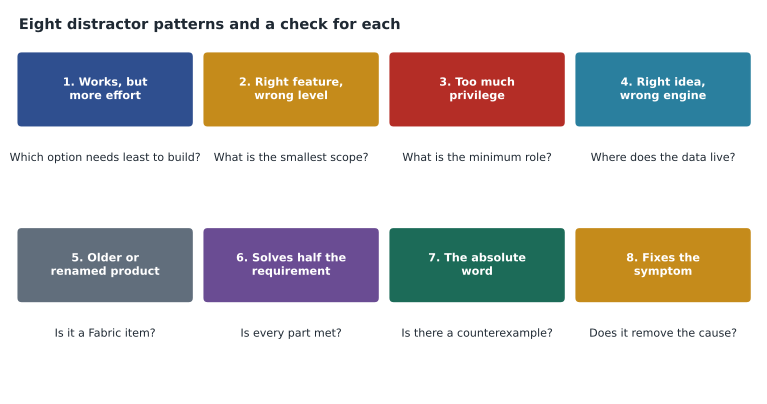
This lesson names the distractor patterns that appear most often on DP-700, shows an example of each, and gives a check for spotting it. The patterns are not tricks to memorize. They are reminders to read the requirement exactly and to prefer the option that meets every part of it with the least extra cost, effort or privilege.
Pattern 1: it works, but not with the least effort
Many questions include a constraint such as 'with the least development effort', 'without writing code' or 'minimize administrative effort'. Several options will work, and the distractors are the ones that work with more effort. Building a pipeline with a Lookup, a Copy and a stored procedure to load 40 tables incrementally works, but a copy job does the same with a few settings. Writing a notebook to replicate a database every few minutes works, but mirroring does it with none. The check is to ask, for each working option, how much the team has to build and maintain, and to pick the one with the least.
Pattern 2: the right feature at the wrong level
Security questions often offer the right kind of control at the wrong scope. A requirement to let one group query one lakehouse is met with item permissions, not a workspace role that would also let them see every other item in the workspace. A requirement to hide some rows from store managers is met with row-level security, not by creating a separate lakehouse per store. A requirement to stop analysts from reading one column is met with column-level security or masking, not by removing their access to the whole table. The check is to ask what the smallest scope is that satisfies the requirement, and whether the option grants anything more.
Pattern 3: too much privilege
A close cousin of pattern 2 is the option that grants too much. Making a service principal a workspace Admin so a pipeline can write to a lakehouse would work, but Contributor is enough. Giving analysts Member so they can share one report gives them the power to manage much more. Microsoft's exams consistently prefer least privilege, and an option that solves the problem by over-granting is almost always wrong when a narrower option exists. The check is to name the minimum role or permission that the task needs.
Pattern 4: the right idea in the wrong engine
Fabric often offers the same idea in several engines, and distractors use the wrong one for the scenario. A KQL materialized view is the right idea for a dashboard over a high-volume event table, but not for a warehouse fact table. An update policy cleans data at ingestion in an eventhouse, but a lakehouse table needs a notebook or a pipeline. A T-SQL stored procedure suits a warehouse but cannot write to a lakehouse table through its read-only SQL analytics endpoint. The check is to confirm where the data lives in the scenario before choosing a feature, and to reject options from another item type.
Pattern 5: an older or renamed product
Fabric changes quickly, and some options name older products or features. Azure Synapse Analytics, Azure Data Factory and Azure Databricks are real services with similar ideas, but a question set in Fabric expects a Fabric item unless it says otherwise. Some Fabric items have been renamed: what was once called data workflows is now the Apache Airflow job, Data Activator is now Activator, and Dataflow Gen1 has been succeeded by Dataflow Gen2 for Fabric work. An option that would be right in an older product or under an old name may be a distractor; it may also simply be the name the question uses, if the outline still uses it. The check is to read for meaning first, then ask whether the option belongs to Fabric as the scenario describes it.
Pattern 6: it solves half the requirement
Requirements often have two or three parts, and a distractor meets one part well. A question might ask for hourly loads that also capture deleted rows. A watermark on a modified date gives hourly loads but cannot see deletes; change data capture can. A question might ask for a dashboard that refreshes every minute and keeps a year of history cheaply. A Real-Time dashboard on an eventhouse refreshes quickly, and a retention policy of 365 days with a short hot cache keeps history without keeping it all in fast storage. The check is to list the parts of the requirement and tick each one off for the chosen option.
| Requirement parts | Distractor that meets one part | Option that meets all parts |
|---|---|---|
| Hourly loads; capture deletes | Incremental copy by watermark | Copy job or pipeline using change data capture |
| Low code; complex nested JSON | Dataflow Gen2 | A notebook run from a pipeline, if low code is a preference rather than a rule |
| Near real time; no load logic | A pipeline every five minutes | Mirroring, if the source is supported |
| Hide values; keep the column visible | Column-level security | Dynamic data masking |
The second row shows a subtlety. If a requirement says 'must be maintained without code' and also 'must parse deeply nested JSON at large volume', the parts conflict, and the question usually signals which matters more. The words 'must' and 'should', and the order in which the requirements are listed, are clues.
Pattern 7: the absolute word
Options that say 'always', 'never', 'all' or 'only' are often wrong, because Fabric features have exceptions. 'VACUUM always speeds up queries' is wrong; it removes old files and saves storage, and only indirectly affects reads. 'Partitioning always improves performance' is wrong for small tables. This is a tendency, not a rule: 'Viewers can never write data to a lakehouse' is correct. The check is to test an absolute option against one counterexample. If one comes to mind, the option is probably wrong.
Pattern 8: fixing the symptom, not the cause
Troubleshooting questions offer fixes for the symptom alongside fixes for the cause. If a pipeline fails every night because its gateway restarts at 1 a.m., adding retries treats the symptom; moving the run or the gateway maintenance treats the cause. If a capacity throttles every morning because a backfill runs at 7 a.m., buying a larger capacity treats the symptom; moving the backfill or slicing it treats the cause. Exams tend to prefer the cause unless the question asks for the quickest workaround. The check is to ask why the problem happens, then pick the option that removes that reason.
Using the patterns
The patterns overlap, and a single wrong option can fit several. The point is not to label each option but to have a short list of questions to ask when two options both look right: Does it meet every part? Is it the least effort? Is it the narrowest scope? Is it the right engine? Is it a Fabric item? Does it fix the cause? Ines will add a column to her practice log for the pattern behind each miss, so that she can see which patterns catch her most and practise those.
Distractors in typed questions
The patterns are easiest to see in multiple-choice questions, but they appear in other formats too. In a drag-and-drop question that asks for the steps to deploy content in order, an extra step that is plausible but not needed, such as 'export the items as files', is a distractor of pattern 1. In a yes-or-no series, three statements about the same scenario often include one that is true in general but false for this scenario because of a detail such as the item type or the capacity. In a hot-area question with a partly completed T-SQL or KQL statement, the dropdown options usually include a keyword from another language, such as a SQL GROUP BY offered in a KQL statement, which is pattern 4 in miniature.
Ordering questions have their own trap: two steps that could be swapped in real life but have a required order in Fabric. For example, a deployment rule can only be set after the first deployment to a stage has created the items, and OPTIMIZE should run before VACUUM in a maintenance pipeline so that VACUUM removes the files OPTIMIZE has replaced. When an ordering option looks almost right, the question is usually testing one such dependency.
A practice routine for distractors
Nikolai gave Ines a simple routine for the practice questions she does each week. Before choosing an answer, she writes one word next to each wrong option: effort, scope, privilege, engine, old, half, absolute or symptom. If she cannot give a wrong option a word, she reads the question again, because either the option is right or she has missed part of the requirement. The routine is slow at first, about twice the time per question, but after three or four weeks it becomes automatic and her speed returns.
The log from this routine is also useful. After a month, she can count which words she writes most often next to the option she wrongly chose. In her November diagnostic, the words would have been 'half' and 'engine' for most misses. If those still dominate in March, she knows to slow down on multi-part requirements and to name the item type before reading options. If they have gone and 'privilege' has appeared, she knows the security review needs another pass.
| Question format | Typical distractor | Pattern |
|---|---|---|
| Drag and drop order | An extra, unneeded step | Works, but more effort |
| Yes or no series | True in general, false for this item type | Wrong engine |
| Hot area in code | A keyword from another language | Wrong engine |
| Case study | Meets one requirement but breaks another | Solves half the requirement |
One last point concerns options that are all wrong in the same way except one. When three options share a feature, such as all granting workspace roles, and one does something different, such as granting an item permission, the odd one out is often the answer. Exam writers build distractors from a common misconception, and the correct answer is the one that does not share it. This is a hint, not a rule, but it is a useful way to break a tie between two options that both still look reasonable.
Worked problem
Eliminating distractors
A company's lakehouse is in a workspace used by many teams. The finance team must be able to query only the finance tables in that lakehouse through the SQL analytics endpoint, and must not see other items in the workspace. What should you do? (A) Add the finance group as Viewers of the workspace. (B) Share the lakehouse with the finance group with Read and ReadData, and use OneLake security or SQL permissions to limit them to the finance tables. (C) Create a new workspace and copy the finance tables into it every night. (D) Add the finance group as Members of the workspace and ask them not to open other items.
Show solution
- A gives access to every item in the workspace: the right kind of control at too wide a scope (pattern 2).
- D grants even more privilege and relies on goodwill (pattern 3).
- C works, but adds a nightly copy to build and maintain, and the data is up to a day old (pattern 1).
- B gives access to one item and then narrows it to the finance tables, with nothing extra.
Answer: B: share the lakehouse with Read and ReadData, and restrict the tables with OneLake security or SQL permissions.
Common mistakes
MistakeA distractor is an obviously wrong option.
InsteadDistractors are written to look right; they usually work in another scenario or meet only part of the requirement.
MistakeAny option that works is acceptable.
InsteadThe best option meets every part of the requirement with the least effort, privilege and cost.
MistakeOptions naming Azure Synapse or Data Factory are always wrong.
InsteadThey are often distractors in Fabric scenarios, but read the question; it may describe an existing Azure service.
MistakeAbsolute words always mark a wrong option.
InsteadThey often do, but some absolute statements are true; test each against a counterexample.
MistakeMore retries are a good fix for a nightly failure.
InsteadRetries treat the symptom; find and remove the cause when the question allows it.
Summary and key terms
- Most wrong answers are reasonable options that are not the best fit for the stated scenario.
- Prefer the option with the least effort, the narrowest scope and the least privilege that meets every requirement.
- Check the engine and item type: a feature from another item or service is a common distractor.
- Watch for old or renamed products, and read for meaning first.
- List every part of the requirement and tick each one for the chosen option.
- Prefer fixes that remove the cause of a problem over ones that only treat the symptom.
- Distractor
- A wrong option written to look right.
- Least privilege
- Granting only the permissions a task needs and nothing more.
- Scope
- How much an access control or setting covers, such as a workspace, an item or a column.
- Root cause
- The underlying reason a problem happens, as opposed to its symptom.
- Practice log
- A record of practice mistakes with the topic and the reason for each.
Practice problems
Work each problem on paper first, then reveal the answer to check.
What should you check first when two options both seem to work?
Show answer
Which one meets every part of the requirement with the least effort, privilege and cost.
Why is making a service principal a workspace Admin usually wrong?
Show answer
It grants more privilege than the task needs; Contributor or an item permission is usually enough.
What does an incremental copy by watermark miss?
Show answer
Deleted rows in the source.
Name one renamed Fabric item that may appear under an older name.
Show answer
The Apache Airflow job, formerly data workflows, or Activator, formerly Data Activator.
How can you test an option that says 'always'?
Show answer
Look for one counterexample; if one exists, the option is probably wrong.
Lesson quiz · 5 questions
Score 60% or more to complete this lesson.
Create a free account to save your progress, take quizzes and earn a certificate.