
MSAZ-329 · Lesson 1 of 12 · 21 min
The Fabric Data Engineer certification
▶ Video coming soon A video version of this lesson is on the way.
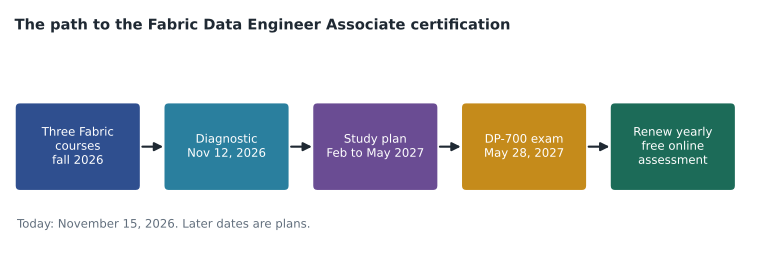
On Friday, November 13, 2026, an hour after the freezer pilot design review, Nikolai Petrenko closed the meeting room door and turned the whiteboard round. The front still showed the pilot timeline. The back was blank, and he wrote one line across the top: 'DP-700, Friday, May 28, 2027.' Ines Duarte had joined the data team at Harrow & Finch Home Supply in Winnipeg in October, and in five weeks she had loaded three years of sales history, built a nightly pipeline, cleaned up a messy lakehouse and helped design a real-time freezer alert. The exam would ask her to show that she could do those things on demand, under time pressure, in someone else's scenario.
The night before, Ines had worked through a 60-question diagnostic set that Nikolai had put together from the quizzes in the three Fabric courses she had just finished. She scored 37 of 60. This course is the plan the two of them built from that result. Its lessons explain the certification and the exam, review each part of the skills outline, practise reading code and avoiding distractors, work through a full scenario, and set out a timed study plan for February to May 2027. Everything after November 15, 2026 in this course is a plan, not something that has already happened.
What the certification is
Exam DP-700, Implementing Data Engineering Solutions Using Microsoft Fabric, leads to the Microsoft Certified: Fabric Data Engineer Associate certification. It is a role-based associate certification, the middle level of Microsoft's scheme, above the fundamentals certifications and below the expert ones. There are no formal prerequisites. Microsoft describes the candidate as someone who loads and transforms data, secures and manages an analytics solution, and monitors and optimizes it, using SQL, PySpark and Kusto Query Language (KQL) along the way.
That description matters because it says what the exam is not. It is not an exam about building reports or semantic models; those belong to DP-600, the Fabric Analytics Engineer exam that Keiko Tanabe plans to take later. It is not an exam about Azure Synapse or Azure Data Factory as separate products, although some ideas carry over. And it is not an exam about one language. A candidate who knows PySpark well but has never written a KQL query, or who is fluent in T-SQL but has never read a notebook, will meet questions they cannot answer.
Nikolai likes to put it in terms of the hub. 'Everything you did this fall is on the outline,' he told Ines. 'The history load is loading patterns. The nightly pipeline is orchestration. The OPTIMIZE on the raw tables is optimization. The freezer alert is streaming and alerts. The exam just asks about all of it at once, in other people's words.'
The exam at a glance
Microsoft's certification page lists the basic facts. The exam is 100 minutes long. It is offered in ten languages: English, Japanese, Chinese (Simplified), Chinese (Traditional), German, French, Italian, Korean, Spanish and Portuguese (Brazil). It is proctored, either at a test centre or online, and is scheduled through Pearson VUE. The page says the exam may include interactive components, which means some questions may ask the candidate to work in a simulated interface rather than choose from a list. The price depends on the country or region where the exam is taken, so Ines will see the price for Canada when she books.
The passing score is 700 on a scale of 1 to 1,000. That is a scaled score, not a percentage of correct answers. Microsoft adjusts scores for the difficulty of each candidate's set of questions, so 700 does not mean that exactly 70 answers in 100 must be right. Some questions may be worth more than one point, and a small number of unscored questions may be included to test new material. A candidate cannot tell which questions those are, so every question deserves full effort.
| Item | DP-700 fact | Where it comes from |
|---|---|---|
| Certification | Microsoft Certified: Fabric Data Engineer Associate | Certification page |
| Exam length | 100 minutes | Certification page |
| Languages | Ten, including English, French and Spanish | Certification page |
| Passing score | 700 on a scaled score | Study guide |
| Skill groups | Three, each weighted 30 to 35 parts in 100 | Study guide |
| Delivery | Pearson VUE, test centre or online, proctored | Certification page |
| Retake after a first failure | 24 hours | Retake policy |
| Renewal | Free online assessment on Microsoft Learn | Certification page |
The study guide and its updates
The most important document is the study guide. It lists every skill the exam can test, grouped into three skill groups and twelve areas, with a weight range for each group. Nikolai printed it and taped it beside Ines's monitor. 'If it is on this page, it can be asked,' he said. 'If it is not, it probably will not be.'
Microsoft revises its exams. When an outline changes, the English exam usually changes first, and the study guide shows the old and new skills side by side for a while. Localized versions follow about eight weeks after the English one. In November 2026 the DP-700 certification page showed an 'at a glance' date of October 19, 2026, and the study guide page had been updated on October 30, but the study guide did not show a change log comparing old and new skills. Ines will check the page again in February, when her study starts, and once more in early May. If the outline has changed, she will study from the new version.
The study guide also says that most questions cover features that are generally available, but that preview features may appear if they are commonly used. That is relevant in Fabric, where some features Ines used this fall were previews, such as workspace monitoring and some maintenance activities. The safe approach is to know what each feature does and whether it is in preview, without relying on preview details that may change.
The practice assessment
Microsoft offers a free practice assessment for DP-700. In 2026 it moved to a new experience on AI Skills Navigator, which Microsoft says matches the exam more closely, and the older practice assessment on Microsoft Learn is no longer updated. Ines will use the new one twice: once early in March to check the focused review, and once in May before the full simulations. A practice assessment is not the exam. Its questions are written to the same outline and in similar formats, but scores on it do not predict a scaled score exactly. It is most useful for finding areas where the explanations surprise you.
Renewal and retakes
Associate certifications expire unless they are renewed. Renewal is free: the candidate passes a short, unproctored online assessment on Microsoft Learn that focuses on recent changes to the technology. Microsoft opens the renewal window during the months before expiry and sends reminders. If Ines passes in May 2027, her renewal will fall in the spring of 2028, and lesson 12 covers how to plan for it.
If a candidate fails, the retake policy applies. After a first failed attempt, the candidate must wait 24 hours before trying again. After each later failure, the wait is 14 days. No more than five attempts are allowed in the 12 months after the first attempt. A candidate cannot retake an exam they have already passed unless the certification has expired. Each retake is paid for, unless an offer or voucher covers it. Ines and Nikolai agreed not to plan around a retake, but to book the exam early enough that a second attempt could still happen before the end of June if it were needed.
Ines's diagnostic
Nikolai's diagnostic set had 20 questions for each skill group. Ines answered 14 of 20 on implementing and managing an analytics solution, 13 of 20 on ingesting and transforming data, and 10 of 20 on monitoring and optimizing. Her total of 37 of 60, about 62 in 100, is a starting point, not a prediction. A diagnostic set this small is noisy: on another day the same knowledge could have produced 33 or 41. What it does show is a pattern.
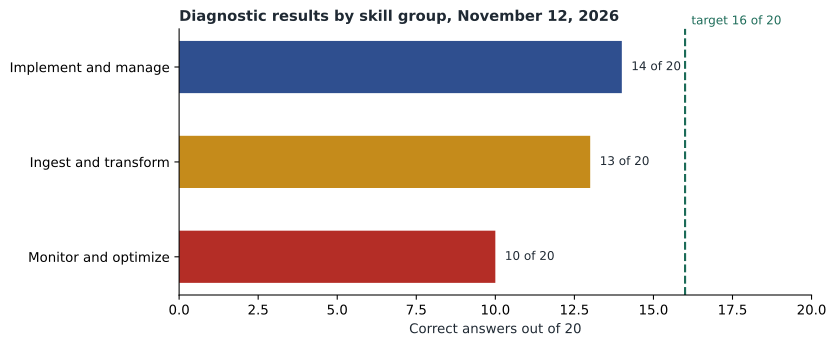
The pattern surprised Ines. She expected ingestion to be her strongest group, because it is what she has done most. But many of her mistakes there were on streaming questions and on choosing between dataflows, notebooks and T-SQL, which she had seen less of. Her weakest group was monitoring and optimizing, even though she had spent two sessions on it. Looking at the wrong answers, Nikolai saw why: she knew how to fix the problems she had met at Harrow & Finch, but the questions described problems in eventstreams, warehouses and semantic model refreshes that she had not met yet.
Nikolai set a target of 16 of 20, or 80 in 100, in every group on practice sets by May. A high average is not enough, because a candidate can fail by being weak in one group even if the others are strong. Lesson 3 turns the diagnostic into a study budget, and lesson 11 turns the budget into dates.
Booking the exam
Ines will book through her Microsoft Learn profile, which hands her over to Pearson VUE to choose a date, a time and a delivery method. Nikolai's advice is to sign in with a personal Microsoft account rather than her work account, as Microsoft recommends. Certifications belong to the person, not the employer, and a personal account keeps her transcript and badges with her if she ever changes jobs. The legal name on the profile must match the government ID she will show on exam day, including middle names if the ID shows them. Fixing a mismatch is easy in January and stressful the night before the exam.
She also has to choose between a test centre and an online exam. A test centre in Winnipeg provides the computer, the room and the proctor. An online exam runs on her own computer at home, after a system check, with a proctor watching through the camera. Both count the same. Ines chose a test centre for a Friday morning, because her apartment shares a wall with a building site and online exams can be ended if the proctor hears voices or sees someone enter the room. Lesson 12 covers both options in more detail.
Harrow & Finch has agreed to pay for one attempt as part of the hub project's training budget, and Elena Brandt asked Ines to book by the end of January so that the date is fixed before the pilot review on February 1, 2027 takes over everyone's calendar. Booking early also makes rescheduling possible: Pearson VUE allows changes up to a deadline before the appointment, and a candidate who misses that deadline may lose the fee.
Accommodations and extra time
Candidates who use assistive devices, need extra time or need other changes to the exam can request accommodations before booking. The request goes through Microsoft, and approval can take several business days, so it should be made well ahead of the planned date. A separate rule covers language: if the exam is not offered in a candidate's preferred language, they can request an extra 30 minutes. Ines will take the exam in English, which is her working language, so neither rule applies to her, but Nikolai mentioned both because colleagues often learn about them only after booking, when it is too late to arrange them for the date they wanted. The same is true of testing-centre rules about breaks, which differ from online rules and are covered in lesson 12.
Worked problem
Reading a diagnostic result
Ines scored 14, 13 and 10 out of 20 in the three skill groups. Her target is 16 of 20 in each. How many more correct answers does she need in each group to reach the target, and in total?
Show solution
- Implement and manage: 16 − 14 = 2 more.
- Ingest and transform: 16 − 13 = 3 more.
- Monitor and optimize: 16 − 10 = 6 more.
- \[2 + 3 + 6 = 11\]
- Her total would rise from 37 to 48 of 60, which is 80 in 100.
Answer: She needs 2, 3 and 6 more correct answers, 11 in all, and most of the gap is in monitoring and optimizing.
Common mistakes
MistakeA scaled score of 700 means exactly 70 in 100 answers were correct.
InsteadScores are scaled for the difficulty of each candidate's questions; 700 is the pass mark, not a fixed share.
MistakeDP-700 covers building reports and semantic models.
InsteadThat belongs to DP-600; DP-700 covers loading, transforming, securing, orchestrating, monitoring and optimizing data in Fabric.
MistakeKnowing one language well is enough.
InsteadThe exam expects candidates to read and write PySpark, SQL and KQL.
MistakeThe practice assessment predicts the exam score.
InsteadIt uses the same outline and formats, but it is a learning tool, not a prediction.
MistakeA failed attempt can be retaken any time.
InsteadThe wait is 24 hours after a first failure and 14 days after each later one, with at most five attempts in 12 months.
Summary and key terms
- Exam DP-700 leads to the Microsoft Certified: Fabric Data Engineer Associate certification.
- It is 100 minutes long, offered in ten languages, proctored through Pearson VUE, and may include interactive components.
- The pass mark is a scaled score of 700, and the price depends on the country.
- The study guide lists every testable skill in three groups weighted 30 to 35 parts in 100 each; check it for updates before and during study.
- Renewal is a free yearly online assessment; retakes wait 24 hours, then 14 days, with at most five attempts in 12 months.
- Ines scored 37 of 60 on a diagnostic, with monitoring and optimizing the weakest group, and aims for 16 of 20 in every group.
- Role-based certification
- A Microsoft certification aimed at a job role, at the associate or expert level.
- Scaled score
- A score adjusted for the difficulty of a candidate's questions, reported on a scale of 1 to 1,000.
- Study guide
- The published list of skills measured on an exam, with weights and update notes.
- Practice assessment
- A free set of sample questions written to the exam outline, used for learning.
- Renewal assessment
- A free, unproctored online test that keeps a certification current.
Practice problems
Work each problem on paper first, then reveal the answer to check.
How long is the DP-700 exam?
Show answer
100 minutes.
What score is needed to pass?
Show answer
A scaled score of 700 or more.
Which three languages does the exam expect candidates to read?
Show answer
PySpark, SQL and KQL.
How long must a candidate wait after a second failed attempt?
Show answer
14 days.
Why is Ines's diagnostic score not a prediction?
Show answer
The set is small and noisy; it shows a pattern of strengths and weaknesses rather than a likely scaled score.
Lesson quiz · 5 questions
Score 60% or more to complete this lesson.
Create a free account to save your progress, take quizzes and earn a certificate.