
MBA-613 · Lesson 9 of 12 · 23 min
Change in unionized and regulated settings
Daniel Osei's plant at Northfield Components is unionized, and its collective agreement was renewed in October after the bargaining the cohort studied in MBA-601. The agreement allows the company to introduce new equipment, but it also contains a technological change clause: the company must give the union notice, discuss how affected employees will be retrained or reassigned, and agree on the classification and pay grade of any new job. The two robotic welding cells will turn eight manual welders into four cell operators and free the other four for work elsewhere in the plant. Daniel's first plan treated the union as a hurdle to clear after the design was complete. Dr. Morin asks him to imagine instead that the union's stewards, who know every welder in the plant, were part of designing the change.
Much writing on change management assumes that managers can redesign work as they see fit, subject only to persuasion. In unionized workplaces, and in industries regulated for safety, privacy or professional standards, that assumption is wrong. Changes to work are governed by collective agreements, labour law, regulators and professional bodies. This lesson explains the rules that shape change in these settings and shows that working within them, and with the people they protect, often produces better changes than working around them.
The collective agreement as a framework for change
A collective agreement is a binding contract between an employer and a union that sets wages, hours, job classifications, seniority rights, grievance procedures and many other terms for the employees it covers. Most agreements contain a management rights clause, which reserves to the employer the right to manage the business, direct the workforce and introduce new methods, subject to the agreement's other terms. In practice, almost any significant change to work touches something in the agreement: job descriptions, classifications, shift patterns, overtime, seniority in selecting new jobs, training rights, discipline or layoffs.
Disagreements about whether a change is consistent with the agreement are usually settled through the grievance procedure, which ends in binding arbitration if the parties cannot resolve them. An employer that implements a change the arbitrator later finds violated the agreement may have to reverse it and compensate employees. Even when the employer wins, a series of grievances consumes time, poisons relationships and slows adoption. The practical lesson is that the agreement should be read at the design stage, not after the launch.
In Canada, labour relations are mostly governed by provincial law; a minority of workers, in federally regulated industries such as banking, airlines, railways, telecommunications and interprovincial transport, falls under the Canada Labour Code. For federally regulated employers bound by a collective agreement, sections 51 to 55 of the Code govern technological change. An employer planning to introduce equipment or material different in kind from what it used before, or a related change in how it operates, that is likely to affect a significant number of employees must give the union written notice at least 120 days before the change, describing its nature, its date, the approximate number and type of employees affected and its likely effect on their terms and job security. The union may then apply to the Canada Industrial Relations Board for leave to reopen bargaining on job security for affected employees, and if leave is granted, the employer may not implement the change until the parties reach agreement or the conditions for a lawful strike or lockout are met. These provisions do not apply where the collective agreement itself contains procedures for negotiating such changes during its term, which is one reason many agreements contain technological change clauses.
Most of Cedarline's employees, like Daniel's, fall under provincial law. Ontario's Labour Relations Act has no general technological change provision of the federal kind, so the rules for introducing new technology at Cedarline's distribution centre come mainly from the new collective agreement and from the duty to bargain in good faith. A few provinces, including British Columbia and Manitoba, do have statutory provisions requiring notice or discussion of technological change. Ontario also imposes a statutory freeze after a union applies for certification: the employer may not change wages or other terms of employment without the union's consent while bargaining for a first agreement is under way. Cedarline's warehouse was under such a freeze from the union's application in June until the first agreement was ratified, which is why the warehouse management system could not have been introduced during that period without the union's agreement.
From adversarial to joint approaches
Labour relations can be conducted at arm's length, with management designing changes and the union reacting, or jointly, with the parties working on problems together while preserving their distinct roles. Each approach has its uses, and most relationships mix them. But for complex changes to work, joint approaches have important advantages. Union representatives often know the work and the workforce better than managers do, and their involvement gives the change legitimacy with employees who distrust management. Joint processes also tend to surface problems before they become grievances.
Interest-based bargaining, developed from Fisher and Ury's principled negotiation and studied in MBA-604, applies these ideas to labour negotiations: parties share interests, generate options jointly and use objective criteria. Joint labour-management committees apply them between negotiations, for health and safety, training, job evaluation or the introduction of new technology. Thomas Kochan and colleagues at MIT have studied labour-management partnerships for decades. Well-known examples include the partnership between General Motors and the United Auto Workers at the Saturn plant, founded in 1985, which involved the union in decisions from product design to supplier selection before it was wound back in the 2000s; and the Labor Management Partnership at Kaiser Permanente, the American health care provider, established in 1997 with a coalition of unions, which has been studied as one of the largest and longest-lasting partnerships of its kind. Researchers have found such partnerships associated with improvements in quality and service, but also fragile: they depend on trust between particular leaders and can collapse when leaders change, when business pressures intensify or when either side feels the other has used the partnership against it.
A joint approach does not mean that the union co-manages the business or that managers give up their responsibilities. It means agreeing on how a change will be designed and introduced, who will be involved, what information will be shared and how disagreements will be handled, while each party remains accountable to its own constituency. It also does not mean bypassing the union by consulting employees directly about matters the union represents them on, which can breach labour law and will certainly damage trust.
Daniel’s robotic cells
Daniel revises his plan. He meets the union's plant chair before any design is final and proposes a joint working group of two stewards, two welders, a supervisor, an engineer from the equipment supplier and himself. The group's mandate is to design the cell operator job, propose a classification using the point factor job evaluation plan the parties agreed in the new collective agreement, plan retraining for the welders who will move to other work, and agree on how the cells' output data will be used. The stewards raise three issues Daniel had not considered: the most senior welders, who have seniority rights to the new jobs, are also the ones closest to retirement and least interested in learning robot programming; the cells' safety guarding must be reviewed by the joint health and safety committee; and the welders want assurance that cell data will not be used to compare individuals.
The group's solution is to post the cell operator jobs under the seniority provisions but to offer retirement-transition roles training new operators to the senior welders who prefer them, to schedule the safety review before the cells arrive and to agree that cell data will be reported by shift, not by person, for the first year. The classification lands one grade above the current welder rate, which the union accepts because operators will need new skills. The change takes six weeks longer to design than Daniel's original plan. But there are no grievances, the first cell reaches its target output in eleven weeks rather than the sixteen the supplier predicted, and two of the senior welders turn out to be excellent trainers.
Regulated settings
Unions are not the only source of rules about change. Many industries are regulated for safety, privacy, quality or professional standards, and regulators often require that changes be assessed, documented and approved before they are made. These requirements can feel like obstacles. They are better understood as formalized versions of good change practice.
Process safety is the clearest example. In industries that handle hazardous materials, such as gas processing, refining and chemicals, a formal management of change procedure requires that any change to equipment, chemicals, technology or procedures be reviewed for its safety implications, documented, approved and communicated to affected workers before it is implemented. In Canada, such requirements arise from provincial occupational health and safety and energy regulation and from the CSA Group's Z767 standard on process safety management, which many operators adopt. Prairie Ridge's gas plants already operate under such a procedure; its merger team must decide how the procedure applies to renewables sites and to organizational changes, such as merging maintenance crews, that can affect safety as much as a new valve.
The phrase is apt: process safety engineers carry out management of change in a literal, disciplined form. Their procedures ask what could go wrong, who must be told, what training is needed and who must approve, which are the questions of this course. Investigations of major industrial accidents have repeatedly found that changes made without such review, including changes to staffing and organization, contributed to disaster. Several safety bodies now recommend applying management of change reviews to organizational changes as well as technical ones.
Health care adds professional and privacy regulation. Lakeview's documentation system records conversations between physicians and patients, so the hospital had to confirm that its use complied with Ontario's Personal Health Information Protection Act, obtain patients' consent and agree with the vendor where recordings are stored and how long they are kept. Physicians remain professionally responsible for the content of their notes under the standards of the College of Physicians and Surgeons of Ontario, whatever software drafted them, which is one reason the cardiologists' concern about errors was so serious. Nurses at Lakeview are unionized, and the hospital must consider whether changes to their documentation duties require discussion with the union.
In each of these settings, the practical advice is the same. Identify early which rules apply and who must be involved. Treat the people who enforce the rules, whether union stewards, safety committees, privacy officers or professional leaders, as part of the design team rather than as reviewers at the end. Document decisions and reasons. And remember that a change that violates the rules can be reversed by someone outside the organization, which is the most expensive kind of failure.
Weighing the joint approach
Joint approaches take longer to design. Are they worth it? Dr. Morin asks the cohort to compare two ways of introducing Cedarline's warehouse management system. In the unilateral approach, management designs the system's performance tracking and announces it, relying on the management rights clause. In the joint approach, the system is designed with the joint pick-rate committee, which adds about three months. The figures are estimates, but they make the trade-off explicit.
# Introducing the warehouse system: unilateral launch versus joint design (thousands of dollars)
annual_benefit = 1800      # staffing and error savings at full adoption
years = 4
rate = 0.09

def pv_benefits(start_month, ramp_months, ceiling):
    total = 0.0
    for m in range(1, years * 12 + 1):
        if m <= start_month:
            continue
        share = min(1.0, (m - start_month) / ramp_months) * ceiling
        total += annual_benefit / 12 * share / (1 + rate) ** (m / 12)
    return total

# Unilateral: launch in month 3, but there is a chance of a grievance that the arbitrator upholds,
# forcing a redesign; slower, lower adoption because of distrust
p_grievance_upheld = 0.35
unilateral_ok = pv_benefits(3, 9, 0.85)
unilateral_redo = pv_benefits(12, 9, 0.80) - 250     # redesign cost and remedy
unilateral = (1 - p_grievance_upheld) * unilateral_ok + p_grievance_upheld * unilateral_redo

# Joint: three more months of design, faster ramp and higher ceiling, small grievance risk
p_joint_grievance = 0.05
joint_ok = pv_benefits(6, 6, 0.95) - 120             # cost of committee time and training
joint_redo = pv_benefits(12, 6, 0.95) - 370
joint = (1 - p_joint_grievance) * joint_ok + p_joint_grievance * joint_redo

print(f"unilateral: if no grievance {unilateral_ok:6.0f}, if upheld {unilateral_redo:6.0f}, expected {unilateral:6.0f}")
print(f"joint:      if no grievance {joint_ok:6.0f}, if upheld {joint_redo:6.0f}, expected {joint:6.0f}")
# How likely would an upheld grievance have to be for the unilateral route to win?
for p in (0.0, 0.1, 0.2, 0.3):
    ev = (1 - p) * unilateral_ok + p * unilateral_redo
print(f" grievance probability {p:.1f}: unilateral expected {ev:6.0f} vs joint {joint:6.0f}")unilateral: if no grievance 4294, if upheld 2800, expected 3771 joint: if no grievance 4475, if upheld 3441, expected 4424 grievance probability 0.0: unilateral expected 4294 vs joint 4424 grievance probability 0.1: unilateral expected 4144 vs joint 4424 grievance probability 0.2: unilateral expected 3995 vs joint 4424 grievance probability 0.3: unilateral expected 3846 vs joint 4424
With these estimates the joint approach has the higher expected value, even though it starts three months later and costs more to design. Two assumptions drive the result: adoption is faster and reaches a higher level when workers have helped design how their performance is measured, and the unilateral route carries a real risk of a grievance that forces a redesign. The sensitivity table shows that even if the chance of an upheld grievance were zero, the joint approach would still do slightly better, because of the faster, fuller adoption. Dr. Morin cautions that the numbers are judgements, and that in some cases speed matters more. But in a workplace with a new union, low engagement and a recent history of disputes about pick rates, the case for the joint approach is strong.
| Setting | Rules that shape change | Who must be involved early | Typical joint mechanism |
|---|---|---|---|
| Unionized plant (Northfield) | Collective agreement; technological change clause; job evaluation plan | Union plant chair, stewards, health and safety committee | Joint working group on job design and classification |
| Unionized warehouse (Cedarline) | First collective agreement; joint pick-rate committee; data-use provision | Union local, joint committee, supervisors | Joint design of performance tracking and training |
| Hospital (Lakeview) | Privacy law; professional standards; nurses’ collective agreement | Privacy officer, medical leaders, nursing union | Clinical governance committee; union consultation |
| Gas and renewables (Prairie Ridge) | Process safety management of change; occupational safety law | Safety committee, operators from both divisions | Management of change review for organizational changes |
Worked problem
Planning Cedarline's warehouse system with the union
Cedarline will introduce a warehouse management system with handheld scanners that direct picking and record each picker's rate. The collective agreement provides a joint pick-rate committee and says scanner data may not be used for discipline without review. Plan the first three months of the change.
Show solution
- Month 1: present the system's purpose and capabilities to the joint committee before configuration; share the vendor's data on which measures the system records.
- Month 1: agree on the committee's mandate for the change: how pick standards will be set, what reports will show, who sees individual data and how the review before discipline will work.
- Month 2: run a pilot in one zone with volunteer pickers and a steward observing; collect pickers' feedback on paths, scanner ergonomics and standards.
- Month 2: the joint health and safety committee reviews scanner use, pick paths and any changes to pace.
- Month 3: the joint committee recommends standards and data rules; management and the union sign a letter of understanding; training is scheduled, with supervisors trained first now that their spans are smaller.
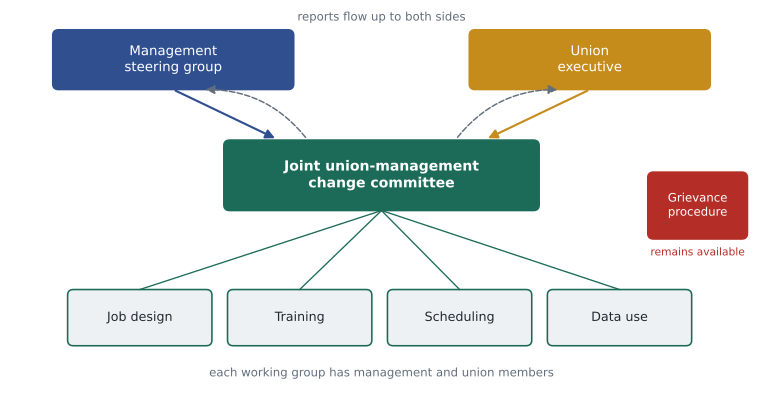
- Throughout: report progress to both the management steering group and the union executive, and keep the grievance procedure available for unresolved disputes.
Answer: The plan uses the mechanisms the collective agreement created rather than treating them as obstacles. It adds three months, but it is far more likely to produce a system that pickers trust and use as designed.
Common mistakes
MistakeThe management rights clause lets us change anything.
InsteadMost changes touch other terms of the agreement or mandatory subjects of bargaining; read the agreement at the design stage.
MistakeConsult employees directly to avoid the union.
InsteadBypassing the union on matters it represents can breach labour law and destroys trust.
MistakeRegulatory review is bureaucracy that slows change.
InsteadManagement of change and privacy reviews are formalized good practice; violations can be reversed by outsiders.
MistakeJoint approaches mean giving up management responsibility.
InsteadJoint design agrees on process and information while each party stays accountable to its own constituency.
Summary and key terms
- In unionized workplaces, collective agreements, labour law and grievance arbitration govern most changes to work.
- Federally regulated employers in Canada face notice and bargaining requirements for technological change; provincially, rules come mainly from collective agreements, a few provincial statutes and statutory freezes during first-contract bargaining.
- Joint labour-management approaches use the knowledge and legitimacy of union representatives; they are effective but depend on trust.
- Regulated settings require formal review of changes; process safety management of change is a literal form of the discipline of this course.
- Involving those who enforce or are protected by the rules early usually speeds adoption and avoids reversal.
- Collective agreement
- A binding contract between an employer and a union setting terms of employment.
- Management rights clause
- A clause reserving to the employer the right to manage, subject to the agreement.
- Grievance arbitration
- Binding resolution of disputes about the interpretation of a collective agreement.
- Technological change clause
- A collective agreement provision on notice, consultation and adjustment when new technology is introduced.
- Joint labour-management committee
- A body of management and union representatives that works on shared problems.
- Management of change
- A formal procedure for reviewing the safety implications of changes before they are made.
Practice problems
Work each problem on paper first, then reveal the answer to check.
Why might the senior welders' seniority rights complicate Northfield's change, and how did the joint group address it?
Show answer
Seniority gives them first claim to the new jobs, but some did not want them; the group offered retirement-transition training roles so they could exercise seniority in a way that suited them.
In the code, what happens to the comparison if the joint approach's adoption ceiling is 0.85 instead of 0.95?
Show answer
The joint approach's expected value falls and becomes lower than the unilateral approach's at low grievance probabilities; its advantage depends heavily on better adoption.
Name two changes in your organization that would require a management of change or privacy review.
Show answer
Answers vary; for example, changing a chemical supplier at a plant, or introducing a new system that collects customer location data.
Why are labour-management partnerships fragile?
Show answer
They depend on trust between particular leaders and can collapse when leaders change, when pressures intensify or when either side feels exploited.
Lesson quiz · 5 questions
Score 60% or more to complete this lesson.
Create a free account to save your progress, take quizzes and earn a certificate.