
MBA-613 · Lesson 1 of 12 · 24 min
Why change matters and why it so often fails
Leading Change is one of the four courses of the final winter term of the weekend EMBA at the Lakeshore School of Business in Toronto, alongside Global Business, Corporate Governance and ESG, and the capstone consulting project. Dr. Gabriel Morin, who teaches it, opens the first Friday session with a confession. For eleven years he was a consultant who designed change programs for other people to carry out: mergers, restructurings, new systems, new operating models. For the following seven he was chief transformation officer of a national insurer, responsible for making one of those programs actually work. He says the second job taught him more than the first, mostly because almost everything he had recommended as a consultant turned out to be harder, slower and more human than his slide decks had suggested.
The cohort is in a good position to understand him. Over two years they have produced, for Cedarline Outdoor and for their own employers, a long list of recommendations: a focused strategy built on durability, a trimmed product range and fewer promotions, a redesigned supply chain with monthly sales and operations planning, a people strategy for the stores and the distribution centre, a three-year digital roadmap, a repair spin-off and a first collective agreement for the warehouse. Every one of these was argued with numbers. Dr. Morin points out that not one of them has yet changed what a single store associate, planner or warehouse picker does on a Tuesday morning. That is the subject of this course: how organizations move from a decision to a different way of working, and why the move so often stalls.
What counts as organizational change
Organizational change is a shift in how an organization works: what people do, how they do it, how they are organized, what they believe and how decisions are made. It ranges from small adjustments, such as a new scheduling rule in one department, to transformations that alter strategy, structure, systems and culture at once. Researchers distinguish several kinds. Developmental change improves what already exists, for instance training managers to give better feedback. Transitional change replaces one known state with another, such as moving from paper forms to a new system. Transformational change moves an organization towards a future that cannot be fully specified in advance, such as becoming a company that earns most of its profit from repair and services rather than new products. The more transformational the change, the less it can be planned in detail and the more it depends on learning along the way.
A second distinction concerns pace. Andrew Pettigrew and later Karl Weick and Robert Quinn contrasted episodic change, which happens in discrete bursts, often triggered by a crisis or a new leader, with continuous change, which is ongoing, incremental and often led from the middle of the organization. Many companies need both. Cedarline's move to a focused strategy is episodic: the board has made a choice, and the organization must reconfigure around it. But the weekly replenishment of stores, the monthly planning meeting and the repair service will only work if the organization keeps improving them continuously after the program office has been disbanded.
A third distinction is between the content of change and its process. The content is what changes: a new structure, a new system, new targets. The process is how the change is carried out: who is involved, in what order, how it is explained, how people learn and how progress is tracked. Most management education concentrates on content, because it is easier to analyse. Dr. Morin's claim, which the course will test, is that process explains a large part of the difference between changes that deliver their promise and those that do not.
The famous statistic
Almost every book and consulting report on change management cites a single figure: about 70 per cent of change programs fail. The number appears in Michael Hammer and James Champy's 1993 book on reengineering, in John Kotter's work, in surveys by large consulting firms and in thousands of presentations. Dr. Morin asks the cohort where it comes from. Nobody knows.
In 2011 Mark Hughes, a researcher at the University of Brighton, published a paper in the Journal of Change Management that traced five widely cited sources of the 70 per cent claim. He found that none of them offered valid and reliable empirical evidence for it. Some were estimates by the authors, some were based on surveys of executives asked for their impressions, and some simply repeated earlier citations. Hughes concluded that the figure is a popular narrative rather than a finding. Later reviewers have reached similar conclusions, and some have noted that studies with careful definitions find widely varying rates, depending on what counts as failure and who is asked.
The point is not that change usually succeeds. Many changes clearly disappoint: systems go live but are used in workarounds, restructurings are announced and quietly reversed, culture programs produce posters and little else. The point is that 'failure' is not a single measurable quantity, and a manager who quotes the statistic to justify a change budget is using a number nobody can defend. More useful questions are which outcomes a particular change is meant to produce, how far it falls short, why, and what could be done earlier to detect and correct the shortfall.
A more recent and better documented figure comes from Gartner's 2025 research on change. In surveys conducted in April 2025 of nearly 1,000 mid- to senior-level leaders and more than 2,500 employees, Gartner found that only 45 per cent of employees said they had achieved the change goals their organization set, that 36 per cent of leaders said their teams tended to wait and see whether changes would last before acting, and that 39 per cent of leaders described change as a major source of stress for their teams. These figures are survey responses rather than audited outcomes, but they describe a common pattern: people hear about many changes, doubt that most will stick, and conserve their effort.
Why change is hard
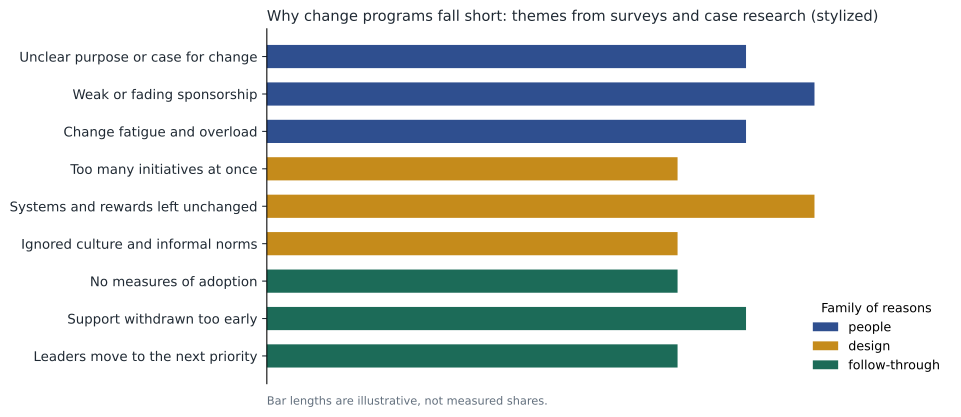
If the failure rate is uncertain, the reasons changes struggle are well understood. Dr. Morin groups them into four families, which correspond to the sections of the course.
The first is diagnosis. Organizations often change the wrong thing, or change one part without the parts that depend on it. A new performance bonus will not change behaviour if the systems that measure performance are unreliable; a new structure will not speed decisions if the decision rights and information flows stay the same. Lessons 2 and 3 cover theories and diagnostic models that help managers see the organization as a system.
The second is people. Change asks individuals to give up familiar routines, competence and sometimes status, in exchange for uncertain benefits that often accrue to someone else. People respond to that request with a mix of commitment, compliance, doubt and resistance, and the mix depends on how the change is introduced. Lessons 4, 5 and 6 cover readiness and resistance, coalitions and sponsorship, and communication.
The third is design. Changes fail when they ignore the formal and informal systems that hold current behaviour in place: structure, processes, measures, rewards, culture and, in unionized settings, collective agreements. Lessons 7, 8 and 9 cover the design of change, culture and change in unionized and regulated settings.
The fourth is follow-through. Many changes are launched with energy and abandoned before they are embedded, because leaders move on to the next priority, because nobody measures whether the new way of working is actually being used, or because too many changes compete for the same people's attention. Lessons 10 and 11 cover continuous and digital change and the work of sustaining change. Lesson 12 brings everything together in a change plan for Cedarline.
The economics of adoption
Dr. Morin then makes a point that the cohort, trained in finance, finds persuasive. Most business cases for change count benefits as if the change will be adopted fully and on time. In practice, benefits arrive only as people adopt the new way of working, and adoption follows a curve: slow at first, faster as early users show it works, then levelling off below one hundred per cent. A change that is adopted half as fast as planned does not lose a little value; it loses a large share, because benefits are delayed while costs are not. He asks the cohort to calculate what that means for one of Cedarline's initiatives.
In MBA-603 the cohort estimated that a single view of inventory across stores, the warehouse and the website would be the largest source of value in Cedarline's digital roadmap. Suppose its benefits at full use are 3.0 million dollars a year, starting in the second year, and that the system and training cost 4.0 million up front. The business case assumed that 90 per cent of stores would use the new inventory view properly within a year of launch. What if adoption is slower, or stops at a lower level, because store staff keep their own spreadsheets?
# Value of a change depends on the adoption curve, not just the decision
import math

def adoption(year, ceiling, speed, midpoint):
    # logistic adoption curve: share of the target group using the new way of working
    return ceiling / (1 + math.exp(-speed * (year - midpoint)))

def npv(cost, benefit_full, ceiling, speed, midpoint, years=6, rate=0.09):
    value = -cost
    for t in range(1, years + 1):
        used = adoption(t, ceiling, speed, midpoint)
        value += benefit_full * used / (1 + rate) ** t
    return value

cost, benefit = 4.0, 3.0  # millions of dollars
cases = {
    "business case: fast, high ceiling": (0.95, 3.0, 1.0),
    "realistic: slower start": (0.90, 1.8, 1.8),
    "stalled: workarounds persist": (0.60, 1.2, 2.0),
}
for name, (ceiling, speed, mid) in cases.items():
    shares = [round(adoption(t, ceiling, speed, mid), 2) for t in range(1, 7)]
    print(f"{name:36s} adoption by year {shares}  NPV {npv(cost, benefit, ceiling, speed, mid):5.2f}m")

# How much is a one-year delay in reaching the midpoint worth?
base = npv(cost, benefit, 0.90, 1.8, 1.8)
late = npv(cost, benefit, 0.90, 1.8, 2.8)
print(f"cost of a one-year delay in adoption: {base - late:4.2f}m")business case: fast, high ceiling adoption by year [0.47, 0.9, 0.95, 0.95, 0.95, 0.95] NPV 7.36m realistic: slower start adoption by year [0.17, 0.53, 0.81, 0.88, 0.9, 0.9] NPV 4.92m stalled: workarounds persist adoption by year [0.14, 0.3, 0.46, 0.55, 0.58, 0.6] NPV 1.58m cost of a one-year delay in adoption: 2.12m
The output shows how sensitive value is to adoption. Under the business-case assumptions the initiative is comfortably positive. With a slower start the value falls by roughly a third, and if adoption stalls at 60 per cent because staff keep working around the system, the investment earns only a small fraction of its planned value over six years. A one-year delay in reaching the midpoint of adoption costs about two million dollars of present value, more than many of the change management activities that could prevent it. The lesson Dr. Morin draws is that the work of leading change is not an overhead added to a business case. It is what determines whether the business case comes true.
Who leads change
Change is often described as something done by a chief executive standing on a stage. Research on change agents paints a different picture. Change is led at several levels. Sponsors, usually senior executives, authorize the change, provide resources and hold people accountable. Change leaders, often heads of functions or project leaders, design and drive particular streams of work. Change agents, who may have no formal authority at all, influence colleagues through their relationships and credibility. And frontline managers translate the change into daily routines, decide what to reward and answer the question every employee asks: what does this mean for me?
Dr. Morin asks each member of the cohort to describe a change they are currently leading or living through, and to name who plays each role. The answers become running cases for the course.
Daniel Osei, at Northfield Components, is overseeing the introduction of two robotic welding cells that the cohort analysed in MBA-603, in a plant whose collective agreement was renewed in October. The union has agreed to the cells, but the welders who will become cell operators worry about pay grades, and the supervisors are not sure how to schedule work around robots. Hana Kowalski, at Lakeview Health, is responsible for an ambient documentation system that records and drafts physicians' notes; after six months only 38 of 120 physicians use it regularly. Leo Brandt is trying to turn Kestrel Analytics, now 180 people, from a startup where everyone knew everyone into a company with managers, processes and a consistent way of making decisions. Grace Mwangi, who will leave Fairway Grocers for Second Ascent once its seed round closes, is spending her last months at Fairway introducing an automated store ordering system to forty store managers who distrust it. Owen Tremblay, at Prairie Ridge Energy, is part of a team merging the company's gas processing and renewables divisions into a single operations organization with one safety system.
These are ordinary changes, not dramatic turnarounds, and that is the point. Most managers spend much of their careers leading changes of this size, usually without formal training and often while doing their regular jobs.
| Change | Type | Main people challenge | Lesson |
|---|---|---|---|
| Northfield robotic cells | Transitional | Job grades, skills and supervisors’ routines in a unionized plant | 9 |
| Lakeview documentation system | Transitional | Physician adoption and trust in a new tool | 4, 11 |
| Kestrel scaling up | Transformational | Culture and decision rights as the company grows | 8 |
| Fairway store ordering | Transitional | Store managers’ distrust of algorithms | 6 |
| Prairie Ridge division merger | Transformational | Two cultures and one safety system | 3, 7 |
| Cedarline transformation | Transformational | Many changes at once for the same people | 12 |
A first look at Cedarline
Dr. Morin ends the session with Cedarline. Its chief executive has asked the cohort for something different this time: not another analysis of what to do, but a plan for how to do it all. The board has approved the focused strategy and its supporting programs. Cedarline's 1,450 employees, including about 640 in stores and 520 in the distribution centre, now face a range reduction, fewer promotions, new planning routines, a new store replenishment rhythm, durability training for store staff, a larger repair service, a new structure for distribution centre supervisors, eight digital initiatives, and a first collective agreement that the warehouse workers and their union negotiated last fall. Each of these was sensible on its own. Together, they land on the same store associates, planners and warehouse workers within about eighteen months.
The chief executive's question is direct: in what order should these changes happen, who should lead them, how should they be explained, how will the company know whether they are working, and how can it avoid exhausting people who are also serving customers through a busy spring season? The cohort will answer that question in lesson 12, using the tools of the course.
Worked problem
Testing a change claim
A vendor of change management software tells Cedarline's chief executive that 70 per cent of transformations fail and that its platform reduces the failure rate by half. How should the chief executive evaluate the claim?
Show solution
- Ask what 'failure' means in the vendor's data: missed financial targets, abandoned programs, late delivery, or respondents' impressions.
- Ask for the source of the 70 per cent figure. Hughes's 2011 review found no valid empirical basis for the widely cited version.
- Ask how the 'halving' was measured: were similar programs with and without the platform compared, or are these testimonials from satisfied clients?
- Translate the question into Cedarline's terms: which outcomes of the transformation matter most (for example, store inventory accuracy, planner adoption of the new process, return on invested capital), and how will progress on each be measured early?
- Decide on the merits whether the platform helps with those measures, for instance by tracking adoption, rather than on the strength of an industry statistic.
Answer: The claim combines an unsupported statistic with an unmeasured benefit. A better approach is to define what success means for each part of the transformation, measure adoption and results from the start, and buy tools only where they improve that measurement or the support given to people.
Common mistakes
MistakeMost changes fail, so the odds are against us whatever we do.
InsteadThe 70 per cent figure has no reliable basis; outcomes vary widely and depend heavily on how change is diagnosed, designed and followed through.
MistakeThe business case is done; implementation is a detail.
InsteadBenefits arrive only as people adopt the new way of working; adoption speed and ceiling often matter more to value than the cost estimate.
MistakeChange is led by the chief executive.
InsteadSponsors authorize change, but leaders, informal change agents and frontline managers determine whether it takes hold.
MistakeEvery change can be planned in detail.
InsteadDevelopmental and transitional changes can be planned; transformational change must be partly discovered as it unfolds.
Summary and key terms
- Organizational change ranges from developmental improvement through transitional replacement to transformation towards a future that cannot be fully specified.
- Change can be episodic or continuous, and most organizations need both.
- The widely quoted claim that 70 per cent of changes fail has no reliable empirical basis, although many changes clearly fall short of their goals.
- Changes struggle for four broad reasons: poor diagnosis, people's responses, designs that ignore supporting systems, and weak follow-through.
- The value of a change depends on the speed and ceiling of adoption, so leading change is part of the business case rather than an overhead on it.
- Developmental change
- Improvement of existing skills, methods or processes.
- Transitional change
- Replacement of a known current state with a known new state.
- Transformational change
- A shift in strategy, structure and culture towards a future that must partly emerge.
- Episodic change
- Change that occurs in discrete, often dramatic episodes.
- Continuous change
- Ongoing, incremental change, often led from the middle of the organization.
- Sponsor
- A senior leader who authorizes a change, provides resources and holds people accountable.
- Change agent
- A person who helps bring about change through influence, with or without formal authority.
Practice problems
Work each problem on paper first, then reveal the answer to check.
Classify each change as developmental, transitional or transformational: a new expense policy; Cedarline's move to earning a growing share of profit from repair; a refresher course on safe lifting.
Show answer
The expense policy is transitional, the move towards repair-based profit is transformational, and the lifting course is developmental.
Using the code above, explain in two sentences why a one-year delay in adoption costs so much.
Show answer
Benefits are pushed later and discounted more, while the up-front cost is unchanged. Because the benefit stream is large relative to the cost, each lost year of benefits removes a large share of net value.
Why might the survey finding that 36 per cent of leaders say their teams wait and see before acting be a rational response by employees?
Show answer
If many announced changes are reversed or abandoned, early effort is often wasted, so waiting to see which changes last conserves effort; leaders must show that a change will stick.
Name the four roles in leading change and give an example of each from your own organization.
Show answer
Sponsor (an executive who funds a program), change leader (a project or function head), change agent (a respected colleague who influences peers) and frontline manager (the supervisor who decides what is rewarded day to day).
Lesson quiz · 5 questions
Score 60% or more to complete this lesson.
Create a free account to save your progress, take quizzes and earn a certificate.