
MBA-613 · Lesson 12 of 12 · 25 min
Capstone: leading Cedarline’s transformation
The final two sessions of the course return to the question Cedarline's chief executive asked in lesson 1. The board has approved a focused strategy built on durability and repair, and a set of programs to carry it out. The cohort's task is not to revisit any of those decisions but to plan how Cedarline will make them real: in what order, led by whom, explained how, supported how, measured how and sustained how. The chief executive has given the cohort access to the transformation office's data and asked for a plan she can take to the board and to the company. Dr. Morin asks the teams to use the tools of the course in sequence and to show their reasoning.
The starting point
The teams begin by assembling the facts. Cedarline has about 1,450 employees: about 640 across 62 stores, 520 in the distribution centre and the rest in head office, planning, customer care and the repair workshop. In fiscal 2026 it had revenue of 468 million dollars and a return on invested capital of 8.0 per cent, below its cost of capital of about 9 per cent. The strategy adopted in MBA-514 aims to restore returns by focusing the range, ending most storewide promotions, building the repair service and the Cedarline Care membership, and staging growth. The supporting programs are the supply chain redesign of MBA-513, with monthly sales and operations planning and weekly store replenishment; the people strategy of MBA-601, with smaller supervisor spans in the distribution centre, durability training for store staff, more planners and repair technicians, and a store scorecard to replace sales-based bonuses; the digital roadmap of MBA-603, with eight initiatives including a single inventory view and a new warehouse management system; and the first collective agreement for the distribution centre, negotiated after the warehouse workers unionized in June.
Dr. Morin reminds the teams of lesson 1's warning: each of these was justified by a business case that assumed adoption. None of the value is yet realized. The plan's job is to make the assumptions come true, or to discover early where they will not.
Diagnosis
The teams use the congruence model of lesson 3. The new strategy demands work that is more planned and less promotional, people who advise on durability and repair, a formal organization whose measures reward inventory discipline and repair, and an informal organization that takes pride in products that last. Today the work is built around seasonal launches and promotions; the people are skilled at selling new product; the formal organization rewards associates on sales and planners on in-stock rates; and the informal culture celebrates big seasons and launches. The fit is poor almost everywhere except in the repair workshop, whose small team already lives the new strategy, and in the customer-facing reputation for durability, which is the brand's core.
The teams then examine readiness. The transformation office ran a short readiness survey, using the four beliefs of lesson 4, among a sample of each group. Store staff believe the change is appropriate, because they hear customers complain about constant sales, but doubt its personal valence, because they fear the end of sales bonuses will cut their pay. Distribution centre workers doubt management support and personal valence after years of disputes about pick rates, although the new agreement has improved trust somewhat. Planners believe in the change and its support but doubt their efficacy with the new tools. Head office staff are broadly ready. The repair team is the most ready group in the company.
| Group | Appropriateness | Support | Efficacy | Valence | Weakest belief |
|---|---|---|---|---|---|
| Store staff (640) | 3.9 | 3.2 | 3.3 | 2.6 | Valence: fear of lower pay |
| Distribution centre (520) | 3.1 | 2.5 | 3.4 | 2.7 | Support: distrust of management |
| Planners and merchandising | 4.1 | 3.8 | 2.7 | 3.4 | Efficacy: new tools and process |
| Head office | 3.8 | 3.6 | 3.6 | 3.5 | No belief below threshold |
| Repair team | 4.6 | 3.9 | 4.0 | 4.4 | No belief below threshold |
Coalition and sponsorship
The coalition follows the analysis of lesson 5: the chief executive as sponsor; the chief operating officer as day-to-day change leader; the chief financial officer, head of stores, director of the distribution centre, head of people and chief digital officer for position power; the lead planner and the senior repair technician for expertise; and a store manager chosen because other store managers name her as the person they go to for advice. The union is engaged through a joint labour-management change committee for the distribution centre, co-chaired by the director of the distribution centre and the union local's president, built on the joint pick-rate committee the collective agreement created.
Sponsorship must cascade. The teams identify the district managers, who oversee groups of stores, and the distribution centre's shift managers as the levels most at risk of becoming sponsorship black holes, because they were not involved in any of the earlier work and their own targets have not yet changed. The plan gives both groups their own briefing and a role before anyone below them is told.
The narrative
The teams draft the core narrative using lesson 6's structure. Cedarline was built on clothing that lasts and on staff who know gear. Over the last five years it grew by adding: more styles, more promotions, more stores and more wholesale accounts. Customers learned to wait for sales, the range grew too large for anyone to know, inventory doubled and returns fell below what the company needs to invest. Cedarline is going back to what made it different: fewer, better products, sold at fair prices without constant discounts, with repair and advice that keep them in use for years. Some things will be hard. Associates will learn new products and repair options; planners will learn new tools; warehouse workers will learn a new system; some customers will miss the sales. In two years, associates will spend more time advising and less time marking down, the stores will have what customers want more often, and repair will be a reason customers choose Cedarline. What we ask now is help in finding what gets in the way.
The narrative is supported by commitments that address each group's weakest belief. For store staff, whose concern is pay, the new scorecard bonus will be designed so that an associate who performed at the median under the old bonus earns at least as much under the new one for the first year, and the scorecard will be in place before promotions end. For distribution centre workers, whose concern is management support and trust, the new warehouse system will be designed with the joint committee, and scanner data will be used as the collective agreement provides. For planners, whose concern is efficacy, the old spreadsheets will be retired only after the new tool has been fixed for long-tail items and every planner has had hands-on training.
Sequencing
The heart of the plan is the order of change. Lesson 7's heat map showed that launching everything as the program offices proposed would overload store staff and distribution centre workers in the second and third quarters. The resequenced plan keeps every group within capacity: the range reduction, the end of promotions and the new store scorecard together in the first two quarters; sales and operations planning from the first quarter; supervisor spans in the distribution centre in the first two quarters, followed by weekly replenishment and, from the fourth quarter, the warehouse system; durability training and the expanded repair service from the third quarter; and the single inventory view from the fifth. The teams also note what cannot move: the end of promotions must coincide with the scorecard, and the warehouse system must follow the supervisor spans.
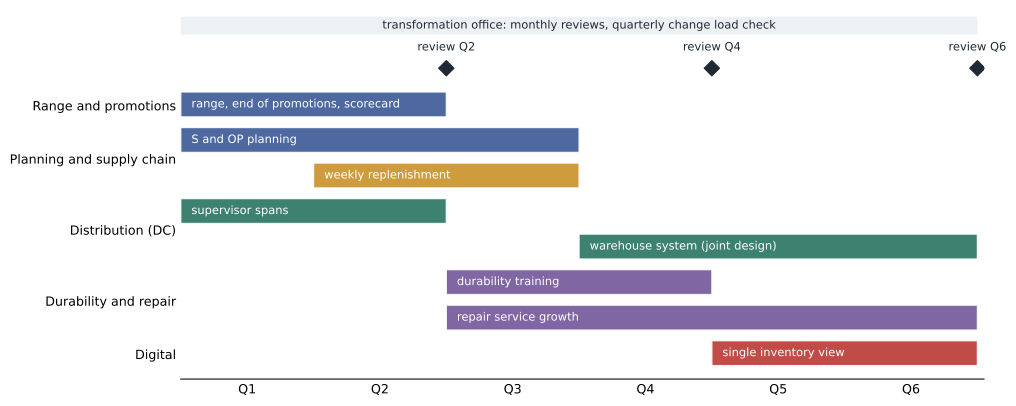
Sequencing has a cost: benefits that start later are worth less. The chief financial officer asks whether spreading the changes is worth it. The teams model three approaches: launching everything as proposed, accepting the overload; the resequenced plan; and a cautious plan that spreads the changes over three years so that no group ever feels pressure. Overload is modelled as slower and lower adoption for the streams that land on overloaded groups, using estimates from the transformation office and from the experience of the cases in this course.
# Value of sequencing: everything at once vs resequenced vs very cautious (millions of dollars, quarterly)
import math
rate_q = 0.09 / 4
quarters = 20   # five years

def adoption(q, start, ceiling, speed, mid):
    if q < start:
        return 0.0
    return ceiling / (1 + math.exp(-speed * (q - start - mid)))

def pv(streams):
    total = 0.0
    for q in range(1, quarters + 1):
        for annual, start, ceiling, speed, mid in streams.values():
            total += annual / 4 * adoption(q, start, ceiling, speed, mid) / (1 + rate_q) ** q
    return total

# stream: (annual benefit at full adoption, start quarter, ceiling, speed, quarters to midpoint)
at_once = {
    "range and promotions":    (4.0, 0, 0.80, 0.9, 3),
    "planning and supply":     (3.5, 0, 0.70, 0.7, 4),
    "warehouse":               (1.8, 1, 0.65, 0.7, 4),
    "durability and repair":   (2.0, 1, 0.60, 0.7, 4),
    "single inventory view":   (3.0, 2, 0.65, 0.8, 4),
}
resequenced = {
    "range and promotions":    (4.0, 0, 0.90, 1.2, 2),
    "planning and supply":     (3.5, 0, 0.90, 1.0, 3),
    "warehouse":               (1.8, 3, 0.90, 1.2, 2),
    "durability and repair":   (2.0, 2, 0.85, 1.0, 3),
    "single inventory view":   (3.0, 4, 0.90, 1.2, 2),
}
cautious = {name: (a, s * 2 + 2, c, sp, m) for name, (a, s, c, sp, m) in resequenced.items()}

for name, plan in (("everything at once", at_once), ("resequenced", resequenced), ("very cautious", cautious)):
    print(f"{name:20s} PV of benefits over five years {pv(plan):6.1f}m")
gap = pv(resequenced) - pv(at_once)
print(f"resequencing adds {gap:4.1f}m; a change program costing 1.5m a year for two years costs about 2.7m in present value")everything at once PV of benefits over five years 30.8m resequenced PV of benefits over five years 40.7m very cautious PV of benefits over five years 31.2m resequencing adds 9.9m; a change program costing 1.5m a year for two years costs about 2.7m in present value
The resequenced plan delivers the most value. Launching everything at once starts the benefits earlier but at lower and slower adoption, because the overloaded groups adopt each change less fully; over five years it is worth nearly ten million dollars less. The cautious plan avoids overload but delays benefits so much that it is worth barely more than launching everything at once. The comparison also puts the cost of change support in perspective: a transformation office, training time, coaching and the joint committee might cost about 1.5 million dollars a year for two years, which is far less than the difference between good and poor adoption. The teams caution that the parameters are estimates, and they recommend that the transformation office replace them with observed adoption data from each review point.
Design, culture and the union
The teams check the design against the 7-S framework of lesson 7. Strategy and structure are settled. Systems must change in order: the store scorecard and planner goals before the processes they support. Shared values will shift through Schein's embedding mechanisms rather than a values campaign: the chief executive will review repair bookings, inventory turns and markdowns at the weekly leadership meeting instead of weekly sales alone; the first stories told at the company's spring meeting will be about an associate who kept a twenty-year-old jacket in use and a planner whose forecasts avoided a markdown; promotions will go to managers whose stores improve the scorecard rather than only sales. Style changes as leaders visit stores and the distribution centre to listen rather than to inspect. Staff and skills change through the hiring and training programs of the people strategy.
For the distribution centre, the plan follows lesson 9. The joint labour-management change committee will design the warehouse system's performance tracking, training and data rules with the union, under the collective agreement's provisions, before configuration. The joint health and safety committee will review scanner use and pick paths. Supervisors will be trained first, after their spans are reduced. The teams estimate that this adds about three months to the warehouse system and, as lesson 9 showed, is likely to pay for itself through faster and fuller adoption and lower grievance risk.
Governance and measurement
A small transformation office of four people, as designed in lesson 10, reports to the chief executive and supports a monthly steering group of the coalition. Each workstream is owned by a line executive. Each has one leading indicator of adoption and one lagging indicator of benefit, reported monthly; the office runs the change load heat map each quarter and an employee pulse survey on change fatigue every two months. At the review points at the end of the second, fourth and sixth quarters, the steering group decides for each workstream whether to continue, adapt or stop, against criteria agreed now.
| Workstream | Owner | Leading indicator | Lagging indicator | Review criterion at quarter 4 |
|---|---|---|---|---|
| Range and promotions | Chief operating officer | Share of sales at full price | Gross margin and markdowns | Full-price share above 70 per cent |
| Planning and supply chain | Chief operating officer | Share of forecasts made in the new process | Inventory turns and in-stock rate | Forecast share above 90 per cent |
| Distribution centre | Director of the distribution centre | Pickers trained; system use by shift | Pick accuracy and cost per unit | Joint committee agrees standards |
| Durability and repair | Head of stores and head of repair | Repair-offer rate (p-chart) | Repair revenue and Care members | Offer rate stable within limits |
| People | Head of people | Scorecard in place; spans at 12 | Turnover in stores and the distribution centre | Store turnover below last year |
| Digital | Chief digital officer | Store inventory accuracy | Ship-from-store contribution | Accuracy on track to 95 per cent |
Sustaining the change
The plan builds sustainment in from the start, following lesson 11. The repair-offer routine will be prompted by the point-of-sale system at the same step of every sale, coached by regional store champions for at least three months and tracked on a p-chart for each region. New hires will learn the new routines in onboarding. Scorecards, planner goals and job descriptions will describe the new behaviours. Each workstream has more than one owner so that it survives a leadership change, and handovers of any coalition member's role will include the transformation. The transformation office will close at the end of the sixth quarter, handing benefits tracking to finance and change standards to the people function, after a review of what Cedarline learned about changing.
Risks
The teams list the risks they consider most serious. The spring season is Cedarline's busiest; launching store changes in the first quarter risks overload during peak trading, so the first quarter's store changes are scheduled to finish training before the season begins. Customers trained by promotions may buy less in the first year; the plan treats this as a risk to the business case and tests it at the second-quarter review. Distribution centre trust is fragile; a single dispute over scanner data could undo the joint approach, so the joint committee will have a fast route to resolve disputes before they become grievances. Leadership attention may drift after the launch; the chief executive commits to chairing the steering group in person for its first year. And the cohort's own business cases may be wrong; the review points exist to find out.
What the chief executive will say
Dr. Morin asks each team to end with the first five minutes of what the chief executive should say to the whole company. The winning version is short. It thanks employees for keeping Cedarline's reputation alive through years of growth that made their jobs harder. It explains in plain words what has changed and why the company is going back to products that last. It names three things that will be hard and three commitments the company is making in return: no associate will earn less in the first year because the bonus is changing, the warehouse system will be designed with the union, and nobody will be asked to learn more at once than they can manage. It describes what a store, the warehouse and the planning office will look like in two years. And it asks each person to tell their manager, in the next month, one thing that gets in the way of doing their job well, with a promise that the answers will be reported back.
Dr. Morin closes the course by reminding the cohort that every change they lead will be different, and that the tools matter less than the habits behind them: diagnosing before prescribing, involving the people who know the work, telling the truth about what is hard, designing the system rather than only the message, measuring adoption early, and staying with the change long after it has stopped being interesting.
Worked problem
Testing the plan with the change formula
Before presenting, the teams test the plan against the change formula D × V × F > R for the distribution centre, the group with the lowest readiness.
Show solution
- Dissatisfaction: high among workers about pick-rate disputes, turnover and supervision; the plan acknowledges it rather than manufacturing urgency.
- Vision: a distribution centre where standards are set jointly, supervisors have time to coach and the system helps rather than polices; it must be stated in the workers' terms, not management's.
- First steps: smaller supervisor spans in the first two quarters, joint committee meetings before configuration and a pilot zone with volunteers; each is concrete and visible.
- Resistance: distrust of management and fear of surveillance; the joint design and the collective agreement's data provisions address both, but a single broken promise would raise resistance sharply.
- Conclusion: the product is likely to exceed resistance only if the first steps happen as promised; the plan should track and publish their completion monthly.
Answer: The formula confirms that the distribution centre plan depends on visible first steps and kept promises. The steering group should treat any slippage in supervisor spans or joint committee meetings as a serious risk, not a scheduling detail.
Common mistakes
MistakeThe strategy is approved, so the hard part is done.
InsteadValue depends on adoption; the plan's job is to make the business cases come true or reveal early where they will not.
MistakeLaunch everything at once to capture benefits sooner.
InsteadOverload slows and limits adoption; resequencing within capacity delivers more value.
MistakeSpread changes out as far as possible to avoid pressure.
InsteadExcessive caution delays benefits so much that value falls; the aim is to stay within capacity, not far below it.
MistakeChange support is overhead.
InsteadIts cost is small compared with the difference between good and poor adoption.
Summary and key terms
- The capstone combines diagnosis, readiness, coalition, narrative, sequencing, design, culture, joint work with the union, governance and sustainment into one plan.
- Readiness differs by group, and each group's weakest belief shapes the commitments and support it needs.
- Sequencing changes to keep every group within capacity delivers more value than launching everything at once or spreading changes too thinly.
- Leading indicators, review points with criteria agreed in advance and a small transformation office provide early warning and decisions.
- Sustainment is planned from the start through prompts, coaching, embedded systems, shared ownership and a planned handover.
- Transformation roadmap
- A sequenced plan of changes across workstreams over time.
- Review point
- A scheduled decision on whether to continue, adapt or stop a workstream, against criteria agreed in advance.
- Joint labour-management change committee
- A body of management and union representatives that designs a change together.
- Change capacity
- The amount of change a group can absorb at once alongside its normal work.
- Sponsorship black hole
- A level of management that does not sponsor a change, breaking the cascade.
Practice problems
Work each problem on paper first, then reveal the answer to check.
In the sequencing code, set every ceiling in the at-once plan to 0.90. What happens, and what does that tell you about the assumptions?
Show answer
The at-once plan becomes worth much more, close to the resequenced plan though still slightly below it; the conclusion depends on the assumption that overload lowers adoption, which the review points should test.
Why must the store scorecard be in place before promotions end?
Show answer
Otherwise associates would lose sales-based bonus income from promotions while still being paid on sales, giving them a reason to resist the change.
Which group would you pilot first for the durability and repair routine, and why?
Show answer
A representative store region rather than the most enthusiastic one, so that its results travel, with a store champion and a p-chart from the start.
Write one commitment the chief executive could make to planners, and explain which belief it addresses.
Show answer
The old spreadsheets will be retired only after the new tool is fixed for long-tail items and every planner is trained; it addresses efficacy.
Lesson quiz · 5 questions
Score 60% or more to complete this lesson.
Create a free account to save your progress, take quizzes and earn a certificate.